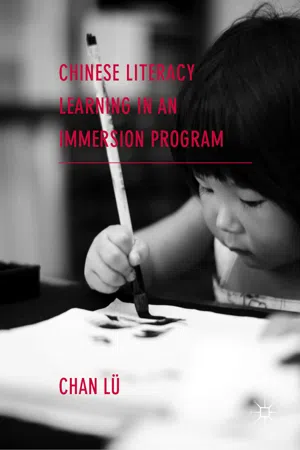
- English
- ePUB (mobile friendly)
- Available on iOS & Android
eBook - ePub
Chinese Literacy Learning in an Immersion Program
About this book
This book examines one-way foreign language immersion education in the United States. It provides a clear and rich description of a Chinese (Mandarin) immersion program, its curriculum, instructional materials, assessment activities, parental involvement and student outcomes. The author analyses two studies that document the development of the students' reading skills in English and Chinese, and the progress of their vocabulary knowledge, lexical inference, and reading comprehension in Chinese. In addition, this book contextualizes the program in its eco-system, including its neighbourhood, school, and the school district, and discusses the importance of school leadership, parental involvement, neighbourhood support and language acquisition planning in making an innovative school program successful. Its concluding chapters offer recommendations for program- and classroom-level practices and suggest pathways for future research on biliteracy learning in Chinese one-way immersion programs. This book will appeal in particular to students and scholars of applied linguistics, second language acquisition and language education.
Information
© The Author(s) 2019
Chan LüChinese Literacy Learning in an Immersion Programhttps://doi.org/10.1007/978-3-030-04987-4_11. Introduction
Chan Lü1
(1)
Asian Languages and Literature, University of Washington, Seattle, WA, USA
Chan Lü
Setting the Context
Since the 1990s and especially during the turn of the twenty first century, the number of students learning Mandarin Chinese as a foreign language in the United States and other parts of the world has been rapidly increasing, particularly when compared to its growth in the previous decades (e.g., Zhou, 2010). 汉语热 (Hànyǔ rè 1 “Chinese language fever”), has become a term frequently used in the media to describe the rising interest in learning Chinese 2 that has coincided with, or perhaps also engendered by, China’s growth as a global economic power (e.g., Chai & Wang, 2017; Scrimgeour, 2014). Under the climate of language order and ideology change in the United States (Zhou, 2010), several macro level factors are highly critical in shaping and propelling the growth of the field of Chinese language teaching and learning in the United States, including funding provided by both the US and Chinese governments, efforts from nongovernmental organizations such as the College Board and Asia, as well as interests from the business sector (Lo Bianco, 2007; Orton, 2010; Wang, 2012).
The rapid increase in Chinese language learners has also attracted serious research attention. More than ten recent monographs or edited works dedicated to Chinese language education, second language acquisition and assessment of Chinese have been published in English-speaking countries since 2010 (e.g., Duff et al., 2013; Everson & Shen, 2010; Han, 2014, 2017; Jiang, 2014; Kecskes & Sun, 2017; Ruan, Zhang, & Leung, 2016; Tsung & Cruickshank, 2011; Wen & Jiang, 2019; Zhang & Lin, 2017), not to mention those published in Chinese-speaking regions. However, one critical issue in the body of research on Chinese second/foreign language learning (CSL/CFL 3 ) is its almost exclusive focus on college-level or adult learners, which seems to be commonly observed among studies concerning foreign language learning. In a descriptive review of the 97 articles published in the Modern Language Journal between 2001 and 2014, Collins and Muñoz (2016) has observed that only 7 of the 97 studies (7.87%) included children at the primary school level. However, in the case of CFL in the United States and other parts of the world, the majority of learners are in the kindergarten to 12th grade (henceforth, K–12) classrooms. According to one report, worldwide, learners enrolled in the K–12 sector is eight times of those in the college CFL classrooms (Chai & Wang, 2017). In the United States, the survey of college-level enrollments in languages other than English, conducted by the Modern Language Association, estimated that there was a total of 53,069 Chinese learners in 2016 (Looney & Lusin, 2018). Comparatively, the National K–12 Foreign Language Enrollment Survey (American Councils for International Education, 2017) estimated a total of 227,086 students enrolled in CFL programs at all levels across the United States in 2014–2015 (p. 8). However, as Li (2018) pointed out, the trend of CFL learners becoming younger in age has attracted more media attention than research effort. Therefore, the gap between the number of students in CFL classrooms and those represented in current literature on foreign language learning is one of the motivations for the current study.
In recent years, Chinese immersion programs have proliferated across the United States, especially at the primary school (kindergarten to fifth grade, henceforth, K–5) level; this alternative form of education has been hailed as a much more effective way of acquiring advanced-level foreign language skills than traditional foreign language programs. Like other foreign language immersion programs in the United States and around the world, Chinese immersion is a form of choice-based educational program through which children learn school subjects in Chinese no less than 50% of their school day. Different from other forms of foreign language learning available in US elementary schools such as the language exploratory classes (e.g., Curtain, Donato, & Gilbert, 2016), foreign language immersion programs offer the promise of additive bilingualism, maintenance and development of biliteracy skills, academic achievement at or above grade level, as well as development of cultural or multicultural competence (e.g., Johnson & Swain, 1997; Tedick & Wesely, 2015). However, as I will further elaborate later in the book, there are still quite a few gaps in the field of language immersion research; most notably, there is a soaring lack of research in the context of one-way immersion (i.e., foreign language immersion; the term is more carefully defined in Chapter 2, Tedick & Wesely, 2015); few studies to date have involved a language that employs an orthographically different language (Fortune, 2012). This is another primary motivation for the present study.
Purpose of the Book
This volume focuses on a 50-50 Chinese (Mandarin) immersion program offered within an elementary, kindergarten to fifth grade public school in a large urban district in the United States. Ultimately, this book hopes to present research-based evidence to those who are involved in immersion education of young children and to provide an opportunity for educators, parents, and researchers to compare, contrast, and connect their own experiences with the program described in this volume, and by doing so, this book will allow for and deepen our understanding of why programs function the way they do. More specifically, the purposes of the book are threefold:
First, this book seeks to describe, identify, and explain the child-internal and child-external factors that affect children’s biliteracy learning. Of late, reading researchers have become increasingly interested in biliteracy learning, however, most of the reading theories are built on monolingual reading which cannot adequately explain the complexity of dual-language involvement in biliteracy learning (Koda, 2008). Additionally, to date, the majority of biliteracy studies involve learners of alphabetic language pairs, such as Spanish/French and English (e.g., Melby-Lervåg & Lervåg, 2011). The growing body of biliteracy studies involving contrasting writing systems, such as Chinese and English, are focused on Chinese children in a Chinese-speaking region learning to read Chinese as their first language (L1) and English as a foreign/second language (FL/L2) (e.g., Mcbride-Chang et al., 2008; Shu, Peng, & McBride-Chang, 2008) or on Chinese immigrant children in North America learning to read Chinese as a heritage language (CHL), which is ancillary in essence, and English as their L2 (e.g., Koda, Lü, & Zhang, 2008). Therefore, this book offers new evidence to the growing body of biliteracy research by incorporating Chinese learners in an immersion setting as a case of biliteracy learners whose backgrounds, context of learning, and learning experiences are different from those represented in current research.
Second, this volume also seeks to understand the process of children’s literacy learning in the partner language. 4 One of the important goals of an immersion program of any language is its effectiveness in helping children become bilingual and biliterate. Studies concerning immersion programs of various types converge on the same finding regarding their societal language and literacy development, which is, those in immersion programs performed as well as, or sometimes better than, their counterparts in non-immersion programs (e.g., Genesee & Lindholm-Leary, 2013; Steele et al., 2017). What we know much less is how children develop literacy skills in the partner language, and to what extent they are becoming biliterate (e.g., Fortune & Song, 2016; Hopewell & Escamilla, 2014). Therefore, this volume hopes to contribute...
Table of contents
- Cover
- Front Matter
- 1. Introduction
- 2. One-Way Immersion and Mandarin Immersion in the United States
- 3. Theoretical Framework, Literature Review, and the Current Project
- 4. Pacific Elementary School
- 5. Chinese Language, Orthography, and Learning to Read
- 6. Properties of School Chinese
- 7. Oral Language, Phonological Awareness, Word Reading, and Passage Reading Comprehension in Grade 2
- 8. Morphological Awareness, Vocabulary Knowledge, Lexical Inference, and Text Comprehension in Chinese in Grade 3
- 9. Implications for Chinese Literacy Learning and Instruction in Chinese OWI Programs: A Proposal
- 10. Recommendation for Program-Level Practices and Future Research Agenda
- Back Matter
Trusted by 375,005 students
Access to over 1.5 million titles for a fair monthly price.
Study more efficiently using our study tools.
Frequently asked questions
Yes, you can cancel anytime from the Subscription tab in your account settings on the Perlego website. Your subscription will stay active until the end of your current billing period. Learn how to cancel your subscription
No, books cannot be downloaded as external files, such as PDFs, for use outside of Perlego. However, you can download books within the Perlego app for offline reading on mobile or tablet. Learn how to download books offline
Perlego offers two plans: Essential and Complete
- Essential is ideal for learners and professionals who enjoy exploring a wide range of subjects. Access the Essential Library with 800,000+ trusted titles and best-sellers across business, personal growth, and the humanities. Includes unlimited reading time and Standard Read Aloud voice.
- Complete: Perfect for advanced learners and researchers needing full, unrestricted access. Unlock 1.5M+ books across hundreds of subjects, including academic and specialized titles. The Complete Plan also includes advanced features like Premium Read Aloud and Research Assistant.
We are an online textbook subscription service, where you can get access to an entire online library for less than the price of a single book per month. With over 1.5 million books across 990+ topics, we’ve got you covered! Learn about our mission
Look out for the read-aloud symbol on your next book to see if you can listen to it. The read-aloud tool reads text aloud for you, highlighting the text as it is being read. You can pause it, speed it up and slow it down. Learn more about Read Aloud
Yes! You can use the Perlego app on both iOS and Android devices to read anytime, anywhere — even offline. Perfect for commutes or when you’re on the go.
Please note we cannot support devices running on iOS 13 and Android 7 or earlier. Learn more about using the app
Please note we cannot support devices running on iOS 13 and Android 7 or earlier. Learn more about using the app
Yes, you can access Chinese Literacy Learning in an Immersion Program by Chan Lü in PDF and/or ePUB format, as well as other popular books in Languages & Linguistics & Teaching Languages. We have over 1.5 million books available in our catalogue for you to explore.