Celebrated former
Chicago Sun-Times columnist Dave Hoekstra unearths stories as he travels, tastes, and talks his way through 20 of America's soul food restaurants
Dr. Martin Luther King Jr. loved the fried catfish and lemon icebox pie at Memphis's Four Way restaurant. In New Orleans, beloved chef Leah Chase recalls introducing George W. Bush to baked cheese grits and scolding Barack Obama for putting Tabasco sauce on her gumbo. Following the "soul food corridor" from the South through northern industrial cities,
The People's Place gives voice to the remarkable chefs, workers, and small business owners who provided sustenance and a safe haven for civil rights pioneers, not to mention presidents and politicians; music, film, and sports legends; and countless everyday, working-class people. Featuring photographs, recipes, and ruminations from notable regulars—including Minnijean Brown, one of the Little Rock Nine who integrated Little Rock Central High School in 1957; former congressman and Atlanta Mayor Andrew Young; jazz legend Ramsey Lewis; James Meredith, the first African American student admitted to the segregated University of Mississippi; and many others—
The People's Place is an unprecedented celebration of soul food and community.
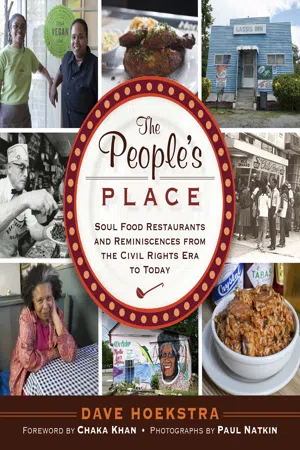
eBook - ePub
The People's Place
Soul Food Restaurants and Reminiscences from the Civil Rights Era to Today
- 240 pages
- English
- ePUB (mobile friendly)
- Available on iOS & Android
eBook - ePub
The People's Place
Soul Food Restaurants and Reminiscences from the Civil Rights Era to Today
About this book
Information
Topic
ArtSubtopic
Culinary ArtsPart 1
Up the Mississippi River

DOOKY CHASE’S RESTAURANT
2301 Orleans Avenue, New Orleans, Louisiana
(504) 821-0600 • www.dookychaserestaurant.com
LEAH CHASE WAS BORN IN RURAL LOUISIANA IN 1923. She is the oldest of eleven children. Before “Mrs. Chase”—as she is known to locals—was a world-famous chef she was a boxing manager. On a warm afternoon in January 2014, Mrs. Chase smiles at the fading glimpse of that memory.
“Joe Louis came to my school, St. Mary’s Academy [in New Orleans],” she says while sitting at a table in the kitchen of Dooky Chase’s restaurant in the Fifth Ward. “He was boxing’s world champion. He showed that you could do anything. I managed a couple of lightweights in the early 1940s. I studied all the [boxing] books I could find. You look at the shoulder, you got to sweat them out.”
Mrs. Chase gets by in a walker, but it doesn’t prevent her from preparing her famous gumbo and gravy on a daily basis at the most famous gathering place of civil rights leaders in New Orleans.
Mrs. Chase places her curled left index finger on the empty kitchen table.
She slowly shifts her finger along an imaginary checkerboard. She deals a satisfied smile. “When I was coming up you had to find your own way,” she says. Her finger is frail but fast as it traces the past. “You go here, but that’s not going to work,” she says. “But don’t move your finger off because if you move your finger off, someone is going to jump you. Then you go to the next one. And the next one.”

Heavyweight boxing champion Joe Louis was an early hero of Leah Chase. Louis (second from left) is promoting his beverage with Edgar Dooky Chase Sr. (second from right) at the restaurant. Courtesy of Dooky Chase’s
She is always moving forward.
Mrs. Chase grew up in a black-and-white world but has made New Orleans a better place because of her understanding of colors. Dooky Chase’s opened in 1939 as a bar at the corner of Orleans and Miro Streets in a neighborhood of African Americans, Italian Americans, and some Chinese Americans. In 1941 it moved to its present location.
Riverfront workers and longshoremen began eating po’boys, set up with Scotch and 7-Up. Sometimes Dooky Chase Sr. gambled with the workers in the back of the bar. Because of a segregated banking system the workers would also cash their checks at Dooky Chase’s.

Dooky Chase’s circa 1940s. Courtesy of Dooky Chase’s
Mrs. Chase’s gumbo has been the great common denominator.
“It is the gumbo that Creoles of color made,” she says. “You go into any local home and you’re going to have that same taste. You’re going to have the shrimp, the crabs, sausage, chicken. And ham and veal stew. You had to make it hearty enough to be a main meal. The veal stew gave it no flavor, but picked up the flavors from the other things. It is soul food with all your heart. It’s not the food, it is what you put into it.
“When I’m fixing this food I’m thinking of who is going to be happy.”
She scolded Barack Obama for putting Tabasco sauce on her gumbo. In August 2006 the future president was the commencement speaker at Xavier University. He stopped at Dooky Chase’s for lunch. “We told him you don’t use Tabasco, uh-uh,” she says. “George W. [Bush], what a kind man he was. Not a good president, but a kind man. Every time he came to New Orleans he sent security for me. We had dinner at Commander’s Palace. They had me sit right next to him. After dinner he asked me to fix breakfast. I didn’t want to do it, but how do you turn down a president? So I fixed breakfast here [in April 2008]. He brought the president of Mexico [Felipe Calderon] and the prime minister of Canada [Stephen Harper]. I gave President Bush shrimp and baked cheese grits, which he never had before. He loved it.”
Mrs. Chase is also an avid art collector and dozens of paintings adorn the restaurant that is accented with white tablecloths and smooth Victorian chairs.

The elegance of Dooky Chase’s: The restaurant bounced back after Hurricane Katrina with the help of volunteers from all over America.

Chef Leah Chase is one of the most avid collectors of African American art in the south. The Main Dining Room and Victorian Room of Dooky Chase’s showcase her collection.
“Karl Rove [former White House deputy chief of staff] came in a couple months ago,” she says. “He said, ‘You know your friend [President Bush] is painting now.’ I said, ‘Can’t tell by me. I don’t see a thing by George W. on my walls.’ [hearty laugh] All the presidents are well and good but they come and go. But it is the everyday person that never forgets you.
“That is what has given me the energy and courage to go on.”
Doratha “Dodie” Smith-Simmons is sitting next to Chase in the kitchen. Smith-Simmons was a task force member of the Congress of Racial Equality (CORE), a test rider for the 1961 Freedom Rides, and a youth member of the NAACP. The Freedom Riders came from all over the United States on interstate buses to protest segregation, poor housing, and other shackled measures in the South. Smith-Simmons and Mrs. Chase are sisters of the soul. “Dooky Chase was the only restaurant that allowed blacks and whites,” she says. “When I was arrested in 1961 for picketing at the police station our lawyers came here for food [fried chicken and shrimp po’boys]. We didn’t eat jail food. The third time I was arrested was over Easter; Mrs. Chase sent baked ham, potato salad, green peas, everything. So I enjoyed going to jail!”
Mrs. Chase considers the not-so-distant past for a few quiet moments.
Then she says, “Deep down, I feel in some ways this restaurant really changed the course of America. This was a safe haven for all of us. We fed everybody. We had an upstairs dining room where people met. The Republic of New Afrika came upstairs and I said, ‘Look, take your chip off your shoulder. I’m going to feed you, you’re going to abide by my rules, and I’m going to respect you.’ And there was no trouble with the Republic of New Afrika [a favorite target of the FBI]. Big Daddy King [Dr. King’s father] always came here. Dr. Sam Cook [president of Dillard University, 1975–1997] used to bring in all the people and Big Daddy King. He was a stickler for introducing these people to his young students. Big Daddy King was fun. He’d say, ‘Sister, I want you to come and cook for me.’ I had a better relationship with him than his son.
“Dr. King was like a prophet. He didn’t come to eat or drink. He came for special things. He would sit down with Judge Augustine, Dr. Mitchell, and Dooky at night. Thurgood Marshall would come and eat his gumbo and crawfish on the floor. Dr. King wasn’t like that. It’s like he was always on a mission.”
Judge Marshall was a compatriot of civil rights attorney Ernest “Dutch” Morial, the first African American mayor of New Orleans. In 1954 Morial was the first African American graduate of the Louisiana State University School of Law. Morial and A. P. Turlow had offices in a former French hospital down the street from the restaurant. In the upstairs room of Dooky Chase’s, Marshall and Turlow planned integration strategies in the Crescent City, with schools being the first target. The community became empowered when Morial became mayor.
James Baldwin wrote in the corner of the bar. James Meredith ate at Dooky Chase’s.
“I’m here every day,” she says. “I stay in the kitchen. I do all my own basic cooking. I get help because I can’t carry the pots like I used to.”
She stops and considers a secret. “I love the White Trash Cooking cookbook,” she says. “It’s a bad name, but those recipes are what they are. What the heck? I have Cracker Cookin’ out of Florida. But I don’t look at the foods as much as I look at the pictures of the people. You look at life the same way.
“You might not like what you see the first time, but look again and you’re going to see something different.”

Leah Chase was born in Madisonville, Louisiana, about fifty miles across Lake Pontchartrain. Charles and Hortensia Lange had thirteen children, but Mrs. Chase’s older sister Claudia died at about eighteen months. And younger sibling Myra died at nine months.
“It was tough and then here comes the Great Depression in ’29,” she says. “So we had nothing but what my daddy could grow. He was a caulker in the shipyards. But his big thing was farming and planting. He loved the soil.”
Charles Lange was proud of how even his rows of crops were. He told his children to plant every onion twelve inches apart. “That way the onions could grow real big,” she says. “Food came to our table like that. You raised a hog primarily for the lard. If we got the hog to three hundred pounds, we knew you were going to get one hundred pounds of lard off of that. We preserved the pork by cooking it and preserving it in its own lard.
“I remember purslane grass. My daddy’s crops were low and he didn’t have hardly anything. So they had this wild grass. My mother would say, ‘Go pick it, but don’t let the neighbors see you doing that because they’ll know we’re so poor, we’re eating this wild grass.’ It cooked like spinach, really. So when I get up in the world and go to Citi’s restaurant in California, I order the liver, twenty-five dollars a plate or whatever—here’s purslane on my plate! Doggone it, I’ve been eating it free all my life.”
The entire kitchen staff laughs.
“It’s been a good life for me,” says Mrs. Chase, who at age twenty-four lost the top half of her right index finger in a bout with rheumatic fever. “My daddy taught us to never worry and never cry in public. I remember when my mother died. He got home and went in the bathroom and cried. He told us three things: you pray, you work, and you do for others. Now, my mother was different. She was what old people called ‘sassy.’ She gave all us girls plaques, ‘How to Be a Woman.’ First, you had to look like a girl. You had to act like a lady. You had to think like a man—don’t try to be like that man. And work like a dog! Those are the rules I have tried to live by, but I had a lot of help.
“Nobody can grow by themselves.”
In the mid-1940s Mrs. Chase was attending a concert by the Dooky Chase (II) Jazz Orchestra. The trumpet player Dooky Chase (II) spotted her in the audience.
They married in 1946 and she began working in her father-in-law’s kitchen in 1950. She was serving up the right food at the dawn of the civil rights movement.
Mrs. Chase reflects, “Even our own people would say, ‘You’re nothing but a cook.’ They don’t realize I’m feeding a lot of people so they can do what they have to do. I can energize them with my food and that is my contribution to their work. But we took it all for granted. You have to make a difference.
“And that is what I’m still fighting today.”
And she is ninety-one years old on this day.
Mrs. Chase’s work resonated across America. Her contributions are not lost on someone like Minnijean Brown, a Congressional Gold Medal winner and one of the bold Little Rock Nine who integrated Little Rock Central High School in 1957. “Her persistence is a form of activism,” Brown says from her home outside Vancouver, Canada. “It is hard to do that over time. And she did...
Table of contents
- Cover
- Title Page
- Copyright
- Contents
- Foreword by Chaka Khan
- Introduction
- I ♦ Up the Mississippi River
- II ♦ Storied Southern Soul
- III ♦ Urban Soul
- IV ♦ Vegan Soul
- Acknowledgments
Trusted by 375,005 students
Access to over 1.5 million titles for a fair monthly price.
Study more efficiently using our study tools.
Frequently asked questions
Yes, you can cancel anytime from the Subscription tab in your account settings on the Perlego website. Your subscription will stay active until the end of your current billing period. Learn how to cancel your subscription
No, books cannot be downloaded as external files, such as PDFs, for use outside of Perlego. However, you can download books within the Perlego app for offline reading on mobile or tablet. Learn how to download books offline
Perlego offers two plans: Essential and Complete
- Essential is ideal for learners and professionals who enjoy exploring a wide range of subjects. Access the Essential Library with 800,000+ trusted titles and best-sellers across business, personal growth, and the humanities. Includes unlimited reading time and Standard Read Aloud voice.
- Complete: Perfect for advanced learners and researchers needing full, unrestricted access. Unlock 1.5M+ books across hundreds of subjects, including academic and specialized titles. The Complete Plan also includes advanced features like Premium Read Aloud and Research Assistant.
We are an online textbook subscription service, where you can get access to an entire online library for less than the price of a single book per month. With over 1.5 million books across 990+ topics, we’ve got you covered! Learn about our mission
Look out for the read-aloud symbol on your next book to see if you can listen to it. The read-aloud tool reads text aloud for you, highlighting the text as it is being read. You can pause it, speed it up and slow it down. Learn more about Read Aloud
Yes! You can use the Perlego app on both iOS and Android devices to read anytime, anywhere — even offline. Perfect for commutes or when you’re on the go.
Please note we cannot support devices running on iOS 13 and Android 7 or earlier. Learn more about using the app
Please note we cannot support devices running on iOS 13 and Android 7 or earlier. Learn more about using the app
Yes, you can access The People's Place by Dave Hoekstra,Chaka Khan,Paul Natkin in PDF and/or ePUB format, as well as other popular books in Art & Culinary Arts. We have over 1.5 million books available in our catalogue for you to explore.