- 224 pages
- English
- ePUB (mobile friendly)
- Available on iOS & Android
eBook - ePub
About this book
Dozens of indigenous fruits, vegetables, nuts, and game animals are waiting to be rediscovered by American epicures, and Appalachia stocks the largest pantry with these delectable flavors.
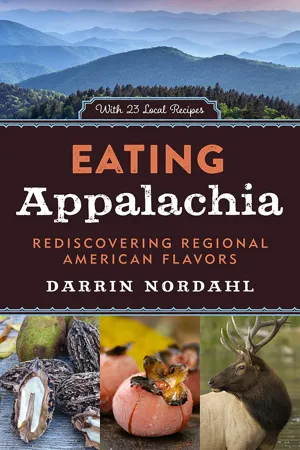
Eating Appalachia looks at the uniquely flavorful foods that are native to the region—including pawpaws, American persimmons, ramps, hickory nuts, and elk, among others—with 23 mouthwatering recipes and 45 color photographs. The book also profiles the food festivals including the Pawpaw Festival in Albany, Ohio; the Feast of the Ramson in Richmond, West Virginia; and Elk Night at Jenny Wiley State Park in Prestonburg, Kentucky. There are recipes for every ingredient: Pawpaw Panna Cotta, Chianti Braised Elk Stew, Pan-Fried Squirrel with Squirrel Gravy, Persimmon-Hickory Nut Bread, and Wild Ginger Poached Pears. Nordahl also discusses some of the larger agribusiness, governmental agency, and ecological issues that prevent these wild, and arguably tastier, foods from reaching our table.
Information
Topic
ArtSubtopic
Culinary Arts1
Albany, Ohio:
WAY DOWN YONDER


Pawpaws, perfectly ripe.

Fresh out of Ohio University and sporting a one-off degree in Wholistic Transition to Sustainability, Chris Chmiel was like many recent college graduates in America: educated, ambitious, and unemployed. Chris’s career interests—as his conferred diploma suggests—were unique, and few occupations resonated with his sustainable values. For Chris, graduation signaled commencement of a different sort—it was time to begin soul-searching.
With his college sweetheart Michelle in tow, Chris wandered the country seeking inspiration and insights into sustainable living. Finding none, he ventured south of the border, where he found a fruit and a purpose on a farm. While working the Mexican soil, Chris discovered guanabana, a curious-looking native piece of produce that resembles a spiky avocado on steroids, but with ivory white flesh and semi-glossy dark, almost black seeds. Guanabana, or soursop as it is called in the States, has an enchanting flavor that is highly revered in its homelands of Mexico, Central America, and the Caribbean. Chris, too, was smitten with soursop. What intrigued him most was that this odd-looking indigenous fruit had attained great commercial success. The fruit is delicious by itself, eaten out of hand. But with its characteristic pineapple tartness and banana creaminess, soursop lends luxurious tropical flavor to ice cream, smoothies, fruit juices and nectars, candy, and aguas frescas.
Inspired by his time on the farm and by the soursop, Chris saw promise in sustainable food production. He and Michelle returned to Ohio, to the town of their alma mater, to begin a soul-lifting life together. But Chris needed a soul-lifting job first. He tried his hand at carpentry, landscaping, cable installation, and cow milking, but none of these trades resonated with Chris’s ecological ambitions. These odd jobs did earn enough, however, for him and Michelle to buy a dozen and a half acres in Albany just down the James A. Rhodes Appalachian Highway from Ohio U. The property was a bona fide fixer-upper: no structure, a few trash heaps, and a patch of gangling trees with fallen, rotten fruit amid the duff. Pawpaw fruit, to be exact. And it was here that Chris recalled the soursop and recited in his head that proverb of eternal optimism.
“WHEN LIFE HANDS YOU LEMONS …”
Chris saw great potential in the pawpaw. Here on his property was a true American fruit of incomparable flavor, texture, and aroma, abundantly provided free by Mother Nature without the need for hoeing, weeding, fertilizing, or irrigating. But it was all going to waste. And not just those on Chris’s property; pawpaws throughout Appalachia moldered from neglect. The soursop is celebrated all over the North American tropics, but here in temperate Appalachia, the pawpaw—cousin to the soursop—has fallen into obscurity.
Chris had found his calling. He founded a business and concocted catchy slogans to increase awareness of one of the oldest American foods now forgotten. “Getting pawpaws to the people” became the mission statement for Chris’s new enterprise, which also adopted the motto “Raising consciousness through cuisine.” Chris named his new business Integration Acres, a reflection of his belief that food, the environment, and we are one inextricable union.
Chris became yet another Johnny Appleseed in Ohio, although he trumpeted the glories of a different fruit. He sang the praises of the pawpaw to whoever would listen. Some were amused and chuckled at him, but most folks were curious to learn more. The pawpaw (Asimina triloba), he told them, is indigenous to Ohio and the largest fruit native to the United States. And he’d remind his neighbors that Ohio has been recognized for producing the nation’s tastiest pawpaws. The American Genetic Association announced a contest back in 1916 to determine where the best of these fruits could be found in America. Entries were submitted from all over the eastern United States. After the final tally, the blue, red, and yellow ribbons all were awarded to pawpaws hailing from the same place: southern Ohio.
Even Ohio legislators have caught Chris’s infectious enthusiasm, recently decreeing the pawpaw the official State Native Fruit. Today, no other state exhibits the zeal for the pawpaw like Ohio does, and Buckeyes can thank one man for that.
GETTING PAWPAWS TO THE PEOPLE
My first taste of pawpaw took hold of me forcefully, in the same manner I imagine it did Chris. What have I been missing my whole life? And why isn’t this fruit in every supermarket and produce stand in America?
I was living in Davenport, Iowa, at the time, and on this particular day—the day I would taste my first pawpaw—I was standing under a bridge in a parking lot on the banks of the Mississippi River. I was meeting an acquaintance, a fellow native-food zealot, who had just returned from a trip in the Appalachian foothills with some fresh pawpaws. He walked over with a white plastic five-gallon bucket filled with what looked to be soft, chartreuse potatoes splotched with soot. “This fruit isn’t going to win any beauty contests,” I thought. But my pawpaw’s homely complexion belied its intoxicating aroma and luscious flavor. I sliced my spoiled potato doppelgänger in half lengthwise and found a cream-colored, custardy flesh with a half-dozen seeds resembling lima beans fashioned from polished ebony. Then the perfume hit me: heady scents of ripe banana with wafts of melon. I knew right then I was in for an utterly exotic treat.
I grabbed a plastic spoon and scooped out a modest helping of pulp, took a deep breath, and braced for my first taste. Wow. Mango was the first flavor my taste buds registered, and then came banana cream. I took another bite. Now I detected other, more subtle flavors, like sweet pineapple and a hint of vanilla. I stood in that parking lot stupefied. The flavor was otherworldly. Surely this cannot be an American fruit. This is tropical through and through—a product of paradise, not Appalachia.
I couldn’t wait to find out more about this sensuous fruit, and after a quick Internet search I came across Chris Chmiel and his zeal for all things pawpaw. I introduced myself, we traded a few e-mails, and by happenstance, as I was driving through Ohio one day en route to North Carolina, I found Chris at the Athens farmers market.
Chris is your average Joe: average height and ordinary build, with a coiffure you’d expect in the Midwest: short and sensible. He just possesses an abnormal fondness for indigenous foods. We chatted a bit while he was answering customer questions about his foodstuffs. Chris was operating a stand at the market, where he was able to promote his business and disseminate information about the pawpaw and other native comestibles. He had set out samples of some jams and relishes for us to try, and I quickly developed a liking for both Chris and the pawpaw. But I left with more questions than Chris had time to answer. It was then I realized that if I wanted to learn all I could about this fruit, I would have to immerse myself in the pawpaw culture and engage with more pawpaw wonks like Chris. I needed to make a pilgrimage to Ohio’s Annual Pawpaw Festival in Albany.
I’ll say one thing, Chmiel throws a good party. Chris started the pawpaw festival in 1999, and I flew out from California to help celebrate its fifteenth year. On the plane, I was doubtful a largely forgotten fruit could sustain the interest of folks over three days in the waning Midwestern summer. But I was obviously unprepared for how popular Chris’s festival has become.
Part of the festival’s allure was undoubtedly the scenery. Set in the Appalachian foothills, the festival site comprises sprawling lawns with the gentlest of undulations, running right up to the banks of Lake Snowden. The space felt like a large yet cozy outdoor room, enclosed by walls of rising hills and verdant forest. Thousands drove to Lake Snowden every day of that festival to enjoy live music, taste dozens of dishes showcasing pawpaw, sample pawpaw beer, and ogle the myriad pawpaw-themed crafts—all set within the sylvan splendor of Appalachia.
Typical of summer festivals, there was plenty of tie-dye and patchouli, dogs and dreads. But I also found chefs, naturalists, distillers, farmers, and scientists here, all eager to reintroduce pawpaw to American cuisine. At first it was hard for me to grasp that this rather uncomely fruit, even with its knockout flavor, could ignite such passion in so many. But then again, I, too, experienced the cult-like appeal of the pawpaw. These aficionados, though different in vocation, were united in mission: the pleasures of the pawpaw should be shared with all Americans, made available in supermarkets across the country.
But they also understood why that couldn’t be.
We’ve all bemoaned the flavorless supermarket tomato—or strawberry, plum, peach, or any number of fruits, for that matter. Supermarket produce has to meet stringent criteria to make the grade, but flavor isn’t one of those measures. Supermarkets prize appearance and shelf life above all else. And each particular fruit or vegetable should be uniform in its beauty. Ever notice how all the supermarket carrots have a remarkably similar length, caliber, and complexion? Ever notice how many carrots from your garden exhibit that same uniformity?
To guarantee good looks, supermarkets demand produce that can withstand the bumps and jostles of commercial agriculture. Tender hands gingerly plucking perfectly ripe peaches and gently placing them in towel-lined wicker baskets is what we like to think happens out in the fields. In reality, the hands must work quickly, feverishly tossing fruit into large bins towed by tractors. After it arrives at the processing plant, huge, complex machinery washes the fruit before it is dropped onto a maze of conveyor belts for sorting and packing. Forklifts grab crates of the produce and load them onto semis, which will then truck the produce some fifteen hundred miles, on average, to the terminal market. There the crates of fruit are unloaded by more forklifts, separated, and repackaged for delivery to grocery stores.
Needless to say, that soft, perfectly ripe peach wouldn’t make it out of the fields before being squished to a pulpy mess. So peaches are picked before they are completely ripe, when the flesh is still quite firm. For added insurance, the supermarket’s preferred varieties of peaches—and tomatoes, plums, and strawberries—have been bred for thicker skins, tougher flesh, and boxier shapes, so that they pack tighter and bruise less, arriving at the supermarket looking glossy and fabulous. Flavor is an afterthought.
But the flavorful pawpaw is thin-skinned and bruises easily. Its complexion is anything but handsome and uniform. It also has a volatile shelf life that gives grocery managers fits. Pawpaws are inedible unless fully ripe, and they will spoil in just two or three days once they are ripe. If these fruits were better suited to the demands of commercial packing, distribution, and sales, pawpaws wouldn’t be so obscure—we would see them in the produce aisle, side by side with all the other popular seasonal fruits. But the sad reality is that the pawpaw will never be as pretty as the flavorless tomato. So grocery chains pooh-pooh the pawpaw.
Still, Chris has had some commercial success with his fruit. One product Chris pioneered is frozen pawpaw pulp. He takes fresh, tree-ripened fruit and runs it through a food mill, separating the creamy flesh from the skins and seeds. Freezing fresh pawpaw pulp creates a transportable product with real longevity. Indeed, in what might be the pawpaw...
Table of contents
- Cover
- Title Page
- Copyright
- Contents
- Introduction: American Ingredients
- 1. Albany, Ohio: Way down Yonder
- 2. Richwood, West Virginia: Feast of the Ramson
- 3. Prestonsburg, Kentucky: Restarting the Game
- 4. Cairo, West Virginia: Tough Nuts to Crack
- 5. Cherokee, North Carolina: Food by Any Other Name
- 6. Colfax, North Carolina: Fruit of the Gods
- Epilogue: Toward a New American Cuisine
- Acknowledgments
- Selected Sources and Resources
Trusted by 375,005 students
Access to over 1.5 million titles for a fair monthly price.
Study more efficiently using our study tools.
Frequently asked questions
Yes, you can cancel anytime from the Subscription tab in your account settings on the Perlego website. Your subscription will stay active until the end of your current billing period. Learn how to cancel your subscription
No, books cannot be downloaded as external files, such as PDFs, for use outside of Perlego. However, you can download books within the Perlego app for offline reading on mobile or tablet. Learn how to download books offline
Perlego offers two plans: Essential and Complete
- Essential is ideal for learners and professionals who enjoy exploring a wide range of subjects. Access the Essential Library with 800,000+ trusted titles and best-sellers across business, personal growth, and the humanities. Includes unlimited reading time and Standard Read Aloud voice.
- Complete: Perfect for advanced learners and researchers needing full, unrestricted access. Unlock 1.5M+ books across hundreds of subjects, including academic and specialized titles. The Complete Plan also includes advanced features like Premium Read Aloud and Research Assistant.
We are an online textbook subscription service, where you can get access to an entire online library for less than the price of a single book per month. With over 1.5 million books across 990+ topics, we’ve got you covered! Learn about our mission
Look out for the read-aloud symbol on your next book to see if you can listen to it. The read-aloud tool reads text aloud for you, highlighting the text as it is being read. You can pause it, speed it up and slow it down. Learn more about Read Aloud
Yes! You can use the Perlego app on both iOS and Android devices to read anytime, anywhere — even offline. Perfect for commutes or when you’re on the go.
Please note we cannot support devices running on iOS 13 and Android 7 or earlier. Learn more about using the app
Please note we cannot support devices running on iOS 13 and Android 7 or earlier. Learn more about using the app
Yes, you can access Eating Appalachia by Darrin Nordahl in PDF and/or ePUB format, as well as other popular books in Art & Culinary Arts. We have over 1.5 million books available in our catalogue for you to explore.