Take an intimate look into the contemporary world of absinthe.
International in scope,
Absinthe: The Exquisite Elixir is a visually rich journey into an alluring subculture. Filled with color reproductions of classic and current lithographs, posters, cartoons, as well as photos of antiques, glassware, and other tools of the absinthe drinker, this new and comprehensive guide explains and illustrates the history, culture, and mystique of the drink known as the Green Fairy.
The authors provide insights into the controversy and effects of the Green Fairy through the stories of famous connoisseurs, including Vincent van Gogh, Oscar Wilde, Ernest Hemingway, and Pablo Picasso. In addition to a rich history, this detailed new guide includes recipes, reviews of existing Absinthe brands, and absinthe's contemporary culture and ritual.
Confirmed absinthe drinkers, neophytes, the curious, and collectors will all find this book equally intriguing and seductive.
- 144 pages
- English
- ePUB (mobile friendly)
- Available on iOS & Android
eBook - ePub
About this book
Information
Topic
ArtSubtopic
Culinary Arts2
The Ascension and Demise of the GREEN FAIRY
To fully gauge absinthe’s impact on the literary and art world, it helps to understand the drink’s long and storied history. Well before the distilled spirit rose to prominence as a fashionable drink with a curious reputation, the ancients noted the medicinal attributes of its namesake herb in early pharmacopeia.
The ancient Egyptians were believed to have combined a plant called absinthium, often referred to as “grand wormwood,” with other regional ingredients, such as juniper berries, fennel, honey, and wine or beer, to create a beverage believed to have medicinal power. Such absinthium-laced potions were prescribed for various digestive ailments, fevers, menstrual complaints, and other common maladies.
Across the Mediterranean, in the civilizations of ancient Greece and Rome, absinthium was claimed to be a vermifuge and general digestive aid, as well as an abortifacient, remedy for jaundice, and treatment for bad breath.
Absinthium continued to be recognized for its value in treating digestive complaints in both man and beast through the Middle Ages and into the Renaissance, although the centuries-old practice of mulling its foliage in beer or wine invariably resulted in a terribly bitter concoction that was unpalatable by all accounts.
The intense bitterness of the herb is perhaps why the people of seventeenth-century England popularized purl, an ale seasoned with a less bitter cousin, Artemisia maritima, that was popular with the working class and served in many a bawdy house. Undoubtedly, it is the reason why in his period work The Complete Herbal (1653), Nicholas Culpeper describes distilling absinthium with “annis” seeds, which would have neutralized the herb’s powerfully unpleasant flavor.
Wormwood
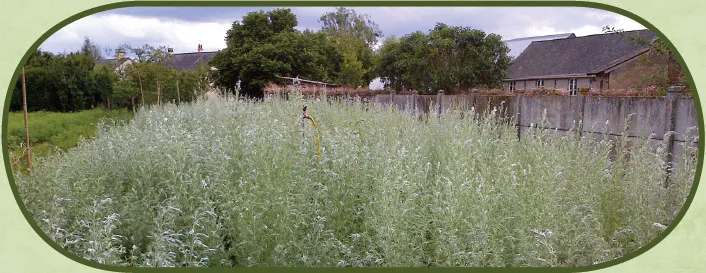
“Wormwood” is a nickname that is casually applied to any of several hundred species of plants in the Artemisia genus, all of which belong to the daisy family (Asteraceae). This genus includes notable botanicals of culinary and medicinal value such as tarragon (Artemisia dracunculus), mugwort (Artemisia vulgaris), sweet annie (Artemisia annua), and many others.
Of these, one particular perennial species grows up to two meters (six feet) in height, with silvery green foliage, yellow button-like inflorescence, a heady minty aroma, and an intensely bitter flavor. This is Artemisia absinthium, aka “grand absinthe” or “grand wormwood,” the namesake herb of the famous spirit, as well as its most essential ingredient.
The Birth of a Spirit
Legend has it that Pierre Ordinaire, a French doctor who lived just across the border in Switzerland, invented the basis of what would become modern absinthe toward the end of the eighteenth century. Upon taking up residence in the scenic Val-de-Travers region of that country, Ordinaire experimented with the art of distillation, using both native and exotic flora that were renowned for their medicinal virtues. And while no one can claim with certainty that Ordinaire invented the concept of distilling absinthe with flavorful seeds (as Culpeper described more than a century before), Ordinaire is credited with creating a noteworthy distilled digestive tonic from grand absinthe, green anise (Pimpinella anisum), and sweet fennel (Foeniculum vulgare), along with others such as hyssop (Hyssopus officinalis), lemon balm (Melissa officinalis), and petite absinthe (Artemisia pontica).
Ordinaire’s creation had several distinct benefits over any similar concoction that had come before. First, the distillation resolved the bitterness problem by drawing out and condensing the medicinal essences of the herb, while joining the distillate with the pleasant flavor of two “hot seeds.” Then, he gave the resulting medicine a post-distillation infusion of botanicals that had a delicate aroma and flavor. These latter botanicals also provided the pleasant natural olive tint. The result was a proprietary digestive tonic that was as delicious as it was potent. Ordinaire graciously shared the fruits of his labor with patients and guests, who marveled at the powers of this “wonder drug.”
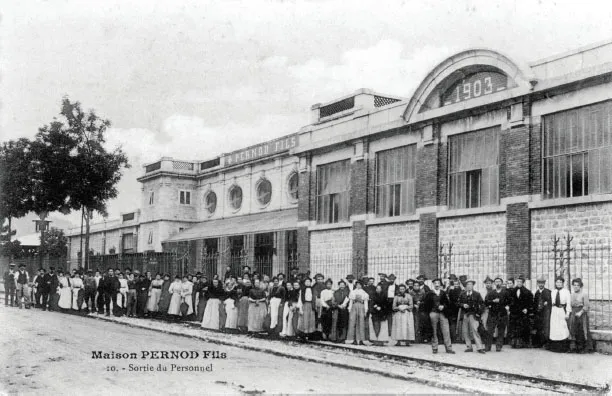
By the time Henri-Louis Pernod died in December 1851, his once-humble distillery had grown into a large building on the banks of the Doubs River.
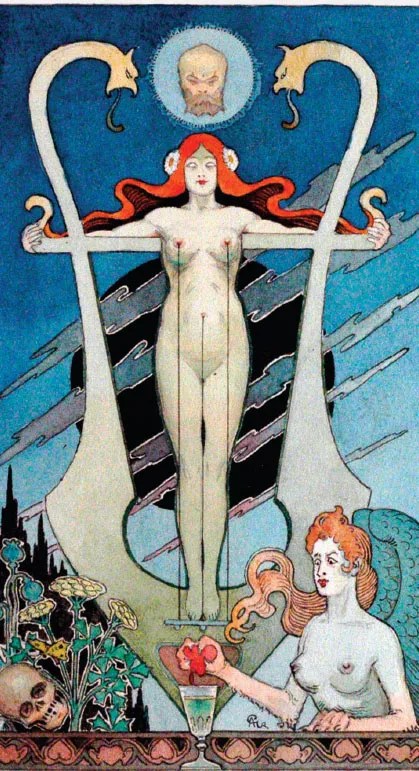
The French artist and illustrator Alexandre Graverol (1865–1949) was well acquainted with absinthe. His delicate watercolors evoke the magic and mystery of absinthe and here incorporates a floating head of Paul Verlaine, a glass of absinthe, opium poppies, and occultist imagery.
Lore has it that before his death, Ordinaire disclosed the recipe for his herbal potion to the two Henriod sisters of Couvet, Switzerland, who continued to prepare Ordinaire’s creation to the delight of traveling guests. It was one such guest, Major Daniel-Henri Dubied, who recognized the economic potential of a liquid so magical it could be a balm for all digestive complaints. In a stroke of entrepreneurship, Dubied purchased the recipe from the Henriod sisters and began distilling the medicine locally in Couvet in 1797. Enlisting the aid of his son Marcelin and his son-in-law Henri-Louis Perrenoud, Dubied capitalized on his son-in-law’s distilling knowledge to launch a modest operation that he called Dubied Pére et Fils.
By 1805, with most clientele being drawn from the French side of the border, and given the high taxes associated with exporting the Swiss spirit,
Henri-Louis, who had changed the spelling of his last name to “Pernod,” reestablished the distillery in the French border town of Pontarlier. He constructed the distillery, consisting of two stills producing around sixteen liters each per day, in a small rented house. Little did Henri-Louis realize what the future had in store for his sleepy regional elixir.
Medicine for the Masses
At the advent of the nineteenth century, France was on a fast track of cultural and technological change. Old ideas gave way to the new, and Europe flourished in the blossoming of the Industrial Age. With advances in technology came advances in communication and transportation, such as the convenience of rail travel, which put all parts of the nation within easy reach.
Meanwhile, advances in agricultural technology gave rise to large-scale farming, which pushed the rural poor to urban centers such as Paris and Lyon in search of service-industry jobs. Much of this work involved difficult physical labor, long hours, and low wages. Nonetheless, by the mid-nineteenth century, the population of Paris alone had swelled to around double its pre-Revolution figure.
In Times of War
During the Algerian Campaign (1844–1847), France seized control of Algeria from the Ottoman Empire. This campaign presented numerous challenges to the young men of the French army, as they wrestled with the hostile terrain and climate of North Africa, as well as sanitation issues that invariably led to illness.
As part of its guarantee to provide clean drinking water, the army issued its soldiers rations of absinthe, as the spirit’s powers of disinfection were purportedly able to render potentially unclean water hygiénique. Perhaps French soldiers discovered a preference for adding a little water to absinthe as opposed to the other way around, but abuse of the delicious anise-flavored medicine soon became rampant. The soldiers’ glaring taste for absinthe achieved considerable publicity back in France, as humorous sketches mocking the “absinthe military” began appearing in popular journals.
When the soldiers returned to France and stepped back into their civilian lives, they retained their taste for the curiously potent anise-flavored medicine that they had befriended in the desert and within the cafés of Algeria. This brought the spirit from its origins as a regional delicacy into the mainstream of urban culture.
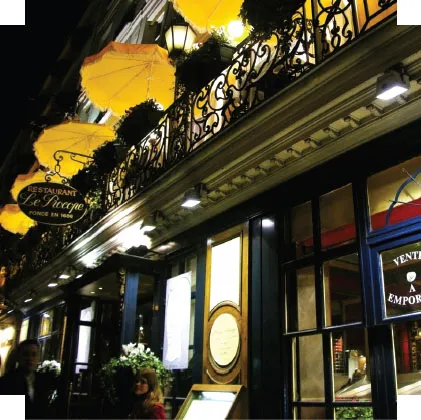
The famous Procope Café in Paris, once a favorite haunt of absinthe drinkers. Opened in 1686, it is the longest continuously operating café in France.
The Rise of Café Culture
The Industrial Revolution also brought demographic shifts that changed the very face of Europe. With the population boom in urban areas came a swelling in numbers of young people, many of whom found difficulty securing steady work. Marginalized to the fringe of society, many of these younger people rejected and ridiculed the bourgeois ideals upon which they were reared. The counterculture they spawned embraced a rejection of conventional societal structure and material wealth in favor of expressing contrarian ideas, all while embracing a lifestyle rife with intoxicating spirits, drugs, and promiscuous sexual freedom. Much like the hippie movement of the 1960s, their carefree behavior and nomad-like mobility were compared with that of the notorious Romani people of the day, who were associated with a region of the Czech Republic known as Bohemia. As such, this new class of citizens became whimsically referred to as bohemians.
The lifestyle of a French bohemian was one that often involved eating little while drinking and smoking in excess. And because the bohemian movement thrived on social exchanges, urban cafés served as congregational centers for the bohemian set, which regularly migrated from one café to another as the evening wore into the late hours.
Café Procope was one such café that witnessed many an inebriated but intellectual debate among famous bohemian habitués, and it is often considered to be the oldest Parisian restaurant in continuous operation, since its debut in 1686. It remains in good order today at its original location at Rue de l’Ancienne Comédie, adjacent to the lively Boulevard Saint-Germain, which is historically renowned for its cafés.
The bohemians befriended absinthe rather early in its rise to popularity, marveling at its preparation ritual, flavor, color, and potency. And as absinthe became the fashionable tipple during the early evening hours when aperitifs are appropriate, that time became known as L’Heure Verte, or the Green Hour, in homage to the delectable spirit.
Burning Down the House of Pernod
As the dawn of the twentieth century arrived, absinthe was big business. Having long since outgrown its days as a regional liquor in s...
Table of contents
- Cover
- Title Page
- Copyright
- Dedication
- Acknowledgments
- Contents
- Foreword by Maxwell Britten
- Introduction by Betina J. Wittels
- Exquisite to the Eye and Mind
- The Ascension and Demise of the Green Fairy
- The Dark Ages
- The Long Road Home: Absinthe Returns
- Accoutrements and Antiques
- Absinthe and the Craft Cocktail Revival
- Absinthe Reviews
- Select Bibliography
- About the Author
Trusted by 375,005 students
Access to over 1.5 million titles for a fair monthly price.
Study more efficiently using our study tools.
Frequently asked questions
Yes, you can cancel anytime from the Subscription tab in your account settings on the Perlego website. Your subscription will stay active until the end of your current billing period. Learn how to cancel your subscription
No, books cannot be downloaded as external files, such as PDFs, for use outside of Perlego. However, you can download books within the Perlego app for offline reading on mobile or tablet. Learn how to download books offline
Perlego offers two plans: Essential and Complete
- Essential is ideal for learners and professionals who enjoy exploring a wide range of subjects. Access the Essential Library with 800,000+ trusted titles and best-sellers across business, personal growth, and the humanities. Includes unlimited reading time and Standard Read Aloud voice.
- Complete: Perfect for advanced learners and researchers needing full, unrestricted access. Unlock 1.5M+ books across hundreds of subjects, including academic and specialized titles. The Complete Plan also includes advanced features like Premium Read Aloud and Research Assistant.
We are an online textbook subscription service, where you can get access to an entire online library for less than the price of a single book per month. With over 1.5 million books across 990+ topics, we’ve got you covered! Learn about our mission
Look out for the read-aloud symbol on your next book to see if you can listen to it. The read-aloud tool reads text aloud for you, highlighting the text as it is being read. You can pause it, speed it up and slow it down. Learn more about Read Aloud
Yes! You can use the Perlego app on both iOS and Android devices to read anytime, anywhere — even offline. Perfect for commutes or when you’re on the go.
Please note we cannot support devices running on iOS 13 and Android 7 or earlier. Learn more about using the app
Please note we cannot support devices running on iOS 13 and Android 7 or earlier. Learn more about using the app
Yes, you can access Absinthe by Betina J. Wittels,T.A. Breaux, T.A. Breaux in PDF and/or ePUB format, as well as other popular books in Art & Culinary Arts. We have over 1.5 million books available in our catalogue for you to explore.