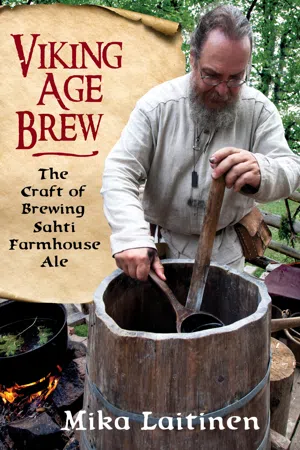
Bringing beer history to life,
Viking Age Brew takes readers on a lavishly illustrated tour of rustic brewhouses fueled by wood and passion. Sahti is a Nordic farmhouse ale that is still crafted in accordance with ancient traditions dating back to the Viking Age. It is often thought of as an oddity among beer styles, but this book demonstrates that a thousand years ago such ales were the norm in northern Europe, before the modern-style hopped beer we drink today reached the masses.
Viking Age Brew is the first English-language book to describe the tradition, history, and hands-on brewing of this ale. Whether you are a brewing novice or an experienced brewer, this book will unlock the doors to brewing ancient ales from medieval times and the Viking Age.
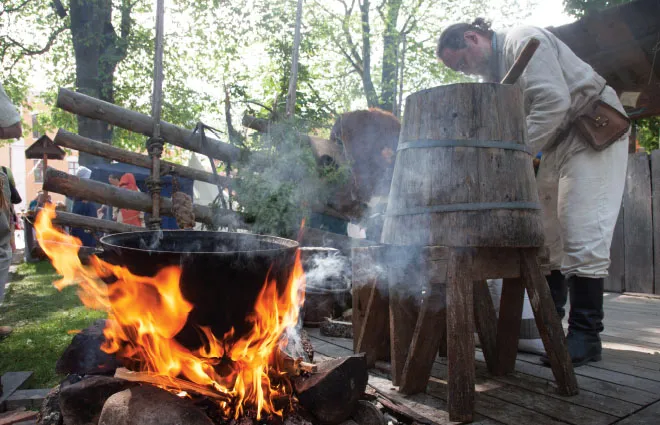
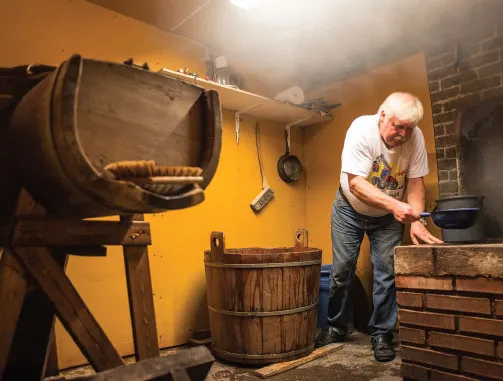
A historical brewing demonstration at the Medieval Market of Turku, 2016. COURTESY OF SAMI BRODKIN
1
An Introduction to Farmhouse Ales
A Few Sips and the Bigger Picture
IN DAYS GONE BY, European farmers brewed beer from their own grains. This was a drink made by the people, for the people. They prepared the grains themselves, added flavors that grew nearby, and fermented the brew with yeast that was in their family. The brewers were regular farming folk who passed on the craft by word of mouth.
In the first millennium, such farmhouse traditions formed the primary way of brewing in Europe. Later, these domestic traditions were superseded, from the twelfth century onward, by beer that was produced more professionally and efficiently. By the twentieth century, preindustrial-style farmhouse brewing had all but disappeared from Europe. It remained in only a few isolated places.
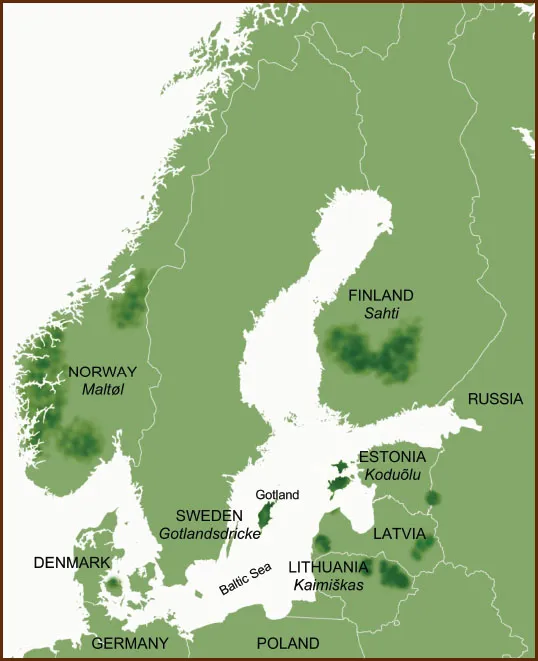
A primitive form of farmhouse brewing was preserved in a few of the northernmost countries in Europe. This created sahti in Finland, koduõlu in Estonia, gotlandsdricke in Sweden, maltøl in Norway, and the kaimiškas beers of Lithuania. Sahti is the best known, but these are all part of the same extended family of ancient farmhouse ales.
These ales are the best surviving examples of what European beer was like before professionally brewed hopped beer became commonplace in the late Middle Ages. Although farmhouse brewing traditions underwent partial modernization in the twentieth century, they still offer a fascinating view of brewing in the Middle Ages and the Viking Age.
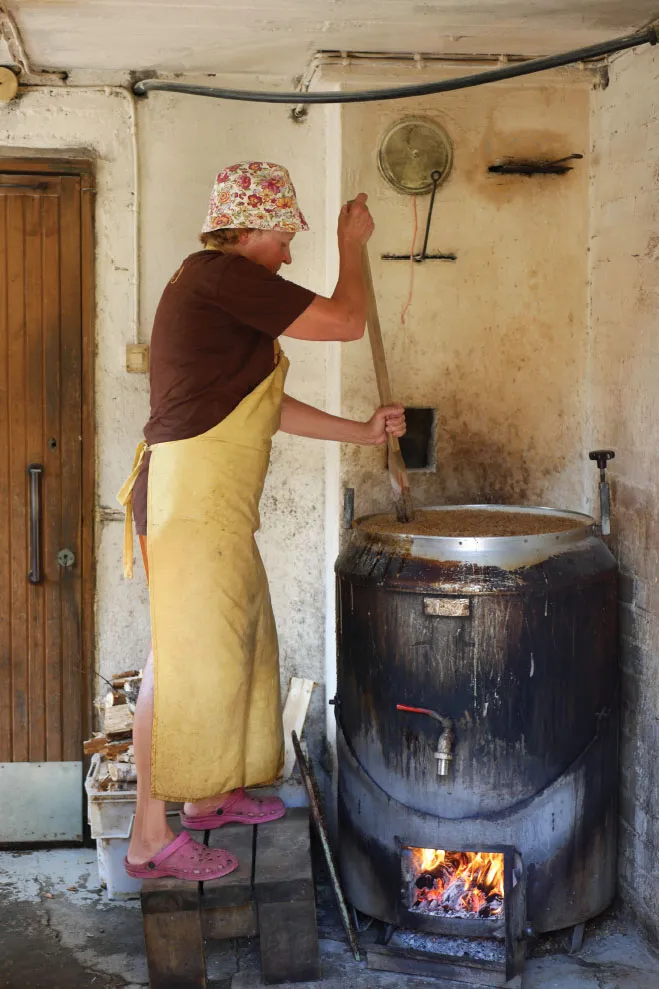
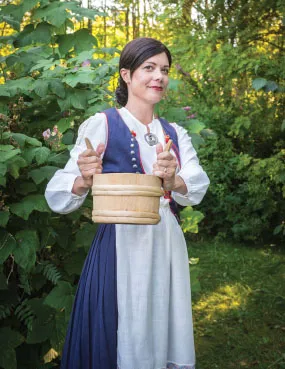
This sahti master, Eila Tuominen, learned the traditional brewing methods by assisting her mother. Her mother, in turn, learned to make sahti in the same way. Nobody knows when exactly it all started. MIKA LAITINEN
Ancient ales are sometimes re-created via fragmented information from archaeological finds and historical texts, supplemented with educated guesses about forgotten crafts. What the surviving farmhouse ales such as sahti bring to the table are practical methods that work without thermometers, stainless steel, or modern brewer’s yeast. As a bonus, sahti and its cousins can even give hints of what medieval ale tasted like, and I can be quite certain that at times it tasted pretty darned good! Admittedly, the primitive folk ales of today aren’t a time machine that can take us directly back to how things were a thousand years ago, but in this book I will argue that they can come close.
A few breweries in northern Europe have scaled up and commercialized the old domestic farmhouse techniques, but these folk beers are rarely exported, and they can be hard to find even in their homelands. However, this is only a small obstacle to tasting fresh malty farmhouse ale that is unlike any industrial beer sold today. Sahti is a traditional form of homebrewing, and here I will unlock the doors to brewing sahti and other ancient ales, whether you are new to brewing or an experienced brewer.
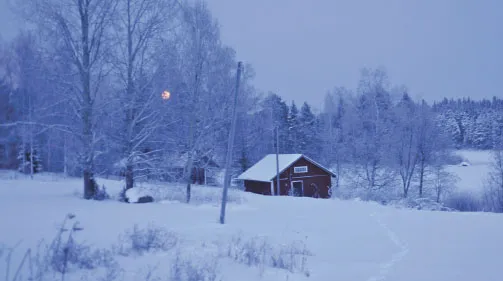
In midwinter the sahti heartland gets only five to six hours of natural light per day. Little wonder that the shortest day of the year marks the high point for northern farmhouse ales. Still today, having plenty of the finest ale ready on December 21 is a matter of honor for a thousand or so traditional Nordic and Baltic brewers.
Before embarking any further, I should clarify that today “farmhouse ale” refers to beers that have their roots in farms but are not necessarily brewed on farms. It is a very generic term—at one time, most beer in Europe was farmhouse ale, after all. Therefore, the term does not describe a particular beer style, nor is it bound to any specific country, ingredient, or brewing technique.
Everyday and Feast Ales
Farmhouse ales have been made in different strengths for different purposes. In wide stretches of northern Europe, low-alcohol ales used to be part of the diet and drunk by everyone, children included. At feasts, however, the ale was expected to be heady and rich in taste. In Nordic farmhouses of yore, the idea of a feast without ale would have been as ridiculous as that of a pub with no beer.
Besides the alcohol content, this division had a notable effect on ingredients and brewing techniques. Everyday ales were easy and economical to brew on a weekly basis for the whole household, while at northern European feasts, both the quality and the quantity of the ale were a matter of pride. As recently as the 1960s, weddings in the districts where sahti thrived were celebrated for several days, and the last drops of this drink practically marked the end of the feast.
Sahti and its closest relatives are clearly feast ales, with an alcohol content typically in the range of 5–9 percent. Even today, sahti is usually made for special events such as Christmas celebrations or weddings. Surely the character of the feasts and the associated drinking customs have helped to preserve the traditions.
Low-alcohol farmhouse ales, on the other hand, are largely extinct, or heavy-handedly modernized. Actually, what I call here everyday ales or low-alcohol ales haven’t always been beers: some versions were sour fermented cereal beverages that contained no alcohol to speak of. Nevertheless, traditional cereal drinks such as kvass in Eastern Europe, kalja in Finland, kali in Estonia, gira in Lithuania, and svagdricka in Sweden reveal interesting facts about the prehistory of beer. While this book mostly discusses feast ales, I will briefly delve into this much overlooked side of beer traditions in the chapter “Low-Alcohol Farmhouse Ales” (page 95).
The most traditional way of enjoying sahti is from a wooden haarikka, which is intended to be shared. MIKA LAITINEN
In addition, there are medium-strength farmhouse ales, which bring a smile to the lips but do not stop the work. Such ales were served, for example, during communal work in which the workers were unpaid but provided with beer. Any such distinction in terms of strength becomes blurred in some regions, however—at least these days when the flavorful premium version is drunk more often. While most sahtis even today are deceptively strong, at 7 to 9 percent alcohol, Lithuanian farmhouse ales, for example, are typically very drinkable at around 6 percent.
Geography
The most noteworthy remnants of ancient European farmhouse ales alive today are found in the Nordic and Baltic regions. The Nordic countries are Denmark, Finland, Iceland, Norway, and Sweden. Sometimes these countries are together referred to as Scandinavia, but the most prevalent definition of Scandinavia includes only Denmark, Norway, and Sweden. The Baltic region is formed by Estonia, Latvia, and Lithuania. All these countries are linked by the Baltic Sea, which throughout history has been an important route of immigration, trade, and warfare. Through the expansion of the Vikings in AD 800–1050, the Nordic influence can be seen in, for example, the British Isles and Russia. While the Vikings are usually thought of as Scandinavians, apparently some Finns joined them, and there were Baltic tribes on the coast of the Baltic Sea that lived much as the Vikings did.
The Nordic and Baltic countries, and the main areas where farmhouse ale traditions remain alive. Once sahti was commonly found across western Finland, but now it is a regional specialty. MIKA LAITINEN
The map of surviving farmhouse brewing traditions is still being honed in 2018. The domestic brewers do not always make a noise about themselves, and nobody can claim to be fully aware of all areas with living traditions. Evidently, farmhouse brewing has survived also in Latvia, but little is known about it. In Sweden, farmhouse brewing is alive only on the island of Gotland. In Denmark, the traditions faded relatively recently, but at least one brewer still practices the ancient craft. Some kind of farmhouse brewing is alive in parts of Russia as well, at least in the republic of Chuvashia and the Perm Krai region.
An Overview of Farmhouse Brewing
The brewing practices of the farm folk have been extremely diverse, but in essence the ancient feast ales such as sahti, koduõlu, gotlandsdricke, maltøl, and kaimiškas beer are crafted as follows.
Malted and unmalted grains, juniper branches, hops, and yeast are the basic ingredients of the northern farmhouse ales. Malted barley is the most common base grain, but rye, oats, and wheat too are used, in both malted and unmalted forms.
The most traditional farmhouse setup involves two large wooden vessels: a vat for mashing and another vat, or a trough-like vessel, for filtering out grain solids. In Finland, the filtering vessel is known as a kuurna and traditionally is made from a hollowed-out log.
Regrettably, traditional home malting has largely disappeared, and now most brewers use commercial malt. In Norway and Lithuania, some brewers still perform malting in the traditional way. Meanwhile, in Finland, a few farmers have revived home malting but with somewhat modernized methods.
In the Nordic and Baltic farmhouse ales, juniper is a more important brewing herb than hops. Traditionally, juniper branches are used as a filtering aid in draining the sweet liquid from the filtering vessel while leaving the grain solids behind. This gives a delicate coniferous taste somewhat different from the berries. Some brewers further enhance the flavor with a juniper infusion, created by infusing branches in hot water. If hops are used, the quantities are small, and many sahtis are unhopped.
In the old days, farmhouses had their own yeast strains for baking and brewing, sometimes using the same one for both jobs. Around 1900, commercial baker’s yeast started to replace the house strains, and by the 1950s sahti was fermented predominantly with commercial baker’s yeast. Some brewers in Norway and Lithuania hold on to their traditional heirloom yeasts, and some of them are still fermenting with a yeast originating from who knows when. Today most northern farmhouse brewers use baker’s yeast, which gives a rustic edge to the ale, since this baking yeast has not been bred or manufactured for brewing.
Much of the character of these ales comes from the traditional brewing process, which evolved from using what farm equipment was available and relied on wooden vessels. Although many Nordic and Baltic brewers now use stainless steel equipment, their brewing practices largely follow the old ways, as if the brewing vessels were made of wood and thermometers had not been invented.
Brewing begins by mixing water with crushed grains to form a mash. The purpose of this step is converting grain starches to sugars, as in all brewing, but the farmhouse techniques for raising and maintaining the temperature are varied and often highly unusual. For example, many sahti brewers add water in several steps over five to eight hours, and even the ancient technique of heating the mash with hot stones is still used by a few brewers.
After this, the mash is scooped into a filtering vessel, on top of fresh juniper branches, which act as a filter. In the end, the resulting malty liquid, or wort, flows out of the vessel, leaving the grain solids behind.
Boiling the wort with hops became common in the late Middle Ages. It gives the beer a bitter edge, removes haze-causing proteins, and acts as a preservative, extending the life of the beer. However, this method did not gain a foothold in all northern farmhouses, since farmers could seldom afford to buy big kettles. Hence, sahti brewers would skip the wort boil altogether or instead boil their mash. An ale made from unboiled wort is hazy and does not keep w...
Table of contents
Cover
Title Page
Dedication
Contents
Foreword by Randy Mosher
Acknowledgments
Part I | Tradition, Culture, and History
Part II | The Craft of a Farmhouse Brewer
Part III | In Your Kitchen or Brewery
A Review of References and Bibliography
Trusted by 375,005 students
Access to over 1.5 million titles for a fair monthly price.
Study more efficiently using our study tools.
Frequently asked questions
Yes, you can cancel anytime from the Subscription tab in your account settings on the Perlego website. Your subscription will stay active until the end of your current billing period. Learn how to cancel your subscription
No, books cannot be downloaded as external files, such as PDFs, for use outside of Perlego. However, you can download books within the Perlego app for offline reading on mobile or tablet. Learn how to download books offline
Perlego offers two plans: Essential and Complete
Essential is ideal for learners and professionals who enjoy exploring a wide range of subjects. Access the Essential Library with 800,000+ trusted titles and best-sellers across business, personal growth, and the humanities. Includes unlimited reading time and Standard Read Aloud voice.
Complete: Perfect for advanced learners and researchers needing full, unrestricted access. Unlock 1.5M+ books across hundreds of subjects, including academic and specialized titles. The Complete Plan also includes advanced features like Premium Read Aloud and Research Assistant.
Both plans are available with monthly, semester, or annual billing cycles.
We are an online textbook subscription service, where you can get access to an entire online library for less than the price of a single book per month. With over 1.5 million books across 990+ topics, we’ve got you covered! Learn about our mission
Look out for the read-aloud symbol on your next book to see if you can listen to it. The read-aloud tool reads text aloud for you, highlighting the text as it is being read. You can pause it, speed it up and slow it down. Learn more about Read Aloud
Yes! You can use the Perlego app on both iOS and Android devices to read anytime, anywhere — even offline. Perfect for commutes or when you’re on the go. Please note we cannot support devices running on iOS 13 and Android 7 or earlier. Learn more about using the app
Yes, you can access Viking Age Brew by Mika Laitinen,Randy Mosher in PDF and/or ePUB format, as well as other popular books in Art & Culinary Arts. We have over 1.5 million books available in our catalogue for you to explore.