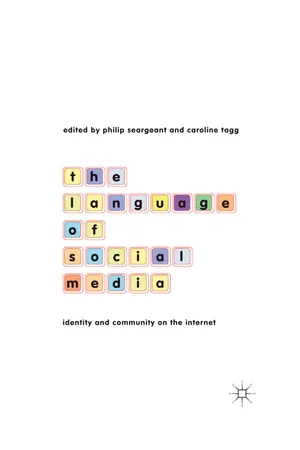
eBook - ePub
The Language of Social Media
Identity and Community on the Internet
- English
- ePUB (mobile friendly)
- Available on iOS & Android
eBook - ePub
The Language of Social Media
Identity and Community on the Internet
About this book
This timely book examines language on social media sites including Facebook and Twitter. Studies from leading language researchers, and experts on social media, explore how social media is having an impact on how we relate to each other, the communities we live in, and the way we present a sense of self in twenty-first century society.
Information
Topic
Lingue e linguisticaSubtopic
LinguisticaThe Performance of Identity on Social Media
1
The performance of a ludic self on social network(ing) sites
Ana Deumert
Cyberspace is often anarchic, playful and even carnivalesque.
Brenda Danet, Cyberpl@y (2001, p. 8)
1 Introduction
This chapter explores contemporary social network(ing)1 applications as a space for the performance of a ludic self and the carnivalesque. Although digital media are also used for serious, information-focused communication, many interactions appear to follow the broad conversational maxim of ‘keep it light/fun’, and as such these media have become a vehicle for what the philosopher Jos de Mul (2005) has called ‘ludic self-construction’, that is, they provide a space in which we relate to ourselves and others in a playful manner.
That there is a ‘primacy of play’ in digital communication was argued already more than ten years ago by Brenda Danet in her book Cyberpl@y (2001), and the concept of play has been productive in a range of publications (e.g. Rao, 2008; Chayko, 2009; McIntosh, 2010; an important early study is Baym, 1995). This playfulness is visible in the types of interactions people engage in online – they play games, joke, flirt, or just hang out with one another – as well as in the language and multimodal imagery they use.
The chapter is structured as follows: Section 2 describes de Mul’s notion of ludic identity, and explores possible reasons for the pervasiveness of a play frame in digitally mediated interactions. Sections 3 and 4 discuss examples of playful performances in a range of social network(ing) applications: internet relay chat (IRC), Twitter, Facebook, and MXit, a South African mobile instant messaging service. The broad theoretical perspective which underlies the argument is based on the work of the Russian language philosopher Mikhail Bakhtin. Two of his theoretical concepts will be central to the discussion: heteroglossia and the carnivalesque.2 The chapter concludes with a brief reflection on Roy Oldenberg’s (1996/7) notion of a third space: are digital spaces the twenty-first century equivalent of the tavern, the café, the street corner?
The data presented come from ongoing work in South Africa, a strongly multilingual and multicultural ‘new’ democracy. Problems with digital infrastructure notwithstanding, growth of social network(ing) applications has been rapid across Africa. Facebook is among the top sites on the continent and mobile access is common (Deumert, forthcoming). The broad appeal of these applications is illustrated by a study which looked at internet usage in two remote villages in Southern Africa: Macha in Zambia, and Dwesa in South Africa. In both villages, a wireless network had been installed as part of a development project. Social network(ing) applications were the top sites accessed and more than two-thirds of (interviewed) villagers had accounts on Facebook (Johnson et al., 2011). What is it that makes social network(ing) applications so attractive to people in Africa and across the world? I will argue that such applications allow people not only to stay in touch with one another (social connectedness), but also provide a much needed space to interact with one another in an informal, playful and enjoyable manner.
2 A ludic state of mind
Jos de Mul (2005) has drawn on Paul Ricoeur’s (1992) theory of narrative self-construction to develop his idea of ludic self-construction in new media contexts. Ricoeur’s work is based on the fundamental insight that we don’t have access to our ‘selves’ through mere introspection, rather we come to know about us through mediation: we construct an image of who we are – for others and for ourselves – through the way we act, move and dress, the music we enjoy, the food we eat, the beliefs we hold, and the stories we tell. We might, for example, tell stories in which we overcome obstacles, and appear victorious and strong. And as we tell such stories we also project ourselves as a particular persona: we will not speak with a soft voice, huddled in the corner of an armchair, but we will be assertive in our demeanour, that is, our voice and body language (see also Wortham, 2000). Speaking about ourselves thus makes us into a particular person, and can transform the way we feel about ourselves. For Ricoeur, telling a story is a dramaturgical event, and the notion of a plot is central. That is, narrators try to establish a storyline, which brings together the varied and poly-interpretable elements of their past experiences into ‘a series of mutually connected and motivated actions’ (de Mul, 2005, p. 254).
De Mul, whose work focuses on computer games, is critical of Ricoeur’s conception of narrativity and his emphasis on a cohesive, continuous, and ultimately concordant, plot. Linear and coherent narratives, typically characterized by a single authoritative voice, are certainly important building blocks for our identities. However, just as important for the formation of self are multilinear plots, lack of closure (i.e. the absence of a Freudian end-pleasure), and interactivity. De Mul calls identities based on the latter processes, ludic identities. Whereas narrative identities are oriented towards the past and coherence, ludic identities are oriented towards the future and the multiple possibilities of being.
Whereas in the case of narrative identity the predominant tendency is toward an increase of closure and thus concordance [...] in the case of ludic identity the predominant tendency is an increase of openness. [...] A possible objection could be that life is no game, but we could formulate an analogue answer as Ricoeur did in reply to the critique that life is no story. Just because our life is no game, not always joyful and full of possibilities, we need games to oppose the continuous threat of closure. And just as in the case of narrative identity, ludic identity is a creation of our imagination that creates real life effects in our daily lives. (De Mul, 2005, pp. 260–1; see also Ibarra & Petriglieri, 2010).
The ability to make interactive choices – i.e. choices which lead to feedback from the computer program and/or those who are engaging with us via the program – is an important aspect of online engagement. Every time we log onto Facebook we experience the volitional dimension of who we are: we might receive a comment to which we respond in turn, play a game or fill in a quiz, open the chat window, approve a friend request, post a photo, comment on a photo in which someone we know has been tagged, and so forth. Interactivity in this sense is more than interaction. It simultaneously refers to:
(a) our ability to change what is represented online, not merely to read or consume it (Cameron, 1995), and
(b) the fact that we do so in a social context where we are always also responding to others and their representations.
(b) the fact that we do so in a social context where we are always also responding to others and their representations.
The dual interactivity of online interaction facilitates a playful, experimental, yet social, state of mind, and the online space becomes ‘a playing field that enables us to (re)configure all kinds of different worlds’ through our actions and interactions (De Mul, 2005, p. 262). The shift from consumption to dialogic production is at the heart of Web 2.0, the participatory web, and the openness it creates is essential to the articulation of a ludic self.
However, playfulness is not solely a consequence of the medium and its affordances, that is, the vast array of actions it makes possible. It is also part of the history of the internet: the early days of the internet were not only characterized by the dominance of a particular language (i.e. English), but also by a particular cultural slant: the subculture of programmers. A central characteristic of this subculture is a broadly playful mood, with a particular focus on manipulating linguistic material for aesthetic and intellectual pleasure:
Hackers,3 as a rule, love wordplay and are very conscious and inventive in their use of language. These traits seem to be common in young children, but the conformity-enforcing machine we are pleased to call an educational system bludgeons them out of most of us before adolescence. Thus, linguistic invention in most subcultures of the modern West is a halting and largely unconscious process. Hackers, by contrast, regard slang formation and use as a game to be played for conscious pleasure. (The Jargon File, 2004; see also Danet, 2001, p. 26ff. for examples).
The hacker subculture, which shows important overlaps with the gaming community, has thus played a central role in establishing a general ludic mood in the digital world from its inception. This has resulted in a situation where certain types of action are favoured over others, thus contributing to the ritual construction of the internet as a place of enjoyable and playful interaction (Rao, 2008; Raessens, 2006).
Recent developments in computer gaming also need to be mentioned in this context. Play has often been seen as standing in opposition to the routine of everyday life, occurring only in specific spaces and at specific times. Following Johan Huizinga (1955), some game researchers have described this space using the metaphor of a ‘magic circle’, that is, a play area or playground, where the normal rules of behaviour are suspended. However, this ‘magic circle’ is not a separate space which is hermetically sealed off from everyday life: its boundaries are always porous, ‘variously punctuated by the demands of “real” life’ (Moore, 2011, p. 376). This permeability has become even more pronounced with the proliferation of mobile technologies and the convergence of social network(ing) and ‘casual’ – as opposed to ‘hard-core’ – gaming applications (Juul, 2010). These casual games have relatively simple rules, are flexible and do not require the long-term engagement typical of hard-core gaming: they can be played in-between meetings, on the bus, or while waiting at the doctor’s surgery. Since 2008, social network(ing) sites such as Facebook have begun to provide a wide range of deeply social (i.e. interactive and multiplay) gaming applications (e.g. Farmville, developed in 2009) as well as props for social play (poking, quizzes). As a consequence, being on Facebook is becoming more and more ‘like a game’:
On Facebook life is a game. Although participants can open chat windows or belong to special interest groups of a more serious nature, the daily drivers of Facebook exchanges are games and quizzes. As technology mediates more and more of our daily social exchanges, the forms of our interaction change. Gaming – light, breezy and fun interactions with friends near and far – keeps ties without being burdensome. (McClard & Anderson, 2008, p. 12).
As we engage in this playful mode, we mobilize (and desire) a particular type of self, as well as a particular set of social relations: light-hearted and creative, enjoyable and full of possibilities. That is, how we communicate (through text, sounds and images), conveys important information about who we are, how we want to be seen, and how we perceive the world. And we follow conversational maxims which are different from those at work in non-playful encounters: truth, relevance and clarity are no longer required for communicative cooperation (see Grice, 1975, for the original formulation of these maxims which define the canonical, proto-typical norm for successful social interactions). In much digital communication, obscurity and ambiguity are licensed, relevance a matter of choice, and truthfulness at times unnecessary. What matters is amusement, laughter and creative enjoyment, or in the words of web designer Jonathan Follett (2007), ‘pure fun’ and ‘interactive silliness’. This is not to say that we do not use social network(ing) applications for more serious communication and that truthfulness never matters; it obviously does since many of our online friends are people with whom we also interact offline. However, there is a broad tendency towards the humorous (even when we discuss serious issues), and playful exaggeration (as in the following Facebook status update from an academic colleague: ‘Suffering from flu and footnotes’, 2012).
3 Playful performances: poetic, dramatic and heteroglossic
Internet relay chat, a popular protocol for real-time (synchronous) internet text-messaging, is one of the early genres of social network(ing). In October 2008, we conducted two chat experiments at the University of Cape Town: in each experiment, five speakers (in their early 20s, both male and female) were connected to a chat program (mIRC) which allowed them to interact with one another in a specifically created chat room.4 One group was bilingual Afrikaans/English, the other isiXhosa/English. Some participants knew each other informally from lectures, others had never met, none were close friends. Both groups were free to speak about whatever they wanted, in whatever language they wanted, during the two-hour session. The only instruction they received was: ‘log on and see what happens’. They were also free to engage with other online activities – such as sending emails or searching the web. Multitasking, a central feature of online language use (see Baron, 2008, pp. 36ff.), was thus permitted. Although the experimental set-up created a somewhat artificial situation initially, this was overcome quickly since participants were not asked to do something they never do, but instead were asked to engage in an everyday practice (albeit in a controlled setting).
What happened? What did the participants choose to do? They did indeed check their emails, read the news and even sent inquiries to prospective employers. Yet, they also talked, for two hours, non-stop, and some hardly wanted to leave when the time was up. In the words of two of the participants, young women in their early 20s:
Loved it, absolutely loved it, oh my goodness, the best two hours I’ve had in the past four weeks! It was fun! I was so much like, chat is one of the best things for me, randomly fabulous, there we go! Everything was just f...
Table of contents
- Cover
- Title
- Copyright
- Contents
- List of Figures and Tables
- Notes On Contributors
- Introduction: the Language of Social Media
- Part I The Performance of Identity On Social Media
- Part II The Construction of Community On Social Media
- Index
Trusted by 375,005 students
Access to over 1.5 million titles for a fair monthly price.
Study more efficiently using our study tools.
Frequently asked questions
Yes, you can cancel anytime from the Subscription tab in your account settings on the Perlego website. Your subscription will stay active until the end of your current billing period. Learn how to cancel your subscription
No, books cannot be downloaded as external files, such as PDFs, for use outside of Perlego. However, you can download books within the Perlego app for offline reading on mobile or tablet. Learn how to download books offline
Perlego offers two plans: Essential and Complete
- Essential is ideal for learners and professionals who enjoy exploring a wide range of subjects. Access the Essential Library with 800,000+ trusted titles and best-sellers across business, personal growth, and the humanities. Includes unlimited reading time and Standard Read Aloud voice.
- Complete: Perfect for advanced learners and researchers needing full, unrestricted access. Unlock 1.5M+ books across hundreds of subjects, including academic and specialized titles. The Complete Plan also includes advanced features like Premium Read Aloud and Research Assistant.
We are an online textbook subscription service, where you can get access to an entire online library for less than the price of a single book per month. With over 1.5 million books across 990+ topics, we’ve got you covered! Learn about our mission
Look out for the read-aloud symbol on your next book to see if you can listen to it. The read-aloud tool reads text aloud for you, highlighting the text as it is being read. You can pause it, speed it up and slow it down. Learn more about Read Aloud
Yes! You can use the Perlego app on both iOS and Android devices to read anytime, anywhere — even offline. Perfect for commutes or when you’re on the go.
Please note we cannot support devices running on iOS 13 and Android 7 or earlier. Learn more about using the app
Please note we cannot support devices running on iOS 13 and Android 7 or earlier. Learn more about using the app
Yes, you can access The Language of Social Media by P. Seargeant, C. Tagg, P. Seargeant,C. Tagg in PDF and/or ePUB format, as well as other popular books in Lingue e linguistica & Linguistica. We have over 1.5 million books available in our catalogue for you to explore.