eBook - ePub
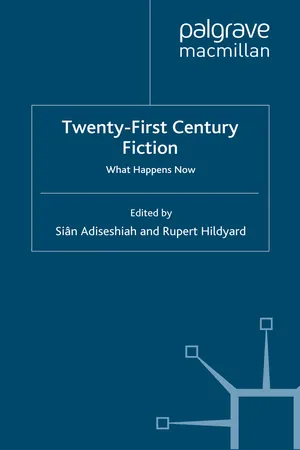
Twenty-First Century Fiction
What Happens Now
- English
- ePUB (mobile friendly)
- Available on iOS & Android
eBook - ePub
About this book
This lively new volume of essays examines what happens now in 21st century fiction. Fresh theoretical approaches to writers such as Salman Rushdie, David Peace, Margaret Atwood, and Hilary Mantel, and identifications of 21st-century themes, tropes and styles combine to produce a timely critical intervention into genuinely contemporary fiction.
Information
1
Introduction: What Happens Now
Twelve years into the twenty-first century, we are at a point when reflection on what is happening now in fiction published in Britain in the new century is possible and indeed offers a unique critical opportunity. The first decade of the 2000s has been remarkable for its literary creativity and diversity. The peculiarly rich features of twenty-first century writing include not only the implications of beginning a new century, but also the particularly potent symbolic evocations that arise from the turn of the millennium. In addition to millennial and post-millennial discourses, the catastrophic events of 9/11, the War on Terror, and the 2008 financial crash and its aftermath have created a new political context that is already generating an abundance of creative and critical writing. And around these human conflicts looms the gathering response of the non-human world we share to the accumulated and accelerating impact of our species. This concatenation of events may be moving both literary fiction and academic criticism beyond the postmodernism associated with the neo-liberal politics of the last thirty years and driving a search for new forms, tropes and theoretical strategies to envisage new horizons of possibility. The essays in this collection reflect the vitality of research on contemporary writing and include a variety of contemporary themes, contexts and approaches such as utopianism; trauma studies; contemporary Gothic; twenty-first century science fiction; posthumanism; new realisms; and neo-Victorianism.
The reader may already have registered how the subtitle of this collection, ‘What Happens Now’, hovers with deliberate ambivalence between the declarative and the interrogative: between celebratory exploration of what is happening now and the uncertainty or dread of what might be coming to us. But it is also intended to echo the revolutionary questions posed by Lenin and Trotsky at the beginning of the last century: ‘What is To Be Done?’ (Lenin, 1989), ‘Where is Britain Going?’ (Trotsky, 1970), or indeed to invoke Paul Gauguin’s questions asked by his 1897 painting, ‘Where do we come from? What are we? Where are we going?’ It is, perhaps, not surprising that similar questions are being asked a century later as both moments are more than superficially comparable, not least in that they share intensive technological developments that remould social experiences, and manifest symptoms of recognition about moving beyond the recognisable ‘now’. We will return to the reverberations of that moment through a discussion of modernism later. The essays in this collection bear witness to the challenge to remake the human understanding of the world that is involved both in serious critical work and in literary writing itself. A sense of the uncontrollability and uncertainty of the contemporary world we live in is apparent in much of the fiction discussed in these essays. Each of the critics in one way or another seeks to respond to the attempt of writers to uncover or defamiliarise the discursive structures of that very contemporary and seemingly ubiquitous predicament.
It is a contemporary predicament in obvious ways. It may be the case that commentators and critics in the West have been claiming to see moments of unprecedented crisis virtually every year since 1945, while living through what seems now one of the most secure and stable economic and political period available to history. But perhaps things really have changed in the twenty-first century – not just because of the latest nightmares of history: 9/11, environmental catastrophe, peak oil, financial collapse, the neo-liberal dismembering of the social democratic settlement – but because of the continuing hollowing out of human cultures and economies by the processes of globalisation, consumerism and marketisation. The integuments of meaning woven by family, gender, community, class, place, politics, religion, nation, even nature have been burst asunder, in the West at least, by the acceleration of technology, communication and globalisation. Is the autonomous individual central to liberal humanism anything more in the twenty-first century than the subject produced by mediatisation, consumerism and the work regime-digital surveillance? That might be one question which literary criticism exists to ask.
At the same time, there is evidence of an emerging appetite to (re)discover new forms of agency – and there is some basis for this too in the texts under consideration in these essays. One effect of 9/11 was to shatter the ‘end of history’ thesis. The moral high ground claimed by the West since the fall of Soviet Communism has unquestionably been undermined; estimates of over half a million Iraqi deaths resulting from the 2003 intervention, the criminal ongoing presence of the prison camps in Guantanamo and the continuing debacle in Afghanistan have turned toxic the ethical pretensions of neo-liberalism. The common sense view that the free market is the most efficient and democratic way of organising our economic life has been undermined by the bankruptcy of free market ideology and practice in 2008. Opposition to the cuts imposed by the Conservative/Liberal Democrat coalition (student demonstrations, the Occupy Movement, strikes, riots) as well as one million plus protesters marching on the streets of London against the Iraq War in February 2003, not to mention the popular opposition across Europe to the austerity programmes dictated by the international capitalist order seem evidence that ‘powerlessness’ is not the sum total of what people are feeling. China Miéville is only one of several to charge ‘litfic’ with being ‘insular, socially and psychologically hermetic, neurotically backslapping and self-congratulatory about a certain milieu’ (2011). And it is probably true that in this collection, the more explicit engagements with power, agency and political critique come from the essays on genre fiction writers, such as Miéville himself, Iain Banks, Glen Duncan, David Peace, Margaret Atwood, Michel Houellebecq and Sarah Hall. But even the dystopian sensibility that pervades much literary fiction, including novels like Ali Smith’s Hotel World, Trezza Azzopardi’s Remember Me, Rachel Seiffert’s ‘Micha’ or John Burnside’s Glister, carries with it an unmitigated utopian yearning for the ‘not-yet’ of a better future.
Naming the twenty-first century
This collection of essays on fiction published since 2000 began with the conviction that it was time to discard the loose appellation ‘contemporary literature’ and define what we want to talk about more tightly: the literature of the twenty-first century. Whereas ‘contemporary literature’ is too often used as an elastic definition stretching in some cases as far back as 1945, and almost always includes texts published well before (most) current undergraduates were born, twenty-first century literature is genuinely contemporary and clearly and unambiguously defined. Where even a relatively recent period like the 1980s has already settled into sets of predetermined critical patterns, ‘twenty-first century’ fiction necessarily focuses attention on what is distinctive about current writing and offers a unique opportunity to write and shape the new period. Of course it is an arbitrary boundary and as the twenty-first century progresses, the character of twenty-first century literary studies will change – its contemporaneity will be diluted, the body of work will expand, critical positions will emerge – but that is part of the automotive process of literary historiography that can be left to later critics and scholars. The crucial point is that research in the field of twenty-first century fiction is already rich, diverse and abundant, but is as yet largely unreported and unrepresented in academic discussion. With over twelve years’ worth of fiction to analyse and evaluate, the time is right to start the discussion of the distinctive features and significant developments of twenty-first century fiction.
What happens now
Perhaps inconveniently – given our attempts to discuss what is happening now and where we might be heading – Bruno Latour states, ‘If there is one thing that has vanished, it is the idea of a flow of time moving inevitably and irreversibly forward that can be predicted by clear-sighted thinkers’:
Actually, it is the time of time that has passed: this strange idea of a vast army moving forward, preceded by the most daring innovators and thinkers, followed by a mass of slower and heavier crowds, while the rearguard of the most archaic, the most primitive, the most reactionary people trails behind. … This huge warlike narrative was predicated on the idea that the flow of time had one – and only one – inevitable and irreversible direction. (2010, p. 472)
If the flow of time is multilinear, reversible and open, this problematises the hunt for a new cultural dominant, a new critical episteme, a post-postmodernism. The postmodern project itself certainly seems to have been discredited. A growing consensus is critical of its paralysing self-reflexivity, knavish use of irony and the ludic, and relativistic approach to historiography, none of which inspired much confidence in its capacity to usefully address the serious and urgent problems of the late twentieth century. Amongst the new mo(ve)ments announced in its wake are Nicolas Bourriaud’s ‘alter-modernism’, Timotheus Vermeulen and Robin van der Akker’s ‘metamodernism’, Raoul Eshelman’s ‘performatism’, Gilles Lipovestsky’s ‘hypermodernity’ and Alan Kirby’s ‘digimodernism’. The extent to which any of these develop into influential critical frameworks remains to be seen, but it is significant that ‘modernism’ is included in most of these new labels – and so modernism, once again, demands attention.
Modernism
The question is whether modernism remains a crucial reference in any literary cartography of the twenty-first century. Is modernism (and above all, for fiction, the work of James Joyce) still the dominant influence (in Harold Bloom’s sense) on the novel a hundred years after or has this particular anxiety-causing precursor been creatively escaped? There is after all a strong case for saying the techniques and inventions of the modernist writers such as interior monologue and stream of consciousness are now thoroughly absorbed into the mainstream of literary fiction. The techniques used by Joyce, Woolf, Kafka or Proust have transformed fiction but they no longer retain the power to shock.
Of all the challenges to literary tradition mounted by modernism, the most radical, powerful and fundamental has always been the apparent rejection of narrative, storytelling, itself. But this rejection of story was always more apparent than real: now we have learnt to read them it is easy to see that texts like Ulysses and Mrs Dalloway remain stories just as seductive as Middlemarch or Anna Karenina. It can be argued that only Samuel Beckett succeeded in making genuine anti-narrative into a successful reflection on narrative, and it is no accident that his work developed into drama: it went beyond the novel. His successors have tacitly accepted that storytelling remains essential to the novel, and this includes those recent writers promoted by critics as the avant-garde such as David Foster Wallace, Don DeLillo, W. G. Sebald, J. M. Coetzee, Will Self and Tom McCarthy.
On the other hand the authority of modernism in the literary imagination remains powerful. One of the most persuasive literary histories in recent years is Gabriel Josipovici’s What Ever Happened to Modernism? (2010) which (supposedly)1 contrasts the achievements of high modernism with the weakness of contemporary novelists like Julian Barnes, Ian McEwan and Martin Amis. Other writers, like Zadie Smith in her November 2008 article ‘Two Sorts of Novel’ and more recently, China Miéville and Will Self, have declared their allegiance to modernist principles, to a radicalism that is both formal and in the widest sense political. In an article in the Guardian, Self attacks what he sees as middle-brow, realist, literary fiction:
To write ‘jolly good reads’ with a beginning, middle and an end – including almost mandatory redemption for a previously morally vacillating protagonist – is the very stuff of books, just as it’s the stuff of life in this right little, tight little island.2 (2012, p. 3)
Zadie Smith brings out how this ‘mandatory redemption’ (she calls it transcendentalism) she discovers in what she calls ‘lyrical realism’ shows its metaphysical politics. The exploration of subjectivity (usually white, middle-class, male) and the transcendence to which it too inevitably leads, is the main target in her 2008 polemic on the different paths open to the literary novel. As she puts it, in the sort of books she labels lyrical realism (Joseph O’Neill’s Netherland is her example) ‘only one’s own subjectivity is authentic, and only the personal offers this possibility of transcendence, this “translation into another world”’ (2008). It is this inauthentic pursuit of authenticity that Smith sees as characteristic of the conventional literary novel and she identifies it with the crisis of the Anglo-American liberal middle class. By the search for authenticity she means the literary attempt to contain and represent (and then transcend) the brute materiality of the world, ‘the thing beyond the pale, the inconvenient remainder impossible to contain within the social economy of meaning’ – behind which lies the mortality that lyrical realism seeks to suppress. As she puts it later, ‘we are all death-marked creatures, defined by matter – though most of us most of the time pretend not to be’ (2008).
Realism
This remark might seem to take us into metaphysical territory but actually brings us back to realism. Realism remains an essential – if slippery as ever – categorisation of modes of writing, not least for the reasons implicit in the title of David Shields’ manifesto for non-fiction and boundary-blurring Reality Hunger (2010). Here, Shields contends twenty-first century experience is not adequately represented in mainstream realist fiction and makes a militant demand for life writing, the essay, and other forms that claim a more authentic engagement with the real than literary fiction. There is also the earlier New Puritan Manifesto of 2000, proposed by Nicholas Blincoe and Matt Thorne in their volume of short stories (All Hail the New Puritans, Fourth Estate, 2000) written by a range of emerging postmillennial writers, including Scarlett Thomas, Geoff Dyer and Toby Litt. This Manifesto sets itself against the deviceful writing of the ‘well-made’ novel and calls for a commitment to the real, for texts to be ‘set in the present day’ and ‘to avoid all improbable or unknowable speculation about the past and future’ and for ‘texts [to] feature a recognisable ethical reality’ (2000).
While Zadie Smith takes issue with ‘giv[ing] up on the imaginative novel’ (2010), at the same time she identifies the writers she admires (for example Georges Perec, Michel Blanchot, William Burroughs, and J. G. Ballard) with a sort of materialist modernism, a modernism cognisant of the hunger for the real, one filled with ‘pure facticity, which keeps coming at you, carrying death, leaving its mark. Everything must leave a mark. Everything has a material reality. Everything happens in space’ (2008). Josipovici makes a similar point in arguing that the essence of the modernist tradition (which he traces back to Aeschylus, Cervantes and Wordsworth as well as more predictable figures like Sterne, Kafka and Beckett) lies in its awareness and foregrounding of the limitations of art and representation, and especially of realist mimesis. Rather than simply subduing the reader with the enchantment of fiction, modernist writing explores what it means to write by making the reader aware of the limitations, falsities, doubts and confusions that are involved in the act of writing, the spell of narrative. Modernist fiction (like the best poetry) is marked by its consciousness of the limits of language.
This might seem both metaphysical again and purely formalist but as Smith’s and Self’s polemics suggest it connects with the political assumptions behind realist fiction. Some time ago Andrzej Gąsiorek exposed the pitfalls of formalist approaches to realism, approaches that reduced realism to a set of stylistic conventions underpinned by a conservative ideological outlook. Gąsiorek helpfully talks about realism in similar terms to Smith’s and Josipovici’s views of a modernist-inflected realism, as ‘internally fissured, frequently conscious of its own contradictions, and constantly mutating into new forms’ (1995, p. 13). Indeed, while Smith is generally critical of lyrical realism’s mellifluous transcendence of materiality and its ‘consoling myth [that] the self is a bottomless pool’, she nevertheless concedes that Netherland, to its credit, ‘has some consciousness of these arguments, and so … is an anxiou...
Table of contents
- Cover
- Title
- Copyright
- Contents
- Notes on Contributors
- Chapter: 1 Introduction: What Happens Now
- Chapter: 2 Such a Thing as Avant-Garde Has Ceased to Exist’: The Hidden Legacies of the British Experimental Novel
- Chapter: 3 Tough Shit Erich Auerbach: Contingency and Estrangement in David Peace’s Occupied City and Kate Summerscale’s The Suspicions of Mr Whicher
- Chapter: 4 When the Two Sevens Clash: David Peace’s Nineteen Seventy-Seven as ‘Occult History’
- Chapter: 5 Remaindered Books: Glen Duncan’s Twenty-First Century Novels
- Chapter: 6 The journey creates us. We become the frontiers we cross’: Stepping Across Lines in Salman Rushdie’s Shalimar the Clown
- Chapter: 7 The Private Rooms and Public Haunts’: Theatricality and the City of London in Michel Faber’s The Crimson Petal and the White
- Chapter: 8 This is my Opa. Do you remember him killing the Jews?’ Rachel Seiffert’s ‘Micha’ and the Transgenerational Haunting of a Silenced Past
- Chapter: 9 A Voice without a Name: Gothic Homelessness in Ali Smith’s Hotel World and Trezza Azzopardi’s Remember Me
- Chapter: 10 Ghosts of Postmodernity: Spectral Epistemology and Haunting in Hilary Mantel’s Fludd and Beyond Black
- Chapter: 11 Intimations of Immortality: Semiologies of Ageing and the Lineaments of Eternity in Contemporary Prose
- Chapter: 12 Crosshatching: Boundary Crossing in the Post-Millennial British Boom
- Chapter: 13 You just know when the world is about to break apart’: Utopia, Dystopia and New Global Uncertainties in Sarah Hall’s The Carhullan Army
- Chapter: 14 Finding the Right Kind of Attention: Dystopia and Transcendence in John Burnside’s Glister
- Select Bibliography
- Index
Trusted by 375,005 students
Access to over 1.5 million titles for a fair monthly price.
Study more efficiently using our study tools.
Frequently asked questions
Yes, you can cancel anytime from the Subscription tab in your account settings on the Perlego website. Your subscription will stay active until the end of your current billing period. Learn how to cancel your subscription
No, books cannot be downloaded as external files, such as PDFs, for use outside of Perlego. However, you can download books within the Perlego app for offline reading on mobile or tablet. Learn how to download books offline
Perlego offers two plans: Essential and Complete
- Essential is ideal for learners and professionals who enjoy exploring a wide range of subjects. Access the Essential Library with 800,000+ trusted titles and best-sellers across business, personal growth, and the humanities. Includes unlimited reading time and Standard Read Aloud voice.
- Complete: Perfect for advanced learners and researchers needing full, unrestricted access. Unlock 1.5M+ books across hundreds of subjects, including academic and specialized titles. The Complete Plan also includes advanced features like Premium Read Aloud and Research Assistant.
We are an online textbook subscription service, where you can get access to an entire online library for less than the price of a single book per month. With over 1.5 million books across 990+ topics, we’ve got you covered! Learn about our mission
Look out for the read-aloud symbol on your next book to see if you can listen to it. The read-aloud tool reads text aloud for you, highlighting the text as it is being read. You can pause it, speed it up and slow it down. Learn more about Read Aloud
Yes! You can use the Perlego app on both iOS and Android devices to read anytime, anywhere — even offline. Perfect for commutes or when you’re on the go.
Please note we cannot support devices running on iOS 13 and Android 7 or earlier. Learn more about using the app
Please note we cannot support devices running on iOS 13 and Android 7 or earlier. Learn more about using the app
Yes, you can access Twenty-First Century Fiction by S. Adiseshiah, R. Hildyard, S. Adiseshiah,R. Hildyard in PDF and/or ePUB format, as well as other popular books in Literature & Literature General. We have over 1.5 million books available in our catalogue for you to explore.