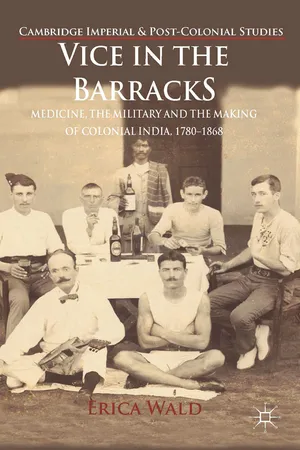
Sex and alcohol preoccupied European officers across India throughout the nineteenth century, with high rates of venereal disease and alcohol-related problems holding serious implications for the economic and military performance of the East India Company. These concerns revolved around the European soldiery in India – the costly, but often unruly, 'thin white line' of colonial rule. This book examines the colonial state's approach to these vice-driven health risks. In doing so it throws new light on the emergence of social and imperial mindsets and on the empire, fuelled by fear of the lower orders, sexual deviation, disease and mutiny. An exploration of these mindsets reveals a lesser-explored fact of rule – the fractured nature of the Company state. Further, it shows how the measures employed by the state to deal with these vice-driven health problems had wide-ranging consequences not simply for the army itself but for India and the empire more broadly. By refocusing our attention on to the military core of the colonial state, Wald demonstrates the ways in which army decision-making stretched beyond the cantonment boundary to help define the state's engagement with and understanding of Indian society.
eBook - ePub
Vice in the Barracks
Medicine, the Military and the Making of Colonial India, 1780-1868
- English
- ePUB (mobile friendly)
- Available on iOS & Android
eBook - ePub
About this book
Shortlisted for the 2014 Royal Historical Society's Gladstone Prize and the 2014 Templer Award for the Best First Book by a New Author.
Information
1
The East India Company, the Army and Indian Society
By the time S. M. Edwardes wrote Crime in India in 1924, the widely held belief among his contemporaries was that ‘prostitution had existed in India from time immemorial’ and, further, that a specific prostitute ‘caste’ could be clearly identified.1 As late as the Second World War, regulations were in place that targeted the ‘habitual spreader of venereal diseases’ – the brothel prostitute – instead of acknowledging the male soldiers’ role in transmission.2 These sentiments had become closely interlinked. Yet until the early nineteenth century, monogamous relationships between European men and Indian women were common and prostitution in India, where it existed, was not viewed with the same venomous distaste as displayed in later years. The move away from official approval (or at the very least, toleration) of these long-term relationships towards encouraging the short-term liaisons that prostitutes provided, was closely linked. What follows is an exploration of these two transformations. Neither represented a ‘natural’ shift, but instead were shaped violently, moulded by the demands and fears of East India Company administrators, army officers, medical surgeons and evangelical missionaries.
This shift was closely linked to officers’ and administrators’ perception of their own European rank and file. This understanding placed the men at the very bottom of an imagined, moral hierarchy. Indeed, as late as the twentieth century, the recruits of the eighteenth century were looked back upon as the ‘scum’ of the nation, a rowdy assortment of reprobates, drunkards and pickpockets thrown together with the labouring poor who completed their ranks.3 In fact, labourers composed the majority of troops and, as Stanley has pointed out, there was a certain degree of respectability associated with service in the Company’s army.4 However, in the vision of the officers and administrators who made vast pronouncements on the men, this fact was largely disregarded. It was a fear of potentially upsetting the men – provoking not only their ire, but raising the spectre of possible mutiny, which, combined with the very real and pressing fiscal dilemmas which the East India Company faced in the late eighteenth century that informed military and medical responses to venereal disease control.
The army’s attitude towards its own soldiers changed very little over the course of the nineteenth century. Among Company officials, the prevailing view of the soldiers as low-class and ‘degraded’ brutes persisted. Officers saw the men as volatile and violent and, as such, believed them to require careful handling. The men’s supposed sexual ‘needs’ were one facet of their presumed character that merited careful attention. Army officials assumed that in the absence of a wife, an alternative would need to be found to satisfy the soldier’s sexual wants and urges. Without such a ‘release’, it was feared that the men would otherwise resort to ‘dangerous’ or ‘deviant’ sexual behaviour – masturbation or homosexuality, in addition to rape or assault. The women living in and around the camps who served as prostitutes would form a large part of this ‘solution’. Yet rising levels of venereal disease among the men soon complicated this situation.
This chapter begins with a brief exploration of the development of the Company armies in India. It pays particular attention to the growth of the European contingent within these forces as the Company’s political and territorial power grew in the eighteenth century. While an unflattering view of the common soldier was certainly not unique to Company officials, this view fit particularly well with the overall ethos of the Company, who, led by profit, sought to maintain power and trade in India as cheaply as possible. As such, as Company rule spread and further expense was required, it was uninterested in any investment in the European soldiers except that which was absolutely necessary. Dealing with the men as ‘degraded’ and morally irredeemable and instead seeking to marshal their brute strength was the shrewd, more economical option that both Company and Crown chose to pursue. The low pay and benefits the soldier received as well as the restrictions imposed on those who surrounded him were perfectly in keeping with this unwritten policy.
An exploration of the interlinked issue of the relationships that existed between European soldiers and officers and Indian women in the late eighteenth and early nineteenth centuries follows. These relationships, while initially encouraged by the Company, would come to be seen as a burden and were accordingly discouraged. This transition was not simply the result of changing racial attitudes in metropolitan Britain; instead, it materialised as a result of very specific factors in India and London. After 1800, wary of having to provide for the ever-expanding families of its soldiers, the Company began to discourage the provision of allowances and pensions for the wives and children of soldiers. Racial difference provided one convenient excuse for paying these companions less money, or indeed, none at all. There were some officials who argued that supporting Indian wives and mistresses made sound economic sense. They asserted that Indian wives and mistresses should be encouraged as they provided the much-needed ‘comforts of home’, such as improved diet and greater attention to dress, and engendered soldiers who were healthier and better disciplined than their unattached peers. Accordingly, for much of the nineteenth century, this transformation of relationships was uneven. However, by the century’s end it was almost entirely complete and Indian companions were relinquished in favour of ‘regulated prostitutes’.
Desperate to ensure that venereal disease did not fatally weaken the army’s defensive capabilities, regimental surgeons sought inexpensive methods of treatment and prevention for syphilis and gonorrhoea which would have the least impact on the men. The system of regulated prostitution was the product of these fears. Supporters of this system argued that it would reduce venereal disease by providing the men with a ‘healthy’ pool of women who were closely monitored for any signs of disease. By this system, surgeons hoped to minimise the number of men rendered unfit by instead shifting the burden and risks associated with treatment to this group of women. What is more, it would avoid ‘provoking’ the men. However, from the start, the system failed to achieve its goals. Seeking explanations for this failure, surgeons and commanding officers pointed not only to the women under its remit, but to other women who did not fall under its net. These included dancing girls and courtesans. These groupings extended far beyond the very base ‘prostitute’ classification and did not easily conform to prevailing British models of sex and morality. Although it is unlikely that many women in these categories would have considered themselves to be of ‘ill repute’, British observers, having little to compare their roles to within British society, began to fuse them all under the misleading title of ‘prostitute’ in the 1810s and 1820s. In many ways, this transformation reflects the contemporary context of Orientalist approaches and interpretations of Indian society and traditions. As was the case with British understandings of Indian laws – Hindu or Muslim – many officials and observers adopted a flattening approach to certain Indian roles and traditions. Moreover, with limited access to certain practices, such as temple dancing, European understandings were passed down based on only the briefest glimpses of the practices under question. The medical, missionary and military targeting of such groups, combined with political and economic changes, meant that by the mid-century, these women came to be designated simply as ‘prostitutes’ by the colonial state.
This chapter suggests that the moral and medical boundaries erected in the early nineteenth century around women deemed ‘prostitutes’ paved the way for their later condemnation and criminalisation as well as dramatically re-defining their social and legal status. When the Indian Penal Code of 1860 was enacted, the Indian ‘prostitute’ was assumed to be a member of the ‘criminal’ category and targeted as such by a number of sections in the Code.5 The women’s separation from what was deemed ‘respectable’ Indian society and insertion in a ‘criminal’ category was crucial to surgeons and commanding officers’ attempts to justify the invasive and socially disruptive methods they proposed to control venereal disease among the European soldiery. Officials presented women deemed to be ‘prostitutes’ as a ‘threat’ to the military (and therefore to the Company’s overall security). To achieve their goals, military and medical officers often adopted the moralising tones of missionaries (who stressed the women’s supposedly innate immorality).
The transition from the earlier social and sexual mores, which had encouraged long-term relationships between Indian women and European men, to a more puritan emphasis on distance and control has been insufficiently interrogated and is often regarded as simply part of a broader shift towards racialist or racist constructions of colonial rule. This chapter explores some of the complexities of these new constructions, arguing that the changed view of Indian women and indeed society, which emerged in the mid-nineteenth century, was not one wholly imported from Europe. Quite the contrary, it developed in large part out of the daily interaction and tensions between European medical men and military officers on the one hand and European soldiers and Indian women on the other, surrounding a range of issues from remunerative support for wives and widows to the treatment of venereal disease.
The East India Company and its army
Formed by a group of wealthy businessmen intent on breaking the Dutch monopoly on the spice trade, the East India Company received a Royal Charter in 1600 from Queen Elizabeth I, which effectively gave it a monopoly on all British trade in the East Indies. The Company quickly began to establish trading posts (known as ‘factories’) on the coasts of India. In an effort to secure both trading and security privileges, the Company moved to form strategic alliances with Mughal rulers and a number of ‘successor’ powers.6 With the Company’s expansion in the eighteenth century, the three largest of these factories were transformed into walled forts. In turn, these forts developed into the three Presidencies from which India was administered. An assigned Company president had effective authority over Fort William in Bengal, Fort St George in Madras and Bombay Castle. Each of the presidents, or governors, oversaw the areas with the assistance of a Council, composed of senior Company servants. These Presidents ruled with relative autonomy – the aim being to oversee and protect the Company’s commercial interests in the area surrounding its factories. This degree of independence amongst the Governors of Bombay and Madras persisted even after the Regulating Act of 1773 elevated the status of Bengal over Bombay and Madras.7 By the late seventeenth century, surrounded by competitors and, at times, local rulers hostile to their presence, the Company began to develop more actively small armies to protect their interests.
The three Presidency armies had humble origins, growing from an ‘ensign and thirty men’ in Bengal, a detachment sent to garrison Bombay and, finally, the re-categorisation of factory door-keepers and soldiers into a company at Madras.8 Simply put, the earlier groups of armed guards who protected the fort and factories grew and in time transformed into the presidency armies. These mercenary forces were largely drawn from the local population in the areas surrounding the main factories. After 1754, smaller units of Crown troops joined the Company forces. The threat of hostilities with France (both in Europe and on the subcontinent) and the opportunities presented by declining Mughal power proved a potent combination that prompted the expansion of Company operations. As the Company grew and increasingly intervened in the political and military balance of power in India, the size and importance of its armies grew apace. Like the differences that persisted in the governance of the three presidencies, each of the three armies maintained distinct policies on everything from recruitment and composition to promotion and benefits. In 1796 (following simmering officer discontent that erupted into a minor mutiny over the issue of batta, or field pay), the Company introduced a series of reforms in an attempt to rationalise these variations.9 Further alterations were attempted in 1824; however, anomalies remained until the Company’s Presidency armies were absorbed into the British army after 1858.10 In a similar manner, stereotypes (and nicknames) persisted about the kind of men serving in each of the armies. The Bengal ‘Qui Hai’ was arrogant, while the Madras ‘Mull’ was lazy and the Bombay ‘Duck’ had fewer benefits and comforts than the other two.11 Petty rivalries persisted between the three armies for much of the century.
Its ‘sepoys’ – Indian troops drilled in a European style and led by European officers – comprised the bulk of the Company’s army in India.12 The French Governor-General Joseph Francois Dupleix was the first to raise sepoy battalions in southern India in 1748. The East India Company army under Major-General Stringer Lawrence followed suit a few years after.13 The Company recruited these men from regions in northern India that had historically served as military catchment areas, namely Bihar, Benares and Oudh.14 The Company also maintained a smaller contingent of European soldiers; however, for most of the period until the mid-nineteenth century, sepoys outnumbered European troops by a ratio of eight to one.15 This was largely due to the relative expense and higher susceptibility to disease of European soldiers. A 1781 letter from General Stubbert to Warren Hastings assured him that even in the most healthy seasons, an eighth of the European force was rendered unfit for service due to illness.16 In 1765, the number of sepoys employed by the British was roughly 9000; by 1808, this number had grown to over 155,000.17 By way of comparison, in 1790 the number of British forces serving i...
Table of contents
- Cover
- Title
- Copyright
- Contents
- List of Illustrations
- Acknowledgements
- Note on Transliteration, Currency and Military Ranks
- Map
- Introduction
- 1 The East India Company, the Army and Indian Society
- 2 Regulating the Body: Experiments in Venereal Disease Control, 1797–1831
- 3 Medicine and Disease in the ‘Age of Reform’
- 4 The Body of the Soldier and Space of the Cantonment
- 5 ‘Unofficial’ Responses to Lock Hospital Closure, 1835–1868
- Conclusion
- Appendix 1
- Appendix 2
- Notes
- Glossary
- Bibliography
- Index
Trusted by 375,005 students
Access to over 1.5 million titles for a fair monthly price.
Study more efficiently using our study tools.
Frequently asked questions
Yes, you can cancel anytime from the Subscription tab in your account settings on the Perlego website. Your subscription will stay active until the end of your current billing period. Learn how to cancel your subscription
No, books cannot be downloaded as external files, such as PDFs, for use outside of Perlego. However, you can download books within the Perlego app for offline reading on mobile or tablet. Learn how to download books offline
Perlego offers two plans: Essential and Complete
- Essential is ideal for learners and professionals who enjoy exploring a wide range of subjects. Access the Essential Library with 800,000+ trusted titles and best-sellers across business, personal growth, and the humanities. Includes unlimited reading time and Standard Read Aloud voice.
- Complete: Perfect for advanced learners and researchers needing full, unrestricted access. Unlock 1.5M+ books across hundreds of subjects, including academic and specialized titles. The Complete Plan also includes advanced features like Premium Read Aloud and Research Assistant.
We are an online textbook subscription service, where you can get access to an entire online library for less than the price of a single book per month. With over 1.5 million books across 990+ topics, we’ve got you covered! Learn about our mission
Look out for the read-aloud symbol on your next book to see if you can listen to it. The read-aloud tool reads text aloud for you, highlighting the text as it is being read. You can pause it, speed it up and slow it down. Learn more about Read Aloud
Yes! You can use the Perlego app on both iOS and Android devices to read anytime, anywhere — even offline. Perfect for commutes or when you’re on the go.
Please note we cannot support devices running on iOS 13 and Android 7 or earlier. Learn more about using the app
Please note we cannot support devices running on iOS 13 and Android 7 or earlier. Learn more about using the app
Yes, you can access Vice in the Barracks by E. Wald in PDF and/or ePUB format, as well as other popular books in History & British History. We have over 1.5 million books available in our catalogue for you to explore.