eBook - ePub
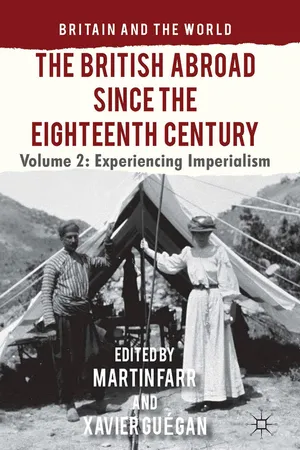
The British Abroad Since the Eighteenth Century, Volume 2
Experiencing Imperialism
- English
- ePUB (mobile friendly)
- Available on iOS & Android
eBook - ePub
The British Abroad Since the Eighteenth Century, Volume 2
Experiencing Imperialism
About this book
This is a collection of twelve interdisciplinary essays from international scholars concerned with examining the British experience of Empire since the eighteenth century. It considers themes such as national identity, modernity, culture, social class, diplomacy, consumerism, gender, postcolonialism, and perceptions of Britain's place in the world.
Information
Topic
HistoriaSubtopic
Historia británicaPart I
Establishing the Empire
1
The Roots of Empire: Early Modern Travel Collections and International Politics in the Long Eighteenth Century
Matthew Day
Sir Joseph Banks, explorer, botanist, President of the Royal Society and member of the Privy Council, was one of the late eighteenth- and early nineteenth-century architects of empire. Despite the ‘extreme aversion’ to study that he is reputed to have shown at Eton, Banks was also a great bibliophile. Indeed, his botanic interests may have been inspired by finding ‘on his mother’s dressing-table an old torn copy of Gerard’s Herbal’.1 John Gerard’s The Herball or General Historie of Plantes was first published in 1597 and, true or not, the anecdote attests to two of the Privy Councillor’s lifelong passions – botany and books – both of which served the project of empire: the former supporting trade, commerce and scientific knowledge as part of the international rivalry of the Enlightenment; the latter as repositories of information which shaped decisions about voyages of commerce, colonisation, exploration and discovery.2
The eighteenth century saw a significant increase in voyage literature, and Banks ‘bought every travel publication of any importance’ reflecting his own predilection for the subject.3 Such works sought to be both entertaining and useful, and were appropriated for a range of purposes. They assuaged and roused the curiosity of armchair travellers, were perused by those interested in the advancement of science and natural philosophy, and studied by promoters of, and participants in, further voyaging activities.4 These intellectual, philosophical, scientific and leisure readings were accompanied by those undertaken by governments and their agents engaged in imperial projects.5
The varied contribution of travel writing to imperialism has been well established. Despite detractors’ claims about the extent to which the concept of imperialism and the promotion of colonialism were both understood and taken up in early modern England, John Parker’s thesis that travel collections published in the fifteenth and sixteenth centuries sought to promote imperial activities still holds good.6 As Patricia Seed has shown, the practices of colonisation – making landfall, claiming possession and establishing a stronghold – were supplemented, asserted and evidenced by narratives of the events.7 Though some texts circulated in manuscript, publication in print facilitated the dissemination of territorial claims. Such strategies were successful: explorers, merchants, colonists and those otherwise involved in promoting imperial ventures, such as investors and government, all used published narrative accounts, as well as manuscript sources, to plan and implement their activities.8 Imperialism was a textual as well as practical phenomenon.
This chapter explores the role of textual interpretation in the imperialist venture.9 It moves away from Parker’s concern with authorial intention to look at the way texts from an earlier epoch were used in the long eighteenth century to make territorial claims and to assert navigational rights. Such an investigation is important for a number of reasons. Firstly, the rapid increase in the publication of travel narratives in the eighteenth century and the claims made within them about their currency, importance, novelty and value support Bourdieu’s thesis that a field of cultural production is a competitive environment in which new entrants seek to usurp the hegemony of earlier products.10 Yet while authors of travel narratives and compilers of voyage collections in the long eighteenth century condemned earlier works in the field, claiming their own to be at its cutting edge, readers, especially those engaged in international politics, valued earlier publications as they sought to justify their claims to territory, trading and fishing rights. Bourdieu’s thesis is helpful when thinking about cultural production, but less pertinent when considering consumption. Secondly, an examination of diplomatic memorials and documents produced by such bodies as the Board of Trade to assert claims of possession sheds light on the reading practices of an earlier age. The close reading of texts and their manipulation for imperialist ends has not been examined greatly by historians of the Board of Trade who have looked more at its structure and modus operandi than its role in supporting international negotiations with European rivals.11 Recent work on diplomacy has focused on delineating diplomatic procedure and the political and economic implications of negotiations, rather than the textual practices of administrators.12 Moreover, attending to such readings, misreadings and manipulations of texts helps us to go beyond the theoretical and jurisprudential issues delineated by John Juricek, Anthony Pagden and Patricia Seed to see the processes of international politics at work, disclosing the machinations and rhetorical manoeuvres of government.13 The focus in this chapter on the reception studies side of the hermeneutic circle thus distinguishes it from earlier investigations into the role of texts in the history of imperialism. For, whereas Juricek, Pagden and Seed draw on their understanding of authorial intention, my approach focuses on what readers actually made of these texts. In doing so it demonstrates the folly of assuming that because a text promoted the nation’s interests it was received in that way. Indeed, this study demonstrates that although governments did draw on early printed sources to promote imperialist agendas, diplomats from opposing countries frequently sought to use the writings of an enemy nation against itself. This was just one of a number of hermeneutic strategies deployed by governments in their negotiations. For, in addition to disputing the semantic meaning of texts, diplomats attacked each others’ choice and deployment of materials, challenged their reading practices and drew on such extraneous facts as the perceived availability of particular sources, their place of publication and language, and the credibility of the author in order to make their case. Ultimately, this analysis of late seventeenth- and early eighteenth-century reading reveals, on the one hand, highly sophisticated interpretations of texts which demonstrate the fissures that could exist even among the procedures and practices delineated so clearly by Juricek, Pagden and Seed, and, on the other, remarkably ill-informed misunderstandings of literature which could jeopardise the imperial enterprise.
The rise of diplomacy in the long eighteenth century involving not only issues of precedence, the increasing use of residential ambassadors and the development of a professional administrative support service to inform negotiations has been well documented.14 Fundamental to that development is what Jeremy Black has called ‘the Information Society’ in which knowledge was gathered through diplomats, agents and intercepts and from books and maps, reflecting the fact that, as Anderson has noted, international law at the end of the seventeenth and start of the eighteenth century owed much to antiquarianism.15 The acquisition of texts necessitated better storage and organisation of documents, and the creation of libraries to support administrative processes was a feature of eighteenth-century government, the French amassing an 8,000-volume library at Versailles by mid-century.16 The availability of such collections helped to make possible detailed researches and archival work which, in turn, facilitated the close examination of texts.
Two of the most important early collections of travel writing used in eighteenth-century international diplomacy were those of Richard Hakluyt and Samuel Purchas. Hakluyt’s The Principall Navigations, Voiages and Discoveries of the English Nation (1589) was reissued in a second edition as the much larger, three-volume The Principal Navigations, Voiages, Traffiques and Discoveries of the English Nation (1598–1600). Purchas took over the mantle of collector from Hakluyt, acquiring some of his documents and producing a four-volume compilation of travel narratives, Hakluytus Posthumous or Purchas his Pilgrimes (1625).17 Hakluyt’s and Purchas’s collections provided a convenient means of accessing documents, narratives and (in the case of Purchas his Pilgrimes) a number of maps relating to the early periods of English navigation, trade and colonialism, and the works of both were used by British governments in their international negotiations.
Yet the willingness to use these compilations in diplomatic circles contrasts sharply with the perception of them by other eighteenth-century producers of travel collections and readers. It is true that attitudes towards the collections changed and that the two were differentiated – Hakluyt’s work often being praised while Purchas’s was disparaged.18 Nevertheless, there were certain grounds on which both were condemned. John and Awnsham Churchill’s A Collection of Voyages and Travels (1704) lamented their ‘great mass of useless matter’, including ‘articles, charters, privileges, letters, relations, and other things little to the purpose of travels and discoveries’.19 It was a complaint echoed by the anonymous author of The Construction of Maps and Globes who thought the ‘Charters, Letters-Patents &c.’ were ‘the useless Parts’ of Purchas’s work.20 The second edition of John Harris’s Navigantium atque itinerantium bibliotheca described Purchas his Pilgrimes as ‘a very trifling and insignificant Collection: His Manner, for I cannot call it Method, is irregular and confused, his Judgement weak and pedantick’.21 John Green, the probable editor of Thomas Astley’s A New General Collection of Voyages and Travels, complained that Purchas ‘maimed’ texts rendering the whole work useless.22 John Reinhold Forster judged the maps in Purchas’s work ‘wretched’ and ‘paltry’.23
Despite the scepticism of those involved in publishing travel narratives, the British Government approved of both Hakluyt’s and Purchas’s collections. In 1668 a volume was drawn up entirely of materials from The Principal Navigations,
containing copies and extracts of treatises, conventions, grants, &c. relating to trade and voyages of discovery from the time of Offa, King of Mercia, to the year 1586.24
A few years later, in 1676, the minutes of the Committee of Trade and Plantations show that the lordships
proposed a continuation of Purchas’ History with relation to his Majesty’s Plantations, but seemed to mention some instruction given already in this matter by the Lords of the Admiralty.25
In 1730 the Board of Trade and Plantations asserted that ‘Purchas his Pilgrims, [was] the most authentic collection of Travels extant in the English language’.26 Given the poor opinion of these works in some quarters, why did the British Government esteem them so highly?
One source of interest was the information that such old collections contained about still unfamiliar places. In 1676, when preparing ‘An account of His Majesty’s Islands of Barbadoes and the Government thereof’, the Committee for Trade and Plantations turned to Purchas his Pilgrimes to get a sense of the indigenous population and concluded that the inhabitants of the smaller Windward Islands ‘have always been very pernicious to the English’.27 In this case the travel collection helped to shape government opinion and was in effect a status report for British eyes only. More usually, collections of travel narratives were used in negotiations with other European p...
Table of contents
- Cover
- Title Page
- Copyright
- Contents
- List of Figures
- Series Preface
- Preface and Acknowledgements
- Notes on Contributors
- Introduction
- Part I: Establishing the Empire
- Part II: Experiencing the Empire
- Part III: Experiencing Other Empires
- Part IV: Experiencing a Post-colonial World
- Index
Trusted by 375,005 students
Access to over 1.5 million titles for a fair monthly price.
Study more efficiently using our study tools.
Frequently asked questions
Yes, you can cancel anytime from the Subscription tab in your account settings on the Perlego website. Your subscription will stay active until the end of your current billing period. Learn how to cancel your subscription
No, books cannot be downloaded as external files, such as PDFs, for use outside of Perlego. However, you can download books within the Perlego app for offline reading on mobile or tablet. Learn how to download books offline
Perlego offers two plans: Essential and Complete
- Essential is ideal for learners and professionals who enjoy exploring a wide range of subjects. Access the Essential Library with 800,000+ trusted titles and best-sellers across business, personal growth, and the humanities. Includes unlimited reading time and Standard Read Aloud voice.
- Complete: Perfect for advanced learners and researchers needing full, unrestricted access. Unlock 1.5M+ books across hundreds of subjects, including academic and specialized titles. The Complete Plan also includes advanced features like Premium Read Aloud and Research Assistant.
We are an online textbook subscription service, where you can get access to an entire online library for less than the price of a single book per month. With over 1.5 million books across 990+ topics, we’ve got you covered! Learn about our mission
Look out for the read-aloud symbol on your next book to see if you can listen to it. The read-aloud tool reads text aloud for you, highlighting the text as it is being read. You can pause it, speed it up and slow it down. Learn more about Read Aloud
Yes! You can use the Perlego app on both iOS and Android devices to read anytime, anywhere — even offline. Perfect for commutes or when you’re on the go.
Please note we cannot support devices running on iOS 13 and Android 7 or earlier. Learn more about using the app
Please note we cannot support devices running on iOS 13 and Android 7 or earlier. Learn more about using the app
Yes, you can access The British Abroad Since the Eighteenth Century, Volume 2 by Xavier Guégan, M. Farr,X. Guegan in PDF and/or ePUB format, as well as other popular books in Historia & Historia británica. We have over 1.5 million books available in our catalogue for you to explore.