- English
- ePUB (mobile friendly)
- Available on iOS & Android
eBook - ePub
About this book
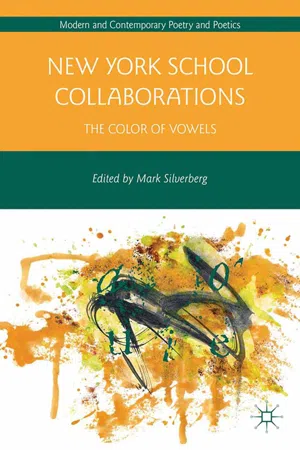
Ranging from conceptual theater to visual poetry the New York School explored the possibilities of collaboration like no other group of American poets. New York School Collaborations gathers essays from a diverse group of scholars on the alliances and artistic co-productions of New York School poets, painters, musicians, and film-makers.
Information
CHAPTER 1
“Our Program Is the Absence of Any Program”: The New York School Reading the Past
Ben Hickman
In the summer of 1950, shortly after arriving in New York, a 23-year-old John Ashbery wrote to his new painter-friend, Jane Freilicher:
I’m reading The White Devil by Webster, a rather charming novel by Mary Webb called “Armor Wherein He Trusted” . . . I’m also reading the poems of Prior, whom Kenneth would love, I’m sure—he writes in a very familiar style, rather like Auden in Letters from Iceland. And Edith Sitwell: I love her early stuff more and more, but certainly can’t take a long poem called Gold Coast Customs, which she considers her Waste Land; it is easily the most intolerable poem ever written . . . I still have to finish D. H. Lawrence (groan) . . . Here’s a comforting little poem from Nicholas Moore . . . It sounds as though he wrote it to Kenneth Koch about John Ashbery . . . (Letter dated August 8, 1950 in the Freilicher archive at the Houghton Library, Harvard)
There are many things revealed in such letters, common between New York School figures whenever they were away from each other. There is the obvious voracity of Ashbery’s reading appetite, his proclivity for variety, the apparently arbitrary mixture of high- and lowbrow, tragic and comic, ancient and modern, with no attempt to suggest connections. There is also the collaborative atmosphere that reading as an activity is evidently taking place in: Ashbery is not only sharing his reading with one friend, he is constantly framing it in relation to another.
The first points have been well documented. A list of the various writers associated with a “New York School tradition” over the years would run to some pages: a result of the coming together of the simultaneously inspiring and repressive “English Canon” most of the poets studied at Harvard, their commitment to European literary and nonliterary avant-gardes, and a unique appetite for the undiscovered and marginal.1 There is clearly an attempt among New York poets “to put together a tradition to build on where none had existed,” as Ashbery puts it in his introduction to Frank O’Hara’s Collected Poems (viii). Such a New York poetic canon, despite the difficulties involved in trying to reconstruct it, is a crucial constituent of the movement’s aesthetic in general, and its aims are heavily tied up with the avant-garde objectives of the poets. Much work has been done in this area (see especially Lehman and Silverberg). My purpose here will be to look into not the content of this tradition, but the more radical originality of its construction, that is, how the reading itself is done. It is through an analysis of the poets reading, and their reading together, that questions of the New York School’s sense of literary history, its relationship with modernism, and its so-called democratic cultural politics can be illuminated as symptoms flowing from a fundamentally original conception of artistic reception itself. It is the simple contention of this chapter that the New York poets’ early collaborative reading practice led to the collaborative conception of poet and reader evidenced in their own poetry.
But first, what does it mean to collaborate on “reading itself”? At its most quotidian, collaboration for the New York School meant discussion. In the years following O’Hara’s arrival in New York in the autumn of 1951, there were various enthusiasms, conversations, and arguments ongoing about reading and individual writers. O’Hara and Ashbery would argue about “which was better,” Vladimir Mayakovsky or Boris Pasternak (Ashbery, “Out” 81). Kenneth Koch, in addition to bringing all manner of European literature into the other poets’ purview, would share his experience of reading Renaissance epics, and consider with Ashbery, who was reading it at the same time, to what extent The Faerie Queene could be considered an “endless comic strip” (Koch, Love 194). Barbara Guest was able to position her interest in Anna Akhmatova, H. D., and Anne Marie Albiach alongside the male poets’ admiration for Marianne Moore, Gertrude Stein, and Laura Riding. Letters show how the poets were constantly urging each other to read the latest big thing (often with the campy imperative, “do read”) and sharing enthusiasms for the specific pleasures of some books, down even to the line “Scramola, Jumpchay” from a novel by Raymond Chandler, which James Schuyler muses on in wonderment in a letter to the painter John Button (Just the Thing 45). Schuyler recalls the effect of meeting Ashbery and his Harvard friends as a liberation, answering Ashbery’s questions about Joyce: “I / didn’t know you were allowed not to like James / Joyce. The book I suppose is a masterpiece: freedom of / choice is better. Thank you, ‘Little J. A. in a / Prospect of Flowers’” (Collected Poems 286–87). The poets were, in effect, influencing each other’s reading habits. Locus Solus is perhaps the first impressive result: despite its individual editors for each issue, the material of Locus Solus (which included the Troubadours, Abraham Cowley, Beat writing, ninth-century Chinese and fifteenth-century Japanese poetry, Sir John Suckling, and the Italian Futurists) is clearly, at the editorial level, the expression of a collective mind seeking to define its approach to the past.
More significant, though, is how reading is manifested in the poetry of the early New York School. Many of the poets’ collaborative experiments in the period are conscious attempts to define and express the results of a shared and social experience of reading. Koch and Ashbery’s “Six Collaborations,” published in the second issue of Locus Solus, is a series of such attempts. “The Inferno” is the silliest :
A chandelier dripping with green wine hits George Bernard Shaw on the back;
Black tea-junipers wave in the infirmary courtyard where scalded Rameau
Hears a rum-soaked dove tell tales of Bernard Berenson being felled by a steel hatrack.
Dr. Schweitzer hustled the lead-poisoned glass of Cointreau
To Walter Savage Landor, who, gargling iced tea, had just tripped over a baby.
The telephone rang. Charles Coburn rushed to answer it, slipping in a slushy puddle of fine à l’eau
In which Robert Southey was already lying dead of electric shock—or strawberry milkshake, maybe. (Ashbery and Koch, Locus Solus II 162)
Clearly, the poem is not to be taken seriously. But for all its slapstick and focus on wine, lemonade and artichokes, the central characteristic of New York School reading is revealed. That is, there is a conscious attempt in “The Inferno” to place writers in the poets’ present, to position and level them with a present of contemporary bric-a-brac. Henry Ford, American financier Bernard Baruch, and a host of Hollywood actors are placed alongside The Book of Genesis, Goethe, and Emerson in an expression of the fact that Koch and Ashbery’s collective reading of the latter takes place in mid-twentieth-century America. Another Koch and Ashbery poem, “New York Times, Sunday, October 25, 1953,” which alternates between cut-ups from the paper and references to high art, situates its allusions similarly. Likewise, O’Hara’s “Memorial Day 1950,” written in his final year at Harvard, explicitly states the standpoint of the now from which the past is being read. His more serious poem, though, goes further to make reading present in what David Herd has called a “reading [that] was a search for a style [in which] the search for a style becomes a style in itself” (“Making” 93). O’Hara is not just writing his reading down, he is performing it by demonstrating its manifestations in his own poetic style:
Fathers of Dada! You carried shining erector sets
in your rough bony pockets, you were generous
and they were lovely as chewing gum or flowers!
Thank you!
And those of us who thought poetry
was crap were throttled by Auden or Rimbaud
when, sent by some compulsive Juno, we tried
to play with collages or sprechstimme in their bed
Poetry didn’t tell me not to play with toys
but alone I could never have figured out that dolls
meant death. (Collected 17)
The poem’s mode here is the aggregate of its named sources: the invocation of Dada suggests O’Hara’s collage method, Rimbaud evokes the adolescent “part autobiographical memoir, part artistic manifesto” form of the poem that Marjorie Perloff identifies (Frank O’Hara 48), with Auden introducing a conversational irreverence later counterbalanced by Pasternak’s “clean” seriousness and Apollinaire’s speed and exclamation—the three together making up the poem’s basic tone. “Memorial Day 1950” not only brings the likes of Pasternak and Picasso into the present of “sewage singing / underneath my bright white toilet seat,” it reads them on it: that is, the poem’s style speaking the lines is simultaneously an interaction with O’Hara’s artistic masters. It is no accident that the poem’s poets are, the absence of William Carlos Williams excepted, the basic constituents of O’Hara’s style throughout his career. O’Hara does not simply assimilate himself to these poets, however, but foregrounds their otherness, their “hollering like stuck pigs” in a world foreign to them. Rather than appearing within a narrative of history in which it is merely the most recent part—the situation of a poem like The Waste Land—the present has an explicit function in “Memorial Day 1950.” The past is not quoted, it is present in the very being of the poem.
In the cases of the twentieth century’s most influential readers, Pound and Eliot, the aesthetic act of reading is marginalized: what is read in The Waste Land and The Cantos is a literature already crystallized into history. The New York School, on the other hand, enacts reading through writing rather than using texts from the past as a preparation for it. This idea requires some clarification, but its broad importance can be sketched here. Reading through poetry immediately brings us to the vexed question of influence, and part of the New York poets’ radicalism can be illustrated by considering this issue. The art historian Michael Baxandall makes some suggestive comments on this score:
“Influence” is a curse of art criticism primarily because of its wrong-headed grammatical prejudice about who is the agent and who the patient: it seems to reverse the active/passive relation which the historical actor experiences and the inferential beholder will wish to take into account. If one says that X influenced Y it does seem that one is saying that X did something to Y rather than Y did something to X . . . If we think of Y rather than X as the agent, the vocabulary is much richer and more attractively diversified: draw on, resort to, avail oneself of, appropriate from, have recourse to, adapt, misunderstand, refer to, pick up, take on, engage with, react to, quote, differentiate oneself from, assimilate oneself to . . . Most of these relations just cannot be stated the other way round. (58–59)
The priority of old over new is the classic relationship of all recent forms of intertextuality, from the classical authority of the early modern period to modernism’s quest for origin. Eliot’s maxim, “Return to the Sources” (“War-Paint” 1036), is the motivating force behind most of the major allusive experiments of the heavily Eliotic version of modernism that mainstream 1950s American poetry had tried to pass on to the New York poets and the culture at large (see Allen). The historian of ideas Quentin Skinner has characterized such a conception of history as a “mythology of coherence” (see 39–43). Texts from the past are legitimized, argues Skinner, to the extent that they are unified within an overarching narrative of history. The reader, that is, uncritically arrives at the work with “set” ideas of what it should be and how it must “contribute” to a group of essential, transhistorical issues, judging texts by the extent to which they confirm the continuation of a certain narrative of history (see 50–56).
Michel Foucault’s concept of a “history of the present” (Discipline 30–31) is a useful tool for thinking about the New York School’s antidote to this. The past for Foucault is something retroactively founded on the present, rather than a matter of first events evolving. History as a discipline should therefore be of rather than simply from the present. The writer’s function is to show up otherness: “against the background of the continuum, the monster provides an account . . . of the genesis of differences” (Order 157); the present should “show how that-which-is has not always been” (Beyond 209). The point of viewing the past “not so much from history as from the present” is that this very act, in its explicit presentation of a contemporary point of view on the past, gives us a “historical awareness of our present circumstance” (Beyond 206). Foucault’s present is clearly differently conceived than the New York School’s: Discipline and Punish reformulates its “archaeology” in the politically pointed context of modern prison revolts and the contemporary subversion of penal assumptions. The structure is the same, however. The New York School reads Eliotic modernism as a species of Skinner’s mythology of coherence, and will attempt to oppose it so as to reorder the priorities of poetry’s reading of history. In their preoccupation with what now does to history, the New York School poets attempt to disclose the present in its newness, as more than a fall from the past. The poets’ reading, as it appears in their poetry, and as it finally represents an collaborative invitation to readers, is the medium for this disclosure.
The Past Really Is Something: Frank O’Hara, for Bill Berkson
O’Hara makes a fundamental distinction between reading that views the work of the past as constituent of the continuous universal currents of poetry, and reading that is able to suggest the newness and difference of the present. He says in a 1965 interview: “The absorption of Lowell in the imitations of Pasternak, of Rilke and so on is domesticating in a certain way [while] the attraction that, say, Ginsberg feels for Pasternak and Mayakovsky . . . is quite a signal of a different kind of talent but also a different kind of mind, a different kind of ability to empathize outside” (Standing 24). Lowell, that is, is absorbed by his poets and his writing, as the word “imitation” suggests, domesticating by enacting the sameness of his and their art; Ginsberg, on the other hand, is able to encompass the difference of Pasternak and Mayakovsky. In the same interview, O’Hara speaks of the problems a “capitalist country” like the United States has in applying its “acquisitive impulse” to art. To acquire is to own and make one’s own, but O’Hara notes that it is the opposite of this that makes art, and particularly avant-garde art, powerful: “Art is not your life, it is someone else’s. Something very difficult for the acquisitive ...
Table of contents
- Cover
- Title Page
- Introduction New York School Collaborations and The Coronation Murder Mystery
- 1 “Our Program Is the Absence of Any Program”: The New York School Reading the Past
- 2 Ballet, Basketball, and the Erotics of New York School Collaboration
- 3 “Permeation, Ventilation, Occlusion”: Reading John Ashbery and Joe Brainard’s The Vermont Notebook in the Tradition of Surrealist Collaboration
- 4 Slippery Subjects: Thoughts on the Occasion of Ashbery and Koch’s “Death Paints a Picture”
- 5 Fair Realism: The Aesthetics of Restraint in Barbara Guest’s Collaborations
- 6 Life without Malice: The Minor Arts of Collaboration
- 7 “An Opposite Force’s Breath”: Medium-Boundedness, Lyric Poetry, and Painting in Frank O’Hara
- 8 Mourning Coterie: Morton Feldman’s Posthumous Collaborations with Frank O’Hara
- 9 “Everything Turns into Writing”: Rhizomes and Poetry Re-Processings in Ted Berrigan’s Sonnets
- 10 Giant Creatures Sculpted Here: Collectivity, Gender, and Performance in the Collaborations of Eileen Myles
- Bibliography
- List of Contributors
- Index
Trusted by 375,005 students
Access to over 1.5 million titles for a fair monthly price.
Study more efficiently using our study tools.
Frequently asked questions
Yes, you can cancel anytime from the Subscription tab in your account settings on the Perlego website. Your subscription will stay active until the end of your current billing period. Learn how to cancel your subscription
No, books cannot be downloaded as external files, such as PDFs, for use outside of Perlego. However, you can download books within the Perlego app for offline reading on mobile or tablet. Learn how to download books offline
Perlego offers two plans: Essential and Complete
- Essential is ideal for learners and professionals who enjoy exploring a wide range of subjects. Access the Essential Library with 800,000+ trusted titles and best-sellers across business, personal growth, and the humanities. Includes unlimited reading time and Standard Read Aloud voice.
- Complete: Perfect for advanced learners and researchers needing full, unrestricted access. Unlock 1.5M+ books across hundreds of subjects, including academic and specialized titles. The Complete Plan also includes advanced features like Premium Read Aloud and Research Assistant.
We are an online textbook subscription service, where you can get access to an entire online library for less than the price of a single book per month. With over 1.5 million books across 990+ topics, we’ve got you covered! Learn about our mission
Look out for the read-aloud symbol on your next book to see if you can listen to it. The read-aloud tool reads text aloud for you, highlighting the text as it is being read. You can pause it, speed it up and slow it down. Learn more about Read Aloud
Yes! You can use the Perlego app on both iOS and Android devices to read anytime, anywhere — even offline. Perfect for commutes or when you’re on the go.
Please note we cannot support devices running on iOS 13 and Android 7 or earlier. Learn more about using the app
Please note we cannot support devices running on iOS 13 and Android 7 or earlier. Learn more about using the app
Yes, you can access New York School Collaborations by M. Silverberg in PDF and/or ePUB format, as well as other popular books in Literature & Literary Criticism in Poetry. We have over 1.5 million books available in our catalogue for you to explore.