- English
- ePUB (mobile friendly)
- Available on iOS & Android
eBook - ePub
About this book
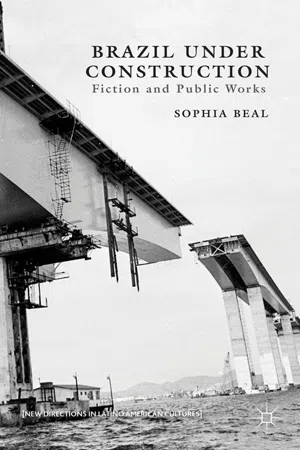
Brazil under Construction tracks how Brazil's major public works projects and the fiction surrounding them mark a twofold construction of the nation: the functional construction of the country's public infrastructure and the symbolic construction of nationhood.
Information
C H A P T E R 1
An Introduction to the Fiction of Public Works
In Brazil, the twentieth century heralded an upsurge in public works construction. Between 1900 and 1984, the country built nearly all its foundational structures: boulevards, electrical lines, tunnels, bridges, highways, subways, and hydroelectric power plants. All of these projects were necessary in order to lay a public works foundation, it is true. However, at the same time, Brazil was building some of the world’s most massive power plants and bridges, and deliberately using public works to emblemize the country’s industrial and aesthetic commitments. What did the construction of these bold public works mean for Brazil? It represented a marked shift in the country’s cohesiveness and national identity. From its independence to its years as an empire (1822–1889), Brazil had crafted a sense of national identity around the figure of the emperor and the region’s differences from Spanish America (Wolfe 6). The public works initiatives of the twentieth century, however, introduced a new narrative of national identity by physically integrating the many isolated regions of the huge country with roads, telegraphs, and electrical lines. Previously disparate states were integrated by public works that literally facilitated communication among distant regions and symbolically signaled the nation’s resolve to become a cohesive whole.
To fully understand such enormous construction projects, we must also understand the influence of those projects on the Brazilian national consciousness. As the following chapters reveal, each of these public works projects stirred controversies about what types of development were most beneficial to Brazil. An understanding of whose voices are heard and whose are excluded in the narration of national progress will deepen our perceptions of such progress.
The term national progress encompasses both the material success of a country and the concept of nationhood, which includes collective notions of national pride, shared values, hope, and cohesiveness. The complexities of defining (and contesting) progress become evident in national debates about public works. What better metaphor for the cohesiveness of a nation than building bridges? And what better way to contest that metaphor than to expose the ironies and injustices related to the bridges’ construction? Repeatedly across the twentieth century, the political speeches and propaganda of the Brazilian government used public works projects to deliver a message of national progress. The government “line” argued that public works catalyze national progress via improved efficiency, the facilitation of commerce and industry, beautification, and the adoption of new technologies. In response, Brazilian writers fleshed out the nuances of the government’s public works initiatives with praise, satire, scorn, and imagination. The central argument of this book is that Brazilian writers successfully used elements of literary language—mystery, contradiction, parody, wordplay, and fantasy—to engage the role of infrastructure in shaping perceptions of Brazil. Large-scale public works projects were both a source of creative inspiration and a vehicle for probing competing understandings of Brazil’s development.
This book examines the many contested meanings of Brazilian public works. Through literary analysis of a diverse range of cultural texts published during the twentieth century, Brazil under Construction demonstrates how public works projects have been symbolically integral to imagining the nation. Would public works stand for integration or oppression? Who would have access to new public spaces? Would urban renewal be a source of hope or despair? The book engages these questions as it tours Brazilian literature spanning from 1904 to present, with stops in the Amazon rainforest, Brasília, Rio de Janeiro, and São Paulo.
The fiction, language, and discourse surrounding Brazilian public works demonstrated how a sense of national progress was experienced, reiterated, and, at times, contested. By making this argument, my work shares a methodological tenet of cultural studies, new historicism, and postcolonial studies, that fiction sheds light on ideological and historical formations of a particular culture and of relationships of power. The book combines concerns with public works, aesthetics, and phenomenology as it analyzes how fiction, through its use of literary techniques, can alter and enhance our perception of Brazilian public works.
DEFINING PUBLIC WORKS
The public works I analyze fall into three categories: those related to public utilities (electrical lines, waterways, gas lines, and sewer pipes), those related to transportation (roads, streetcars, subways, buses, rail lines, tunnels, and bridges), and those related to energy generation (hydroelectric dams and power stations). To avoid excessive repetition, I occasionally use the noun infrastructure and the adjective infrastructural synonymously with public works. Definitions of public works vary greatly, but my particular interest is in public works that constitute tangible networks of wires, roads, tracks, or pipes as opposed to public works that are standalone buildings or facilities (public libraries, hospitals, schools, and so forth). Highway systems, electrical grids, and water pipes connect neighborhoods, cities, states, and countries. However, instead of fostering a sense of civic cohesion, public works in Brazil—due to unequal distribution and elitist policies—often have had the opposite effect. Failed public works and uneven access to public works generate civic dissolution, blight, and feelings of alienation. An analysis of the word public in relationship to the term public works sheds light on this phenomenon.
In the context of the term public works, works refers to engineering structures and public has two meanings. Public refers to the government’s ownership or regulation of works and also to the fact that these works are available to all. The dual meaning of public underscores the logistical and ethical motivation for government regulation or control of the construction and maintenance of public works. In terms of logistics, public works often involve extensive physical networks of pipes, asphalt, or wires. To create a highway system or an electrical grid may entail demolition of preexisting structures, seizure of land via imminent domain, government regulation, or negotiations across borders. Due to their expansiveness and complexity, public works require government intervention and government funding to be built. In terms of ethics, public works constitute a common denominator of comfort and convenience that ought to be made available to citizens and communities. Public works are built, regulated, maintained, and updated theoretically for the common good. Yet, in practice, the forces that motivate the construction, regulation, and maintenance of public works often deviate from this ideal.
For instance, some of Brazil’s first public works were built for resource extraction, not for public good, such as the trains initially built to transport sugar and coffee and only later converted for passenger use (Wolfe 5). Another example is the Belo Monte Dam along the Xingu River. Since the proposal for the massive hydroelectric power complex in 1979, indigenous community members have exposed how the project will primarily benefit the aluminum industry and large companies at the expense of indigenous peoples whose land (and means of sustenance) will be flooded and destroyed.1
In Brazil, many public works have oscillated between public and private ownership. The shifts toward privatization of public works understandably have coincided with shifts toward a smaller government. In 1990, President Collor initiated the privatization of many public works via the Programa Nacional de Desestatização (National Privatization Program). Thus, throughout the 1990s, energy, public transport, highways, telecommunications, and water supply and sanitation—which had been controlled by federal, state, or municipal governments—were largely privatized. For instance, the telephone monopoly, Telebrás, formed during the military dictatorship in 1972, was eliminated in the 1990s. Many public works involve public–private partnerships. For instance, the Brazilian federal government now owns 52 percent stake in Eletrobras, the largest Brazilian electricity utility, which was founded in 1962.
Anthropologist James Holston’s analysis of Brazil’s long history of insurgent and differentiated citizenship displays how public works may not be so public after all, as some citizens are routinely denied access to potable water, public transportation, and safe sewerage. In his 2008 book, Insurgent Citizenship: Disjunctions of Democracy and Modernity in Brazil, Holston studies equality and citizenship in Brazil, from the specific vantage point of contemporary São Paulo. Through a comparative analysis of Brazil and other countries, Holston notes that in Brazil—unlike in France and the United States—equality was not a key demand in the national independence movement or subsequent efforts to form a coherent nation-state. The term equality was mentioned only once in Brazil’s 1824 Imperial Constitution, the country’s first constitution, which was drafted after the nation’s independence from Portugal in 1822 (Insurgent 64). Holston employs the term differentiated citizenship to understand both a historical and current form of citizenship. Brazil’s version of citizenship entails unequal treatment of different types of citizens. For entitled citizens, this translates to privileges and protection. Yet for disenfranchised citizens, it translates to vulnerability in the form of a lack of rights and of power (Insurgent 19). Holston fleshes out this contradiction with a close analysis of its repercussions for those living on the periphery of São Paulo, where public works are central to the struggle for a better life. He observes that the term periferia (periphery) probably began to be used in the 1940s in São Paulo to refer to communities on the outskirts of the city, yet “only in the 1960s did it become the popular way of designating the settlements of people beyond the city’s perimeter of urbanized services and infrastructure” (Insurgent 147). Therefore, the concept of a periphery in this context (and I would argue in the Brazilian context more generally) refers not only to a relative geographical position (peripheral to an urban center) but also to a lack of urban infrastructure.
As Holston articulates, in the drama to obtain a better life in the periphery of São Paulo, faulty urban infrastructure is a hurdle that must be overcome:
The periphery signifies for residents a drama of extraordinary change, whose themes of inequality and struggle, segregation and inclusion, poverty and improvement, denigration and assertion are at the same time and in the most everyday ways both intensely personal and political: a drama in which the experiences of shacks, dirt roads, raw sewage, flooding, eviction, violence, faulty urban services, packed buses, and interminable commutes to work are read through the future of house building, neighborhood improvements, community organization, and modern consumption that constitutes the dream of someday having a house-and-a-destiny-of-one’s-own. Residents read everyday change in their neighborhoods—each new setting of tile, appliance, sofa, and second storey, each new health clinic, school, paved road, and sewage line—as installments in this narrative of the transformation of subaltern life. (Insurgent 156)
Throughout Brazilian testimonies and fiction, too, the drama involving public works proves to be intensely personal and political. Three examples flesh out this point.
Writer Carolina Maria de Jesus broaches these topics in terms of access to the power grid. In Jesus’s abridged diary, published in 1960 as Quarto de Despejo: Diário de uma Favelada (Child of the Dark: The Diary of Carolina Maria de Jesus), electricity is not a source of light as much as a source of government exploitation. Jesus, a woman from the São Paulo favela Canindé, who writes in the 1950s, must pay for electricity that she does not use (14). She collects cans to sell in order to pay the bill, which amounts to more than a day’s wages. In this context, the government is available to punish, but not to protect, and access to public works is not necessarily an improvement.
Lima Barreto’s Clara dos Anjos, which was posthumously published in 1923 and 1924 as a folhetim (a form of fiction published serially in a newspaper) serves as another example.2 The narrative decries the lack of sewers, of good roads, and of sufficient streetlights in Rio de Janeiros’s subúrbios (low-income neighborhoods on the outskirts of a city) in the early 1900s. The narrator caustically notes that in a handful of these subúrbios, “o governo federal caridosamente supre . . . algumas bicas públicas” ‘the federal government charitably supplies . . . a few public waterspouts’ (85). The ironic use of the word caridosamente (charitably) challenges the government’s narrative of charity, implying that access to public works should be ubiquitous, not an infrequent government performance of goodwill.
Jorge de Lima’s Spenserian sonnet “O acendedor de lampiões” ‘The Lamplighter,’ written in 1914, laments social inequality with regard to gas lighting, while simultaneously calling attention to the beauty of the worker’s feat. Written in twelve-syllable alexandrino verses, the poem transforms the worker’s job into a grand spectacle by beginning with an energetic announcement of his arrival: “Lá vem o acendedor de lampiões da rua!” ‘Here comes the street’s lamplighter!’ (305). After establishing in the octet how the worker tirelessly provides light when the moon and sun do not, the speaker goes on to introduce in the sestet the broader social theme of inequality with the lines: “Ele que doira a noite e ilumina a cidade, / Talvez não tenha luz na choupana em que habita” ‘He who gilds the night and illuminates the city, / May not have light in the hut he inhabits’ (305). In a universal tone—the setting goes unnamed—the poem’s association of light with progress captures the unevenness of access to the comforts of modernization. The social message is ambiguous because the poem does not divulge the root cause of the inequality. What stands out, instead, is the speaker’s consciousness of the workers who are responsible for the beautification of the city. This poem urges the reader to envision what it might be like to contribute to a society’s public works, while not enjoying personal access to them.
Such examples beckon us to consider how public works might be conceived of as a right. The aforementioned examples from Jorge de Lima and Lima Barreto imply that everyone in a community has a right to public works, but what sort of right is this? Drawing on Jacques Rancière and Hannah Arendt’s scholarship on rights, literary critic Michael Rubenstein connects public works and positive rights, which are rights that permit or oblige action as opposed to inaction. Rubenstein writes that when communities without access to electricity protest in favor of their right to it (he refers specifically to protesters in the country Georgia), they “announce the demand for positive rights, not ‘the right not to be killed’ or ‘the right not to be tortured’ but ‘the right to light’: the right to be seen, to be recognized, to be supplied” (193). For Rubenstein, citizens deserve access to public works because such access acknowledges that those citizens are members of a society. However, James Holston turns this idea around, conceiving of the right to public works not as something bequeathed to citizens, but as an empowering mechanism for citizens to have the opportunity to affect positive change in their communities. Thus, for Holston, the right to urban infrastructure falls under the category of contributor or stakeholder rights, which:
concern the “rights to the city” that were fundamental in mobilizing the new practices of citizenship in the peripheries—rights to public services, infrastructure, and residence that pertain to urban life as a condition of dwelling. I call them contributor rights because residents advance them as legitimate claims on the basis of their contribution to the city itself—to its construction through their building of homes and neighborhoods, to city government through their payment of taxes, and to the city’s economy through their consumption. (Insurgent 260)
Both Rubenstein’s and Holston’s conceptions of a right to public works coincide in their conviction about the need for more egalitarian access to basic public works and their understanding that to demand functional public works is to demand something beyond bare necessity, which ultimately will benefit a larger community.
Artistic representations of Brazilian public works throughout the twentieth century expose the impact of failed and uneven public works. By decrying the defects of the public works grid, cultural texts imaginatively underscore the importance of public works for a functional community. A critical analysis of public works is particularly fruitful in the case of Brazil because the country has invested extensively in large-scale public works, and yet many of its citizens lack access to basic public works. The next section considers this point.
THE FICTION OF BRAZILIAN PUBLIC WORKS
The fictional representations of public works explored throughout these pages demystify public works publicity and beckon readers to consider instead the symbolic connotations of specific public works. Since when, one might ask, are public works inscribed with so much symbolic meaning? An illustrative example involving a Brazilian reservoir begins to answer this question.
Canudos, the site of prophet Antônio Conselheiro’s religious community of over 25,000 followers, was famously decimated by the Brazilian military in 1897 because the government saw ...
Table of contents
- Cover
- Title
- 1 An Introduction to the Fiction of Public Works
- 2 Conquering the Dark: Literature, Lighting, and Public Space in Rio de Janeiro in the Early 1900s
- 3 The Spectacle of Light: A Public Works Company in Southeastern Brazil (1906–1971)
- 4 Brasília: The Real and Promised City in 1960s Brazilian Literature
- 5 Fiction and Massive Public Works during the Brazilian Military Regime (1964–1985)
- 6 São Paulo’s Failed Public Works in Ferréz’s Capão Pecado and Luiz Ruffato’s Eles eram muitos cavalos
- Epilogue
- Notes
- Works Cited
- Index
Trusted by 375,005 students
Access to over 1.5 million titles for a fair monthly price.
Study more efficiently using our study tools.
Frequently asked questions
Yes, you can cancel anytime from the Subscription tab in your account settings on the Perlego website. Your subscription will stay active until the end of your current billing period. Learn how to cancel your subscription
No, books cannot be downloaded as external files, such as PDFs, for use outside of Perlego. However, you can download books within the Perlego app for offline reading on mobile or tablet. Learn how to download books offline
We are an online textbook subscription service, where you can get access to an entire online library for less than the price of a single book per month. With over 1.5 million books across 990+ topics, we’ve got you covered! Learn about our mission
Look out for the read-aloud symbol on your next book to see if you can listen to it. The read-aloud tool reads text aloud for you, highlighting the text as it is being read. You can pause it, speed it up and slow it down. Learn more about Read Aloud
Yes! You can use the Perlego app on both iOS and Android devices to read anytime, anywhere — even offline. Perfect for commutes or when you’re on the go.
Please note we cannot support devices running on iOS 13 and Android 7 or earlier. Learn more about using the app
Please note we cannot support devices running on iOS 13 and Android 7 or earlier. Learn more about using the app
Yes, you can access Brazil under Construction by S. Beal in PDF and/or ePUB format, as well as other popular books in Literature & Social History. We have over 1.5 million books available in our catalogue for you to explore.