eBook - ePub
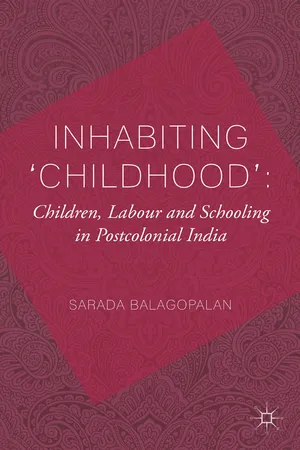
Inhabiting 'Childhood': Children, Labour and Schooling in Postcolonial India
- English
- ePUB (mobile friendly)
- Available on iOS & Android
eBook - ePub
Inhabiting 'Childhood': Children, Labour and Schooling in Postcolonial India
About this book
Through a rich ethnography of street and working children in Calcutta, India, this book offers the first sustained enquiry into postcolonial childhoods, arguing that the lingering effects of colonialism are central to comprehending why these children struggle to inhabit the transition from labour to schooling.
Information
1
Re-forming Lives: The Child on the Street and the ‘Street Child’
In the early nineties, Calcutta, a city that has long been identified with the charity of Mother Teresa, began to experience a radically different kind of philanthropic affect. Elaborating itself through newer NGOs and charity organizations, this new secular humanitarianism gathered around a figure who was previously noticed, but not spectralized or ‘recognized’, as a singular target of reform. This was the figure of the ‘street child’. In post-partition Calcutta, as the city dealt with unprecedented population shock waves of refugees and rural migrants,1 poor children on the street became a common sight. But they only helped produce the general picture of desperate poverty, a displaced postcolonial humanity struggling for survival in the modernist city. They were not unique or visible as a singular and special category of a problem that needed fixing. As an indistinct part of the mass of the poor, they gradually served as metonyms for the city’s decline and its inability to keep pace with the increased aestheticization and modernization in other Indian metropolises, thus effectively reinforcing Calcutta’s commonplace conflation with charity and decay (Hutnyk, 1996). However, within this generic conflation, in the nineties newer shifts in technologies of acting upon the poor had started emerging. These shifts, which had strong linkages with a transnational, ‘development’ form of governmentality, incipiently emerged against a waning backdrop of Marxist dreams of a revolutionary society and came to redefine the city’s relationship with its children on the street. Within this, such children were rapidly reassembled in the new ‘population’ type we call ‘street children’.
Although in a general sense the hyper-visibility of the street child can be traced to the global ratification of the UNCRC in 1989,2 it was acutely magnified in Calcutta, which was embarrassingly branded as the Indian city with the ‘largest number of street children’. As a build-up to this Convention, unprecedented attention began to be paid to issues concerning children and more specifically to the daily plight of poor children in the non-west (Agnelli, 1986). Increased international media coverage painted a dismal portrait of the latter’s everyday lives, with the street child representing a particularly stark figure that served as a moral foothold within this global effort to standardize children’s material circumstances through an emerging discourse on children’s rights. UN conventions (except when they are viewed as interfering in issues of national security) are somewhat peripheral to the world of domestic politics in India, and the Indian media, in keeping with this sentiment, paid minimal attention to this Convention. But, unlike UN conventions of the past, the critical significance of this one lay in the ways it marked the moment of a crucial domestic policy shift in imagining reform for marginalized children. Its workings, though less visible in the early nineties because of their being restricted to NGOs, began, by the end of the decade, to coincide with the Indian state’s new and more systemic articulation that universal and compulsory schooling constitutes an ideal future for these and all poor children. The nineties were dominated by international donors, government-aid agencies in the US and Europe and multilateral funding institutions vying to find perfect solutions to transform the lives of street children. During this period, Calcutta witnessed a formidable rise in the number of NGOs that worked with this population, with each of these organizations carving out their turf geographically, competing for funds through marking the need for their services by inflating the numbers served. This meant that estimates of the number of street children in the city grew phenomenally, and this statistical and non-governmental pressure managed to draw the existing Communist government into the new discourse of concern and care.3 The need to address this issue generated a previously unseen willingness to work with these local organizations as well as international donors to improve the plight of these children. The Ministry of Social Welfare estimated that of the 10.9 million persons living in the city in 1992, 75,000 to about 200,000 consisted of children living on its streets.4
The counting of street children as a distinct category and the rapid ascendance of this ‘population’ as an object of care were evidenced in the setting up of the City Level Programme of Action (CLPOA) in 1995, with the Municipal Corporation of Calcutta providing office space in its main building in Chowringhee to house this initiative. Viewed as ‘a joint effort by both government and non-government agencies to coordinate programs that favour poor children and promote child-rights oriented policies’ (UNICEF, 2003), this coalition of forty-three street children’s organizations was the first of its kind in the city. Its emergence marked a shift from an earlier moment of government suspicion of NGO efforts to a recognition of the need for their active involvement. Estimated to be working with 32,000 of the city’s 200,000 street children, the CLPOA consciously organized itself as a ‘city’ initiative by ensuring that each of its NGOs worked in a distinct, and not overlapping, area of Calcutta. The CLPOA worked systematically, using a new language of ‘increasing the capacities of local organizations’, to create a comparable similarity in the programmes undertaken by the forty-three organizations in its network. It thereby established, for the first time in Calcutta’s history, an incipient citywide imagination of reform for street and working children.
Coordinated by a central body, whose members included the Calcutta Municipal Corporation, the sectoral government departments (for education, health, social welfare and labour) of the West Bengal state government, the police department, Human Rights Commission, Juvenile Welfare Board and UNICEF (UNICEF, 2003), the CLPOA marked a shift in the direction of what Sarah White (1999) has, in the context of Bangladesh, referred to as the move from an ‘established rhetoric of opposition between State and NGOs’ to a relationship of ‘complementarity and common interest’. According to White, this is part of a more generalized trend actively promoted by international funding and regulatory agencies, like the World Bank, to place NGO activities on a favourable scale with those of the state and to increasingly use these organizations to improve and compete against the government’s delivery of services. The CLPOA appeared to reflect this trend quite strongly given that it had been set up by UNICEF and was housed by the Calcutta Municipal Corporation, at the request of the Director for Social Welfare for the government of West Bengal, with an express mandate to highlight ‘children’s issues’ in all government departments, including the police. However, because it also worked to secure a new ‘population’ of children, namely ‘street children’, CLPOA effectively marked more than the delivery of services. It appeared as a strategy to locally stabilize and reproduce the multiple circuits of persons, ideas and institutions linked to the implementation of a larger transnational reform effort around a new imagination of children’s rights. The powerful involvement of the state in CLPOA efforts related to the protection, promotion and dissemination of children’s rights disclosed that the deployment of this language was intimately linked to a new, complementary relationship between NGOs and the state, that is, a new form of governmentality. The liaison officer appointed by the CLPOA reported directly to the city’s mayor, and the first person to hold this position saw her responsibilities as twofold: the first was specifically tied to sensitizing the media and the state (especially the police) to issues that affected these children, and the second was to devise a uniform curriculum that would allow for these children to be mainstreamed into the city’s municipal schools.
CINI-ASHA,5 the most powerful NGO in this coalition, was responsible for central Calcutta, where it managed twenty centres, several of which, like the Sealdah Station shelter, were both ‘drop-in centres’ and ‘night shelters’. Started in 1989, the Sealdah shelter was CINI-ASHA’s first intervention with street children,6 and this residential site, located on a railway platform in one of the city’s busiest railway stations,7 delivered services exclusively for boys. In addition to literacy instruction, the site also provided shelter, food, rudimentary health services, counselling services, storage lockers and facilities for bathing. It served as the main laboratory for generating and consolidating new techniques of reform and development of these children. Processes of record keeping, formulation of daily routines, shifting regulations of what the children were permitted to do while outside the shelter, pedagogic material for literacy instruction and the creation of case histories were developed as techniques at Sealdah and then made available through different, but complementary, circuits that extended towards other similar local initiatives as well as came to influence the growing matrix of a global imagination of street children’s programmes. While this ‘local’ site on the platform of the station grounded and generated its own globality, it remained open to various shifts in the global arena of street child politics. These shifts often made themselves known at this local level through changed requirements in measuring the success of the site’s interventions with these children. Unlike the dreariness usually associated with record keeping, what was remarkable about these nervously drafted reports and the loop of information collection they triggered between the Sealdah centre, the CINI-ASHA office and the donor agency was how this reciprocal process fit existing initiatives on the station platform while generating new areas of concern. This documentation, because it relied primarily on a reporting through numbers, continually deployed ‘street child’ as an obvious category to describe these children. They had become a reified population.
Imprecise categories and their accommodations
This category of the ‘street child’ – coined in the seventies to replace the earlier colonial/disciplinary state’s ‘tactless’ naming of children found on the streets as vagrants, runaways or urchins – carried within its new philanthropic apparatus an additional moral charge of reframing such children through the discourse of victims and victimhood, as primarily abject subjects. This reframing included assumptions that these children’s psychosocial maladjustment and neglect were a result of their origins being located in the twin conditions of their lives on the street and the absence of a familial environment. Attempts to define who counted as a ‘street child’ often misrecognized all children present on the street as ‘street children’, sensationalizing their lives in order to corner the required programmatic resources (Connolly and Ennew, 1996). Even though increased academic and policy research pointed to the relationships that a large majority of these children had with their families and extended kin,8 the continued recognition of this population within newly minted categories of ‘moral panic’ (Krinsky, 2008), like ‘Children in Especially Difficult Circumstances’ – a category that originally also covered children affected by organized violence and disasters – meant that the absence of family and the traumatic effects this signified continued to function as the dominant narrative on these lives. These homogenizing and hegemonic assumptions also exercised a certain deterministic weight, that is, the spirit of reform under which these programmes worked required the ability to stabilize these children’s lives around a protection-cum-disciplinary axis, whose challenge lay in securing lasting marks of identification on their target population.
At Sealdah, a series of practices – the ways in which information was collected when a new boy joined the site, programmatic interventions that did not include children’s families within its imagination, the dramatization of current lives through skits and rallies to raise ‘awareness’ amongst a general public – directly involved and affected the children. Through these practices, they became aware of the ways the ‘street child’ category worked to frame their lives, while they simultaneously contested this categorization. Unlike the precise surety consolidated through the operation of statistics and numbers in formal documentation, these practices continually disclosed a more complex fact about the everyday functioning of the category street children. This was its constant accommodation of the reality that for these children the very category of ‘street child’ itself functioned as a powerful but profoundly imprecise and incomplete reading of their lives. Let us then look at these practices more closely.
A skit in/out of its performance
In early 1995, the global emphasis on community-based models of AIDS prevention was beginning to modify the existing contours of health provision amongst street children. The disease was assumed to threaten street children as a ‘population’, since their individual behaviours put them at high risk of transmitting the virus. As a result, there was widespread mobilization of these children as ‘peer educators’ by local NGOs. The pedagogic strategies they were assigned included scripting and acting out short skits that highlighted ‘good practices’, performed in various public locations across Calcutta and usually attracting large crowds. A few children would enact the skit, while others would hold up the banner of the NGO – CINI-ASHA in this case – as the backdrop of a temporary stage on the sidewalk. The NGO staff often developed the stories that these skits dramatized, and the children brought in the required authenticity by drafting dialogues to generate curiosity, laughter and a sense of identification with the issue at hand.
Most skits were variations of a storyline that had a young ‘street child’ as its main protagonist and traced this child’s fall into ‘bad company’. The latter was primarily signified through a narrative cohering around the child’s penchant for unprotected sex (with multiple partners) as well as his regular ganja use and needle sharing. The particular skit I saw performed on the open grounds of the Calcutta Book Fair revolved around two ‘street children’ who have AIDS but are unaware of the deadliness of the disease, both in its ability to kill them and in their own role as carriers of the virus. The ‘reformist’ moral telos of the play consisted of their immersion within an NGO programme that eventually makes them realize the ‘truth’ about AIDS, after which they decide to start a campaign to inform their peers about the disease and how it can be prevented. However, their plans are thwarted on the street by the ‘dadas’ – powerful local goons/drug traffickers – who want these children to continue taking ganja. These ‘dadas’, within street children discourse, constituted the criminal types or the problematic non-citizen subjects, from whom these children need to be rescued. Within the narrative of the play, it is the NGO and the police who serve as equal agents of ‘good governance’ to save these children from this more pervasive contamination. The story ended with the children being doubly ‘rescued’ from this darkness: firstly, in an empirical and institutional sense by an NGO that offers to take care of them and, secondly, in a more comprehensive (ideologically) transformative sense through their subsequent realization that in ‘education’ lies a bright, safe and normal future. Idealizations of citizenship involving ‘information’, ‘education’ and ‘awareness of one’s rights’ served to differentiate younger street children from the older youth on the streets, and the subsequent creation of new identities was indexed by children learning to recognize the previously not so obvious ‘dadas’ as the threatening and absolute figures of otherness. After that performance at the annual Calcutta Book Fair, Shankar – a young street child of thirteen, who usually had the most significant role in the skit – turned to me and remarked quite straightforwardly, ‘We are asked to act out our lives in this drama. People only come to watch us because we are street children. But the real drama is that we are really acting out the ways people usually think of us and our lives on the street.’
Shankar’s statement provides an opening through which to discuss ‘street children’ both as a specific identity produced by the population category as well as the name of a more heterogeneous subjectivity that continually marks the limited nature of the category itself. The lives of children on the street are implicated in the category and yet, simultaneously, consist of a profound and boisterous laughter aimed at the category’s limited reading of them. The subjection of these children to the power exerted by the NGO, which compelled them to assume the identity that the category provided, was seldom a straightforward exercise at the Sealdah site. Shankar’s ‘acting out’ his life as a ‘street child’ revealed his accommodation of a particular register of recognition, while simultaneously disclosing his belief that the category provided an inadequate description of his life. Instances like the skit made him aware that children like him were categorized as belonging to a collectivity marked by loss, in which their passivity and abjection were emphasized.
The categorization of course, also put into place attendant incitements to rescue and save, which then served as the terrain on which the NGO crafted its efforts. Reforming this ‘population’ was often linked to a certain fixity in the ways their current lives were understood by the NGO, with the arbitrariness of the street, their proclivity for crime, their disregard for sexual norms, along with the dominant fact of their young age, all impinging on the NGO’s basic working assumption of the street child as ‘victim’. An awareness of this victimization, their construction as vulnerable children, circulated through routines at the site that mapped themselves on to children’s bodies in an attempt to discipline and thereby transform signs of neglect into redeemable futures. Though aware that the NGO space was constituted through its ability to fix their identities as victims and then act upon them as such, these children’s subjectivities rested on a more expansive reading of their lives. While certain ‘objective facts’ of their lives – working on the streets in highly exploitative situations, regularly sniffing glue and scavenging – did indicate a certain precarity that is central to the idea of ‘street children’, their ability to set themselves apart and live beyond this frame meant that their subjectivities were seldom foreclosed by these ‘objective facts’. And, as Shankar’s statement makes clear, it was in the tension between a reading of them as children and what the children understood as their efforts to create community and craft lives in the city that this ‘politics of saving’ was actualized.
The case of a ‘case file’
For the children, the most emblematic iteration of the category’s conventional understanding of their lives took place when they joined the shelter and their case-history was required to be recorded. Despite the staff’s awareness of the complexities of the kinship networks, both fictional and real, which were maintained and cultivated by these children, a new child’s entry at the site often served as a moment when the category functioned as an empty sign to broadly accommodate the child on the street as ‘abandoned’.9 Most children recounted that in the initial interview, they highlighted tragic and painful events in their lives. In some cases, these were related to the reasons they left home but, more often, to experiences on the street. When it came to the reasons they were on the street, the children believed that they could provide family poverty as an adequate cause for their need to earn an income. However, given that most of them had begun earning quite early in life while living at home, their articulation of the reasons they left was often tied to a traumatic event that reinforced assumptions about their victimization.
Sanjib Mandal, a child of about eight, recounted that when his mother got TB and was unable to work, he dropped out of school and found employment as domestic help. He continued to stay at home and work for the next three years until his employe...
Table of contents
- Cover
- Title
- Copyright
- Contents
- List of Figures
- Acknowledgements
- Introduction
- 1 Re-forming Lives: The Child on the Street and the ‘Street Child’
- 2 Sedimenting Labour through Schooling: Colonial State, Native Elite and Working Children in Early Twentieth-Century India
- 3 Memories of Tomorrow: On Children, Labour and Postcolonial ‘Development’
- 4 The Politics of Failure: Children’s Rights and the ‘Call of the Other’
- 5 ‘A Magic Wand’: Reading the Promise of the ‘Right to Education’ against the Lives of Working Children
- Conclusion
- Notes
- Bibliography
- Index
Trusted by 375,005 students
Access to over 1.5 million titles for a fair monthly price.
Study more efficiently using our study tools.
Frequently asked questions
Yes, you can cancel anytime from the Subscription tab in your account settings on the Perlego website. Your subscription will stay active until the end of your current billing period. Learn how to cancel your subscription
No, books cannot be downloaded as external files, such as PDFs, for use outside of Perlego. However, you can download books within the Perlego app for offline reading on mobile or tablet. Learn how to download books offline
Perlego offers two plans: Essential and Complete
- Essential is ideal for learners and professionals who enjoy exploring a wide range of subjects. Access the Essential Library with 800,000+ trusted titles and best-sellers across business, personal growth, and the humanities. Includes unlimited reading time and Standard Read Aloud voice.
- Complete: Perfect for advanced learners and researchers needing full, unrestricted access. Unlock 1.5M+ books across hundreds of subjects, including academic and specialized titles. The Complete Plan also includes advanced features like Premium Read Aloud and Research Assistant.
We are an online textbook subscription service, where you can get access to an entire online library for less than the price of a single book per month. With over 1.5 million books across 990+ topics, we’ve got you covered! Learn about our mission
Look out for the read-aloud symbol on your next book to see if you can listen to it. The read-aloud tool reads text aloud for you, highlighting the text as it is being read. You can pause it, speed it up and slow it down. Learn more about Read Aloud
Yes! You can use the Perlego app on both iOS and Android devices to read anytime, anywhere — even offline. Perfect for commutes or when you’re on the go.
Please note we cannot support devices running on iOS 13 and Android 7 or earlier. Learn more about using the app
Please note we cannot support devices running on iOS 13 and Android 7 or earlier. Learn more about using the app
Yes, you can access Inhabiting 'Childhood': Children, Labour and Schooling in Postcolonial India by S. Balagopalan in PDF and/or ePUB format, as well as other popular books in Social Sciences & History of Education. We have over 1.5 million books available in our catalogue for you to explore.