Designing Social Research
eBook - ePub

Designing Social Research

The Logic of Anticipation

  1. English
  2. ePUB (mobile friendly)
  3. Available on iOS & Android
eBook - ePub

Designing Social Research

The Logic of Anticipation

About this book

Designing Social Research is a uniquely comprehensive and student-friendly guide to the core knowledge and types of skills required for planning social research.

The authors organize the book around four major steps in social research – focusing, framing, selecting and distilling – placing particular emphasis on the formulation of research questions and the choice of appropriate 'logics of inquiry' to answer them. The requirements for research designs and proposals are laid out at the beginning of the book, followed by a discussion of key design issues and research ethics. Four sample research designs on environmental issues illustrate the role of research questions and the application of the four logics of inquiry, and this third edition includes new material dedicated to social research in a digital, networked age.

Fully revised and updated, Designing Social Researchcontinues to be an invaluable resource to demystify the research process for advanced undergraduate and graduate students. Together with the authors' Social Research: Paradigms in Action and Blaikie's Approaches to Social Enquiry, it offers social scientists an informative guide to designing social research.

Frequently asked questions

Yes, you can cancel anytime from the Subscription tab in your account settings on the Perlego website. Your subscription will stay active until the end of your current billing period. Learn how to cancel your subscription.
At the moment all of our mobile-responsive ePub books are available to download via the app. Most of our PDFs are also available to download and we're working on making the final remaining ones downloadable now. Learn more here.
Perlego offers two plans: Essential and Complete
  • Essential is ideal for learners and professionals who enjoy exploring a wide range of subjects. Access the Essential Library with 800,000+ trusted titles and best-sellers across business, personal growth, and the humanities. Includes unlimited reading time and Standard Read Aloud voice.
  • Complete: Perfect for advanced learners and researchers needing full, unrestricted access. Unlock 1.4M+ books across hundreds of subjects, including academic and specialized titles. The Complete Plan also includes advanced features like Premium Read Aloud and Research Assistant.
Both plans are available with monthly, semester, or annual billing cycles.
We are an online textbook subscription service, where you can get access to an entire online library for less than the price of a single book per month. With over 1 million books across 1000+ topics, we’ve got you covered! Learn more here.
Look out for the read-aloud symbol on your next book to see if you can listen to it. The read-aloud tool reads text aloud for you, highlighting the text as it is being read. You can pause it, speed it up and slow it down. Learn more here.
Yes! You can use the Perlego app on both iOS or Android devices to read anytime, anywhere — even offline. Perfect for commutes or when you’re on the go.
Please note we cannot support devices running on iOS 13 and Android 7 or earlier. Learn more about using the app.
Yes, you can access Designing Social Research by Norman Blaikie,Jan Priest in PDF and/or ePUB format, as well as other popular books in Social Sciences & Sociology. We have over one million books available in our catalogue for you to explore.

Information

PART 1:
FOCUSING RESEARCH DESIGN

5
Research Questions and Purposes

5.1 Chapter Summary

  • All social research is built on the foundation of research questions.
  • Research questions define the nature and scope of a study.
  • Research questions can be grouped into three main types, ‘what’, ‘why’ and ‘how’ questions.
  • The three types of questions form a sequence for the research process: ‘what’ questions, followed by ‘why’ questions, followed by ‘how’ questions.
  • The importance of answering ‘what’ questions should not be underestimated.
  • The developmental nature of a research design should not be used as an excuse to avoid the effort required to formulate appropriate research questions.
  • While the process of developing a set of research questions can be the most challenging part of any research project, techniques are available to assist the process.
  • Research questions are what the research is designed to answer, not the questions asked of respondents or participants.
  • The aim of the literature review is to indicate what the state of knowledge is with respect to each research question or group of questions.
  • Hypotheses are best guesses at answering ‘why’ and, possibly, ‘how’ questions.
  • If required, hypotheses should be derived from the literature review, particularly from theory or research results. Sometimes a new theory may have to be constructed.
  • In some research, working hypotheses may emerge, and be tested, in the course of the data collection and/or generation and analysis.
  • As an aid to the conception, clarification and classification of research questions, it is also useful to think about social research in terms of its purposes.
  • Social research can pursue eight major purposes: explore, describe, understand, explain, predict, change, evaluate and assess impacts.
  • Many research purposes require ‘what’ questions. Understand and explain, and, to a lesser extent, evaluate and assess impacts, require ‘why’ questions. Only change requires ‘how’ questions.
  • Research purposes are not a list of the activities the researcher is going to carry out; they can be either the analytical or the practical goals of a project.

5.2 Introduction

Formulating research questions is the most critical component of any research design. It is only through the use of such questions that a research problem becomes researchable, that choices about the focus and direction of research can be made, that its boundaries can be clearly delimited, that manageability can be achieved and that a successful outcome can be anticipated. Establishing research questions also makes it possible to select logics of inquiry and methods of data collection and/or generation and analysis with confidence. In other words, a research project is built on the foundation of its research questions. However, getting these questions clear and precise requires considerable thought and sometimes some preliminary investigation.
This chapter discusses:
  • three main types of research questions;
  • the functions of research questions;
  • how to develop and refine research questions;
  • the relationship between research questions and hypotheses, and the functions of the latter; and
  • how research questions can provide a guide and framework for the review of the literature.
As a way of elaborating research questions, consideration is also given to the research purposes behind the questions. Hence, there is a discussion of:
  • the nature and range of research purposes that can be pursued; and
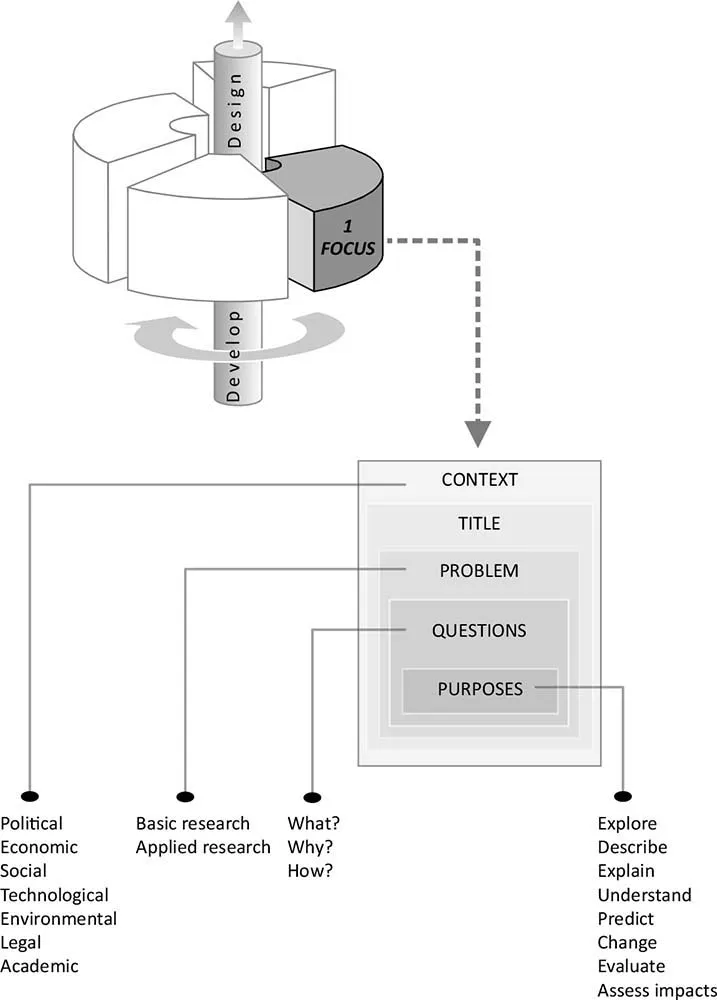
  • the relationship between research purposes and research questions (see Figure 5.1).

5.3 Research Questions

Research questions are essential for defining the nature and scope of research. By selecting questions, and paying attention to their wording, it is possible to determine what is to be studied and, to some extent, how it will be studied. The way a particular research question is worded can have a significant influence on how much and what type of research activity will be required.
Conventional wisdom suggests that research should be guided by one or more hypotheses. According to this view, in order to get started on a research project the researcher should: first, select a research problem; second, state one or more hypotheses to be tested; and, third, measure and correlate the variables related to the concepts in the hypotheses. However, this procedure is only relevant when quantitative data are used with Deductive logic. While there is a role for hypotheses in this kind of research, they neither provide the foundation for a research design nor are they very useful for defining the focus and direction of a research project. In fact, the ritual of formulating and testing hypotheses can lead to unnecessary and unhelpful rigidities in the way in which research is conducted. In some kinds of research, it is impossible or unnecessary to set out with hypotheses. A much more useful procedure is to establish one or more research questions.
image
Figure 5.1 Focusing a research design determines its scope

A Neglected Component of Social Research

Until fairly recently, few textbooks on research methods gave attention to the formulation of research questions, and some ignored this vital part of the research process entirely. Exceptions can be found. See, for example: Hedrick et al. (1993); Miles and Huberman (1994); Blaxter et al. (2002); Mason (2002, 2017); Yin (2003a); Maxwell (2005); Marshall and Rossman (2006); Neuman (2006, 2014); Flick (2006, 2007, 2014, 2015); Green (2008); Punch (2014); Creswell (2017).
It is interesting to note that these books are either concerned with qualitative research methods or include a significant discussion of them.
Flick argued for the importance of research questions in qualitative research.
Experience from my own research and even more from supervising and consulting other people in their research has shown how decisive it is for the success of a project to have a clear and explicitly formulated research question. (Flick 2007: 22)
[A] first and central step, and one which essentially determines success in qualitative research, but tends to be ignored in most presentations of methods, is how to formulate the research question(s). (Flick 2006: 105)
Creswell (2017) argued that, in a qualitative study, research questions are central, not objectives (goals for research) or hypotheses (predictions involving variables and statistical tests). We concur wholeheartedly with Flick’s statements above and would argue that what he and Creswell say about qualitative research applies to all social research.
Mason (2002) set her discussion of research questions in the context of intellectual puzzles that demand some kind of explanation. These puzzles take a variety of forms, depending on the ontological and epistemological positions adopted by the theoretical and intellectual traditions from within which they emerge. Intellectual puzzles then lead to research questions that Mason regarded as forming the backbone of a research design, and as having much greater significance than hypotheses or propositions, particularly in qualitative research. For her, research questions should be clearly formulated (whether or not you intend to modify them or add to them later), intellectually worthwhile, and researchable (both in terms of your epistemological position, and in practical terms), because it is through them that you will be connecting what it is that you wish to research with how you are going to go about researching it. They are the vehicles which you will rely upon to move you from your broad research interest to your specific research focus and project, and therefore their importance cannot be overstated. Research questions, then, are those questions to which you as researcher really want to know the answers, and in that sense they are the formal expression of your intellectual puzzle (Mason 2002: 19–20).
These examples should be sufficient to reinforce our argument about the pivotal role played by research questions in social research.

Types of Research Questions

Research questions can be grouped into three main types: ‘what’ questions, ‘why’ questions and ‘how’ questions. Restricting resea...

Table of contents

  1. Cover
  2. Copyright
  3. Introduction
  4. Part 1: Focusing Research Design
  5. Part 2: Framing Research Design
  6. Part 3: Selecting Research Design
  7. Part 4: Distilling Research Design
  8. Part 5: Researching Networked Worlds
  9. Part 6: Illustrations
  10. Appendix I: Three Research Paradigms
  11. Appendix II: Examples of Research Topics, Problems and Questions Notes
  12. References
  13. Index
  14. End User License Agreement