A Marginal Revolution Best Non-fiction Book
?"[A] fascinating book." –Steven Mintz, Inside Higher Ed
"Substantive on virtually every page, the author actually understands how universities work…An impressive performance." —Tyler Cowen, Marginal Revolution ?
"With his extraordinary breadth of curiosity and equal ease in the histories and cultures of these countries, only Bill Kirby could have written this book. It is must-reading for everyone who cares about universities, a thought-provoking lesson in the strange mix of durability and vulnerability that defines this key modern institution." —Richard Broadhead, President Emeritus, Duke University
"William Kirby's new book is unique. I know of nothing else on higher education that resembles it in breadth, scope, and sheer comparative information and analysis. Anyone interested in the nature of universities during the past two centuries will want to read this volume." —Neil L. Rudenstine, President Emeritus, Harvard University
Today American institutions dominate nearly every major ranking of global universities. Yet in historical terms, America's preeminence is relatively new, and there is no reason to assume that US schools will continue to lead the world a century from now. Indeed, America's supremacy in higher education is under great stress, particularly at its public universities, while Chinese universities are on the ascent. Will China threaten American primacy??
Empires of Ideas looks to the past two hundred years for answers, examining the successes of leading universities to determine how they rose to prominence and what threats they currently face. William C. Kirby gives special attention to the challenges that Chinese academic leaders must confront: reinvesting in undergraduate teaching, developing new models of funding, and navigating a political system that may undermine a true commitment to free inquiry and academic excellence.
eBook - ePub
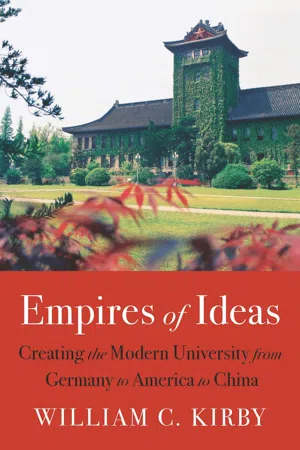
Empires of Ideas
Creating the Modern University from Germany to America to China
- 492 pages
- English
- ePUB (mobile friendly)
- Available on iOS & Android
eBook - ePub
About this book
Information
Topic
EducationSubtopic
Education GeneralCHAPTER ONE
The University in Germany
A Historical Introduction
AT THE center of Berlin, on the central avenue Unter den Linden, sits an armory, or Zeughaus, built by Frederick III, Elector of Brandenburg, in the late seventeenth and early eighteenth centuries. It became a military museum in 1875 under the unified Prussian-German Empire. In 1943 it was the site of a failed attempt to assassinate Adolf Hitler. Today it is home to the German Historical Museum.
Visitors entering the museum are introduced not to the story of “Germany,” which as a political entity did not exist before 1870, but to the history of German-speaking peoples in a European context, whether under Prussian, Polish, Austrian, or French rule. Visitors progress through exhibits from late Roman times through to the Middle Ages. They experience the Reformation and the Thirty Years’ War from alternative perspectives; dynastic rivalries between the Bourbons and the Habsburgs; the French Revolution and Napoleonic conquests; the abortive revolutions of 1848; Germany’s unification and its defeat in World War I; the Weimar experiment; Hitler’s rise, genocide, and Germany’s demise in World War II. Then at 1949, the exhibit divides, and visitors must decide: to go left is to be greeted by a Trabant, the spunky socialist fiberglass auto, and to enter the German Democratic Republic; to go right is to be escorted by a Volkswagen bug to the Western world of the German Federal Republic. When visitors reach 1990, the exhibit, like Germany, reunites.
Like the path of German history, the story of German universities is not linear. As with the landscape traversed by the museum, some German-founded universities are no longer in the territory of any German-speaking state. The East Prussian University of Königsberg, for example, where Immanuel Kant taught and served as rector in the late eighteenth century, lies now in the Russian Federation, the site of a federal university recently renamed for Kant by Vladimir Putin. Today the University of Heidelberg calls itself “Germany’s oldest university,” but that is true only if one limits German geography to the present Federal Republic.1 Scattered across the lands of the Holy Roman Empire, the medieval and early modern establishments that called themselves “universities” bore little resemblance to the research institutions that would transform the world of universities in the nineteenth century and beyond.
With papal blessing, Emperor Charles IV, who was also king of Bohemia, founded the University of Prague in 1348 to educate Bohemians, Bavarians, Poles, and Saxons, although it took the university more than a decade to produce its first graduate. His son-in-law, Rudolf IV, Duke of Austria, followed suit in 1365 with the University of Vienna. Divisions in Christianity fed the establishment of new institutions. The Western Schism of 1378 and ensuing confrontation led to the founding of the universities of Heidelberg (1386), Cologne (1388), and Erfurt (1392), as existing ecclesiastical institutions were enlarged into universities. A regional bishop typically administered the university, which was, in principle, subject only to the Emperor. After the establishment of universities in Greifswald in 1456 and Freiburg (Breisgau) in 1457, it was common practice to possess the “privileges” of the emperor, such as certain exemptions from taxation and military service, in addition to the one given by the pope. German universities had a public character from birth.
German universities grew in number, if not distinction, when the Protestant Reformation of the sixteenth century increased demand for institutions whose religious affiliations aligned with those of a sovereign: cuius regio, eius religio (“whose realm, his religion”). Before the Reformation, there were fifteen universities in German-speaking lands; by 1700 this number had doubled.
These were universally small institutions reliant on imperial, papal, or princely patronage. Enrollment and teaching positions fluctuated considerably; some universities came close to extinction. Enrollment at the best-regarded institutions ranged between one thousand and twelve hundred students, but the smallest universities had but eighty to one hundred attendees. Reputations rose and fell. No single university dominated the landscape. In the early fifteenth century, Erfurt and Cologne were among the largest and most eminent. A century later, Leipzig and Ingolstadt rose to prominence. Humanism and the Reformation gave Wittenberg and Leipzig, as well as Helmstedt, Frankfurt an der Oder, Jena, and Ingolstadt their days in the sun. During the Thirty Years’ War, Königsberg, Rostock, and Cologne became comparatively large universities, with students fleeing war conflict zones and—in the best tradition of university students of any era—avoiding military conscription.
German universities in the eighteenth century trained men for professions, such as in medicine, the clergy, or (by studying law) the government. Universities were, in principle, the apogee of a variegated system of schools of highly uneven quality. Most of these served different segments of society for very specific functions. Cadet schools trained officers for the military, while seminaries graduated pastors. Aristocratic families sent young men to what we may call “knight schools”—the Ritterakademien—that became popular in the late sixteenth century as places to learn military and courtly manners. Sons of artisans and merchants studied at Latin schools for several years before learning a trade. These schools were not part of any systematic hierarchy, and, as a result, there was no single path to university. Whatever their type, these schools were mostly “ill-equipped, poorly run, and badly attended.”2
The behavior of students did not enhance the reputation of universities. Eighteenth-century versions of National Lampoon’s Animal House made universities infamous for intoxication and immorality—with brawling accompanied by swordplay (although the Schmisse, or dueling scar, would not become popular until the nineteenth century). The late-eighteenth century educational reformer Joachim Heinrich Campe asked rhetorically, “Do universities do more good than harm?” His answer was no. “The best young people are, if not destroyed completely, at least made wild at universities and return from them weakened in body and soul, lost to themselves and the world.”3
Even—or perhaps especially—in the century of Enlightenment, German universities had a simply awful reputation. While in Paris and Oxford university life flourished, attracting scholars from across Europe, in Germany universities remained largely provincial. It was not a compliment when they were called “medieval.” They were considered sites of rote learning, imparted to students by a professoriat reciting ancient texts and largely beholden to church and sovereign.4 Professors lectured and (on occasion) published in Latin. Leading intellectuals largely made their reputations apart from university life. The great mathematician and philosopher Gottfried Wilhelm Leibniz thought of universities as monasteries with “sterile fancies.”5 He convinced the Elector of Brandenburg not to establish a new university, but to found instead (in 1700) a Societät der Wissenschaften, which became the Royal Prussian Academy of Sciences.
There were, however, attempts in the eighteenth century to reform the potential of German universities. The practical needs of the state with a growing bureaucracy, as well as early Enlightenment currents, gave impetus to rethinking the role of the university. The University of Halle was founded in 1694 by the same, reformist Elector of Brandenburg (Frederick III). It was built on the grounds of an existing Ritterakademie, to which were added faculties of theology and law. Early Enlightenment figures, like Christian Thomasius in Halle, sought to transform universities from places of orthodoxy and dogma and into havens for reflection and free speech well suited to the modern state. Thomasius began to lecture at Halle in the German vernacular, rather than in Latin. He brought together the medieval with the modern, in a curriculum that covered riding, fencing, and preparation for the Prussian civil service. Halle was also a business success, competing successfully for the offspring of the nobility (who paid higher fees than others) by combining an early modern “general education” with a contemporary legal education.6
Halle’s early success (it would not last) inspired competition from the House of Hanover, now in union with Great Britain and a rival of Prussia. Founded in 1737 by George II of England and Elector of Hanover, the University of Göttingen foreshadowed in some ways the coming of the modern research university. It was nonsectarian; the state confirmed professorial appointments; it recruited talent from across German Europe by paying high salaries; it developed a strong Philosophische Fakultät, encompassing the arts and sciences; and, for eminently practical reasons, it brought together a superb law faculty. As a leading figure in Göttingen’s rise, the Hanoverian official Gerlach Adolf von Münchhausen, noted, “That the legal faculty be filled with famous and excellent men is necessary above all, because that faculty must induce many rich and distinguished students to study in Göttingen.”7 Göttingen cultivated an enviable, internal esprit de corps. When in 1789 the Prussian minister Friedrich Gedike reported to King Frederick William II on the state of German universities, he wrote this about Göttingen: “Nowhere else have I found as much fondness for their university on the part of professors as here. They seem to take it as a foregone conclusion that their university is the best in Germany. They often speak of other universities with disdain or pity. It’s as if they are all intoxicated with pride in the university’s merits—partly real, partly alleged, and partly imagined.” At least from a Prussian point of view, Göttingen was a scholarly paradise. Gedike found little of the “factionalization, envy, backbiting, and need to diminish one another’s accomplishments” that was ubiquitous in other universities. “Or, at least, they are less apparent here.”8
The University of Jena was another beacon of excellence. Located in the duchy of Saxe-Weimar, it reached its height in the second half of the eighteenth century under the Duke Karl August, who was Goethe’s patron. It was a center of German idealism, where at different times the faculty included Fichte, Hegel, Schelling, and Schlegel. Even Schiller taught there briefly.
Yet the German university “system,” to the degree one can describe it as such, still suffered from stasis and educated the privileged few at the turn of the nineteenth century. It remained polycentric, still (despite Göttingen’s pretensions) with no single leading institution. It relied on princely patronage and the high tuition charged to noble and elite families, but its audience was shrinking, not growing. German universities outside Austria enrolled in toto, at most, nine thousand students in 1700. A century later, enrollments had fallen by at least one-third, to less than six thousand. Other estimates put the number as low as thirty-seven hundred in 1780.9 To the degree that innovation had occurred at all, it was in the newer institutions of Halle and Göttingen, not in the large majority of institutions, where a lethargic and privileged professoriat defended its historical practices. In the view of educational reformers such as Campe, it was too late to reform: “To change the nature of the universities means to abolish them.”10 At the turn of the nineteenth century, the Prussian minister responsible for higher education proposed just that: the total elimination of the university as an institution.11
That this did not happen was in no small measure the result of the efforts generously attributed to a home-schooled man who never finished his university studies at Frankfurt an der Oder and Göttingen: Wilhelm von Humboldt. His story, and that of the University of Berlin, which he initiated in 1810 and which became the exemplar of the modern research university, is the subject of Chapter 2. Here we might simply set out several themes that endured from the pre-Humboldtian world of German universities to the world of universities today.
First, even after the ascendance of the University of Berlin over the course of the nineteenth century to a position of national and international eminence, German higher education remained decentralized, in the hands of the various political entities governing German-speaking lands. Despite several German unifications (1870, 1938, 1990) there would be no “national university.” Today, it is still the individual states (Länder) of the Federal Republic that oversee German universities. Universities rose and fell in prestige and in competition one with another: if in the eighteenth century this was a competition for students, in the twenty-first century it is a race for recognition in an “Excellence Initiative.”
Second, modern German universities inherited from their medieval and early modern ancestors certain traditions of institutional autonomy, initially as corporations, which set their own procedures of governance and were guarded jealously. Whereas in the eighteenth century this often fostered a defensive insularity and a stultifying pedantry, the self-regulating capacity of a renewed professoriat in the nineteenth century to set new standards of research and teaching would differentiate the German university from anything else. And disputes over internal governance would nearly bring German universities to their knees in the 1960s.
Third, from early modern times to nearly the present, governance meant the rule not just of professors, but of Ordinarien, of full professors. Nineteenth century reforms formally established the Ordinarienuniversität, or a university of chaired professors, as the norm. There were three basic ranks of faculty: the Ordinarius, or ordentlicher (full) Professor, who held a chair, or Lehrstuhl; what we might translate as associate professor, appropriately named Extraordinarius, or außerordentlicher Professor, whose only hope at a professorship was t...
Table of contents
- Cover
- Title Page
- Copyright
- Contents
- Preface, 2025
- Preface
- Introduction: The “World-Class” University
- 1. The University in Germany: A Historical Introduction
- 2. The Modern Original: The University of Berlin
- 3. Truth, Justice, and Freedom in a Cold War World: Free University of Berlin
- 4. The Rise and Challenges of American Research Universities
- 5. Rising through Change and through Storm: Harvard University
- 6. Public Mission, Private Funding: The University of California, Berkeley
- 7. Outrageous Ambitions: Duke University
- 8. A Chinese Century? The Revival and Rise of Chinese Universities
- 9. From Preparatory Academy to National Flagship: Tsinghua University
- 10. The Burden of History: Nanjing University
- 11. Asia’s Global University? The University of Hong Kong
- Conclusion: Lessons and Prospects
- Notes
- Index
Trusted by 375,005 students
Access to over 1.5 million titles for a fair monthly price.
Study more efficiently using our study tools.
Frequently asked questions
Yes, you can cancel anytime from the Subscription tab in your account settings on the Perlego website. Your subscription will stay active until the end of your current billing period. Learn how to cancel your subscription
No, books cannot be downloaded as external files, such as PDFs, for use outside of Perlego. However, you can download books within the Perlego app for offline reading on mobile or tablet. Learn how to download books offline
Perlego offers two plans: Essential and Complete
- Essential is ideal for learners and professionals who enjoy exploring a wide range of subjects. Access the Essential Library with 800,000+ trusted titles and best-sellers across business, personal growth, and the humanities. Includes unlimited reading time and Standard Read Aloud voice.
- Complete: Perfect for advanced learners and researchers needing full, unrestricted access. Unlock 1.5M+ books across hundreds of subjects, including academic and specialized titles. The Complete Plan also includes advanced features like Premium Read Aloud and Research Assistant.
We are an online textbook subscription service, where you can get access to an entire online library for less than the price of a single book per month. With over 1.5 million books across 990+ topics, we’ve got you covered! Learn about our mission
Look out for the read-aloud symbol on your next book to see if you can listen to it. The read-aloud tool reads text aloud for you, highlighting the text as it is being read. You can pause it, speed it up and slow it down. Learn more about Read Aloud
Yes! You can use the Perlego app on both iOS and Android devices to read anytime, anywhere — even offline. Perfect for commutes or when you’re on the go.
Please note we cannot support devices running on iOS 13 and Android 7 or earlier. Learn more about using the app
Please note we cannot support devices running on iOS 13 and Android 7 or earlier. Learn more about using the app
Yes, you can access Empires of Ideas by William C. Kirby in PDF and/or ePUB format, as well as other popular books in Education & Education General. We have over 1.5 million books available in our catalogue for you to explore.