eBook - ePub
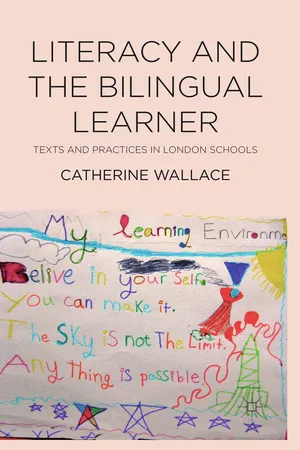
Literacy and the Bilingual Learner
Texts and Practices in London Schools
- English
- ePUB (mobile friendly)
- Available on iOS & Android
eBook - ePub
About this book
Literacy and the Bilingual Learner explores the literacy development of bilingual learners in London (UK) schools and colleges through a series of vignettes and case studies of learners and their educational experiences.
Information
Topic
EducationSubtopic
Education General1
Texts and Practices: Sociolinguistic
and Political Perspectives
In this chapter I discuss the role of literacy practices and texts within educational contexts. Recent literature has tended to privilege practices over texts, the performer or doer over the material substance we draw on (see, for instance, Street 2012). Here I wish to bring the text into sharper focus, as a necessary mediating factor in literacy practices, especially in the context of schooling, where skill as readers and writers of linear text continues to offer the best chance of educational success. At the same time I will discuss literacy from two perspectives: first, at the micro level, as a sociolinguistic process and second as a social and political phenomenon. What counts as reading or writing, particularly in school, is linked to wider cultural values and expectations embedded in educational policy and political decree.
Literacy: the great divide
Literacy is the major theme of this book, raising the highly charged issues, social, educational and political which are associated with the word. Over the past thirty years or so there has been something of a great divide among literacy scholars; while those of a more psychological turn prefer to talk of reading and writing as universal cognitively based skills, others favour the view of literacy as social practice. Brian Street (1984, 1995) has famously talked of autonomous and ideological views of literacy: the former seeing the acquisition of literacy as everywhere the same, while an ideological view argues for the sociocultural contextualization of literacy. Street’s work built on the ground-breaking ethnographic study of a fellow anthropologist, Shirley Brice Heath (Heath 1983) who studied three literacy communities in the United States, over thirty years ago. This led to the characterization of literacy as cultural practice, rather than as a cognitive or language skill. Street’s work in what has become known as the New Literacy Studies is tied to the conceptualization of literacy favoured by those such as Langer who note: ‘Rather than seeing (literacy) as composed of independent skills and proficiencies that are called upon at needed moments … the educated individual calls upon a multi-layered history of experiences with language and content, cutting across many contexts’ (Langer 2001: 838).
Literacy and schooling
Recent scholarship in the New Literacy Studies group is largely concerned with the ‘new kinds of technical formations and practices associated with the use of computer and digital technologies’ (see Snyder 2009: 141). Schooling is seen to exert a dead hand here, in particular the continuing book culture which, Snyder suggests, neglects or side-lines the information and communication technologies. I want to argue, however, that school is where literacy education is played out for most of us, that literacy collocates strongly with the world of school and that while pupils and teachers need to embrace new technology such as interactive whiteboards and computers, skill in handling the print text remains key, especially for emerging writers and readers or those learning in a second language. Only more privileged groups can bypass the conditions of formal education. Here then my concern is with what literacy means for bilingual learners within educational institutions, as well as the ways in which students and teachers handle the constraints and tensions they experience.
In many ways literacy is co-terminous with education. As Olson (1994: 43) claims, literacy in Western cultures is not just about ‘learning the a, b cs; it is learning to use the resources for writing for a culturally defined set of tasks and procedures’. Particularly in the UK, achievement in literacy is strongly bound up with overall educational success, as noted by Robin Alexander (2003). But Alexander also indicates in his study of the cultures of schooling across five countries (see Alexander 2000) that it is simplistic to talk of ‘western’ notions of literacy education. He shows how nations such as France, the United Kingdom and the United States differ ideologically in their approach to schooling, and, by extension, in how they view the role of literacy within education. One difference is the privileging of different kinds of talk, which I discuss in future chapters. What western nations share however is the fact that literacy is viewed as a major kind of cultural capital. For new arrivals into western educational systems, however skilful their oracy, expressed for instance through oral narratives both in the home language and English, without the ‘right’ kind of literacy – to be discussed further below and in Chapter 2 – future academic and professional success will elude them.
Those writing within the New Literacy Studies tradition have tended to see everyday literacies as the point of departure: we map out the quotidian literacy experiences of young people and take them into schooling. Street (2009: 28) makes the point that ethnographically trained trainers might pass knowledge of home literacies and numeracies on to literacy facilitators. Underpinning such counsel, however, is an unproblematized view of educational institutions. As Yandell notes, there is a tendency to treat the literacy practices of schooling as a constant, rather than full of tensions and contradictions, as in any other arena of social life (Yandell 2012). Also, the journey between home and school may be complex and circuitous: school literacies might influence home and everyday literacies so that tastes or values developed in school impact on home-reading practices. Influence is a two-way street. Admittedly, certain literacies may not make the journey from home to school – nor indeed from school to home. Bernstein (see Bernstein 1996: 171) talks of how literacies which are strongly tied to everyday, common sense knowledge – what he calls ‘horizontal literacies’ – may resist the translation to schooling. Equally literacy practices promoted by school may not make a smooth journey into home for some children, as we discuss in Chapter 3.
Gregory and Williams in their ground-breaking study of the lives and literacies of different generations of, mainly poor, families living in the East End of London, document how children ‘syncretise or blend home, community and school language to enhance both home learning and official school achievement’ (Gregory and Williams 2000: xvii). They challenge the supposed link between poverty and poor literacy skills, offering vivid examples of achievement by the young Bangladeshi women they talked to. Nonetheless, it cannot always be assumed that cultural practices, simply because valued by particular social class, ethnic minority or religious groups, support educational advancement. We need to be alert to the risk of romanticizing peer-group or home practices which might be ultimately narrow and conservative in their effects, rather than liberating or cognitively enriching, a point made some years ago by Giroux who notes that the culture students bring ‘may be in dire need of critical interrogation and analysis’ (see Giroux in Macedo and Freire 1987: 5). Recently, in a neoliberal era, commercialization and marketization have increased as global forces, shaping local cultural practices in ways which may be even less supportive of literacy for empowerment.
Empowerment is an over-used word and requires justification. I use it here to emphasize my concern in the book with educational access and social justice, dedicated less to the furtherance of individual rights than to ensuring equality of opportunity for social groups which may not achieve their full potential, such as the learners in this book. Not all the resources which these learners bring will exert the same leverage in the public domain. It is not that out of school knowledge is of no matter but that it needs to be brought into a productive relationship with school knowledge to create a literacy for the longer term. Clearly we are positing an ideal world: much school literacy practice offers meagre evidence of the creation of significant cultural capital. Nonetheless it is the task of school to develop forms of literacy to prepare learners for an unpredictable world, and which have global reach as well as local relevance. In particular, for those of us concerned with educational advancement, we need to address the matter of skill, being good at literacy. There is a tendency with some accounts of literacy as practice to celebrate the uses of literacy over learning, underplaying the importance of achievement, a sense of progress or longer-term educational consequences.
A sociolinguistic perspective: bringing practice and text together
While the New Literacy Studies have enriched our understandings of literacy as situated cultural activity, it is possible to marry the research on literacy practices with the concerns with schooling which revolve around the text, in particular the print text, as the material form which mediates in literacy education. In a book about education both are important; so, though I broadly subscribe to the cultural practice view of literacy, I shall also be concerned not just with the role of the text, but with the ways in which readers and writers access or produce texts in educational contexts and how the teacher mediates in this process.
In the following sections I shall look at what the practice view affords educators and then turn to the role of the text, and how we might want to conceptualize the text as the prime mediating tool in literacy education. I shall bring these strands together under what I call a sociolinguistic perspective. Linguistic ethnographers such as Blommaert et al. (2005), Rampton (1995) and Harris and Lefstein (2011) have investigated classrooms using a detailed sociolinguistic analysis. Here my interest is in a sociolinguistics tied more firmly to pedagogy, in particular the ways in which literacy lessons are enacted by teachers and learners with varying degrees of effectiveness. The approach is sociolinguistic in that it addresses three sociolinguistic principles: context dependence, the notion of repertoire, and variation. Practically this means that literacy as a practice is grounded in situational, cultural, and wider political contexts. Second, language users draw from a linguistic repertoire; this is particularly significant in the case of the learners in this book, who use a range of different languages and varieties in different contexts of use. Finally, the behaviour of readers and writers is variable as they react to textual and contextual constraints and possibilities. Acknowledging variability as an inherent element of language behaviour, of which reading and writing are a part, offers a challenge to the view of language and learning as fixed at any point of time (a view we see as embedded in the idea which dies hard in the United Kingdom at least, that learners have a ‘reading age’, for instance). At the same time, a sociolinguistic view of the text sees the text not as a bounded discrete object but as always ‘text in context’, taking on value and meaning from the physical and cultural setting, which includes, crucially, what the reader brings to the text.
Literacy as practice
Literacy domains
Once literacy is viewed as social practice one can classify literacy acts in ways similar to that in which speech has been classified by sociolinguists. Fishman famously proposed the notion of domains (see Fishman 1968) as areas of daily life such as family, friendship, education, work and religion. We can adapt these in the case of reading and writing to contextualize literacy by mapping literacy practices on to daily life: thus our students will read different things in different ways for different purposes in their religious, work, private and intimate lives. Rampton (1995) and Hewitt (1986) document the ways in which young people take on the identities and language uses of their peers through a process of cultural exchange which Rampton calls ‘crossing’. However, within this fluidity it is still possible to see patterns in the deployment of linguistic resources. Thus rather than talk merely of ‘multiple’ literacies such as computer literacy, media literacy, Koranic literacy and academic literacy, one can see how far they are domain specific and/or where they have the potential to cross domains. For bilingual and multilingual learners, domain specific literacy is likely to involve not just a functional differentiation of literacy to serve a different purpose, but a different language. Appreciation of this wider landscape of our learners’ literacy lives is important to the understanding of the literacy practices and identities which I discuss in future chapters.
Multiple literacies
A few years ago in preparation for a talk on multiple literacies. I asked a former research student of mine, now back home in Pakistan, to document the literacy practices of her daily life in the form of a literacy diary. This was the result.
Table 1.1 A literacy diary
Fariha Hayat
Friday, May 16, 2008 | Reading | Writing |
5:15 am | An excerpt from Quran (my holy book) that is written in Arabic. However, I don’t really define it as ‘reading’ since I only decode Arabic words; I am unable to comprehend what it says! As a scaffold, the Quranic text I use is with Urdu translation otherwise what’s the point of reading Quran when one is illiterate in Arabic? This is just a ‘quick fix’ solution since translation can never equate the original | None |
7:00–7:30 am | English Newspaper: DAWN | Playing Crossword that features in DAWN just to kick start my mind |
8:30 am–6:00 pm | Official documents (in English) especially since we had a faculty meeting this Friday | Official documents(in English) Mobile texts to friends: code mixed and/or in Romanized Urdu (Urdu written in English) |
Reading/marking students’ assignment for Academic Literacy (in English) | ||
Mobile texts from friends: code mixed and/or in Romanized Urdu (Urdu written in English) | ||
I take my ‘reading circle’ every alternate Friday. This week we read together two short articles on plagiarism; (1) a point (2) counter point. However, we discussed these ‘bilingually’ (mostly English and Urdu to decode confusing bits) | ||
Graffiti (mostly local/global politics and slogans) on walls, etc. in English, Urdu, code mixed | ||
Billboards in both English and Urdu. The more fashionable products are mostly in English (of course) |
Karachi-Pakistan 2008.
It is noticeable that Fariha does more reading than writing in everyday life, even as an academic; day to day, most of us process far more texts than we ever produce. Not all the learners in this book have the level of sophistication of Fariha. However many have much richer literacy repertoires than is commonly acknowledged by the wider society. Indeed teachers may be unaware of the linguistic agility which their bilingual learners are daily required to exercise. Many of our students have, like Fariha, multilingual language repertoires and some are bi or multiliterate. Research has shown (see Cummins 2000; Swain et al. 1990) that literacy ability in one language will transfer across to literacy in other languages, even when the orthography is different. As Cummins puts it ‘students who have developed literacy in their L1 will tend to make stronger progress in acquiring literacy in L2’ (Cummins 2000: 173). This is on the basis of what he earlier had conceptualized as ‘the interdependence hypothesis’ (Cummins 1979). While Bialystok (2001: 174) acknowledges that the potential impact of bilingualism on children’s literacy may depend on the educational context she also points out that many learners approaching texts in a second language will be able to draw on literacy knowledge in the first language in productive ways. One reason for not over-emphasizing the discreteness of literacy skills and aptitudes is that the evidence is strong for the interconnectedness of these across languages and contexts. I shall argue in this book for the presence of an overarching aptitude and disposition related to what it means to be a reader (and writer), even while these are deployed and inflected in culturally different ways and through different languages.
Literacy as talk
Talk mediates in literacy as everyday practice, whether we are discussing what might be included in a shopping list or skimming through the TV or film programmes with a friend or partner to choose entertainment. Talk supports and surrounds reading and writing especially for early learners. For those learning English as a second language talk is indeed a necessary condition of learning to read. Only in skills based autonomous instruction is it assumed to be possible to teach literacy without a foundational knowledge of the spoken language. In cases where learners have had only limited access to the syntax and vocabulary of English, reading becomes a mechanical practice, devoid of meaning. For those bilingual learners with a good oral knowledge of the target language, talk serves as the bridge into second language literacy. Educators such as Gibbons (2002) and Martin (1984) describe a mode continuum, by which spoken language can be progressively reshaped and elaborated to take on some of the features associated with written language. Gibbons gives a helpful example of what this might look like in the case of a c...
Table of contents
- Cover
- Title
- Copyright
- Contents
- List of Figures and Tables
- Acknowledgements
- A Note on Terminology
- Introduction: Setting the Scene
- 1 Texts and Practices: Sociolinguistic and Political Perspectives
- 2 Literacy Instruction and the Bilingual Learner
- 3 Bilingual Learners in a Multilingual Primary School: Literacy Narratives about Texts and Practices
- 4 New Arrivals in a Multilingual Secondary School: Literacy Narratives about Texts and Practices
- 5 New Arrivals in the Classroom: Literacy and the Curriculum
- 6 Adult Bilingual Learners: The Foregrounding of Critical Literacy in the Classroom
- 7 Pulling the Threads Togethe
- Bibliography
- Index
Trusted by 375,005 students
Access to over 1.5 million titles for a fair monthly price.
Study more efficiently using our study tools.
Frequently asked questions
Yes, you can cancel anytime from the Subscription tab in your account settings on the Perlego website. Your subscription will stay active until the end of your current billing period. Learn how to cancel your subscription
No, books cannot be downloaded as external files, such as PDFs, for use outside of Perlego. However, you can download books within the Perlego app for offline reading on mobile or tablet. Learn how to download books offline
Perlego offers two plans: Essential and Complete
- Essential is ideal for learners and professionals who enjoy exploring a wide range of subjects. Access the Essential Library with 800,000+ trusted titles and best-sellers across business, personal growth, and the humanities. Includes unlimited reading time and Standard Read Aloud voice.
- Complete: Perfect for advanced learners and researchers needing full, unrestricted access. Unlock 1.5M+ books across hundreds of subjects, including academic and specialized titles. The Complete Plan also includes advanced features like Premium Read Aloud and Research Assistant.
We are an online textbook subscription service, where you can get access to an entire online library for less than the price of a single book per month. With over 1.5 million books across 990+ topics, we’ve got you covered! Learn about our mission
Look out for the read-aloud symbol on your next book to see if you can listen to it. The read-aloud tool reads text aloud for you, highlighting the text as it is being read. You can pause it, speed it up and slow it down. Learn more about Read Aloud
Yes! You can use the Perlego app on both iOS and Android devices to read anytime, anywhere — even offline. Perfect for commutes or when you’re on the go.
Please note we cannot support devices running on iOS 13 and Android 7 or earlier. Learn more about using the app
Please note we cannot support devices running on iOS 13 and Android 7 or earlier. Learn more about using the app
Yes, you can access Literacy and the Bilingual Learner by Catherine Wallace in PDF and/or ePUB format, as well as other popular books in Education & Education General. We have over 1.5 million books available in our catalogue for you to explore.