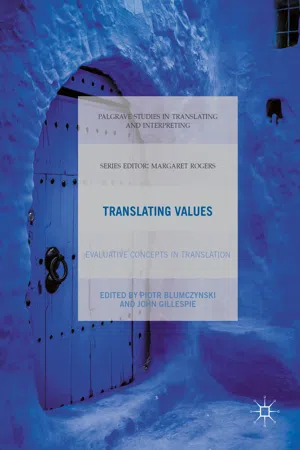
eBook - ePub
Translating Values
Evaluative Concepts in Translation
- English
- ePUB (mobile friendly)
- Available on iOS & Android
eBook - ePub
Translating Values
Evaluative Concepts in Translation
About this book
This collection explores the central importance of values and evaluative concepts in cross-cultural translational encounters. Written by a group of international scholars from a diverse range of linguistic and cultural backgrounds, the chapters in this book consider what it means to translate cultures by examining core values and their relationship to key evaluative concepts (such as authenticity, clarity, home, honour, or justice) and how they influence the complex multidimensional process of translation. This book will be of interest to academics studying cross-cultural and inter-linguistic interactions, to translators and interpreters, students of translation and of modern languages, and all those dealing with multilingual and multicultural settings.
Information
© The Editor(s) (if applicable) and The Author(s) 2016
Piotr Blumczynski and John Gillespie (eds.)Translating ValuesPalgrave Studies in Translating and Interpreting10.1057/978-1-137-54971-6_11. Introduction
Piotr Blumczynski1 and John Gillespie2
(1)
School of Modern Languages, Queen’s University Belfast, Northern Ireland, UK
(2)
School of Modern Languages, Arts and Humanities Research Institute, Ulster University, Northern Ireland, UK
This book has emerged from an international collaborative research project that ran from 2012 to 2015, bringing together scholars from the UK and Ireland, as well as Austria, France, India, Italy, Jordan, Poland, Spain, and the USA. Funded by the Arts and Humanities Research Council’s theme ‘Translating Cultures’, the theme itself provided our overarching research problem. What does it mean to translate cultures?
‘Culture is one of the two or three most complicated words in the English language’, observes Raymond Williams in his classic Keywords. A vocabulary of culture and society (1976: 87). For such a complicated word and complex concept, it is notable how many of its definitions stress the centrality of values. Kroeber and Parson (1958: 583) identify culture with ‘transmitted and created content and patterns of values, ideas, and other symbolic-meaningful systems’. Clyde Kluckhohn writes that ‘the essential core of culture consists of traditional ideas and especially their attached values’ (1962: 73). Kluckhohn, who led a Harvard research group investigating values in several distinct cultural groups, acknowledged in the group’s concluding symposium that ‘the study of values seemed to merge with the study of culture, and to engage with the same problems’ (Powers 2000: 27). In short, culture revolves around values. They hold the cultural community together and underpin mutual interests. Indeed, it is impossible to conceive of a cultural community whose members hold opposite or otherwise incompatible values, so central are shared values to the very concept of culture. Translating cultures, therefore, above all involves engaging with their values.
Now, values can be understood as ‘conceptions, explicit or implicit, distinctive of an individual or characteristic of a group, of the desirable which influence the selection from available modes, means and ends of action’ (Kluckhohn 1951: 395) or simply as ‘core conceptions of the desirable’ (Rokeach 1979: 2). But the fact that they are core also means that they are often ‘invisible’ (Hofstede 2001: 11), wrapped in thick layers of cultural material. In his onion diagram representing the manifestation of culture at different levels, Hofstede places values at the core, surrounded by the successive layers of rituals, heroes, and symbols. But if values are ‘broad tendencies to prefer certain states of affairs over others’ (Hofstede 2001: 5), what happens when we encounter some other states of affairs, emanating from and supported by alternative sets of values? It is precisely here that translation—in its broadest sense—comes into the picture.
The aim of our project was to explore how values are translated: firstly, from tendencies and preferences into specific evaluative concepts—often expressed through key terms that underpin language-specific worldviews—and subsequently, in a process of negotiation within as well as between different communities. We started from a consideration of the role of English evaluative concepts (such as clarity, decency, fairness, or humility) in translating religious and devotional texts in a range of languages and cultures in the context of understanding this centrality of values to culture. We set ourselves the following questions: how is evaluation related to conceptualisation? How do values change and evolve over time? How are they embedded in linguistic, literary, cultural, and social contexts? What role does translation play in propagating or contesting certain values? What is the value of translation itself?
As the network grew and our research progressed, while keeping a broadly religious focus, the scope of the project widened out to other cultural areas. The study of evaluative concepts has proved fruitful—as the contributors to this volume, from diverse linguistic and cultural backgrounds, as well as bringing a broad range of research expertise, clearly demonstrate—and has resulted in remarkably rich insights, as a brief overview of the key research findings of each chapter makes clear.
Studying the role of cultural translation has meant raising awareness of the presence and power of values. James Underhill examines cultural barriers of meaning by looking at walls as barriers and boundaries from a multilingual ethnolinguistic perspective. He begins by exploring the symbolic value of walls, and then, their breaking down in the wake of the breaching of the Berlin Wall, demonstrating how its destruction has been recuperated by ideological, religious, and other cultural discourses. His subsequent corpus-based analysis provides a rich imagery of walls and their evaluative ambiguity: they may also be perceived as necessary and protective, contrasting with the dominant discourse of the need to bring walls down. Underhill argues that translators, acting as gateways set within the boundaries that nations and peoples build up around themselves, must apprehend, understand, and negotiate three spheres of values: the values of the source culture, of the target culture, and the space between, the space of encounter, where they can meet if they are willing to make the effort to transcend their inherent ethnocentrism, and strive to understand one another. This awareness can lead to positive cultural relations.
Elżbieta Tabakowska, in her discussion of the interplay between values and emotions in the complicated context of interlingual translation, continues a linguistic line of analysis and underscores the importance of increasing awareness of the role of values in the translation, in this case the emotions and values of the translator. Drawing attention to intercultural differences, she distinguishes between feeling emotions, emotional valuation, and speaking of values and emotions. She observes that, in (literary) narrative, emotional valuations are presented as either coming from the narrator or from her/his characters; they are either explicitly reported on or merely implied, and thus, left open to the reader’s interpretation. In the second part of her chapter, Tabakowska offers various examples demonstrating how the power and range of the original message may be distorted by the intervening presence of the translator, who brings to the translation process her/his own system of values and experience.
Worldviews and their underpinning values are perhaps most clearly articulated in religious systems. Accordingly, a significant number of further contributions focus on religious, devotional and ecclesiastic texts. Here, the emphasis is often on a transmission of meaning that preserves the truth of doctrinal concepts. In the context of Bible translation, James Maxey critiques three evaluative concepts of the act of translation, emanating from an equivalence paradigm—accuracy, naturalness, and clarity—and advances alternative criteria inspired by a proposed paradigm of hospitality: carefulness, authenticity, and transparency. He argues that this alternative triad is not only more defendable from a Translation Studies perspective, but also offers sufficient space to consider translation for non print-based media—specifically biblical performance translation. Maxey’s theory draws upon decades of research from performance translation in one particular community in central Africa, so it remains constantly sensitive to the practicalities involved. He highlights the value of translation experience as releasing translators who are no longer faced with a stable unchanging text, but rather who carefully translate a tradition that has become their authentic experience of previous authentic experiences, while remaining transparent to the otherness of the earlier traditions. This hospitable openness to the transmission of meaning to diverse cultures is based on the key value of respect for the culture of the other.
In the two following contributions, dealing with the translation of specific evaluative concepts found in the sacred texts of the world’s largest religions, the emphasis is on the avoidance of distortion in the transmission of religious values, where the mistranslation of terms and concepts can misrepresent religious truth. David Bell offers an analysis of the New Testament term hypotasso, which, in many English translations and in general reception, becomes synonymous with obedience and submission, specifically of women to men in marriage. However, the context of the Greek term seems to indicate it refers to an attitude towards authority more related to values like mutual respect and honour than mindless obedience or subservience. Similarly, Aladdin Al-Tarawneh discusses three Islamic concepts, often (mis)translated into English as friendship, justice, and retaliation. Relying on linguistic analyses and the exegesis of the Quran, he re-examines the semantic and evaluative profiles of these concepts, suggesting much richer images that, to a very significant extent, dispel some popular misconceptions about the values propounded by Islam. Both studies suggest very strongly that a better understanding of the contextual implications of key evaluative concepts in both source and target languages would help the translator minimize textual misunderstandings, as well as find ways of successfully improving the flows of communication and understanding between different religious traditions.
Shifts of meaning in religious translation can have negative consequences that an awareness of evaluative concepts can avoid. However, on occasion such translation can enhance the message of the original. Aleksander Gomola offers the analysis of an English translation of a contemporary Polish mystical text: Dzienniczek (‘Diary’) by Faustyna Kowalska. He discusses how the translation process affects the representation of evaluative concepts like homeland or morality, as well as a number of conceptual metaphors found in the original, concluding that the resulting lexical and stylistic differences between source and target texts result in an English translation of Dzienniczek that is in some respects more convincing as a mystical text than the original. Importantly, Gomola’s essay suggests that devotional texts continue to play a significant part in culture, shaping the worldviews of millions of people and offering them evaluative concepts that often guide them in their lives.
Two chapters offer a particular focus on nineteenth-century Ireland, exploring the interplay between the various historical, moral, religious, and sociocultural forces that shaped translations in that time and place. They show that translations can have far-reaching social and cultural consequences, influencing behaviour and belief over many years. Michèle Milan studies the many shades of meaning behind the concept and value of simplicity, examining the poetics of simplicity within the framework of translation history. Her twofold investigation builds, firstly, upon a broad range of literary, translation and sociocultural studies, with special attention to classic simplicity, and then draws on a survey of nineteenth-century translation in Ireland. Milan demonstrates the inter-relation of the concept not only with ideas of plainness, soberness, clarity, chastity, and purity, but also both with romantic notions of naturalness and authenticity, and with democratic ideals of access and equality. Anne O’Connor assesses how translation was used to promote certain religious worldviews and values in nineteenth-century Ireland. Drawing on the private correspondence of Cardinal Paul Cullen (1803–1878) as a case study, she shows how his translation efforts were an effective means of advancing a religious view, and how private letters had a public function in promoting ultramontane Catholic ideologies. The stream of translation present in private letters shows its important role in the multilingual world of the Catholic Church, and how essential it was for communication, self-promotion, and influence at this time.
Two further contributions investigate the translational handling of evaluative concepts in missionary endeavours in Asia, underscoring the tension between the delivery of a universal Christian message, the specific cultural background of the missionaries who proclaim it, and the religious and cultural context into which it is proclaimed. Hephzibah Israel discusses the term ‘Protestant’, which rose out of the specific religious and political contexts of Reformation Europe, and considers how it travelled to South Asia. In particular, she explores the range of meanings, sacred and secular, inherent in the untranslated term ‘Protestant’ in nineteenth-century Tamil-speaking South India and Sri Lanka. Focusing on a bilingual (Tamil and English) journal Utaya Tārakai/Morning Star, published in Jaffna from 1841, she argues that the enterprise to shape a ‘rational’ and improved public opinion was possible by equating ‘Protestant’ with ‘rationality’, where the ‘Protestant’ position is the only ‘reasonable’ one. Similarly, Gerda Wielander provides a succinct analysis of the translation and expression of Christian values in the modern Chinese context. Starting with an historical overview of translational encounter during the nineteenth century, she explains the particular significance of the Chinese Union Version (1919) within the broad attraction of Christianity at this moment in Chinese history. She goes on to examine Bishop K.H. Ting’s (1915–2012) attempts to create a ‘theology rooted in the Chinese soil’, an example of how core Christian values have been negotiated in this process of translation into a very specific Chinese cultural context. Wielander provides two fascinating contemporary examples of the tension between localization and the retention of the universality of the Christian faith: calls for a Chinese language theology, and the official expectation of a Sinification of Protestant Christianity.
Three contributions shift focus onto the translation of literary texts. David Johnston demonstrates how the interplay between private desire and ingrained codes of a public morality centred on honour, shame, and retribution lay at the heart of how Spanish Golden Age theatre performed community to itself. Using as an example Calderón’s play Painter of Dishonour, he shows that translation, in terms of its activities as an historicizing mode, is well placed to trace the development of the coercive components of this morality across time and space. But, as a re-creative mode, translation also enables audiences today both to understand the moral weight that such terms exercised in their own context, and to relate them to the different moral observance of our contemporary moment. In that way, Johnston proposes a theory of translation for the stage that refuses to bifurcate between past and present, one that is both historicizing and re-historicizing.
John Gillespie considers Samuel Beckett’s bilingual oeuvre and examines how he translates his works, sometimes originally written in French, sometimes in English, into the other language—or rather recreates them in the other language. Gillespie shows that the meanings of the author, who is also his own translator, necessarily shift between cultural contexts. By considering specific references to God, the Bible and Christianity, which pervade Beckett’s work, looking in particular at En attendant Godot, Gillespie demonstrates that there is a marked difference of tone and cultural resonance in English when it comes to dealing with matters of belief, indicating the emotional legacy of Beckett’s experience and evaluation of religion in Ireland, as well as his profound frustration with it.
Adam Głaz’s contribution takes the discussion one stage further; values become especially cherished when they are perceived to be most vulnerable: for example, house and home are particularly vulnerable in times of war and its immediate aftermath. Based on a close analysis of the English renderings of the Polish dom (‘house/home’) in three post–World War II novels, Głaz considers the valuation inherent in the Polish (con)texts on several interwoven levels: the lexical systems of the two languages and the symbolism they activate, the properties of the texts being translated, and the broad cultural background underpinning the interpretation of the novels. Using Jordan Zlatev’s (2009: 179) cognitive semiotic framework, Głaz a...
Table of contents
- Cover
- Frontmatter
- 1. Introduction
- 2. Who Wants Walls? An Ethnolinguistics of Insides and Outsides
- 3. Emotional Valuation: Values and Emotions in Translation
- 4. Alternative Evaluative Concepts to the Trinity of Bible Translation
- 5. Submission and Its Conflicting Value Systems: A Case Study
- 6. Re-examining Islamic Evaluative Concepts in English Translations of the Quran: Friendship, Justice and Retaliation
- 7. English Evaluative Concepts in a Contemporary Devotional Christian Text. A Comparative Study of Dzienniczek by Faustyna Kowalska and Its English Translation
- 8. Clarity, Soberness, Chastity: Politics of Simplicity in Nineteenth-Century Translation
- 9. Letters to Italy: Translation and Religion in Nineteenth-Century Ireland
- 10. Improving the Public: Translating Protestant Values through Nineteenth-Century Bilingual Print Journalism in South Asia
- 11. Translating Protestant Christianity into China—Questions of Indigenization and Sinification in a Globalised World
- 12. Translating the Past: The Moral Universe of Calderón’s Painter of Dishonour
- 13. Beckett as Translator of Beckett: The Transmission of (Anti-?) Religious Concepts
- 14. Vulnerable Values: The Polish Dom (‘House, Home’) in English Translation
- 15. Smart Dreamers: Translation and the Culture of Speculative Fiction
- 16. Translation as an Evaluative Concept
- Backmatter
Trusted by 375,005 students
Access to over 1.5 million titles for a fair monthly price.
Study more efficiently using our study tools.
Frequently asked questions
Yes, you can cancel anytime from the Subscription tab in your account settings on the Perlego website. Your subscription will stay active until the end of your current billing period. Learn how to cancel your subscription
No, books cannot be downloaded as external files, such as PDFs, for use outside of Perlego. However, you can download books within the Perlego app for offline reading on mobile or tablet. Learn how to download books offline
Perlego offers two plans: Essential and Complete
- Essential is ideal for learners and professionals who enjoy exploring a wide range of subjects. Access the Essential Library with 800,000+ trusted titles and best-sellers across business, personal growth, and the humanities. Includes unlimited reading time and Standard Read Aloud voice.
- Complete: Perfect for advanced learners and researchers needing full, unrestricted access. Unlock 1.5M+ books across hundreds of subjects, including academic and specialized titles. The Complete Plan also includes advanced features like Premium Read Aloud and Research Assistant.
We are an online textbook subscription service, where you can get access to an entire online library for less than the price of a single book per month. With over 1.5 million books across 990+ topics, we’ve got you covered! Learn about our mission
Look out for the read-aloud symbol on your next book to see if you can listen to it. The read-aloud tool reads text aloud for you, highlighting the text as it is being read. You can pause it, speed it up and slow it down. Learn more about Read Aloud
Yes! You can use the Perlego app on both iOS and Android devices to read anytime, anywhere — even offline. Perfect for commutes or when you’re on the go.
Please note we cannot support devices running on iOS 13 and Android 7 or earlier. Learn more about using the app
Please note we cannot support devices running on iOS 13 and Android 7 or earlier. Learn more about using the app
Yes, you can access Translating Values by Piotr Blumczynski, John Gillespie, Piotr Blumczynski,John Gillespie in PDF and/or ePUB format, as well as other popular books in Languages & Linguistics & Translating & Interpreting. We have over 1.5 million books available in our catalogue for you to explore.