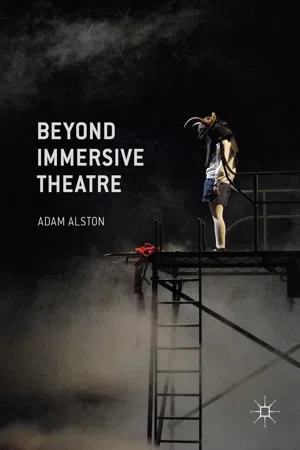
My interest in immersive theatre was piqued in 2007 after experiencing two performances that were both intoxicating and exhilarating, and seemed to capture something of an innovative streak in theatre performed in Britain at the time: Punchdrunk’s The Masque of the Red Death (2007–2008) and a piece by members of De La Guarda called Fuerzabruta (2005–).1 The first was a delirious romp through the haunting, morbid imaginings of Edgar Allan Poe. Audiences wore masks, a Punchdrunk trademark, and were free to roam throughout the various rooms, staircases and corridors of London’s Battersea Arts Centre (BAC), rifling their way through immaculately detailed and thematically cohesive environments, and encountering performed excerpts plucked from Poe’s oeuvre along the way. The second, Fuerzabruta, was performed in a large tent at the Edinburgh Festival Fringe while it was on a world tour. For theatre critic Lyn Gardner, it was ‘like having a spotlight shone in your eyes while being hit with a sledgehammer by someone who insists, “We have ways of making you have fun”’ (Gardner, 2007). A series of spectacles followed on from one another in the centre and all around a single promenade space: a man running through cardboard walls atop a giant treadmill; dancers spinning many metres above the spectators’ heads on a reflective silver sheet that encircled the audience; a giant transparent swimming pool containing a thin film of water that descended to within touching distance, soon to become enlivened by the crashing and swirling of performers who allowed the water to refract kaleidoscopic rainbows of light; and descent into an all-out, water-drenched party fuelled by pounding techno thuds.
In both cases, audiences enter ‘experience machines’. Experience machines are enclosed and other-worldly spaces in which all the various cogs and pulleys of performance – scenography, choreography, dramaturgy, and so on – coalesce around a central aim: to place audience members in a thematically cohesive environment that resources their sensuous, imaginative and explorative capabilities as productive and involving aspects of a theatre aesthetic.
The term ‘experience machine’ is not my coinage; it derives from a thought experiment proposed by the philosopher Robert Nozick, who describes it as a kind of flotation tank that stimulates the brain to artificially induce desired experiences (Nozick, 1974, pp. 42–5). He asks: is the experience machine preferable to the more difficult pursuit of desire in everyday life, as an autonomous individual? The reference may seem odd because Nozick is a political philosopher concerned with the role of the state and not with immersive theatre performances. More specifically, he is a neoliberal: a defender of the absolute sovereignty of inviolate individuals and of ‘a minimal state, limited to the narrow functions of protection against force, theft, fraud, enforcement of contracts, and so on’ (Nozick, 1974, p. ix). For Nozick, the experience machine represents the pursuit of hedonism and subservience to a system that rewards subjects with desirable experiences at the expense of independence – independence at the phenomenological level of experiencing independence, and at the ontological level of being an independent person. He loathes the idea of submitting to ‘a world no deeper or more important than that which people can construct’ (Nozick, 1974, p. 43), and uses the thought experiment to argue that the sovereignty of inviolate individuals supersedes the immediate gratification of desire on moral grounds.
The experience machine envisaged by Nozick bears some similarity to the immersive environments that audiences enter in performances like The Masque of the Red Death and Fuerzabruta, along with crucial dissimilarities. Both performances offer escapist experiences that take place in aesthetic environments that fully surround, or ‘immerse’, their audiences, and that encourage audiences to ‘give into’ and become ‘swept up’ by the experiential qualities of a performance. However, they also invite individual audience journeys through these environments, particularly in Punchdrunk’s masked performances, which are linked to a set of expectations that include promenading and participating, and a physically active and explorative pursuit of personal pleasure. In other words, they involve activities that are precluded in Nozick’s thought experiment, which figures the plugged-in subject as an indolent and inert dreamer. While these performances resonate with the experience-centred and all-encompassing environments that Nozick envisions, they also welcome productive audiences whose industriousness and thirst for feeling ideally supplants torpidity. The Masque of the Red Death and Fuerzabruta therefore muddy distinctions between submission to an engaging experience and a mode of encounter that celebrates personal freedoms to act and explore in experientially stimulating environments.
I have subsequently journeyed to countless old warehouses, disused office blocks, appropriated municipal buildings, abandoned factories, populated and condemned housing estates and towers, purpose-built and temporary structures, tents, railway arches, wine cellars, a range of underground storage units and tunnels, shipping containers, mobile and stationary vehicles (and occasionally theatres) to experience a raft of immersive theatre performances, most of which tend to share a set of broadly defined features. Immersive theatre centres on the production of thrilling, enchanting or challenging experiences, which feature as an important part of an immersive theatre ‘artwork’ that audiences co-produce by doing more than watching, or by augmenting the productivity of watching as a prospectively participating spectator. Audiences might roam freely through spaces, interact and/or dialogue with performers and/or other audience members, or physically engage with a performance environment that surrounds them completely. They are expected to be alert, engaged, involved and prepared for invigoration. And they are expected to put their psychological and physiological capabilities to work, either through some form of physical exertion, or through an intimate involvement in performance that enlivens the affective possibilities of an uncertain future.
Beyond Immersive Theatre identifies and responds to an intensification of audience productivity in immersive theatre that some of these features begin to signal, focusing especially on the limits of immersion and the ‘productive participation’ of audiences in a contemporary take on the experience machine. It recognises productive participation as a feature of immersive theatre aesthetics that stems from demands that are often made of audiences – demands to make more, do more, feel more, and to feel more intensely – and enquires into the meanings and values of productive participation. The term ‘productive participation’, then, really names a romanticism, modification and enhancement of an audience’s inherent productivity, rather than a discrete category of audience engagement. Moreover, the book approaches the intensification of audience productivity from a political perspective, tracing connections between modes of involvement and empowerment in immersive theatre and the economic and political contexts – particularly those impacted by neoliberalism – that embed immersive theatre performances and inform the analysis of immersive theatre aesthetics. Finally, while the book presents a critique of productive participation as a feature that recurs in neoliberalism’s political and economic structures, it also sets out to identify and explore practices that diversify and evolve immersive theatre aesthetics in ways that might question or frustrate the pervasiveness and impact of neoliberal production and productivity, on however small a scale.
The ‘beyond’ in the book’s title is therefore not intended to announce the obsolescence of immersive theatre; rather, it refers to that which seems or is meant to remain outside the physical boundaries of an immersive environment. More specifically, the term is intended to draw attention to how the political and economic contexts that couch immersive theatre performances – including the nature and effects of a government’s neoliberal policies and philosophy, and innovations in economic production and consumption – might enhance understanding of immersive theatre aesthetics and especially the politics of audience immersion and participation. What are the relevancies of these contexts for the scholarly analysis of immersive theatre, particularly with regards to audiences? How might they develop comprehension of the aesthetics and politics of audience immersion and participation? How total is the closure of an immersive environment from these contexts? Is the intensification of an audience’s productivity laudable? Is it empowering? What kind of politics exists in immersive theatre performances that claim no political agenda?
The next section sets out and unpacks some common features of immersive theatre performances, focusing on the positing of theatre audiences as productive participants. The section after that defines and historicises neoliberalism and the emergence of an ‘experience economy’ as contextual elements that inform and steer my critical approach to the production and consumption of immersive theatre aesthetics. I then position the book in a field of immersive theatre scholarship and in relation to studies of neoliberalism in socially engaged art and performance, and outline how some immersive theatre makers are upsetting the imaginary of the experience machine by frustrating productive participation. A final section introduces the methodology, structure and ambition of the book, which is ultimately intended as both a critique of the contemporary experience machine, and as an informed celebration of practices that respond to a pervasive romanticism of intensified productivity within and beyond immersive theatre.
Productive Participation
Immersive theatre is an ambiguous and generic referent, not least because there is no consensus over what it is that draws companies and artists together as makers of immersive theatre. For Josephine Machon, a leading scholar of immersive theatre aesthetics, the ‘area of study is broad and contestable’, refers to ‘pluralities of practice’ and ‘is impossible to define as a genre, with fixed and determinate codes and conventions, because it is not one’ (Machon, 2013, pp. xv–xvi, original emphasis). The murkiness of what exactly immersive theatre refers to is exacerbated once a broad range of companies and artists are taken into account that may not be as well known as Punchdrunk as makers of immersive theatre, but that nonetheless present an equally valid claim to be immersive theatre makers – or, in the absence of a direct claim, might still be recognised as such, or appear as occasional makers of immersive theatre. Such an approach might then consider: Analogue, ANU Productions, Art of Disappearing, Badac Theatre, Belt Up, Christopher Green & Ursula Martinez, Commonwealth Theatre, Coney, De La Guarda, dreamthinkspeak, Extant, FoolishPeople, Goat and Monkey, Grid Iron, Half Cut, Il Pixel Rosso (along with Silvia Mercuriali’s work outside of the company), Imagine Nation, Kate Bond & Morgan Lloyd, Kindle Theatre, La Fura dels Baus, Look Left Look Right, Lucien Bourjeily, Lundahl & Seitl, Nandita Dinesh, Nimble Fish, non zero one, Ontroerend Goed, Punchdrunk, Ray Lee, Rift (formerly Retz), Secret Cinema, shunt (along with work developed independently by members of the shunt collective), Sound&Fury, Teatro de los Sentidos, Theatre Delicatessen, Third Rail Projects, Visual Respiration, WildWorks and ZU-UK (formerly Zecora Ura).
These companies and artists are all (or have been) makers of contemporary theatre and performance, with some better known than others and some that may not have been pigeonholed in the mind of the reader as makers of immersive theatre, not least because several have only dabbled in immersive theatre making, or choose to refer to their work in other terms. However, what this list excludes is what came before their emergence, as well as other art contexts that involve audience immersion. It largely excludes civic performance and pageantry, happenings, environmental theatre, site-specific art and performance, installation art, and relational art, all of which bear at least some connection, in one form or another, to the work of the companies just surveyed.
Immersive theatre is a loose term. It can describe practices that precede the currency of the immersive moniker, just as understandings of immersive theatre will probably – hopefully – continue to evolve as practitioners experiment with audience engagement. For that reason, you will not find a rigid definition of immersive theatre in this book. What you will find are detailed examinations of common features of performances dubbed ‘immersive’ that focus on modes of productivity that are assigned to audiences in immersive settings, and to which audiences are invited to posit themselves as productive participants. You will find a narrative that seeks to identify what produces a sense of immersion, and what might frustrate an audience’s resourcing in the production of an immersive theatre aesthetic.
Theatre audiences who do not intervene directly in the action of performance are no more docile than pedestrians who are herded or amble between spaces in immersive theatre. To a certain extent, ‘productive participation’ is what audiences do in all theatre performances when they’re not sleeping, daydreaming or procrastinating (although some performances might still build on these activities). In ‘The Emancipated Spectator’, Jacques Rancière influentially critiques Bertolt Brecht’s and Antonin Artaud’s approaches to the engagement of theatre audiences to make a similar point, allowing his caricatured framing of each to stand in for twentieth-century theatre practice more generally. Brecht described the audience’s ‘critical approach’ to theatre as ‘our great productive method’, and he designed and mobilised dramaturgic and aesthetic strategies to awaken this kind of audience productivity (Willett, 1964, p. 187). And Artaud proposed ideas for staging proto-immersive theatre, as these ideas might be understood today, so as to ‘cruelly’ jolt audiences out of docility; an important aim was to facilitate the audience’s realisation that fiction is not what they encounter w...