- English
- ePUB (mobile friendly)
- Available on iOS & Android
eBook - ePub
About this book
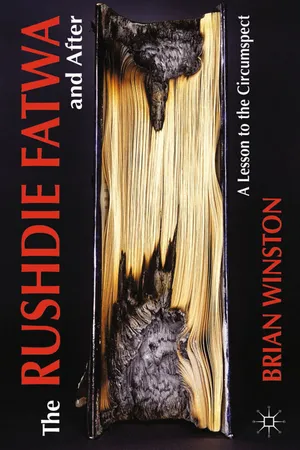
This resounding defence of the principles of free expression revisits the Satanic Verses uproar of 1989, as well as subsequent incidents such as the Danish cartoons controversy, to argue that the human right of free speech is by no means so secure that it can be taken for granted.
Information
Topic
PhilosophySubtopic
Literary Criticism Theory1
A Story to Pass the Waking Hours of the Night
Night 1, ‘The Merchant and the jinni’, The 1001 Nights
The Original Offence
The editorial adviser’s tale
The Satanic Verses affair was, in its formal structure, like a ‘nested’ story in The 1001 Nights where the teller of the tale encounters a character who tells a tale in which another character tells a tale and so on and so on. Circles within circles, encounter upon encounter; so, in fact, the story of this affair does not begin with the stone Khomeini cast against Salman Rushdie’s fourth novel.
That first stone was cast by Khushwant Singh, writer and editorial adviser to Penguin of India who were to publish The Satanic Verses there. On vetting the manuscript – which puts him among the very small minority of players in this saga who actually read what Rushdie wrote (presumably) in its entirety – Singh informed the Indian press a week before the London publication that the book contained ‘derogatory’ references to Islam, Muhammad and the Qur’an (K. Malik, 2009: 1). His intervention meant the book would be far more widely noticed than if it had simply appeared in the usual way. In effect, his prognosis – that publication would ‘cause a whole lot of trouble’ – became a species of self-fulfilling prophecy.
Singh might have been marginal, if crucial, to this story, but he was no minor player. Born a Sikh, he became an agnostic but one not above retreating to a gurdwara in times of personal stress (Singh, 2002: 310, 370). He announced in his autobiography, Truth, Love and a Little Malice, that he wished to be buried according to Baha’i rights (Singh, 2002: 382). Like so many leading Indian politicians and intellectuals, he was born to wealth – his father had been knighted by the British – and educated as a lawyer in Britain; but, by profession, he became one of India’s most famous and admired journalists and broadcasters, sometime editor of the Hindustan Times and member of the Rajya Sabha. He was also a prolific novelist in his own right who did not mind risqué fiction or, to take one emblematic example of his taste, Ginsberg’s Howl (Singh, 2002: 391). Indeed, Singh even hosted the beat poet and his male lover in his own home (Singh, 2002: 346). In short, Singh, aged 99 (at the time of writing), is urbane, intellectual and sophisticated, a Westernised liberal figure and a rather unlikely character to be a catalyst for The Satanic Verses uproar.
Of course, it is entirely possible that, upon publication, The Satanic Verses would have provoked the response it did without his help. But other contentious fictions had appeared without uproar. For example, Naguib Mahfouz, Egypt’s greatest twentieth (Christian) century writer, published Children of Gebalawi in 1959. At his hands, as in Rushdie’s, narratives of the Abrahamic monotheisms were retold as fantasy (Ruthven, 2006: 385). Although banned in Egypt and many other Muslim countries, no fatwa was placed on Mahfouz’s head and he was to go on writing, eventually winning the Nobel Prize for literature in 1988. The book was not translated from Arabic to English until 1967, but, in either language, it demonstrates that offending Islamic sensibility did not automatically attract death threats.
The fact is that The Satanic Verses was scarcely unique in being disrespectful to Islam and Rushdie was not even the only ranking novelist with a Muslim background writing in English to offer a disparaging take on his ancestral faith and Muslim culture. Like Mahfouz, the Somalian Nuruddin Farah wrote a novel, Maps (1986), which, in some opinions, revealed him as being by inclination at least an ‘apostate’ (Mazrui, 1992). It can also be noted that, in some opinions, Farah is significant enough for a Nobel literature prize to be thought long overdue (Jaggi, 2012: 12). But in 1986, again, there was no uproar, although his politics forced him into exile – politics, not apostasy.
It is true, though, that between Children of Gebalawi and The Satanic Verses, a certain militancy in defence of Islam had become ever more evident. There were the long-running conflicts in the Indian subcontinent and the Middle East which pitted Muslim interests against others. Additionally, there was an escalating incidence of violent intercommunal (at least in part religious) strife all round the edges of the Muslim heartland – from the Balkans, through sub-Saharan Africa to the islands of Indonesia. The increasing flow of Muslims into the West was also creating its own deepening tensions. Nevertheless, the Umma had not yet acquired a conditioned reflex (as it were) to literary fiction perceived as hostile: after The Satanic Verses affair, the reflex seemed to be established, typically manifesting itself in violent spasms of public outrage.
In the 1980s, the very thought that fictions such as The Satanic Verses or Maps could become battlegrounds in what would shortly be called, more than a little tendentiously, ‘the clash of civilisations’ had yet to be articulated. The writing of history in terms of warring, hermetically sealed cultures had been classically expressed in Arnold J. Toynbee’s 12-volume A Study of History (1934–61). He saw in history a pattern of mass migrations importing alien external ‘churches’ into host civilisations, thereby transforming them. The integrated world of the late twentieth century was, however, rendering this vision only superficially attractive. Given a progressively more interdependent globe, the idea of a ‘clash’ can be nothing but a cover for Western supremacism. Equally, ‘[a]fter centuries of colonialism and an accelerating globalization agenda process dominated by Western media, Western technology, Western values, and Western products, arguments employed to defend the alleged uniqueness of non-Western cultural traditions against Western values ... may seem almost farcical’ (Ishay, 2004: 10). For Edward Said, the concept of an inevitable struggle between civilisations, with its unavoidable connotation of a ‘survival of the fittest’ outcome, was nothing less than ‘preposterous’: ‘One of the great advances in modern cultural theory is the realization, almost universally acknowledged, that cultures and civilizations are so interrelated and interdependent as to beggar any unitary or simply delineated description of their individuality’ (Said, 2003 [1978]: 348–9).1
Culturally everything – from the concept of ‘zero’ to the mobile phone, from the export of oil to the import of labour – suggests sibling rivalry, albeit far too often violent rivalry, rather than a battle to the death between warring aliens. Centuries of tolerance on the part of Islam towards adherents of its sibling Abrahamic monotheisms alone makes the claim of a clash of civilisations moot. Relations between the Umma and the West might have been strained, even on occasion to the point of invasions and occupations, terrorist outrages and interstate conflicts; but such upheavals were still in the 1980s primarily a direct function of politics and economics, not culture (in so far as that is distinguishable in this context), much less religion.
In short, Penguin had no reason to be concerned about Rushdie’s book and, moreover, its Indian subsidiary anticipated a hardback sale of only some 150 copies (K. Malik, 2009: 11). In my opinion, Singh, by raising the matter, abused his position at least morally if not legally. As an editorial adviser any response of his was, presumably, implicitly confidential, a matter of commercial privilege. His action determined the framework for the reception of the Rushdie book because it did not consider the work as a whole which the usual reviewing process would have done. Singh chose to advertise aspects of the novel, specifically the most fantastical sections, in the same spirit as that of an adolescent Western lad sharing with mates in the playground any ‘dirty bits’ which he chanced upon.
The Satanic Verses, it can be plausibly suggested, is a fiction designed specifically for Western consumption, an attempt vividly to enter the mentalité of the immigrant Muslim experience via the semi-realistic improbabilities of magic realism (A. Malik, 2005: 100). For Rushdie, the book is ‘about migration, metamorphosis, divided selves, love, death, London and Bombay’ (Subrahmanyam, 2009: 20). It was also, in his view, innocuous: ‘It’s very hard to be offended by The Satanic Verses,’ he said in a television interview, pre-recorded but transmitted on the day news of the fatwa reached the West. ‘It requires a long period of intense reading. It’s a quarter of a million words’ (Anthony, 2009: 6).
The words which most caught Singh’s attention are those, comparatively few, describing overt fantasies, dreams which, inter alia, thinly disguise elements of the history of Muhammad. There is the direct reference to some Qur’anic verses – the eponymous verses of Rushdie’s title – which a legend some two or three centuries after the time of the Prophet suggested that he had suppressed as having come to him from the Devil. This, of itself, was, it was claimed, ‘suggestively derogatory’ to the devout (K. Malik, 2009: 2). For one thing, although the incident was recorded by a number of Arab compilers in the ahadith, traditions, the term itself – ‘Satanic Verses’ – was coined, it is suggested, by the Orientalist and colonial adminstrator Sir William Muir in 1858 (for example Ahsan, 1982: 39). This was bad enough, but far more importantly, it was also offensive because the suggestion that the Prophet could have been misled by Satan raises the possibility that the Qur’an, or parts of it, might not be the word of God. This is anathema because: ‘The Qur’an was perfect, inviolable in the sense that a scientific manual was true. A single flaw in the text would call the rest into doubt’ (Ruthven, 2002: 42).
Rushdie also insults his Muhammad figure by giving him an offensive nickname, a play on the Prophet’s name coined centuries ago by the Crusaders. He mocks – in connection with Muhammad but in entirely tame language (‘fart’ is about as vivid as it gets) – such things as the Islamic code of sexual practice. ‘[S]odomy and the missionary position were approved of by the archangel, whereas the forbidden postures included all those in which the female was on top’ (Rushdie, 1988: 364). Finally, some whores take on the identity of Muhammad’s wives which proves very good for business at the brothel where they work:
For obvious reasons it was not politic to form a queue in the street, and so on many days a line of men curled around the innermost courtyard of the brothel, rotating about its centrally positioned Fountain of Love much as pilgrims rotated for other reasons around the ancient Black Stone. (Rushdie, 1988: 381)
It would not seem unreasonable to suggest that Rushdie’s presentation of this material was clearly designed to offer offensive ‘impieties’ but, it can be noted, his intention – what might or might not have motivated Rushdie’s speech act – is actually of no consequence in the context of the uproar the book’s publication provoked. Any critical assessment of his intentions, anyway, would surely find him wanting to be funny and, if hostile, accuse him of failing. The accusation that he intended to cause a furor, implicitly to help sell the book, is not only outrageous, it is also irrelevant. It is his readers’ reception of his text that is central. He is no more responsible, by this token, for causing some of them to find offence when he did not intend it than he is of failing to evoke it had he wanted it. In reception terms I can read the passages to which objection was so violently taken (the abstruse theological problem of the title, perhaps, apart) as smacking more of a comedic Life of Brian-level satire than a vitriolic assault.
Contrariwise, one Muslim opinion-former characterised it as ‘the most offensive, filthy and abusive book ever written by any hostile enemy of Islam’ (Al-Mugham al Ghamdi, 1989: 87). Even ‘sceptical’ Islamic opinion spoke of it as ‘an attempted annihilation of [Muslim] cultural identity’, equating this with the threat of physical genocide (Sardar, 2004: 281). For the distinguished academic Ali Mazrui, who had remained calm in the face of Nuruddin Farah’s Maps, Rushdie’s work was no better than Mein Kampf (Mazrui, 1990: 116–39). The Satanic Verses was not a thing of paper and ink but, in the eyes of Hesham el Essawy, chair of the Islamic Society for the Promotion of Religious Tolerance, a ‘monster’ (Appignanesi and Maitland, 1989: 59); but monstrous indeed was the Islamist response to it. It was to be some years before contrary forceful Muslim reaction was publicly heard when, for example, 91 writers and artists produced a collection in Rushdie’s defence – Pour Rushdie – unambiguously arguing for free expression (Abdallah, 1994 [1993]). The initial dominate reaction was far from this. It was as dangerous and threatening to the Western idea of liberty as was the book insulting and, supposedly, intimidating to Islam. The response would provoke an unprecedented, bloodstained attack on the principle of free speech and, thereby, strike at the very foundations of Western culture.
This is not to deny that Muslims had cause to be fearful of their position and safety. In the UK, thuggish attacks on individuals from South Asia (or of South Asian descent) had become prevalent enough for the activity to merit, in popular parlance, its own term – ‘Paki-bashing’. The community had needed to react to this constant hostility. They had been actively doing so on the streets since, at the latest, a clash between the fascist National Front and a body of mainly Punjabi immigrants, supported by the Anti-Nazi League, in Southall, London in April 1979. This is the incident that is said to mark the moment when British Muslims moved from passivity in the face of bigotry and harassment to a more active defensive posture (Tripathi, 2008: 50).2
Defensive actions could be expected to be sympathetically received, by the bien-pensants at least, when resistance is deployed, bravely, in the face of street-thuggery or worse. Sympathy was less certain to be forthcoming when Muslims, by extending these tactics in the Rushdie affair to embrace, say, public book burnings, demonstrated their own intolerance. Being offended, after all, is not the same as being discriminated against. The former is an invisible internal state while the latter is a visible consequence of the actions of third parties. There was a clear risk of exacerbating intercommunal tensions by reacting to an affront with mass public protest meetings. Indeed, fuel was perhaps being given by the community to its enemies, by choosing to fight perceived prejudice on such self-attested grounds.
That risk was publicly justified by the unique depth of Muslim anguish over the insult The Satanic Verses caused:
Any believer in freedom of expression and in the function and validity of literature can appreciate why a Western reader, educated in a presumably secular, liberal-humanist culture, may be bedeviled by all the fuss and furor about a mere book, a work of fiction containing a troubling dream sequence. However, in order to understand the enormity of what has been done [by Rushdie], a circumspect, tolerant reader needs to appreciate what the Prophet Muhammad means to a Muslim across the Muslim world and throughout their immigrant communities in the West. (A. Malik, 2005: 100)
This is the basis both implicitly and explicitly used to justify the need for action, even action deemed illegal by the host society. The argument is that violent demonstrations, bullying censorship, intimidation and murder are all warranted by religious necessity. This need is uniquely compelling in Islam: Muslims could do no other. Excoriating those who insult Islam is essential to the core identity of every believer. Rushdie, in effect, forced the Muslim response; it is he, not they, who carries the responsibility for what occurred.
One can well accept that this argument, to one degree or another, underlies the actions taken by many Muslims both during and after The Satanic Verses affair. Moreover, one need not question that it was truly felt to be compelling. Nevertheless, the extent to which it was actually supported by factors beyond the internal beliefs of the participants can be queried. Beyond the reality of personal affront, the legitimacy of the case for Muslim exceptionalism as a justification can be challenged. Three major elements can be discerned in this claim – the integration of religion and state in Islam, the relationship of the faithful to the Prophet Muhammad, the holiness and inerrancy of the Qur’an. None of these, however, are of themselves unique in kind although the other Abrahamic monotheisms nowadays produce markedly fewer adherents who would subscribe, unquestioningly, to the equivalent beliefs in their faiths.
The nearest Islam comes to being exceptional is that the Christian chas...
Table of contents
- Cover
- Title
- Copyright
- Contents
- Preface and Acknowledgements
- Introduction: A Lesson to the Circumspect
- 1 A Story to Pass the Waking Hours of the Night: The Original Offence
- 2 A More Remarkable Story: Throwing Down the Gauntlet
- 3 Give Me More of These Examples: Contagion
- Afterword: Perceive the Dawn of Day: Lessons to the Circumspect
- Notes
- Bibliography
- Index
Trusted by 375,005 students
Access to over 1.5 million titles for a fair monthly price.
Study more efficiently using our study tools.
Frequently asked questions
Yes, you can cancel anytime from the Subscription tab in your account settings on the Perlego website. Your subscription will stay active until the end of your current billing period. Learn how to cancel your subscription
No, books cannot be downloaded as external files, such as PDFs, for use outside of Perlego. However, you can download books within the Perlego app for offline reading on mobile or tablet. Learn how to download books offline
Perlego offers two plans: Essential and Complete
- Essential is ideal for learners and professionals who enjoy exploring a wide range of subjects. Access the Essential Library with 800,000+ trusted titles and best-sellers across business, personal growth, and the humanities. Includes unlimited reading time and Standard Read Aloud voice.
- Complete: Perfect for advanced learners and researchers needing full, unrestricted access. Unlock 1.5M+ books across hundreds of subjects, including academic and specialized titles. The Complete Plan also includes advanced features like Premium Read Aloud and Research Assistant.
We are an online textbook subscription service, where you can get access to an entire online library for less than the price of a single book per month. With over 1.5 million books across 990+ topics, we’ve got you covered! Learn about our mission
Look out for the read-aloud symbol on your next book to see if you can listen to it. The read-aloud tool reads text aloud for you, highlighting the text as it is being read. You can pause it, speed it up and slow it down. Learn more about Read Aloud
Yes! You can use the Perlego app on both iOS and Android devices to read anytime, anywhere — even offline. Perfect for commutes or when you’re on the go.
Please note we cannot support devices running on iOS 13 and Android 7 or earlier. Learn more about using the app
Please note we cannot support devices running on iOS 13 and Android 7 or earlier. Learn more about using the app
Yes, you can access The Rushdie Fatwa and After by B. Winston in PDF and/or ePUB format, as well as other popular books in Philosophy & Literary Criticism Theory. We have over 1.5 million books available in our catalogue for you to explore.