- Selected by Choice as an Outstanding Academic Title for 2011
- Brings together leading international scholars to consider ethical issues raised by globalization, the practice of journalism, popular culture, and media activities
- Examines important themes in communication ethics, including feminism, ideology, social responsibility, reporting, metanarratives, blasphemy, development, and "glocalism", among many others
- Contains case studies on reporting, censorship, responsibility, terrorism, disenfranchisement, and guilt throughout many countries and regions worldwide
- Contributions by Islamic scholars discuss various facets of that religion's engagement with the public sphere, and others who deal with some of the religious and cultural factors that bedevil efforts to understand our world
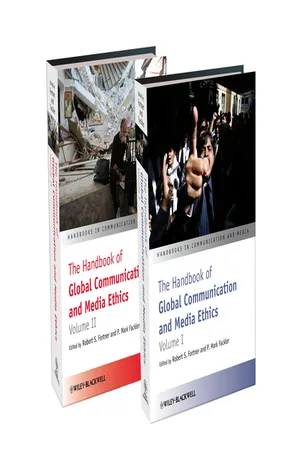
eBook - ePub
The Handbook of Global Communication and Media Ethics
- English
- ePUB (mobile friendly)
- Available on iOS & Android
eBook - ePub
The Handbook of Global Communication and Media Ethics
About this book
This groundbreaking handbook provides a comprehensive picture of the ethical dimensions of communication in a global setting. Both theoretical and practical, this important volume will raise the ethical bar for both scholars and practitioners in the world of global communication and media.
Information
1
Primordial Issues in Communication Ethics
In order to organize the primordial issues in communication ethics, and give them their correct scope and character, a standard typology should be useful. The study of ethics is normally divided into three parts: metaethics, normative ethics, and descriptive ethics.
Descriptive ethics reports on the moral behavior of specific persons or groups and studies the way ethical decision-making functions de facto. In terms of communication, descriptive ethics gives an account of failures and successes in journalism practice, locates the problems, and identifies specific dilemmas facing media workers. Metaethics addresses issues about normative theories and philosophically examines, among other things, the nature of the good and right, the problem of evil, and the validity of ethical theories. Normative ethics fuses actual morality with principles, concentrating on the justice or injustice of societies and institutions. Most broadly, normative ethics concerns the best ways for professionals to lead their lives and the principles to be promoted. Normative ethics seeks to establish norms and guidelines, not merely to describe details or deal with abstractions.
The normative category has received the greatest scholarly attention in media ethics, so five of the eight primordial issues presented below are from that domain: social justice, truth, non-violence, human dignity, and privacy. The need to retheorize classical theory and relativism are the two major issues in metaethics. Given the dramatic innovations in global media technology, instrumentalism is the premiere issue when conducting research into the morality of communication professionals and institutions.
Metaethics
1 Moral theory
Ethical theory always needs attention, and with a special urgency today. The classical canon – centered on virtue or consequences or duty – has opened the pathway to sophisticated work in media ethics. However, a new generation of media ethics in the multicultural and transnational mode requires that we retheorize existing theory (see Christians, 2009). Rather than ethical theories rooted in rationalism that are rule-ordered and gendered masculine, beliefs and worldviews should be made more central in theory-making. Rather than a rule-based system, theory should empower the imagination to give us moral discernment and an inside perspective on reality. Even though we make an epistemologically acceptable move to more dynamic theory, a crucial challenge is whether it answers the question, “Why should I be moral?” This is a summary of the first primordial issue; what follows is an elaboration.
Presuppositional thinking
Mainstream ethical theory, grounded in rationalism, produces moral principles that are unconditioned by circumstances. For ethical rationalists, the truth of all legitimate claims about moral obligation can be settled by formally examining their logical structure. Humans act against moral obligations only if they are willing to be irrational.
This kind of media ethics, rooted in classical moral philosophy, is unidimensional. Autonomous moral agents are presumed to apply rules consistently and self-consciously to every choice. Through rational processes, basic rules of morality are created that everyone is obliged to follow and against which all actions can be evaluated. In communication ethics, neutral principles operate by the conventions of impartiality and formality. This is an ethics of moral reasoning that arranges principles in hierarchical fashion and rigorously follows logic in coming to conclusions. Journalism ethics that follows this approach, therefore, is based on standards and doctrines that guide professional practice. In mainstream professional ethics, codes of ethics are the typical format.
Utilitarianism is a single consideration theory, for example. It does not simply demand that we maximize general happiness, but renders irrelevant all other moral imperatives that are in conflict with it. Moral reasoning is equivalent to calculating the consequences for human happiness. Utilitarianism presumes there is one domain that determines what we ought morally to do. The exactness of this one-factor model is appealing, but gains its validity by leaving out whatever cannot be calculated. Kant is another example. He assimilated ethics into logic. Moral laws to be universally applicable must be free from inner contradiction. Through the mental calculus of willing an action to be universalized, imperatives emerge unconditioned by circumstances. Moral absolutes are identified in the same rational way that syllogisms are identified as valid or invalid.
A new generation of media ethics that is both intercultural and international needs to go beyond one-dimensional models by incorporating presuppositions into its theories. Human beings are committed to presuppositions inescapably. All human knowledge must take something as given. A faith commitment is the condition through which human cognition universally is intelligible. Theories of morality do not arise from an objectivist rationalism, but from our fundamental beliefs about the world. Worldviews are the gyroscope around which our thinking and experience revolve. They are the home of our ultimate commitments at the core of our being. Worldviews give meaning to our consciousness. They represent a set of basic beliefs about human destiny. Presuppositions are therefore sine qua non in rethinking moral theory
Why be moral?
Even if we broaden the boundaries of our moral theory to include the presuppositional, does this retheorizing answer the question, “Why should I be moral?” When theoretical models center on decision-makers who are accountable to a principle, then why I should be moral is pertinent and answerable. However, when transnational and intercultural beliefs and values are the target and beginning point, the issue seems obscure and tenuous.
An inescapable contribution of classical theory is that they were serious about addressing the question, “Why be moral?” The only presuppositional theory that is acceptable is one that answers it also. The moral domain by its very character entails the question. Like a magnetic force, the good compels me as a moral agent. Should no such imperative exist, morality as a whole is incoherent. “Why should I be moral?” is understood not as a prudential question (“Why is morality in my interest?”), but as a question about justification: “Why should I accept the moral demand as a demand upon me?” (cf. Hare, 2001).
The virtue ethics of Aristotle and Confucius both assumed that moral obligations have authority from the community to which we belong. For Aristotle, the city is like a parent; it has made us what we are. Membership in a community reaches beyond our values and sentiments to engage our identity itself. To be true to ourselves, we have to acknowledge the authority of the moral demand our community instills into us.
Another alternative from the classics is to locate the authority of morality in human nature, specifically in the organic human inclinations. In this perspective, we can tell what is good for us by looking at what we are naturally inclined to act upon. Doing the good benefits our human flourishing. For Jeremy Bentham, for example, the chief good is satisfaction, and for all humans the source of their true happiness is experiencing pleasure and avoiding pain.
For Kant, reason demands moral action. It is the nature of reason to will universal law, and it demands this not only in theories of science, but in practical thinking about what we do. Hence, we ought to base morality on reason. Reason is my authority for acting morally.
If our motivation is only self-interest, psychoanalysis is needed, not morality. If I decide to seek a Provost’s position because of my own career and without altruism, then the moral domain has no validity. Forty-six million Americans are without health insurance. Why should I care about health care reform if it means higher rates or poorer quality for me? Politics or economics could explain my position – health care is currently out of control and providing it more extensively hurts my small business. Or politically, for the sake of our international reputation and attracting foreign investment, our country should be able to match or exceed national health care anywhere in the world.
Regarding the biological turn, why should I be held accountable if the moral arena is subsumed by sociobiology or neuroscience? James Q. Wilson’s The Moral Sense (1993) faces the critique that morality and sense perception are two different domains. Morality is not like other human arenas, in this case, perception. I am reading Charles Taylor’s The Secular Age and too preoccupied with it to lay it down. I feel a moral compulsion to attend a university workshop on Palestinian refugee camps, but decide in this instance to keep reading. But, I have no choice regarding perception. I’m at my desk and the desk exists. The moral sense is inescapable, but where is the moral demand in it?
For those of us committed to ethics, we insist on moral obligations as crucial, over the long term, to human action. It is obvious in family life that self interest, politics and economics do not exhaust our motivations. Regarding the environment, a vocabulary of moral obligation is taking shape that will help ensure social and cultural change. However, psychoanalytic, economic, and political explanations are so powerful that the moral domain is typically rendered impotent. Once again the urgent question – will a new generation of presuppositional theory be able to answer convincingly, “What should I be moral?” To be intellectually legitimate, resolving this issue is essential as media ethics theory is retheorized.
2 Relativism
Another premiere challenge in metaethics is relativism, and unless we deal with it philosophically, the future of the news media is limited (see Christians, 2009). Relativism is a longstanding problem since Friedrich Nietzsche made it inescapable. However, in this first decade of the twenty-first century, relativism has reached maturity, and has taken on a comprehensiveness that threatens our conceptual progress in media ethics.
Friedrich Nietzsche
Obviously relativism has been a prominent issue since the nineteenth century’s Friedrich Nietzsche (1844–1900). In his terms, in a world where God has died and everything lacks meaning, morality makes no sense. We live in an era beyond good and evil ([1886]1966). Since there is no transcendent answer to the why of human existence, we face the demise of moral interpretation altogether. For Nietzsche, morality had reached the end of the line. In its contemporary version, defending a good beyond the senses is not beneficent, but imperialism over the moral judgments of diverse communities.
For relativists in the Nietzschean tradition, the right and valid are only known in local space and native languages. Judgments of right and wrong are accepted as such by their adherents’ internal criteria. Therefore, these concepts and propositions are considered to have no validity elsewhere. For cultural relativism, morality is a social product. Whatever the majority in a given culture approve is a social good. Since all cultures are presumed to be equal in principle, all value systems are equally valid. Cultural relativity now typically means moral relativism. Contrary to an ethnocentrism of judging other groups against a dominant Western model other cultures are not considered inferior only different.
All forms of public communication tend to exacerbate the problem of relativism – journalism’s emphasis on particulars, for instance. Reporters work at the juncture of globalization and local identities – both of them happening simultaneously. They are caught in the contradictory trends of cultural homogeneity and resistance. The integration of globalization and ethnic self-consciousness is a major necessity. The news media’s penchant for everyday affairs makes integration difficult. In their passion for ethnography, for diversity, for the local – media academics and practitioners typically allow cultural relativity to slide into philosophical relativism.
The preoccupation in communication studies with narrative usually leaves relativism unattended. Through stories we constitute ways of living in common. Moral commitments are embedded in the practices of particular social groups and they are communicated through a community’s stories. However, narrative ethics is conflicted in its own terms about which value-driven stories ought to be valued. What in narrative itself distinguishes good stories from destructive ones? On what grounds precisely does narrative require fundamental changes in existing cultural and political practices? Because some customs are relative, it does not follow that all are relative. While there are disagreements over details, policies, and interpretations, these differences do not themselves mean that no moral judgments can be made about major historical events – The Holocaust, Stalinism, genital mutilation, the slave trade, apartheid in South Africa, and so forth. The challenge for journalism ethics in a global age is honoring cultural diversity, while simultaneously rejecting moral relativism.
When cultural pluralism slides into moral relativism, we usually have not faced up to the pernicious politics that insists on the prerogatives of a nation, caste, religion or tribe. Cultural relativism turned into a moral claim is disingenuous. If we argue that moral action depends on a society’s norms, then “one must obey the norms of one’s society and to diverge from those norms is to act immorally … Such a view promotes conformity and leaves no room for moral reform or improvement” (Velasquez et al., 2009). Ordinarily social consensus does not indicate the wrongness of a society’s practices and beliefs. While continuing to critique relativism on its own terms, another need in metaethics is defending the credibility of realism. A valid realism is the antidote to philosophical relativism, and the next section establishes its possibility.
Realism
Our creative ability works within the limits of a given animate order, creativity within a shared cosmos. People shape their own view of reality. This fact however, does not presume that reality as a whole is inherently formless until it is defined by human language. A natural world that exists as a given totality is the presupposition of historical existence. Reality is not merely raw material, but is ordered vertically and through an internal ordering among its parts. Some kinds are hierarchical, subspecies within species, and species within genus; but relations among humans are horizontal, that is, no inferior race to serve a superior one. This coherent whole is history’s source, an intelligible order that makes history itself intelligible. From a realist perspective, we discover truths about the world that exist within it.
This is ontological realism, inscribed in our very humanness. It does not appeal to an objective sphere outside our subjectivity. Among human beings are common understandings entailed by their creatureliness as lingual beings. All human languages are intertranslatable. In fact, some human beings in all languages are bilingual. All languages enable their users to make abstractions, draw inferences, deduce and induce when solving problems. All human languages serve cultural formation, not merely social function. All humans know the distinction between raw food and cooked. Of major importance in our philosophical work is a legitimate realism on this side of Einstein, Freud, and Darwin, and realism grounded in human language qualifies.
In terms of ontological realism, norms can be embedded successfully within culture and history, East and West. As an indicator of its distinctiveness, the sociologist Robert Wuthnow (1987) argues that as the human species generates symbolic systems it maintains boundaries between moral norms and actual behavior. Through natural language, homo sapiens establishes the differences and similarities of people’s worldviews. In an ironic twist on conventional skepticism, normative claims that presume realism are not a medieval remnant but the catalyst for innovation. Given the ambiguities within relativism itself, and the possibility of a constructive response through realism, theorizing in media ethics can move forward constructively.
Normative Ethics
3 Social justice
The bulk of the work in communication ethics is normative, where principles are established for media institutions and practitioners. Of the five normative principles requiring the most attention, justice is first. To insure the effectiveness of new media technologies for the long term, a number of moral issues have become transparent within the global information system. Some are new moral problems and others are being transformed. The centerpiece is social justice. Especially in these days of the information revolution, the venerable concept of justice should be at the forefront of normative media ethics. Only a sophisticated view of social justice can respond adequately to the new world information order. Justice is the normative foundation on which to base regulatory standards and professional guidelines for the convergence of information and computer technologies (ICTs).
The major question for social justice as a primordial issue is accessibility. In terms of the principle of just distribution of products and services, media access ought to be allocated to everyone according to essential needs, regardless of income or geographical location. Comprehensive information ought to be assured to all parties without discrimination.
In contrast, the standard conception among privately owned media is allocating to each according to the ability to pay. The open marketplace of supply and demand determines who obtains the service. The assumption is that decisions about the consumers’ money belong to them alone as a logical consequence of their right to exercise their own social values and property rights without coercion from others. From this perspective, media businesses are not considered charitable organizations and therefore have no obligation to subsidize the information poor.
An ethics of justice in which distribution is based on need defines fundamental human needs as those related to survival or subsistence. They are not frivolous wants or individual whims or desires. As a matter of fact, there is rather uniform agreement on a list of most human necessi...
Table of contents
- Cover
- Series page
- Title page
- Copyright
- Notes on Contributors
- Preface
- 1 Primordial Issues in Communication Ethics
- 2 Communication Ethics
- 3 Information, Communication, and Planetary Citizenship
- 4 Global Communication and Cultural Particularisms
- 5 The Ethics of Privacy in High versus Low Technology Societies
- 6 Social Responsibility Theory and Media Monopolies
- 7 Ethics and Ideology
- 8 Fragments of Truth
- 9 Glocal Media Ethics
- 10 Feminist Ethics and Global Media
- 11 Words as Weapons
- 12 Multidimensional Objectivity for Global Journalism
- 13 New Media and an Old Problem
- 14 The Dilemma of Trust
- 15 The Ethical Case for a Blasphemy Law
- 16 The Medium is the Moral
- 17 Development Ethics
- 18 Indigenous Media Values
- 19 Media Ethics as Panoptic Discourse
- 20 Ethical Anxieties in the Global Public Sphere
- 21 Universalism versus Communitarianism in Media Ethics
- 22 Responsibility of Net Users
- 23 Media Ethics and International Organizations
- 24 Making the Case for What Can and Should Be Published
- 25 Ungrievable Lives
- 26 Journalism Ethics in the Moral Infrastructure of a Global Civil Society
- 27 Problems of Application
- 28 Disenfranchised and Disempowered
- 29 Questioning Journalism Ethics in the Global Age
- 30 Ancient Roots and Contemporary Challenges
- 31 Understanding Bollywood
- 32 Peace Communication in Sudan
- 33 Media and Post-Election Violence in Kenya
- 34 Ethics of Survival
- 35 Voiceless Glasnost
- 36 Media Use and Abuse in Ethiopia
- 37 Collective Guilt as a Response to Evil
- 38 Journalists as Witnesses to Violence and Suffering
- 39 Reporting on Religious Authority
- 40 The Ethics of Representation and the Internet
- 41 Authors, Authority, Ownership, and Ethics in Digital Media and News
- 42 Ethical Implications of Blogging
- 43 Journalism Ethics in a Digital Network
- 44 Now Look What You Made Me Do
- 45 Protecting Children from Harmful Influences of Mediathrough Formal and Nonformal Media Education
- 46 Ethics and International Propaganda
- 47 Modernization and Its Discontents
- 48 Communication Technologies in the Arsenal of Al Qaedaand Taliban
- 49 The Ethics of a Very Public Sphere
- Index
Trusted by 375,005 students
Access to over 1.5 million titles for a fair monthly price.
Study more efficiently using our study tools.
Frequently asked questions
Yes, you can cancel anytime from the Subscription tab in your account settings on the Perlego website. Your subscription will stay active until the end of your current billing period. Learn how to cancel your subscription
No, books cannot be downloaded as external files, such as PDFs, for use outside of Perlego. However, you can download books within the Perlego app for offline reading on mobile or tablet. Learn how to download books offline
Perlego offers two plans: Essential and Complete
- Essential is ideal for learners and professionals who enjoy exploring a wide range of subjects. Access the Essential Library with 800,000+ trusted titles and best-sellers across business, personal growth, and the humanities. Includes unlimited reading time and Standard Read Aloud voice.
- Complete: Perfect for advanced learners and researchers needing full, unrestricted access. Unlock 1.5M+ books across hundreds of subjects, including academic and specialized titles. The Complete Plan also includes advanced features like Premium Read Aloud and Research Assistant.
We are an online textbook subscription service, where you can get access to an entire online library for less than the price of a single book per month. With over 1.5 million books across 990+ topics, we’ve got you covered! Learn about our mission
Look out for the read-aloud symbol on your next book to see if you can listen to it. The read-aloud tool reads text aloud for you, highlighting the text as it is being read. You can pause it, speed it up and slow it down. Learn more about Read Aloud
Yes! You can use the Perlego app on both iOS and Android devices to read anytime, anywhere — even offline. Perfect for commutes or when you’re on the go.
Please note we cannot support devices running on iOS 13 and Android 7 or earlier. Learn more about using the app
Please note we cannot support devices running on iOS 13 and Android 7 or earlier. Learn more about using the app
Yes, you can access The Handbook of Global Communication and Media Ethics by Robert S. Fortner, P. Mark Fackler, Robert S. Fortner,P. Mark Fackler in PDF and/or ePUB format, as well as other popular books in Social Sciences & Media Studies. We have over 1.5 million books available in our catalogue for you to explore.