"You think it is pleasant watching a fat virgin become infertile? I want to be seen and noticed and invited by people. I want anything... that is not this."
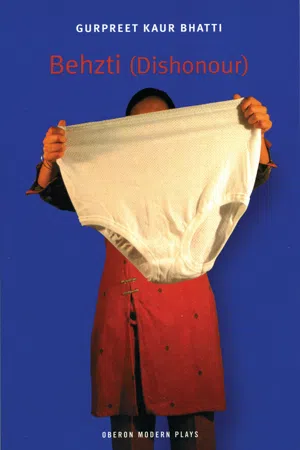
Past her prime, Min joyfully spends her life caring for her sick, foul-mouthed mother, Balbir. Today, for the first time in years, they´re off out. Mother and daughter head to the local Sikh Temple, but when Balbir encounters old friends, a past trauma rears its ugly head. Min and Balbir´s illusions are about to be shattered as they become immersed in a world of desperate aspiration and dangerous deals.
In a community where public honour is paramount, is there any room for the truth? Behzti was scheduled to open at The Door (Birmingham Rep) in December 2004 but was cancelled due to protests by some members of the local Sikh community.
- 88 pages
- English
- ePUB (mobile friendly)
- Available on iOS & Android
eBook - ePub
Behzti (Dishonour)
About this book
Information
Foreword
Truth is everything in Sikhism, the truth of action, the truth of an individual, God’s truth. The heritage of the Sikh people is one of courage and victory over adversity. Our leaders were brave revolutionaries with the finest minds, warriors who propagated values of egalitarianism and selflessness.
But sometimes I feel imprisoned by the mythology of the Sikh diaspora. We are apparently a living, breathing success story, breeding affluence through hard work and aspiration. There is certainly much to be proud of and our achievements and struggles have been extraordinary. They are a testament to our remarkable community – energetic, focused and able. But where there are winners there must be losers. And loss.
I find myself drawn to that which is beneath the surface of triumph. All that is anonymous and quiet, raging, despairing, human, inhumane, absurd and comical. To this and to those who are not beacons of multiculturalism, who live with fear and without hope and who thrive through their own versions of anti-social behaviour. I believe it is necessary for any community to keep evaluating its progress, to connect with its pain and to its past. And thus to cultivate a sense of humility and empathy: something much needed in our angry, dog-eat-dog times.
Clearly the fallibility of human nature means that the simple Sikh principles of equality, compassion and modesty are sometimes discarded in favour of outward appearance, wealth and the quest for power. I feel that distortion in practice must be confronted and our great ideals must be restored. Moreover, only by challenging fixed ideas of correct and incorrect behaviour can institutionalised hypocrisy be broken down. Often, those who err from the norm are condemned and marginalized, regardless of right or wrong, so that the community will survive. However, such survival is only for the fittest, and the weak are sometimes seen as unfortunates whose kismet is bad. Much store is set by ritual rooted in religion – though people’s preoccupation with the external and not the internal often renders these rituals meaningless.
My play reflects these concerns. I believe that drama should be provocative and relevant. I wrote Behzti because I passionately oppose injustice and hypocrisy. And because writing drama allows me to create characters, stories, a world in which I, as an artist, can play and entertain and generate debate.
The writers I admire are courageous. They present their truths and dare to take risks whilst living with their fears. They tell us life is ferocious and terrifying, that we are imperfect and only when we embrace our imperfections honestly, can we have hope.
Such writers sometimes cause offence. But perhaps those who are affronted by the menace of dialogue and discussion, need to be offended.
The human spirit endures through the magic of storytelling. So let me tell you a story.
Gurpreet Bhatti
November 2004
November 2004
My thanks to Janet Steel, Lindiwe Phahle, Cathy King, Roy Battersby, Michael Buffong, Amber Lone, Anne Edyvean, Manjeet Singh, Surinder Kaur Bhatti, Arun Arora, Sunil Lakhanpal, SAMPAD, everyone at The Birmingham REP and special thanks to Ben Payne.
Characters
BALBIR
MIN
ELVIS
GIANI JASWANT
MR SANDHU
TEETEE
POLLY
For Lindi, who guided me to the truth.
And who was the finest human being I have ever known.
I thank God for the gift of your soul, my beloved,
most treasured friend.
And who was the finest human being I have ever known.
I thank God for the gift of your soul, my beloved,
most treasured friend.
PROLOGUE
Bathing, Dressing And Eating
BALBIR KAUR, a Sikh woman in her late fifties, sits naked perched on a small stool in a bath. Her face is scarred with disappointment but her eyes are alive with ambition. There is a bucket of water and a plastic mug in front of her. She takes a mugful of water and pours it over her body. She looks around anxiously and shouts out. She speaks with a Punjabi accent.
BALBIR: No soap!
Silence. She looks around again.
No bloddy soap, shitter!
Silence. BALBIR pours another mugful of water over herself. MIN, a faithful but simple lump of lard, bustles in. She’s a sturdy but ungainly ingénue, prone to outbursts of extreme excitability. MIN is dressed unfashionably in mismatched A line skirt, patterned blouse and pink trainers. Her uncombed hair is in bunches, and she looks younger than her 33 years. She hurriedly unwraps a new bar of household soap.
MIN: It was in the flipping fridge.
BALBIR: You want me to die.
MIN: Those chipolatas smell all carbolic now… I’m at sixes and sevens…
BALBIR: Before I have finished living.
MIN: Most probably butterflies.
MIN hands BALBIR the soap and refills the bucket. MIN goes to lather BALBIR’s back and body.
BALBIR: Too ...
Table of contents
- Front Cover
- Title Page
- Copyright
- Contents
- Foreword by Gurpreet Kaur Bhatti
- Glossary
Trusted by 375,005 students
Access to over 1.5 million titles for a fair monthly price.
Study more efficiently using our study tools.
Frequently asked questions
Yes, you can cancel anytime from the Subscription tab in your account settings on the Perlego website. Your subscription will stay active until the end of your current billing period. Learn how to cancel your subscription
No, books cannot be downloaded as external files, such as PDFs, for use outside of Perlego. However, you can download books within the Perlego app for offline reading on mobile or tablet. Learn how to download books offline
Perlego offers two plans: Essential and Complete
- Essential is ideal for learners and professionals who enjoy exploring a wide range of subjects. Access the Essential Library with 800,000+ trusted titles and best-sellers across business, personal growth, and the humanities. Includes unlimited reading time and Standard Read Aloud voice.
- Complete: Perfect for advanced learners and researchers needing full, unrestricted access. Unlock 1.5M+ books across hundreds of subjects, including academic and specialized titles. The Complete Plan also includes advanced features like Premium Read Aloud and Research Assistant.
We are an online textbook subscription service, where you can get access to an entire online library for less than the price of a single book per month. With over 1.5 million books across 990+ topics, we’ve got you covered! Learn about our mission
Look out for the read-aloud symbol on your next book to see if you can listen to it. The read-aloud tool reads text aloud for you, highlighting the text as it is being read. You can pause it, speed it up and slow it down. Learn more about Read Aloud
Yes! You can use the Perlego app on both iOS and Android devices to read anytime, anywhere — even offline. Perfect for commutes or when you’re on the go.
Please note we cannot support devices running on iOS 13 and Android 7 or earlier. Learn more about using the app
Please note we cannot support devices running on iOS 13 and Android 7 or earlier. Learn more about using the app
Yes, you can access Behzti (Dishonour) by Gurpreet Kaur Bhatti in PDF and/or ePUB format, as well as other popular books in Literature & British Drama. We have over 1.5 million books available in our catalogue for you to explore.