eBook - ePub
The Presidentialization of Political Parties
Organizations, Institutions and Leaders
- English
- ePUB (mobile friendly)
- Available on iOS & Android
eBook - ePub
The Presidentialization of Political Parties
Organizations, Institutions and Leaders
About this book
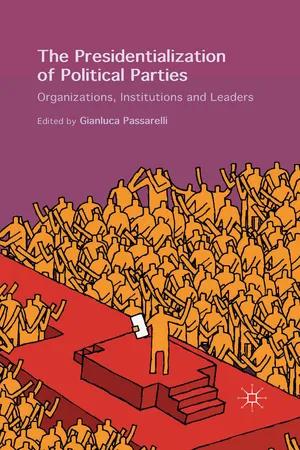
This book explains why the level of party presidentialization varies from one country to another. It considers the effects of constitutional structures as well as the party's original features, and argues that the degree of party presidentialization varies as a function of the party's genetics.
Information
1
Parties’ Genetic Features: The Missing Link in the Presidentialization of Parties
Gianluca Passarelli
I answer that the principalities of which one has record are found to be governed in two different ways; either by a prince, with a body of servants who assist him to govern the kingdom as ministers by his favor and permission; or by a prince and barons, who hold that dignity by antiquity of blood and not by the grace of the prince. Such barons have states and their own subjects, who recognize them as lords and hold them in natural affections. Niccolò Machiavelli, The Prince1
Introduction
Since the 1970s–1980s, “advanced” democracies have experienced an undoubted increase in the level of centralization of political power in – lato sensu – executive hands. This has meant that the head of government and party leadership as a whole has become more prominent, to the detriment of mid-level political actors and institutions, such as party cadres and parliament. As a consequence, scholars have started referring to centralization, personalization, prime-ministerialization, and even to the presidentialization of politics.
The presidentialization of politics is a relatively new and important phenomenon (Patterson and Mughan, 1992; Cole, 1993; Foley, 1993; 2000; Mughan, 2000; Samuels, 2002; Poguntke and Webb, 2005; Karvonen, 2010; Aarts et al., 2011; Bittner, 2011). However, the term presidentialization has become highly debatable. In particular, a contentious suggestion is that the presidentialization of politics could make (semi) presidential and parliamentary regimes on a par with presidentialism.
The aim of this book is to explain why the level of party presidentialization varies from one country to another. Following Samuels and Shugart (2010a), we argue that constitutional structures affect the level of party presidentialization. Samuels and Shugart claim that “party behavior and organization tend to mimic constitutional structure, giving rise to ‘presidentialized’ parties” (2010a, p. 16) and “to the extent that the constitutional structure separates executive and legislative origin and/or survival, parties will tend to be presidentialized” (2010a, p. 37). To this I add the party’s original features and argue that the degree of party presidentialization varies as a function of the party’s genetics, namely the original organizational characteristics of a party (see paragraph 4).
The literature has mainly focused on the general process of personalization that has been detected in recent modern politics, especially in western democracies. Depending on the cases studied, on the research fields and the data availability (and reliability), the studies conducted have had different foci. The role of institutions, the characteristics of leadership and leaders, as well as the electoral process or the mass media influence, have been the main explanatory variables analyzed in order to explain the phenomenon of presidentialization. Of course, the choice of variables included is also related to the research question(s) that scholars have sought to verify. Thus, the weakening of party loyalties, the kind of electoral system, the influence of mass media, and the form of government have in turn been considered as the independent variables, the factors that justify the above-mentioned phenomenon of a “presidentialization of politics.” All these approaches have significantly contributed to a better clarification of the characteristics of such a political process.
Nevertheless, none of them has been able to furnish a complete interpretation of and justification for the presidentialization of politics. Each factor has served to enlighten a singular aspect of such a phenomenon; but the overarching framework remains incomplete. This result is not due to a weak theoretical approach but is rather a symptom of the underlying structure of the research, which was principally attempting to test the causal effects between a defined explanatory variable and an outcome of the so-called presidentialization of politics in itself. Hence, researchers mostly focused on one or a number of aspects of the presidentialization of politics, illustrating which variables were affecting such a configuration of contemporary politics. Some studies emphasized the role of institutions, others the inevitable growing weight and influence of political and electoral changes and evolutions in each context.
However, the personalization of politics (McAllister, 2007), centralization (of government etc.), and style of leadership (candidate-centered electoral campaign, party organization, government, etc.) have different meanings and they present many differences (Blondel, 1984; Elgie, 1995; Helms, 2005, 2012). All are necessary though not sufficient conditions for the presidentialization of politics.
Here, we place greater stress both on the concept of presidentialization, and on demonstrating empirical evidence of the phenomenon, if any such evidence exists. Indeed, the presidentialization of politics in our view means the presidentialization of parties, or, better still, a phenomenon that arises from the behavior of political parties. Parties are in fact key political actors in the political system and often drive changes and innovation. It follows, therefore, that a focus on them would help to better define the borders of presidentialization around the body politic in modern democracies.
Constitutional constraints and the genetic characteristics of parties
By adopting the principal–agent theoretical approach, Samuels and Shugart based their study on the “theory of how institutions shape politicians’ behavior” (2010a, 22). In this theoretical structure and causal mechanism of analysis, the principal is the party and the agent is the party leader. Believing that much of the literature on party organization has failed to take account of the impact of regime type, Samuels and Shugart aim to explain variation in the organization and behavior of political parties. In particular, the aim is tested: to what extent “the presence of constitutionally separate executive authority ‘presidential-izes’ political parties” (p. 14). The authors are well aware of the relevance and importance of the socio-political factors that have enabled party formation and behavior, but they make clear that the “analysis of these differences should begin with the difference in constitutional design” (p. 18). Following this line of thinking, we will start the analysis of each case included in the book by illustrating the constitutional framework that defines the political context in which parties act. We then will focus on parties’ behavior, in particular by examining their genetic features and the way in which these features can affect the level of presidentialization.
Variation can be observed in all the three regime types: presidential, semi-presidential, and parliamentary. Indeed, even though the Samuels and Shugart’s crucial question is how political parties organize and when they must bridge the “gap between the executive and the legislature” – clearly referring to the context of the separation of powers – they make it clear that parties in presidential regimes can exhibit “parliamentarized” characteristics and vice versa. Moreover, they affirm that such characteristics are likely to be “ephemeral” because of the “inescapable logic” of the regime’s institutional foundations” (Samuels and Shugart 2010a, p. vi). Their work and arguments make clear that a comparison is advantageous and to replicate and to extend it is fruitful. In fact, we concede that “a real strength of Samuels and Shugart’s approach is that it allows the comparison of presidential, parliamentary and semi-presidential regimes” (Elgie, 2011a, p. 396). Moreover, if on the one hand they argue that regime type is the “missing variable” when explaining variation in party organization, their work also suggests that party organization might be the “missing variable” in studies on the effect of regime types and on their functioning. Therefore, we focus on the study of the parties and the level of their “presidentialization.” According to Samuels and Shugart, presidentialized parties are the result of presidentialized constitutional systems. If so, as their work indicates, political parties also need to be included in studies (Samuels and Shugart, 2010a, pp. 18, 21) of the effects of political regimes, in order to observe the concomitant influence of party organization on such an outcome: presidentialization of parties. The variance is greater “across than within democratic regime-types, due to the constitutional separation of origin and survival” (p. 15). Here our proposal offers to include in the analysis the “missing” link that parties’ genetic features represent.
However, we add to this literature by exploring the ways in which endogenous party factors, including a party’s genetic features (Panebianco, 1988), act as an intervening variable to shape the degree of presidentialization of parties. Given that these party factors vary from one party to another and from one country to another, we would expect to see that the degree of presidentialization of parties varies in each context. A more detailed discussion and analysis of the role that parties play in the process of personalization and presidentialization of politics is thus necessary. Parties are affected by the process of presidentialization, and if any presidentialization occurs they are the political actors that show more presidentialized characteristics. In a sense, we can affirm that the presidentialization of politics is basically visible/possible – given such contextual constitutional and institutional conditions – thanks to the mediation carried out by political parties. The latter offer the clearest evidence that presidentialization is (or is not) going on in a given context. Parties may simply experience such a process due to constitutional features and/or they can also mitigate or enhance it, in our view, due to their internal, organizational and genetic characteristics.
This argument introduces the research design of the book that we will detail in section in this introduction. We can start by indicating the independent and the dependent variables. The causal trajectory is summarized as follows: constitutional structures affect party presidentialization through the medium of endogenous party factors. We consider the genetic model of organizational development (penetration vs diffusion), the characteristics of the dominant coalition (factions vs tendencies), as well the balance of power in the dominant coalition (central office vs public office). The constitutional asset represents the most important factor in determining whether a party (and then the politics) can be presidentialized more or less. That factor – the constitutional features – offers the opportunity and the constraint to proceed toward a more effective presidentialization process. Once the win set of chances to have a more or less cogent process of presidentialization has been established, the parties’ genetic features act as an intervening variable in strengthening or weakening that trend. Some parties are in fact naturally prone to adapt to presidentialization emanating from the institutions, while others are more hostile to it. The different outcomes and configuration of a presidentialization of parties will then depend upon the various combinations of such variables and conditions. The latter combinations are those of countries (constitutional frame and type of government) and party features.
The overlapping between the process of strengthening of executive power and the so-called presidentialization of politics has led to different interpretations of the phenomenon. In particular the presidentialization thesis has been criticized and debated in relation to its theoretical and conceptual frames. According to some scholars the presidentialization thesis is conceptually weak and under-specified (Samuels and Shugart, 2010a, b), and its empirical results are often scant (Karvonen, 2010; Dowding, 2013a; Heffernan, 2005, 2013).
In Poguntke and Webb’s words “presidentialization denominates a process by which regimes are becoming more presidential in their actual practice without, in most case, changing their formal structure” (2005, p. 1). In particular, they refer to the presidentialization of politics as “the development of increasing leadership power resources and autonomy within the party and the political executive respectively, and increasingly leadership-centered electoral process” (p. 5).
On the other hand, according to Samuels and Shugart (2010a), only parties under presidential systems can be truly presidentialized because presidentialization is a direct effect of separated powers. Indeed, it is only under a constitutional context that provides independent and separated powers that parties cannot hold their presidential candidates accountable once elected. By contrast, in parliamentary systems even if a leader’s reputation can overshadow the party reputation, parties have more effective tools to keep leaders’ ambitions under control. Consequently, Samuels and Shugart define presidentialization “as the way the separation of powers fundamentally shapes parties’ organizational and behavioral characteristics, in ways that are distinct from the organization and behavior of parties in parliamentary systems” (p. 6).
As we have seen, the debate around presidentialization has been, and to some extent still is, rich and stimulating. The discussion has been invested with theoretical and empirical consequences, cases, and definitions. On one side, we have scholars who claim that even in parliamentary regimes, there are detectable trends toward the presidential model without a change in constitutional forms.2 The presidentialization concept combines different empirical trends into a unique theoretical understanding of ongoing power shifts (also) within parliamentary regimes. On the other side, scholars claim that both the theoretical and conceptual underpinnings of those propositions are weak, supported only with scarce and ambiguous empirical evidence. Thus, Karvonen states that the “general ‘gut impression’ of expert authors seem to be more in favor of the presidentialisation thesis than is warranted from the actual evidence presented in the various country studies” (2010a, p. 20). However, as Webb et al. argue, offering a number of defences against these criticisms, those arguments are “quite nuanced and not conclusive” (2012, pp. 79ff.), and thus leave open the option of an increasing process of personalization of politics.
The differences between these theoretical approaches implies analogous distinctions in terms of meaning conferred to concepts, such as personalization, centralization of politics, and of course presidentialization itself. Those differences are not merely semantic but are substantial, due to their empirical and theoretical consequences. If those claiming presidentialization exists think that we can observe it in all three regime types, the related presidentialization of parties can be observed independently from variation in executive-legislative institutions. By contrast, for other scholars such a phenomenon is not possible in non-separation of power regimes (Samuels and Shugart, 2010a, p. 10n 13). Moreover, in terms of empirical findings in support of presidentialization, the first approach refers to three organizational faces (Key, 1952; Sorauf, 1968; Katz and Mair, 1993) of parties’ presidentialization (Poguntke and Webb, 2005, pp. 2ff.); whereas the second essentially refers to a presidentialized party which delegates to its leader which has discretion in electoral and governing arenas (Samuel and Shugart, 2010a, p. 16).
The debate is ongoing (Foley, 2013) and has seen the use of frank and direct language, with some arguing that the term presidentialization “should be expunged from political science vocabulary” (Dowding, 2013a, p. 617), while others defend the thesis (Poguntke and Webb, 2013).
Once the main theoretical frame and the related problematic (and partially unsolved) conceptual controversies have been defined, we can see that obstacles originate from the following: the presidentialization of politics (and therefore of parties) refers to an institutional factor: the leader, in presidential systems, is independent from the legislative branch and is politically and institutionally unaccountable. Thus, a similar trend is not possible in parliamentary regimes.
Presidentialization and personalization
We move beyond controversies, similarities, and differences between indicators of presidentialization for each definition (for example, how to measure it) and among the theoretical approaches, while recognizing that we think those claims are too important to ignore. We claim that differences between the “personalization of politics” and “presidentialization of politics” essentially refer to the fact that: a) the former implies mainly considering a sort of personal “capital” in terms of skills, characteristics, attitudes, for example, while b) the latter considers primarily institutional resources, constraints, and opportunities.
In this book we focus on political parties and on their presidentialization. Consequently, we analyze the presidentialization of politics in terms of political parties. Keeping in mind that the separation of powers shape parties’ behavior and characteristics, we argue that we can have presidentialization beyond presidential systems if certain circumstances are present. In particular, we refer to the parties’ genetic features which can make the overcoming of institutional constraints possible. Thus, we agree that it is not automatic “that ideal-type parties follow rigidly from regime-type. Some parties in parliamentary systems may exhibit presidentialized features” (Samuels and Shugart, 2010a, p. 16; Poguntke and Webb, 2005), and, in reverse, some “parties in presidential systems [ … ] exhibit ‘parliamentarized’ characteristics” (Samuels and Shugart, 2010a, p. 17).
Our research argues that, while constitutional structures help to shape the level of party presidentialization, in order to better understand this process we need to include an analysis of endogenous party factors. We refer to the presidentialization of parties – given the different constitutional regimes – as the situation in which they have given greater autonomy to their leader, with great independence on crucial political topics (e.g. electoral campaign, ministerial appointments, public policies): in that situation s/he (the leader) is unaccountable to the party. These conditions are primarily possible in separation of powers contexts. Hence, this trend can be downsized or emphasized by the parties’ genetic features which can enable those political actors to overcome, albeit partially and/or ephemerally, the constitutional constraints that prevent presidentialization of parties. A few indicators will help us to detect such a trend in the selected cases: the level of accountability, not only in instituti...
Table of contents
- Cover
- Title Page
- Copyright
- Contents
- List of Figures and Tables
- Preface
- Acknowledgments
- Notes on Contributors
- Glossary (parties included in the research)
- 1. Parties’ Genetic Features: The Missing Link in the Presidentialization of Parties
- 2. The Presidentialization of Parties in Chile
- 3. The Presidentialization of American Political Parties
- 4. Political Parties: The Case of Brazil
- 5. The Presidentialization of Dominant Parties in France
- 6. Poland: The Presidentialization of Parties in a Young Democracy
- 7. Party Presidentialization in Ukraine
- 8. The Presidentialization of Party Politics in the UK
- 9. The Presidentialization of Parties in Australia
- 10. The Presidentialization of Political Parties in Germany
- 11. The Partial Presidentialization of Parties in Japan
- 12. The Absence of Party Presidentialization in Italy
- 13. The Presidentialization of Parties: Why, When, Where
- References
- Index
Trusted by 375,005 students
Access to over 1.5 million titles for a fair monthly price.
Study more efficiently using our study tools.
Frequently asked questions
Yes, you can cancel anytime from the Subscription tab in your account settings on the Perlego website. Your subscription will stay active until the end of your current billing period. Learn how to cancel your subscription
No, books cannot be downloaded as external files, such as PDFs, for use outside of Perlego. However, you can download books within the Perlego app for offline reading on mobile or tablet. Learn how to download books offline
Perlego offers two plans: Essential and Complete
- Essential is ideal for learners and professionals who enjoy exploring a wide range of subjects. Access the Essential Library with 800,000+ trusted titles and best-sellers across business, personal growth, and the humanities. Includes unlimited reading time and Standard Read Aloud voice.
- Complete: Perfect for advanced learners and researchers needing full, unrestricted access. Unlock 1.5M+ books across hundreds of subjects, including academic and specialized titles. The Complete Plan also includes advanced features like Premium Read Aloud and Research Assistant.
We are an online textbook subscription service, where you can get access to an entire online library for less than the price of a single book per month. With over 1.5 million books across 990+ topics, we’ve got you covered! Learn about our mission
Look out for the read-aloud symbol on your next book to see if you can listen to it. The read-aloud tool reads text aloud for you, highlighting the text as it is being read. You can pause it, speed it up and slow it down. Learn more about Read Aloud
Yes! You can use the Perlego app on both iOS and Android devices to read anytime, anywhere — even offline. Perfect for commutes or when you’re on the go.
Please note we cannot support devices running on iOS 13 and Android 7 or earlier. Learn more about using the app
Please note we cannot support devices running on iOS 13 and Android 7 or earlier. Learn more about using the app
Yes, you can access The Presidentialization of Political Parties by Gianluca Passarelli in PDF and/or ePUB format, as well as other popular books in Politik & Internationale Beziehungen & Vergleichende Politikwissenschaften. We have over 1.5 million books available in our catalogue for you to explore.