eBook - ePub
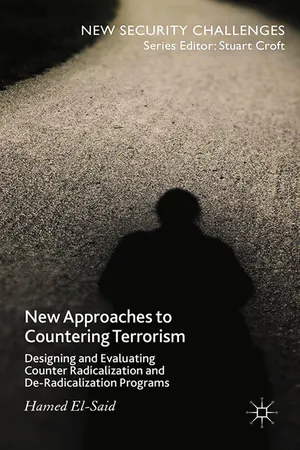
New Approaches to Countering Terrorism
Designing and Evaluating Counter Radicalization and De-Radicalization Programs
- English
- ePUB (mobile friendly)
- Available on iOS & Android
eBook - ePub
New Approaches to Countering Terrorism
Designing and Evaluating Counter Radicalization and De-Radicalization Programs
About this book
Hamed El-Said investigates Counter-de-Rad programmes in Muslim majority and Muslim minority states. This multifaceted book provides a new approach to evaluate Counter-de-Rad Programmes and develops a holistic framework which will allow policy-makers and practitioners to design and effectively implement and assess such programmes in the future.
Information
1
Introduction
Rehabilitating radicals
Organized terrorism remains a major threat facing many communities of the world. Despite the fact that more than a decade has passed since 9/11, which instigated a long and ongoing first-world ‘war on terror’, there are no signs that terrorism is receding. On the contrary, the most recent developments not only suggest that terrorism remains a large problem, but that it will be so for some time to come. For example, Christopher Stevens, the former American Ambassador in Libya, along with three other American diplomats, was brutally assassinated in September 2012 by a radical Libyan salafist group, some of whom were allegedly disengaged under a de-radicalization program initiated and supervised personally by Saif Dine al-Islam. In Arab countries that have recently experienced a regime change as a result of the outbreak of the Arab Spring almost two years ago (Libya, Tunisia, Yemen and Egypt), this has been associated with the rise of radical salafist movements in these countries. The outbreak of fighting in Syria has apparently attracted thousands of Ansar radical fighters (an offspring of al-Qaeda) to the country who are now dominating the core fighting units of the so-called ‘Free Syrian Army’. The war in Syria has also attracted several hundred Muslim citizens living in Western democratic states, such as Australia. After ten years of occupation and the loss of its once powerful regime, Iraq is witnessing a constant increase in violence. In Afghanistan, the ‘war on terror’ shows no signs of waning, with the Taliban fighters demonstrating strong determination not only to oust NATO forces from their country, but also to restore their lost political power at any price. They continue to provide logistical, financial and operational support to their Pakistani Taliban partner, which has destabilized and divided Pakistan itself, through the paralysis of its political and economic systems, and cost the country more than $20 billion in economic losses and more than 35,000 human lives. In Western Africa, extreme right and fundamentalist salafist movements are also on the rise, encouraged by the weakness and corruptibility of Western African states and their absent developmental capacities which bred and continue to breed massive inequities, considerable unemployment and unsustainable poverty. In Somalia, the al-Shabab radical group remains influential and threatening both to the stability of the country and the region as a whole. Pirates continue to use Somali territory as a safe haven to threaten international maritime trade. In Nigeria, new militant Islamist groups have emerged, such as the Boko Haram and Ansaru Islam, which are considered today the most ‘formidable threat’ to the interests of the United States and other Western states in the region (Chothia, 2013. On salafism in the Arab world, see Zelin, 2013; Trager, 2013). The recent launching of military operations by the French government in Mali is a testimony to the rising influence of the fundamentalist-right salafist movements in Western Africa.
The above-cited events and developments will have far-reaching regional and global ramifications, although the full extent of these implications is difficult to predict at the present time. The immediate regional implication of the French military operations in Mali, for example, was the attacks against Algeria’s main gas field in January 2013 and the ensuing hostage crisis that claimed the lives of more than 80 individuals, including several Westerners, in a dawn raid in retaliation for France’s intervention in Mali and the Algerian government’s support for that intervention. While the jury decides the full implications of the aforementioned recent developments, one thing is clear: terrorism’s days are not numbered and the death of Osama Bin Laden, the former leader of al-Qaeda, has not ushered in a new era of peace and stability, one in which the threat from terrorism no longer exists.
On the other hand, there is a growing consensus among observers of all political stripes that the fight against radicalism and its offspring, violent extremism, has been mismanaged and mishandled. Even long before the 9/11 attacks of 2001 against the twin towers of the World Trade Center in lower Manhattan and the Pentagon, many scholars and academics were already criticizing the prevailing kinetic approach to countering the phenomenon of terrorism, referred to hereafter as Violent Extremism (VEm). Those critics have long called for a broader and more balanced approach, one which will rely more on, and incorporate larger aspects of, ‘soft’ or ‘smart’ policies as an integral part of the counterterrorism tool kit used by state officials, security enforcement, practitioners and wider communities involved in countering VEm (Schmidt, 2000; Angell and Gunaratna, 2011). As the ‘war on terror’ dragged on longer than expected, voices against the prevailing kinetic response to VEm grew louder, sharper and broader. The fiercest attack from a high-ranking Western official came from the former British Foreign Minister, David Miliband. In 2009, Mr Miliband publicly stated that we were ‘wrong’ in our approach to the phenomenon of VEm and that the notion of a ‘war on terror’ has not only delayed the fight against terrorism, but has also ‘caused more harm than good’.
Criticism of a kinetic approach to countering VEm has also come from the Afghani leader, Hamid Karzai, who sturdily and unremittingly disparaged increased reliance on drone attacks by the United States, which killed many innocent people in Afghanistan and elsewhere, as a key counterterrorism tactic. He also criticized the alleged US torture of Afghani detainees, and, in March 2013, called upon the US government ‘to put in Afghan control ... the Bagram Jail, 50 kilometres north of Kabul ... within days’ (The Nation, 2013). In Yemen, drone attacks have not only killed a large number of innocent bystanders, but have also undermined the informal approach to countering radicalization which the Yemeni government began implementing after 2008. This approach relied heavily on mediation between state officials and their relatives and family members in al-Qaeda to convince the latter to repent (El-Said and Harrigan, 2012). Following the end of the military operations launched by the Pakistani armed forces in late 2007 to tackle militants in the Swat Valley region, the Pakistani armed forces launched an ambitious de-radicalization and counter-radicalization program there. This included a population census to list the names of all inhabitants of the Valley, encouraging community and tribal leaders to play a bigger role in countering violent ideology and activism in the area, and providing some educational and health facilities to the inhabitants of the region. The program also included special debates and a religious rehabilitation program for the hundreds of youths radicalized and recruited by the Pakistani Taliban and arrested by the Pakistani armed forces during and after the military operations in the Valley. As in Yemen, ‘The program was destroyed by the American drone attacks, which demolished the confidence we built with the inhabitants of the Valley who now believe that we were conspiring with the Americans against them’.1
In other words, the kinetic response served to undermine the ‘public perceptions of government’ and its ability not only to address the threat properly and appropriately, but also to secure its citizens (CGCC, 2012). It neither inspired confidence in the ability of the state to undermine the threat nor stemmed the support for violent extremists. A kinetic approach, which included the invasion of two Muslim states (Afghanistan and Iraq) and drone attacks against another half-dozen were seen as unjust and thereby damaging to social cohesion and social harmony. They also delayed resorting to alternative approaches and paid little attention to the ‘the process of radicalisation’ (ICSR, 2010, p.8), treated terrorism as an event rather than a process, and as such ignored conditions conducive to radicalization and extremism that lead to terrorism. Equally important, the kinetic approach neglected the fact that this wave of terrorism differs from its predecessors in many ways, including in its brutality, complexity, suddenness and ideology. With regard to the latter, despite the fact that religion is not the essence, the current wave of VEm derives a great deal of its justification for violence from a misunderstood and narrowly applied religious scripture, a fact that makes it politically incompetent and religiously illegitimate (El-Said, 2013).
It is for all of the above reasons that the war on terror has become ‘wrong’, ‘inappropriate’ and ‘caused more harm than good’. Treating radicalization as a process requires a completely different approach, one where the overriding objective is to win the ‘hearts and minds’ of communities most vulnerable to radicalization and VEm. This approach should both understand and refute the ideology of VEm to successfully deal with conditions conducive to radicalization and extremism that lead to terrorism. As the Rand Corporation (2006, p.1132) argued, what is really needed is ‘Waging the War of Ideas’, not ‘the war on terror’ to defeat radicalization and VEm.
Increased public and official dissatisfaction with purely kinetic approaches to VEm has been associated with, and has perhaps led to, the emergence of ‘new and innovative approaches to counter-terrorism’ (Horgan and Braddock, 2010, p.1). These ‘new and innovative approaches’, to be sure, first emerged and were implemented in some Muslim-majority states, particularly in countries like Egypt, Yemen, Indonesia and Saudi Arabia, before migrating to countries like Malaysia and Singapore (El-Said and Harrigan, 2012). More recently, some Western democratic states have also flirted with these ‘innovative approaches’ and attempted to implement some or a large proportion of them. Examples include the United Kingdom, the Netherlands, Germany, Belgium, Norway and Australia. British, European, American and Australian officials flocked to Riyadh, Yemen, Jakarta and Kuala Lumpur to study these programs and learn about their effectiveness. They have also invited officials from those countries to their capitals to educate their own officials about counter-radicalization and de-radicalization (Counter-de-Rad) programs and verify their potential applicability in and adaptability to Western contexts. As Vidino and Brandon (2012, p.1) noted: ‘Since the mid-2000s, several European countries have developed comprehensive counter-radicalization strategies seeking to de-radicalize or disengage committed militants and, with even greater intensity, prevent the radicalization of new ones’. Within this context, the United Kingdom, the Netherlands, Norway and Denmark have carried out ‘the most extensive counter-radicalization initiatives’ (Ibid).
Goals and objectives of the book
Despite their popularity and increasing fame, Counter-de-Rad programs remain largely ‘under-researched’ (Bhui, Hicks, Lashley and Jones, 2012, p.2), ‘not fully understood’ (Bhui, Dinos and Jones, 2012, p.2) and ‘the exception worldwide ... not the norm’ (Angell and Gunaratana, 2011, p.448). Horgan and Braddock (2010, p.267) are in agreement: ‘despite their popularity, data surrounding even the most basic of facts about these programs remains limited’.
Several Counter-de-Rad programs have been extensively studied over the past few years. El-Said and Harrigan (2012), for example, have studied such programs in eight Muslim-majority states: Algeria, Bangladesh, Egypt, Malaysia, Morocco, Jordan, Saudi Arabia and Yemen. Horgan and Braddock (2010) have also, very briefly, studied some of same programs, particularly in Saudi Arabia and Yemen, as well as in Northern Ireland, Colombia and Indonesia. Omar Ashour (2009) focused on two countries’ de-radicalization processes: Algeria and Egypt. Finally, Lorenzo Vidino and James Brandon (2012) have also very recently studied counter-radicalization programs in four European countries: the United Kingdom, Norway, Denmark and the Netherlands. Apart from several duplications and overlapping in terms of programs studied, the total number of studied Counter-de-Rad programs so far remains small, no more than 14 or 15 out of at least 35 or 40 programs that have been implemented or are currently being implemented worldwide (El-Said and Barrett, 2011).
Apart from El-Said and Harrigan’s work (2012), most of the above-mentioned studies sought to describe the key components of Counter-de-Rad programs (Vidino and Brandon, 2012), factors behind the de-radicalization of large violent extremist (VEt) organizations (Ashour, 2009), or to investigate ‘critical issues surrounding assessment of their effectiveness and outcomes’ (Horgan and Braddock, 2010, p.1). None, with the exception of El-Said and Harrigan (2012), really looked at the process of radicalization itself, why and how individuals are recruited from populations vulnerable to VEm, and why most recruited individuals, particularly in Western contexts, come from certain groups or communities. Other studies, like Sageman (2008) and Krueger and Maleckova (2002), for example, took an individual approach, profiling the demographics of individual terrorists or suicide bombers and generalizing from their work that ‘poverty does not cause terrorism’. Here, too, the process of radicalization has been neglected and we were told little about the population from whence those individuals came, were recruited and radicalized. As Bhui, Dinos and Jones (2012, p.1) noted: ‘Studies of terrorism have focused on those identified as engaged with terrorist organisations or convicted of terrorism crimes, with little attention given to populations that are vulnerable to recruitment to terrorist action.’
Finally, no study has so far developed any form of framework through which Counter-de-Rad programs can be studied, understood and even effectively designed and implemented. Angell and Gunaratana (2011, p.348) rightly argued that ‘there has been very little effort to examine the concepts, processes, and outcomes of terrorist rehabilitation’, let alone to develop a framework to facilitate their comprehension and implementation. Horgan and Braddock (2010, p.269) concur; studies of terrorism, they concluded, lack ‘a framework for guiding the development of future such initiatives that draw lessons from existing programs (effective or otherwise)’.
This book fills an important gap in the literature. It analyses and evaluates Counter-de-Rad programs in six United Nations Member States in a way that follows up and builds on our earlier work in 2012 (El-Said and Harrigan), or Volume I of this larger project. It differs from Volume I in many ways too.
First, while Volume I focused completely on (eight) Muslim-majority states. This Volume (II) is more diversified. It integrates and analyses Counter-de-Rad programs in both Muslim-majority and Muslim-minority states. Four Muslim-majority states (Mauritania, Sudan, Turkey and Pakistan) and two Muslim-minority states (Australia and Singapore) are discussed and analysed in this volume. Second, we treat VEm as a process, rather than as an event. ‘No one is born an extremist or terrorist’ (Angell and Gunaratna, 2011, p.365). Harris-Hogan (2012, p.5) of the Global Terrorism Research Centre at Monash University in Melbourne concurs:
Radicalisation is a process in which individuals develop, adopt and embrace political attitudes and modes of behaviour which diverge substantially from those of any or all of the established and legitimate political, social, economic, cultural, and religious values, attitudes, institutions and behaviours which exist in a given society.
Treating radicalization as a process suggests that this process is reversible. Its reversal requires a good understanding of the conditions conducive to radicalization in each context. Only through such understanding will the establishment of an effective and context-specific Counter-de-Rad program be possible. This is how ‘perhaps we can decrease the numbers of those drawn to that lifestyle’ and intelligently and proactively rehabilitate those who have already become violent extremists (Angell and Gunaratna, 2011, p.365). Therefore, and rather than simply describing key elements of Counter-de-Rad programs, this volume analyses conditions conducive to radicalization and VEm in each country case study. The inclusion of Australia and Singapore along with Muslim-majority states in this volume provides a unique opportunity to compare and contrast Counter-de-Rad programs in two completely different contexts. Analysing the radicalization process in Muslim-minority states will have relevance to Western countries in general, as it will shed light on factors that can radicalize members of minority groups in such countries. It will also shed some light on the kind of challenges Western democracies and Christian-majority states can face when attempting to implement Counter-de-Rad programs. Neither the latter nor the former issues have been ‘fully understood’ or received the attention they deserve (Bhui, Dinos and Jones, 2012, p.1).
Finally, we develop in this volume, for the first time, a solid framework that can guide policymakers, security agencies and practitioners in building their capacity and directing their future efforts in developing effective Counter-de-Rad programs. Such a framework is derived mainly from our analysis of the 14-country case study presented in volume I and II of this project. We draw on, and analyse, lessons from the existing literature on counter-radicalization. We must first define the main terminologies and concepts that will be used repeatedly in this book.
Definitions and terminologies
The abstract and general use of vocabulary and terminology in terrorism studies and literature has been provocative, and at times intimidating. For example, concepts such as radicalization, extremism and terrorism are extensively used in the literature to refer to violence carried out by groups and individuals belonging only to the Islamic faith. In fact, these terms have become synonymous with something called ‘Islamic violence’, as if the Islamic faith itself encourages violence and terrorism. Worse, such connotations and terminologies have confirmed stereotypes prevalent particularly among ‘Many Americans and Europeans [who] see Islam as a religion of violence, especially toward those who do not share the faith ... this lens distorts the past, constrains our present, and endangers our future’ (Karabell, 2007, p.5).
Historically speaking, the relationship between Muslims and non-Muslims was not constantly characterized by violence, as some would like us to believe. The Islamic empire itself prospered precisely because it protected and coexisted with other monolithic and non-monolithic religions. For example, the Islamic Caliph Harun al-Rashid (of the Abbasid empire which lasted for more than 600 years starting around the middle of the 8th century) insisted on translating and building upon the knowledge of such Greek philosophers as Aristotle and Plato. He also wanted ‘to see how their ideas met opposing theologians, and he invited scholars and preachers of other faiths to his court. Jews, Christians, Buddhists, and Muslims engaged in spiritual and spirited jousts, and each tradition was enriched by knowledge of the others’ (Karabell, 2007, p.4). His sons after him, particularly al-Mantasour, followed their father’s footsteps and continued to protect knowledge imported and translated from other religions, the pursuit of social justice, the recognition of identities, respect for diversity, and maintenance of social cohesion. Minorities of other religions were always treated as ‘People of the Book’ and cousins of Muslims (ibid). Even today, Muslims are latecomers to the world of terrorism, as we know it. Groups and individuals belonging to all other faiths, cultures and traditions have resorted to violence long before a minority of groups and individuals belonging to the Islamic faith did. As Angell and Gunaratna (2011, pp.351–2) wrote: ‘we have witnessed terrorism stemming from the propaganda of deviant versions of Hinduism, Judaism, Christianity, Buddhism, Sikhism, and others’. However, ‘There is known history and forgotten history, history that supports our sense of the present and history that suggests other pathways’ (Karabell, 2007, p.3). Which version of history we choose is up to us.
Even among Muslims, violence is a ‘minority pursuit’ (Jarvis, 2009, p.5). The overwhelming majority of Muslims around the world reject vio...
Table of contents
- Cover
- Title
- 1 Introduction
- 2 Counter-de-Rad: Setting the Framework
- 3 Radicalization in a Western Context: The Case of Australia
- 4 Counter Radicalization and De-radicalization in Western Democracies: The Case of Australia
- 5 Mauritania: From Toleration to Violent Islam
- 6 Singapore: Crisis of Identity, Shared Values and Religious Rehabilitation
- 7 Sudan: De-radicalization and Counter Radicalization in a Radicalizing Environment
- 8 From Militarization to Democratization: The Transformation of Turkeys Counterterrorism Strategy (CTS)
- 9 Concluding Remarks
- Notes
- Bibliography
- Index
Trusted by 375,005 students
Access to over 1.5 million titles for a fair monthly price.
Study more efficiently using our study tools.
Frequently asked questions
Yes, you can cancel anytime from the Subscription tab in your account settings on the Perlego website. Your subscription will stay active until the end of your current billing period. Learn how to cancel your subscription
No, books cannot be downloaded as external files, such as PDFs, for use outside of Perlego. However, you can download books within the Perlego app for offline reading on mobile or tablet. Learn how to download books offline
Perlego offers two plans: Essential and Complete
- Essential is ideal for learners and professionals who enjoy exploring a wide range of subjects. Access the Essential Library with 800,000+ trusted titles and best-sellers across business, personal growth, and the humanities. Includes unlimited reading time and Standard Read Aloud voice.
- Complete: Perfect for advanced learners and researchers needing full, unrestricted access. Unlock 1.5M+ books across hundreds of subjects, including academic and specialized titles. The Complete Plan also includes advanced features like Premium Read Aloud and Research Assistant.
We are an online textbook subscription service, where you can get access to an entire online library for less than the price of a single book per month. With over 1.5 million books across 990+ topics, we’ve got you covered! Learn about our mission
Look out for the read-aloud symbol on your next book to see if you can listen to it. The read-aloud tool reads text aloud for you, highlighting the text as it is being read. You can pause it, speed it up and slow it down. Learn more about Read Aloud
Yes! You can use the Perlego app on both iOS and Android devices to read anytime, anywhere — even offline. Perfect for commutes or when you’re on the go.
Please note we cannot support devices running on iOS 13 and Android 7 or earlier. Learn more about using the app
Please note we cannot support devices running on iOS 13 and Android 7 or earlier. Learn more about using the app
Yes, you can access New Approaches to Countering Terrorism by H. El-Said in PDF and/or ePUB format, as well as other popular books in Politik & Internationale Beziehungen & Vergleichende Politikwissenschaften. We have over 1.5 million books available in our catalogue for you to explore.