- English
- ePUB (mobile friendly)
- Available on iOS & Android
eBook - ePub
About this book
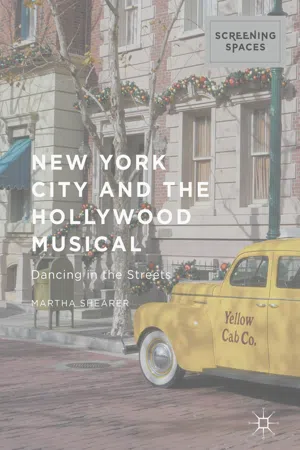
In examining the relationship between the spectacular, iconic and vibrant New York of the musical and the off-screen history and geography of the real city—this book explores how the city shaped the genre and equally how the genre shaped representations of the city. Shearer argues that while the musical was for many years a prime vehicle for the idealization of urban density, the transformation New York underwent after World War II constituted a major challenge to its representation. Including analysis of 42nd Street, Swing Time, Cover Girl, On the Town, The Band Wagon, Guys and Dolls, West Side Story and many other classic and little-known musicals—this book is an innovative study of the relationship between cinema and urban space.
Information
Print ISBN
9781137569363
Subtopic
Danse© The Author(s) 2016
Martha ShearerNew York City and the Hollywood MusicalScreening Spaces10.1057/978-1-137-56937-0_11. Introduction: A Wonderful Town?
Martha Shearer1
(1)
King’s College London, London, UK
In ‘New York, New York’, the opening number of On the Town (Gene Kelly and Stanley Donen, 1949), three sailors arrive in the city and embark on an exhilarating tour of its monuments, landmarks, public artworks and ethnic neighbourhoods, moving between them on a variety of modes of public transport. Compressing three hours of narrative time into a three-minute song, the sequence is a choreographed and rapidly edited vision of a tourist’s first encounter with the city. The shooting of landmarks reinforces the number’s tourism: the Washington Square Arch, Grant’s Tomb and the Statue of Liberty all fill the frame; the landmarks are the subject of the image rather than the sailors. The emphasis on the city’s iconicity in ‘New York, New York’ is maintained throughout the film, where landmarks are used as incidental backgrounds at the expense of geographical plausibility. In a montage where the sailors visit a series of museums, the Metropolitan Museum of Art (at the eastern edge of Central Park) and the Museum of Modern Art (further down Fifth Avenue at 53rd Street) are connected by a shot of their taxi driving through Times Square, several blocks south of the latter. Towards the end of the film, when police are chasing Claire (Ann Miller), Hildy (Betty Garrett) and the sailors, Hildy decides they should go to ‘a place right across the Brooklyn Bridge where no one will find us’, Brooklyn. But despite her intention to go somewhere anonymous, the journey enables several shots of the bridge itself at dusk, and they eventually end up at Coney Island.
Writing on On the Town has tended to present it as an oddity. ‘New York, New York’ stands apart from urban location sequences in other post-war Hollywood films, where the broader tendency evident in films like The Naked City (Jules Dassin, 1948) was towards realist semi-documentaries. Thomas Schatz, for example, suggests that it marks a ‘curious complement’ to the post-war dramas shot in New York, whose style ‘corresponded closely to their downbeat view of postwar urban life’ (Schatz 1997, 377). And On the Town was also unusual for incorporating relatively extensive location shooting in a studio-era musical. But in being a musical so obviously about New York and partly filmed on location, On the Town also throws up problems with a widely held idea about the musical: that its ‘escapism’ means it presents worlds that are distinct in some way from everyday urban reality. In his influential landmark study of the genre, Rick Altman categorizes musicals into three subgenres, each of which is defined by its distinction from contemporary urban life: the ‘folk musical’, taking place in an idealized American past; the ‘fairytale musical’, taking place in a foreign land; the ‘show musical’, about the production of entertainment (Altman 1987, 126–127). By this logic only show musicals could be set in domestic cities, and despite defining the folk musical by its relationship to the past, Altman includes in that category films such as It Happened in Brooklyn (Richard Whorf, 1947), On the Town and West Side Story (Jerome Robbins and Robert Wise, 1961), presumably on the grounds that their folk musical syntax negates their contemporary urban settings.
But for most of the studio era, when the musical was one of Hollywood cinema’s most important genres, New York was by far its most common setting. Until the mid-1950s, at least half of all musicals released each year were set there, and in some years that figure was significantly higher (see Appendix). The musical also had close off-screen connections to New York: the city provided key personnel, numerous below-the-line workers and source material, especially its own Broadway musicals. The importance of urban space for the genre has been noted in a number of studies of the musical’s representation of cities (Freire-Madeiros 2002; Bukatman 2003, 157–183; Napper 2009; Fischer 2010) as well as brief comments in influential discussions focusing on other aspects of the genre: Mark Roth writes that, like the gangster film, the musical was ‘basically urban’ (Roth 1981, 43); Steven Cohan suggests that there are considerable parallels between the musical and film noir, noting ‘one shouldn’t forget how many musicals were similarly set in cities’ (Cohan 1993, 68).
When the question of place has been addressed in work on the musical, quite often it is proclaimed that musicals depict utopias or are uniformly positive (McArthur 1997, 32; Mundy 1999, 57; Bukatman 2003, 159). This line of argument rests on a reading of Richard Dyer’s seminal essay ‘Entertainment and Utopia’, in which he argues that the ‘escapism’ of entertainment is utopian. Rather than claiming that musicals necessarily construct utopias, he characterizes the genre’s utopianism as ‘what utopia would feel like rather than how it would be organized’ (Dyer 2002, 20). But the question of the ‘topos’ of this utopianism remains unresolved. If entertainment feels utopian, what implications does that have for the spaces it constructs and the places it depicts? Space and place are implicit concerns in Dyer’s essay but rarely directly addressed.1 Critics writing on the location shooting in On the Town often describe its representation of New York in terms of fantasy, artifice or transformation. And Dyer gives On the Town as an example of a musical where utopia is ‘implicit in the world of the narrative’ as well as the numbers, suggesting that the film is about ‘the transformation of New York into utopia’ (Dyer 2002, 30–31). But closer examination reveals the limits of the term ‘utopia’ when explicitly focusing on space and place in the musical generally and On the Town specifically. An emphasis on the city’s transformation, its distinction from the real city, overlooks the film’s particular relationship to New York’s post-war history and its own overriding irony.
As On the Town progresses, it repeatedly undercuts its own pleasurable tourism. Following the ‘New York, New York’ number the sailors encounter less glamorous aspects of the city: their attempts to find their way around are frustrated, the subway is cramped and crowded and they cannot get seats, and later they encounter the exploitative Madame Dilyovska and Hildy’s comically dowdy roommate, Lucy Schmeeler (Alice Pearce). By the film’s conclusion these less utopian elements have been largely sidelined: the sailors return to their ship, seen off by the romantic partners each of them has met, who have convinced the police to drop charges against them (based on the disruption they have caused to the city) on the grounds of ‘hospitality’ and ‘civic pride’. Hildy tells the police, ‘Why, we should have hugged them to our bosoms and said, “Boys, the town is yours!”’ In this sense, then, the film’s ending does represent the city’s capitulation to the energy and community that the sailors represent, to the utopian qualities of its opening number.
And yet, as indicated by Hildy and Claire’s performances to the police—in which they misrepresent the sailors’ visits to museums as a thirst for high culture rather than an attempt to track down a girl who has caught Gabey’s (Gene Kelly) eye—the film presents its conclusion as at best fleeting. When combined with its undercutting of its opening number’s idealized tourism, the effect is to present the sailors’ utopian New York as a misreading. Nowhere is that more evident than in their presumption that the title ‘Miss Turnstiles’ indicates great celebrity. On entering a subway carriage they spot a poster of June’s ‘Miss Turnstiles’. Whereas the other passengers ignore it, for the sailors the fact that her poster is up all over the subway accords her great significance. They take the poster’s hyperbolic blurb at face value and presume that Miss Turnstiles is a ‘real New York glamour girl’ and a debutante, saying, ‘She can do anything, look what it says.’ As Gabey responds to the poster with the line, ‘Gee, she’s wonderful,’ he is shown in close-up with lowered background noise, highlighting the unreality of the moment. This shot is followed by a fantasy dance sequence where Miss Turnstiles performs all the roles and activities the poster describes: artist, dancer, debutante, home-loving girl, athlete. When Gabey later tells Ivy (Vera-Ellen), the Miss Turnstiles model, ‘Back home in Meadowville, Indiana, we don’t meet girls like you,’ he is partly right. Even though Ivy is herself from Meadowville and a ‘cooch dancer’ at Coney Island, the ‘Miss Turnstiles’ of Gabey’s imagination is his fantasy of a New York woman. At the same time, the film’s principal New Yorkers, Claire and Hildy, collude to bribe waiters into treating Ivy like a celebrity, maintaining Gabey’s delusions.
The mismatch between the sailors’ ideas of New York and the city’s reality even affects Chip’s (Frank Sinatra) attempts at sightseeing. Using his grandfather’s 1905 guidebook, he tells Hildy that he wants to see the Hippodrome (demolished in 1939), the Florodora Girl (the most recent revival of Florodora was in 1920) and the city’s highest point, which he believes to be the Woolworth Building (overtaken by the Chrysler Building in 1930 and the Empire State Building in 1931). Hildy responds, ‘Don’t you realize a big city like this changes all the time?’ The film suggests in this moment not only that the city develops at a swifter pace than other places in the nation, but also that its representation fixes an identity for the city that is inevitably out of step with its real development. New York changes ‘all the time’, so the implication is that it is changing now as well. The fixed identity expressed in guidebooks and touristic impressions of the city (including the film’s own opening number) may well be inaccurate.
The idea that the film’s tourist romanticization of the city is ironic is reinforced by its trailer. It was narrated by James A. Fitzpatrick, known for celebratory travel documentaries such as Mighty Manhattan, New York’s Wonder City (1949), which covers many of the same landmarks as ‘New York, New York’. The trailer begins with the film’s opening shot of the sun rising over the Manhattan skyline accompanied by Fitzpatrick’s narration, ‘And so another sun rises over fabulous and mighty Manhattan, where visitors by thousands seek out historical landmarks on its placid streets,’ followed by a shot of three raucous children taking seats on the subway that the sailors were about to occupy. The trailer makes explicit an assumption that is central to the film: the audience is presumed to be more sophisticated than the protagonists, to be aware that the sailors are naïve. They are addressed as insiders at the same time as being granted the pleasure of the tourist experience.
An emphasis on On the Town’s exhilarating tourism obscures its tonal complexity and place in the history of both New York and the relationship between the city and Hollywood. On the Town was made as both New York and Hollywood were on the brink of dramatic transformations. Its emphasis on the speed of urban development and the mismatch between the city’s pace of change and external perceptions was retained from the wartime Broadway musical from which the film was adapted but was particularly resonant towards the end of the 1940s. Eric Gordon argues that post-war suburbanization produced a shift in the way that cities were viewed:
Urban spectatorship shifted from inside to outside, from familiarity to a rational distance. That shift was particularly pertinent for the film industry. In the studio era, New York was by far Hollywood’s most valuable market. Yet in the post-war years the film industry was undergoing its own spatial transformation: the combination of suburbanization and the Paramount Decision undermined its urban exhibition base, ultimately leading to Hollywood’s crisis of the late 1960s. On the Town straddles the period’s developing spectatorial divide, assuming an urban sophistication on the part of its audience yet also incorporating exhilarating tourism. Just as an emphasis on On the Town’s opening sequence grants a misleading impression of the film as a whole, arguments that the musical constructs utopias close down engagement with the complex and varied ways in which musicals construct space and place.No longer looking out at urban images from within the city, the urban spectator was outside looking in at the city. As more and more of the middle class packed up their urban apartments for suburban accommodations, for the first time since the nineteenth century, middle class spectators didn’t want to be involved in urban presentation—they wanted the city to be made for them in a manageable, and contained, form. (Gordon 2010, 126–127)
This book is a study of the relationship between the history and geography of New York City and its representation in the Hollywood musical from the coming of sound to the 1970s, exploring how the city shaped the genre and how the genre shaped the representation of the city. I argue that the musical needs to be understood spatially, not only because of the volume of musicals set in New York, but also because it was generically organized around performance space. However rigidly one defines the musical, space for musical performance is critical, whether that is stages—in nightclubs, theatres or Hollywood studios—or off-stage spaces—a street, a barn, a rooftop, the top of the Empire State Building. And in representing cities, musicals needed to construct the kind of city where a musical could take place: thriving nightclubs and theatre and the kinds of streets and neighbourhoods that would facilitate eruptions into song and dance. The genre thrived on New York’s particular inflection of urban modernity: its urban density, its status as a cultural capital and its iconicity, most obvious in its famous skyline.
In arguing for the importance of urban space to the musical, I am not proposing a new definition. The fact that urban space does not define the genre, that musicals do not need to be set in New York, has arguably been a barrier to engaging with its prevalence and with how the genre’s representation of cities has changed over time. Theorizations of film genre have questioned notions of both essentialist generic definitions and fixed generic identities; Altman, for example, suggests that genre should be seen as ‘the temporary by-product of an ongoing process’ (Altman 1999, 54, original emphasis). This book approaches the musical as an ongoing process that to a large extent was immersed in the ongoing development and discourse around New York and contemporary American urban space in general.2 The importance of space to the genre’s pleasures and organization meant that it was prey to the effects of the spatial reorganization of the nation’s real cities.
During the course of the period covered by this book—from the Hollywood musical’s emergence with the coming of sound to its decline in the 1970s—the genre went from being one of Hollywood’s most important genres to the beginning of a lull of several decades, while New York went from being a vibrant, dynamic ...
Table of contents
- Cover
- Frontmatter
- 1. Introduction: A Wonderful Town?
- 2. Urban Space and the Origins of the Musical
- 3. The Neighbourhood Musical
- 4. The Nostalgia Musical
- 5. Fabulous Invalids: Broadway and Times Square
- 6. A New Way of Living: Post-war Musicals and the New New York
- 7. Epilogue: Death or Metamorphosis?
- Backmatter
Trusted by 375,005 students
Access to over 1.5 million titles for a fair monthly price.
Study more efficiently using our study tools.
Frequently asked questions
Yes, you can cancel anytime from the Subscription tab in your account settings on the Perlego website. Your subscription will stay active until the end of your current billing period. Learn how to cancel your subscription
No, books cannot be downloaded as external files, such as PDFs, for use outside of Perlego. However, you can download books within the Perlego app for offline reading on mobile or tablet. Learn how to download books offline
Perlego offers two plans: Essential and Complete
- Essential is ideal for learners and professionals who enjoy exploring a wide range of subjects. Access the Essential Library with 800,000+ trusted titles and best-sellers across business, personal growth, and the humanities. Includes unlimited reading time and Standard Read Aloud voice.
- Complete: Perfect for advanced learners and researchers needing full, unrestricted access. Unlock 1.5M+ books across hundreds of subjects, including academic and specialized titles. The Complete Plan also includes advanced features like Premium Read Aloud and Research Assistant.
We are an online textbook subscription service, where you can get access to an entire online library for less than the price of a single book per month. With over 1.5 million books across 990+ topics, we’ve got you covered! Learn about our mission
Look out for the read-aloud symbol on your next book to see if you can listen to it. The read-aloud tool reads text aloud for you, highlighting the text as it is being read. You can pause it, speed it up and slow it down. Learn more about Read Aloud
Yes! You can use the Perlego app on both iOS and Android devices to read anytime, anywhere — even offline. Perfect for commutes or when you’re on the go.
Please note we cannot support devices running on iOS 13 and Android 7 or earlier. Learn more about using the app
Please note we cannot support devices running on iOS 13 and Android 7 or earlier. Learn more about using the app
Yes, you can access New York City and the Hollywood Musical by Martha Shearer in PDF and/or ePUB format. We have over 1.5 million books available in our catalogue for you to explore.