- English
- ePUB (mobile friendly)
- Available on iOS & Android
eBook - ePub
About this book
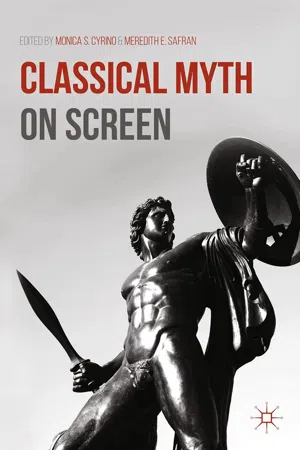
An examination of how screen texts embrace, refute, and reinvent the cultural heritage of antiquity, this volume looks at specific story-patterns and archetypes from Greco-Roman culture. The contributors offer a variety of perspectives, highlighting key cultural relay points at which a myth is received and reformulated for a particular audience.
Information
Topic
ArtSubtopic
Art GeneralPart I
The Hero’s Struggle
1
“Italian Stallion” Meets “Breaker of Horses” : Achilles and Hector in Rocky IV (1985)
Lisl Walsh
Homer’s Iliad and its narration of the conflict between the Greeks and Trojans, and Hector and Achilles, stands as the ur-text against which all subsequent tales of war, friendship, and revenge can be compared.1 Scholars of classical antiquity have long recognized later works as inheritance, imitation, and adaptation of Homer’s timeless epic. Sylvester Stallone’s Rocky IV (1985), on the other hand, has not been regarded as timeless.2 Critics have typically discussed it alongside other action films in the context of Reagan-era culture, politics, and ideology: a relatively uncomplicated pro-America microcosm of the Cold War.3 Certainly the film is meant to comment on America’s conflict with the Soviet Union and American ideology of the time, yet the film is hardly unproblematically pro-American or simplistic in its treatment of the political conflict. Reading Rocky IV as an inheritance of the myth of Achilles, Patroclus, and Hector sheds new light on how the film engages with issues of social and political identity, responsibility to community, friendship, and war.
The observable structural parallels begin with context:4 in the midst of war—the Trojan War and the Cold War, respectively—Achilles and Rocky Balboa are uninterested in engaging an enemy challenger (Hector; Ivan Drago) in a fight that could bring them fame and protect the welfare and status of their respective societies. The protagonist’s best friend (Patroclus; Apollo Creed) feels compelled to fight in his stead; this friend is then killed by the enemy challenger. The bereaved protagonist withdraws from his community before deciding to face off against the enemy challenger, whom he defeats. In both narratives, the protagonists’ actions are structured around a central core of initial alienation from conflict, followed by loss, withdrawal, and revenge.
Who Should Fight and Why
Patroclus and Creed both fight to uphold values that Achilles and Rocky have ceased to share: investment in personal glory and the reputation and well-being of their society. Such values are as fundamental for a patriotic American athlete as they are for a Homeric warrior. In the Iliad, Achilles’ initial withdrawal from battle stems from a personal conflict with his general, Agamemnon, who refuses to acknowledge that Achilles is the “best of the Greeks” (Iliad 1.244, 1.412). He also renounces both personal stake in the conflict and identification with the rest of the group: “I didn’t come here to fight on account of some Trojan spearmen, it’s nothing to do with me. They never took my cattle or horses” (Iliad 1.153–54).5 Although Achilles’ anger cools, he remains disinterested in re-entering the war, expressing his preference for a long yet anonymous life over the prestige of battle glory, which comes at the cost of an early death (Iliad 9.308–429). The promise of glory and helping the community, when his life is the cost, no longer makes the fighting worthwhile, even when he is promised the chance to prove his claim of supremacy by fighting the best of the Trojans, Hector.
In Rocky IV, though Drago has asked specifically to fight the world-famous champion, Rocky similarly prefers a safer and quieter life at home over the glory of the fight. When Creed expresses his wish to fight Drago, Rocky tries to dissuade him: “Maybe the show is over . . . we’re like turnin’ into regular people.” Unlike Creed, who misses being in the spotlight and associates fame with having people care about him, Rocky seems to embrace the anonymity of being a “regular person,” and its corresponding lack of public responsibility. More significantly, and also unlike Creed, Rocky doesn’t feel any patriotic imperative to defend the reputation of the country against the Soviet claims of supremacy.
War Game
For both Patroclus and Creed, the desire to fight seems to stem from a sense of responsibility for the well-being and reputation of their society, but they also display more self-centered motives. Patroclus, who has been driven to tears by the suffering of the wounded Greek soldiers, states that he fights to stop their slaughter by the Trojans (Iliad 16.3–4, 22–45). But once in command, Patroclus fights not only to protect Greeks. He also defends Achilles’ honor (16.269–74) and seeks to satisfy his own rage and desire for glory by storming the walls of Troy, even if that means confronting Hector: Patroclus “rages around with his spear” (16.699), and “his own valor destroying him, he springs forward like a lion, pressing on hotly” (16.752–54). So Patroclus is driven both to help others and to increase his own renown.
In Rocky IV, Creed also has two motives driving him to fight Drago. Ostensibly, he wishes to represent his country and prove something to the Soviets: as he explains to Rocky and Adrian, “It’s something I believe in . . . I don’t want this chump to come over here with all that hype, you know, trying to make us look bad. With Rock’s help and great media coverage, we can make them look bad for a change.” At the press meeting for the bout, Creed reiterates his patriotism: “Let’s call it a sense of responsibility . . . I have to teach this fellow to box—American style”; “I just wanna show the whole world that Russia doesn’t have all the best athletes.” Creed champions the idea of protecting America’s sense of superiority over the Soviets. But the context of the pre-fight press exhibit constitutes a form of play, in which athletes routinely hype their antagonism, joke with the audience, and belittle their opponent. Creed, after exiting the stage, immediately drops his performed anger and asks Rocky, “How did I do?” Likewise, earlier in the film, Creed had referred to the exhibition bout as “kid stuff.” The Soviets, mistakenly, take this seriously.
But Creed also confesses to Rocky, in private, that he is concerned about the loss of his individual fame now that he’s retired: “It’s crazy—people care about you when you’re in that ring, and they care about you when you’re bleedin’, but once you step outta that ring, Stallion, it’s like ancient history.” As “warriors,” he and Rocky lose their usefulness without a “war” to fight. Creed’s fight, like that of Patroclus, is just as much about his individual motives—being famous and feeling useful—as it is about defending the honor of the country.
This conflict between individual and community plays out in Creed’s and Patroclus’ fight scenes, as do the consequences of the protagonists’ absences. Unfortunately for Patroclus, Achilles’ army of Myrmidons proves unable to protect Patroclus from his own folly.6 Patroclus, wearing Achilles’ armor, indeed manages to drive the Trojans away from the ships and prevent the Greeks’ defeat, but his personal fury and desire for killing push him beyond his capabilities, and outside the protection of the group. The fact that the Greeks as a whole are threatened when Patroclus joins the fight emphasizes the community identity of the participants, but Patroclus’ own desire for glory spurs him to try to breach the walls of Troy himself, only to find death at the hands of Hector.
The fight between Creed and Drago echoes Patroclus’ death scene. The choreographed entrance of the fighters is clearly meant to sell their fight as a conflict between two nations. While Drago stands in the ring, Creed, in his “Uncle Sam” costume from Rocky II (1979), is lowered in on a platform backed by a giant golden bull’s head.7 Creed hops and dances energetically to James Brown’s “Living in America,” singing alongside James Brown himself before entering the ring and vaunting around Drago, much as Patroclus taunts Hector’s charioteer (16.744–50). This spectacle of excess is enhanced by a swarm of sparkly, scantily clad dancers, as model airplanes—one representing the USSR, the other the USA—are flown by wires over the cheering crowd; the lights are blinding, the sound is loud. Into this frenetic show are inserted short cuts of the main cast—Adrian, Rocky, Creed’s other trainer Duke, Paulie, Creed’s wife Mary Anne, Drago’s wife Ludmilla, and Drago’s trainer—all of whom seem surprised by the pageantry as they shrug and raise eyebrows at each other across the stadium. The bout begins with a clear message: this fight is about national supremacy, and wealth, entertainment, and technology are America’s ammunition.
Once the fight begins, however, the silence in the room and prolonged camera shots provide a striking contrast; here are two individuals fighting, and “America”—the technology, the bustle, the crowd—can do nothing to help its ostensible representative. The cultural construct of the “exhibition bout” provides Creed no safety; the fight is quick and deadly. Drago treats the fight like a soldier in battle, eradicating the opponent without concern for life or death.
Withdrawal and Revenge
Only when their respective wars “get personal” do the aloof heroes feel the need to act. Their new carelessness about their own survival further hints at the underlying similarity between these protagonists and their enemies.8 For Achilles, the ideation of revenge necessarily takes on a sacrificial tone: Achilles knows that if he fights, his fate is to die before he leaves Troy (Iliad 9.410–16). But with his friend’s death, he stops caring about the value of his own life, stating, “My heart urges me not to live nor to remain among men, unless Hector loses his own heart first, struck by my spear, and pays the due penalty for Patroclus . . . But now I go to overtake Hector, the destroyer of my dear friend, and then I shall receive my death” (Iliad 18.90–93; 18.114–15). Whether he or Hector dies seems less important than the opportunity to face each other: “I’ll test Hector face to face; e...
Table of contents
- Cover
- Title
- Copyright
- Contents
- List of Illustrations
- Acknowledgments
- Introduction: Cinemyths: Classical Myth on Screen
- Part I The Hero’s Struggle
- Part II Fashioning the Feminine
- Part III Negotiating the Cosmic Divide
- Part IV Cinemyth-Making
- Bibliography
- Filmography
- List of Contributors
- Index
Trusted by 375,005 students
Access to over 1.5 million titles for a fair monthly price.
Study more efficiently using our study tools.
Frequently asked questions
Yes, you can cancel anytime from the Subscription tab in your account settings on the Perlego website. Your subscription will stay active until the end of your current billing period. Learn how to cancel your subscription
No, books cannot be downloaded as external files, such as PDFs, for use outside of Perlego. However, you can download books within the Perlego app for offline reading on mobile or tablet. Learn how to download books offline
Perlego offers two plans: Essential and Complete
- Essential is ideal for learners and professionals who enjoy exploring a wide range of subjects. Access the Essential Library with 800,000+ trusted titles and best-sellers across business, personal growth, and the humanities. Includes unlimited reading time and Standard Read Aloud voice.
- Complete: Perfect for advanced learners and researchers needing full, unrestricted access. Unlock 1.5M+ books across hundreds of subjects, including academic and specialized titles. The Complete Plan also includes advanced features like Premium Read Aloud and Research Assistant.
We are an online textbook subscription service, where you can get access to an entire online library for less than the price of a single book per month. With over 1.5 million books across 990+ topics, we’ve got you covered! Learn about our mission
Look out for the read-aloud symbol on your next book to see if you can listen to it. The read-aloud tool reads text aloud for you, highlighting the text as it is being read. You can pause it, speed it up and slow it down. Learn more about Read Aloud
Yes! You can use the Perlego app on both iOS and Android devices to read anytime, anywhere — even offline. Perfect for commutes or when you’re on the go.
Please note we cannot support devices running on iOS 13 and Android 7 or earlier. Learn more about using the app
Please note we cannot support devices running on iOS 13 and Android 7 or earlier. Learn more about using the app
Yes, you can access Classical Myth on Screen by M. Cyrino, M. Safran, M. Cyrino,M. Safran in PDF and/or ePUB format, as well as other popular books in Art & Art General. We have over 1.5 million books available in our catalogue for you to explore.