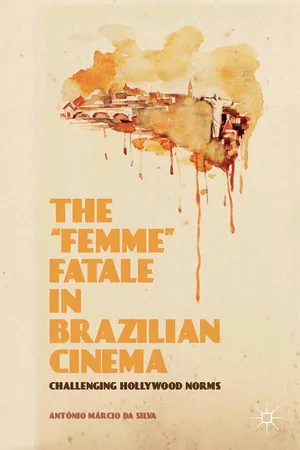
In film, the femme fatale has long been constructed as a beautiful heterosexual Caucasian woman. Da Silva shows the need to incorporate diverse ethnic groups and male homosexuals into the range of "femmes" fatales and examines how the Brazilian representations cross gender, race, and class and offer alternatives to the dominant Hollywood model.
eBook - ePub
The "Femme" Fatale in Brazilian Cinema
Challenging Hollywood Norms
- English
- ePUB (mobile friendly)
- Available on iOS & Android
eBook - ePub
The "Femme" Fatale in Brazilian Cinema
Challenging Hollywood Norms
About this book
Information
Subtopic
Art General1
The Black Femme Fatale in Xica da Silva
The sexual danger the femme fatale represents in American film noir (which did not occur, however, only in this film genre) is “constructed through foreign, racialized, and exoticized others” (Fay and Nieland 171). Nevertheless, although foreignness in film noir relates to racial issues, this seems to be masked by the fact that the femme fatale is played by light-skinned actresses, such as Rita Hayworth and Greta Garbo. Indeed, the relationship of film noir with blackness, for instance, is mostly figurative and is implied by the symbols the films use such as “jazz music, the black-and-white cinematography, and even the darkness of the femme fatale herself” (Fay and Nieland 274)—the black body is absent from characters in leading roles, particularly those playing the femme fatale. The “visual blackness” suggested through symbols such as the ones above is, therefore, what stands out in the analysis of racial issues in the films (e.g., Oliver and Trigo’s study). For Oliver and Trigo, the femme fatale’s “darkness” and her “repressed racial blackness” are indications of her questionable maternal origin as this is likely to be the source of her evilness.
Thus, blackness in film noir is suggested through the cinematography and the visual style, but the femme fatale herself remains a light-skinned woman. Although this could be because of the context specificities, the 1940s, it seems to be related to the imaginary surrounding the femme fatale as Caucasian. This is strongly indicated by the lack of black femmes fatales in neo-noir films and in studies that fail to identify the femme fatale beyond noir and neo-noir films. As Caputi argues (by referring to Hannsberry), “Many theorists, through differing strategies, neglect to critique representations of dangerous, monstrous, and violent women of color and focus only on sexy white femmes fatales” (51). Moreover, as Caputi points out, all the negative features that make a woman “bad” or “noir” are those related to women of color and are rooted in colonialist and racist views: “primitive emotions and lusts, violence, sexual aggression, masculinity, lesbian tendencies, promiscuity, duplicity, treachery, contaminating corruption, sovereignty, and so on” (52). Yet, these are “transmitted” onto the Caucasian femme fatale and the black one is consequently ignored in cinema. As Fay and Nieland point out, “Film noir’s misogyny is perhaps a more culturally acceptable alibi for its racism” (164–65). But as Caputi further observes (by referring to Lalvani), although the femme fatale is essentially characterized as a white woman, her background is a colonialist one.
Wager emphasizes noir’s minimum focus on racial issues. Even more significant, as the author rightly points out by quoting Orr, is that remakes of film noir have done the same thing. Wager argues that the most these films show is somebody “passing” as white and that the “racial threat” for these “white” characters concerns their true racial origin being discovered, as happens in Devil in a Blue Dress (1995) where “the femme is trapped by her ambiguous racial status” (125). The author, nevertheless, contends that because this film concentrates on race it loses its impact on gender; indeed, race motivates most evil in the film.
The issues these authors raise regarding race is evident in Brazilian cinema where black people have mostly played minimal roles, such as servants and criminals, in films (see Stam, Cross-Cultural). Only on very few occasions have they been the main characters of a Brazilian film, let alone a femme fatale. Xica da Silva is an exception to this. Hence, by engaging with this filmic representation of the black Brazilian femme fatale, this chapter aims to subvert the existing conception of such a figure as a Caucasian woman and to show that such a character is performatively constituted. This is crucial for an up-to-date understanding of the figure and to “decolonize” the Euro-American imaginary surrounding it.
Carlos Diegues’s Xica da Silva is based on the life of the eponymous protagonist—a slave who lived in the hamlet of Tijuco (now Diamantina) in the province of Minas Gerais, which is a region where the Portuguese mined diamonds and other precious stones, during the eighteenth century.1 In the film, Xica da Silva (Zezé Motta) becomes renowned for possessing a phenomenal sexual drive and much cunning. She performs different sexual tricks—“some things that only she knows how to do”—that cause men to howl not only with pleasure but also with pain. She captures the attention of the newly arrived Portuguese contractor João Fernandes (Walmor Chagas), sent by the Portuguese Crown to Tijuco to mine for diamonds. But once there, he falls in love with Xica and, as a result, provides her with whatever extravagance she demands; he even presents the slave with her enfranchisement letter. Consequently, Portugal sends a revenue agent—the Count of Valadares (José Wilker)—to check João Fernandes’s excessive expenditure and this ends the lavish lifestyle he provided for Xica. Furthermore, because of his relationship with the black slave, João Fernandes loses his position as a contractor and is sent back to Portugal.
Since its release, the film has been reviewed by film critics and scholars from different subject areas, and they show much disagreement about its “quality” and the approach the filmmaker chose to portray the historical character. For instance, one reviewer says that the film “recreates the past without creating a postcard”2 (F. Ferreira n. pag.), while another criticizes the relationship of the filmmaker to the plot by saying that “there is hardly any identification of the author with the slaves but with the masters” (Nascimento n. pag.). Some critics even call it a “disguised pornochanchada,”3 whereas others see Xica da Silva as a film that “stands out in the mediocre context of Brazilian cinema production, as it is one of the few to attract the public without the bad taste of pornochanchadas” (J. Ferreira n. pag.). Regardless of the various critics’ views, the film achieved box-office success. On its release in Rio de Janeiro on September 4, 1976, it made a profit of about Cr$ 1.200.000.00 (Nas telas). Over eight million viewers watched it in the first two and a half months it was shown (Johnson, Carnivalesque). Its reception at film festivals also demonstrated its success. For example, during the Brasília Film Festival, it was described as an “exuberant film, lively, contagious—in sum, a film with enormous public sympathy” (Vartuck n. pag.).
Despite the film addressing various important issues for understanding the Brazilian society of its time—mostly in a metaphorical way—as cinema-novo films (the film critics’ “thermometer” of Brazilian film quality) did in the previous decade, it clearly was not understood at the time. For example, the difference between Xica da Silva and the cinema-novo films mostly concerns aesthetics. Xica da Silva brought different aesthetics to the screen than the Brazilian audience of cinema novo of that time—composed mainly of members from the country’s intellectual elite—was used to seeing. As Soares observes, what differentiates “the avacalhação [sloppiness] in Xica da Silva from that in the films of Glauber Rocha and Rogério Sganzerla is that Xica is popular not because it talks about the ‘people’ or on behalf of the ‘people,’ as preach the cinema-novo filmmakers, but because it speaks the language of the ‘people’” (60). Xica da Silva tackles different issues such as race, gender, and sexuality that are as important as the ones the cinema-novo films focus on, such as hunger4 and drought in the sertão (“backlands”). The “misunderstandings” of the film are seemingly a result of the allegorical way it addresses these issues.
The film’s allegorical approach also leaves room for different interpretations and helps to question if there is a true and definite historical version of this character. Xica da Silva develops in a way that deconstructs the notion of historical truth, which earns the film an accusation of showing “disrespect to Brazilian History” (Nascimento n. pag.). Diegues’s portrayal of the historical character challenges the conventional way of understanding history and the traditional way the character is conceived in sociohistorical imaginaries. That is, the film does not reduce history to “the ‘what really happened’ of past events” (Hill 3); instead, it works with a notion of history that includes the totality of processes whereby individuals experience, interpret, and create changes within social orders, and both individuals and groups change over time as they actively participate in changing objective conditions (Hill).
Thus, Xica could be a “historical truth,” a “myth,” or even neither of these if the conventional binary way of seeing history is deconstructed and the structuralist way of understanding both myth and historical truth is challenged, as Hill proposes. Hill deconstructs this dichotomy within history by arguing that such an approach is based on an uncritical distinction that sees myth as atemporal, whereas history is based on a sequence of chronological events. In his view, the structuralist disentanglement of mythic “structure” from historical “event” has resulted in a view of myth as fiction “as opposed to history as fact, a dichotomy that disappears as soon as it is recognized that neither myth nor history is reducible to a text, thing, fact, or event” (5).
Concerning myth and the femme fatale, Place sees this as a mechanism used to apply an ideological operation—to control the strong, sexual woman. According to Place, besides expressing dominant ideologies, myth is “responsive to the repressed needs of the culture” (36). It gives voice to the unacceptable archetypes as well: “The myth of the sexually aggressive woman (or criminal man) first allows sensuous expression of that idea and then destroys it” (36). Indeed, with its representation of a black femme fatale from the colonial period, Xica da Silva arguably responds to and criticizes the country’s political situation at the time it was made, and the “unacceptable archetype” of the femme fatale works as a smokescreen to slip through censorship while it addresses these issues. The criticism is done in a carnivalesque and allegorical way, and the way it brings “history” to the screen works as an escape valve for the weak to occupy the position of power and change places with the dominant class. Thus, Xica causes social inversion in the colonial setting. As a consequence, the black femme fatale simultaneously represents the glamour and the horror of “otherness” once she becomes both a source of pleasure and a threat to the colonial society via the control she exercises over the European male colonizer through her “fatal” sexuality.
The Slave Femme Fatale and the Colonial Setting
Xica first appears in the film in the courtyard of her master’s house. The clothes she wears identify her as a slave; therefore, unlike many traditional Caucasian femmes fatales who have power from the beginning of the films and control nearly everyone and everything around them, the black femme fatale needs empowerment to exercise such control over the colonial society, especially its men. Such empowerment moreover supports the view that the femme fatale is not born as such but is an identity that is performatively constructed through the character’s acts. This is indicated through Xica’s acts from her first appearance in the film, which shows that she depends on no one but herself to achieve liberation. That is, like the femme fatale in neo-noir, she does this by playing with the very fantasy that patriarchal males have about female sexuality: she freely talks about her sexual acts and uses these to dominate males. Although she is not an example of the conventional model of beauty that is disseminated through depictions of traditional femmes fatales, she is as sensual and seductive as they are. She knows the power her body has and she uses it to cause social inversion.
Xica immediately puts every new idea she has into action, and she achieves her goal of occupying a prestigious place in colonial society. But her acts disrupt the colonial society’s social and sexual order. In contrast to other slave women in colonial contexts whose bodies were “readily available” to the colonial white males, Xica “is portrayed in the film as mostly in control of hers” (Dennison and Shaw 172). Unlike what some film critics have stated (e.g., Stam, Tropical), men do not possess Xica. As Araújo rightly observes, “Contrary to the traditional interpretation of the film, Xica is not used sexually. She enjoys the pleasure sex provides” (42). The black femme fatale possesses the men and they have to do exactly what she wants. Xica’s power over men is not only a subversion of hegemonic gender and sexual roles, as is mostly the case with the new femme fatale, but also an inversion of the master/slave dichotomy within the colonial context, and it shows the ways in which she exploits these for her own benefit. The colonial males are unable to resist Xica’s sadistic treatment and this indicates the masochistic pleasure they find in it, which additionally confirms the black femme fatale’s control over them. Through her performance as a femme fatale, Xica becomes a threat to the colonial society once it loses control over her, and she manages to occupy a position of power (as João Fernandes’s quasi-wife) from which she controls everyone around her.
Besides dominating the males through her sexual power, Xica causes anxiety for the colonial elite by getting involved with men who are against colonial rule, such as her owner’s son José (Stepan Nercessian) and Teodoro (Marcus Vinícius). José is involved with the anticolonial movement known as Inconfidência Mineira,5 while Teodoro explores the diamond mines without permission from the ruling authorities and refuses to pay the high taxes he owes the Portuguese Crown. However, despite the black femme fatale representing numerous threats, the white European “hero,” João Fernandes, cannot avoid getting involved with her, and he provides her with whatever she demands.
João Fernandes’s relationship with Xica paradoxically becomes necessary for him as it reaffirms his colonizer position in relation to the “other,” that is, the colonized black femme fatale—similar to other colonial contexts. For example, Yee points out that according to imperialist exoticism, the successful protagonist (the European hero) “should emerge sufficiently cleansed and strengthened from his encounter with the revalorised colonial subject to be able to assert his own status as hero faced with the more pernicious exoticism of the femme fatale” (478). In Xica da Silva, João Fernandes gets involved with a femme fatale who possesses an unrestrained sexual drive that is a test for his status as a hero and a patriarchal male. However, he fails the test and his involvement with the “devalued,” exotic, and colonized black femme fatale costs him his position of power as he loses his post as a contractor because of this. Hence, unlike what Yee states about European heroes in her study, João Fernandes does not leave the colony as a strengthened hero.
The sense of “otherness” in Xica da Silva additionally recalls the perception of other colonized countries that different European colonizers’ discourses have portrayed over centuries. The image of inhabitants of such countries has been propagated as essentially sexual, which provides possibilities for the colonizer to not only fulfill his prohibited sexual desires but also reassure his masculinity. McClintock argues that during the Renaissance European travelers had “an eager and lascivious audience for their spicy tales” (22). The author further contends that Africa and the Americas became the “porno-tropics for the European imagination” and “a fantastic magic lantern of the mind onto which Europe projected its forbidden sexual desires and fears” (22). However, their sexual contact with nonwhite women in the colonial setting brought risks because “through sexual contact with women of colour European men ‘contracted’ not only disease but debased sentiments, immoral proclivities and extreme susceptibility to decivilised states” (Stoler, qtd. in McClintock 48). This projection of prohibited desires McClintock points out is presented in Xica da Silva through the construction of the black femme fatale as the sexually insatiable “other” with whom the European male colonizer releases his sexual desires. She reduces him to her passive and masochistic sexual plaything.
Xica’s sexual behavior mirrors Doane’s claim that unrestrained female sexuality presents a danger to the male and to the system of signification itself. An example of this is how Xica, similar to other neo-noir...
Table of contents
- Cover
- Title
- Introduction
- 1 The Black Femme Fatale in Xica da Silva
- 2 The Femme Fatale’s “Troubled” Gender in Madame Satã
- 3 Social Class and the Virgin/Whore Dichotomy in Bonitinha mas ordinária
- 4 The Fetish “Dirt” as “Social Pollution”: The Married Femme Fatale in A dama do lotação
- 5 The “Abject” Lesbian Fatale in As intimidades de Analu e Fernanda
- 6 “Quoting” the Film-Noir Femme Fatale in A dama do Cine Shanghai
- Conclusion
- Notes
- Filmography
- Bibliography
- Index
Trusted by 375,005 students
Access to over 1.5 million titles for a fair monthly price.
Study more efficiently using our study tools.
Frequently asked questions
Yes, you can cancel anytime from the Subscription tab in your account settings on the Perlego website. Your subscription will stay active until the end of your current billing period. Learn how to cancel your subscription
No, books cannot be downloaded as external files, such as PDFs, for use outside of Perlego. However, you can download books within the Perlego app for offline reading on mobile or tablet. Learn how to download books offline
Perlego offers two plans: Essential and Complete
- Essential is ideal for learners and professionals who enjoy exploring a wide range of subjects. Access the Essential Library with 800,000+ trusted titles and best-sellers across business, personal growth, and the humanities. Includes unlimited reading time and Standard Read Aloud voice.
- Complete: Perfect for advanced learners and researchers needing full, unrestricted access. Unlock 1.5M+ books across hundreds of subjects, including academic and specialized titles. The Complete Plan also includes advanced features like Premium Read Aloud and Research Assistant.
We are an online textbook subscription service, where you can get access to an entire online library for less than the price of a single book per month. With over 1.5 million books across 990+ topics, we’ve got you covered! Learn about our mission
Look out for the read-aloud symbol on your next book to see if you can listen to it. The read-aloud tool reads text aloud for you, highlighting the text as it is being read. You can pause it, speed it up and slow it down. Learn more about Read Aloud
Yes! You can use the Perlego app on both iOS and Android devices to read anytime, anywhere — even offline. Perfect for commutes or when you’re on the go.
Please note we cannot support devices running on iOS 13 and Android 7 or earlier. Learn more about using the app
Please note we cannot support devices running on iOS 13 and Android 7 or earlier. Learn more about using the app
Yes, you can access The "Femme" Fatale in Brazilian Cinema by Kenneth A. Loparo,Antônio Márcio da Silva in PDF and/or ePUB format, as well as other popular books in Media & Performing Arts & Art General. We have over 1.5 million books available in our catalogue for you to explore.