Tracing the history of Africa's relationship to film festivals and exploring the festivals' impact on the various types of people who attend festivals (the festival experts, the ordinary festival audiences, and the filmmakers), Dovey reveals what turns something called a "festival" into a "festival experience" for these groups.
- English
- ePUB (mobile friendly)
- Available on iOS & Android
eBook - ePub
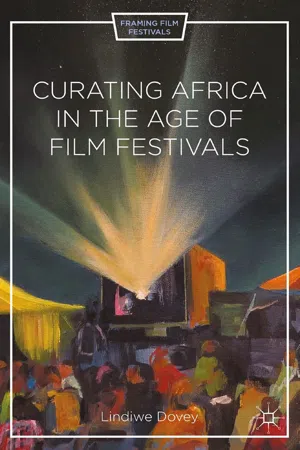
Curating Africa in the Age of Film Festivals
About this book
Information
1
Early Curatorial Practices European Colonialism, and the Rise of “A-list” Film Festivals
A Species of Origin: Proto Film Festivals
If one situates the earliest film festivals within a two-millennia history of practices of collecting, curating, and displaying objects in Europe, their participation in “the writing of specific colonial and national histories” and the “universalizing of bourgeois views and visions” (Morgan 2013: 23) becomes overwhelmingly apparent. In his history of the museum, Jeffrey Abt locates its etymology in mouseion, an ancient Greek word referencing cult sites dedicated to muses. The early museum was a site imbued with aura, the home of original objects that could not be found elsewhere. Aristotle was the first on record to start collecting specimens and, in this practice, he “formulated an empirical methodology requiring social and physical structures to bring into contiguity learned inquiry and the evidence necessary to pursue it” (Abt 2011: 116). This is an important point, conjuring as it does the will to create knowledge that was also one of the foundational motivations behind the construction of museums. However, collecting and curating practices have always exceeded the desire to pass on knowledge to others through the content of the exhibits themselves; they have at the same time been invested in teaching “curated ways of seeing and behaving” (Morgan 2013: 23), forms of citizenship, belonging, and exclusion.
Whereas the world’s first known public museum—the Museum of Alexandria (founded circa 280 BCE)—initially venerated objects as religious or spiritual items, with the shift from Hellenic to Roman civilization the new emphasis was on the display of “looted statuary and paintings from conquered lands” as a way of signifying power, status, and military might (Abt 2011: 117). It was in this new context of empire and conquest that the word “curator” was first used in Latin, referring to people tasked with looking after statues displayed in public (ibid.); “cura” in Latin means to “care.” Later, this Latin word was adopted into Middle English to signify those people in the clergy who acted as assistants to vicars and priests, and whose main responsibility was the pastoral care of people in the parish. While today the words “curator” and “programmer” are often used interchangeably for the work performed by the people who select and present the films at festivals, “programmer” used to be far more prevalent. It seems to have been adopted from radio and television broadcasting language and gestures towards the handling of mechanically reproduced material. The word “program” is derived from the Greek “programma,” which originally referred to giving “written notice”—in other words, to publicize something. Besides these early connotations of marketing, the word “program” today summons the idea of computer programming and tasks that are technical and coded. It is for this reason that I prefer the word “curate” to describe the work of people involved in the shaping of film festival content. This work demands a different kind of “care”—not usually of original objects, since film is a mechanically reproduced medium,1 but of people and the presentation of their creations, a point to which I will return later.
The distinction between “auratic objects” and “art” began a long time before the age of mechanical reproduction. A new way of looking at objects was cultivated during the Roman Empire, developing citizens into observers of “art” rather than participants in worship. Bassett suggests that “[e]mphasis on the aesthetic appeal of cult images neutralized their sacred qualities and in so doing made them legitimate objects of profane aesthetic contemplation of the Christian viewer” (quoted in Abt 2011: 119, my emphasis). This paved the way for the proliferation of the practices of collecting and displaying objects in the Renaissance, when explorers and traders returned to Europe with plundered or bartered goods that they wished to show off in cabinets and cases (ibid.). These goods included a mixture of natural specimens (naturalia), human-made pieces such as coins and medals (artificialia), and paintings and statues (ibid.: 121). Again, all of this activity went hand in glove with the will to create and document knowledge, evidenced by “an outpouring of books that catalogued, classified, and illustrated the findings” (ibid.: 120). The study of the natural specimens would develop into the field of the natural sciences; the study of artificialia into the field of antiquarian studies and later history; and the study of paintings and statues into the rise of theories of the aesthetic.
With the shift from the Roman imperial era to the Renaissance, these objects moved from public to private domains. As Abt points out, “Whereas statuary and painting were displayed in outdoor or readily accessible settings during the Roman and Byzantine eras, during the Renaissance the presentation of such works moved indoors or to less approachable locations” (2011: 121). The theme of conquest also reasserted itself, with regents using collections, or their patronage of collections, as ways of expressing their “symbolic mastery of the greater world” (Kaufmann, quoted in Abt 2011: 123). The movement towards the creation of public museums and galleries and related kinds of experience erupted out of the English, North American, and French revolutions, with their insistence on social equality. This resulted in many previously private collections being opened to the public in the 1700s. A particularly dramatic example of this is embodied in an exhibition held in August 1793 at the Museum Français, the new name given to the Grand Gallery of the Louvre Palace that had recently been appropriated by the French revolutionaries. The revolutionaries showed off the sumptuous paintings and objects they had taken from the monarchy at this exhibition, which formed part of a Festival of National Unity to celebrate the achievements of the revolution in bringing power to the people (Abt 2011: 128). Rejecting religion, the revolutionaries carefully ensured that their curation of the works incorporated viewers into a world where a certain level of distance would encourage an appreciation not of the “spiritual” values of the works, but of the historical development of aesthetic styles over time. In this way, an individuation of both viewers and the makers of the goods contributed to a new sense of democratic equality and participation.
But museums, given their owners’ interest not only in imparting education but in the status and prestige of spectacular display, have long been bedfellows of conquest. It did not take long before France’s proliferating public museums in the early nineteenth century were filled with the spoils of Napoleon’s expeditions. Similarly, the world fairs that originated in London in 1851 and then spread like wildfire to the rest of Europe, Asia, Australia, the United States, and North Africa were not innocent events but spectacular imperial strategies, in light of what Robert Rydell calls a “crisis of confidence” that was sweeping the Victorian world at the time (2011: 149). The race was to possess the entire world and to prove that possession by putting it on display. The world fairs, also known as the Colonial and Universal Exhibitions, had close relationships with museums in many cases, but they were, like film festivals, relatively short-lived events that, nonetheless, brought many people together in one concentrated space and time. They were extremely popular, with the 1900 Paris Universal Exposition attracting over 50 million people across its six months. Rydell thus argues that it is no exaggeration to claim that the world fairs “shaped both the form and substance of the modern world” (2011: 136).
Again, what was important to organizers here was not simply relaying the content of these exhibitions to visitors, but training them in new ways of looking at, thinking about, and behaving in the world. The version of “worldliness” curated and cultivated at the fairs is described as follows by Rydell, through the compilation of the work of a range of scholars:
The world fairs created a highly mediated and constructed version of reality intended to make exhibition-goers self-regulating and to outfit them with “an encyclopedic urge” to possess the world through knowledge of its component parts (Corbey 1993: 360–2). . . . What Mitchell adds to this analysis is an insistence that exhibitions were not merely “representations of the world, but the world itself being ordered up as an endless exhibition.” Exhibitionary representations, in other words, are “part of a method of order and truth essential to the peculiar nature of the modern world” that gives them primary importance in defining modernity (Mitchell 1992: 290, 314). (2011: 141, my emphasis)
These fairs put the world on show. As with the recently constructed category of “world cinema,” which asks viewers to prepare themselves for a particular kind of global address and to tap into worldly desire (Andrew 2010, Betz 2010),2 presenting the particularities of distinct cultures and experiences was not the point of the world fairs so much as imparting to visitors a sense that the world was—quite literally—at their fingertips.
What was fundamentally different about the world fairs compared to museums was that they involved the display not simply of objects but of real, living human beings, through their construction of large-scale “villages” claiming to display “life” in different parts of the planet. As Catherine Hodeir says of the way the different races were represented at the 1931 Universal Exhibition in Paris, “the ‘white’ European was culture personified, the ‘yellow’ Asian in an upper middle range between nature and culture, the ‘Arab from North Africa’ in a lower middle range, and the ‘black’ African was closest to nature” (2002: 238). Black Africans were shown as being “representative of a former stage of human development” (ibid.: 234), as not being fully human. Made to dress in “leopard-skin loin-cloths” and act in “primitive” ways, they fascinated journalists of the time and their photographs appeared in thousands of publications (ibid.: 237). As Hodeir points out:
A representative photo in Paris Soir depicts the African “native” alongside zebras and monkeys from the Vincennes zoo. This association between African “natives” and African animals related not only to their mode of display, but to the evolutionary narrative of the civilizing process. (ibid.)
In reality, however, the African people appearing in the Exhibitions led very different lives outside of their performance time, wearing “Western” clothes, eating European food, and attempting to learn about their surroundings on the tiny salaries they were provided (Hodeir 2002, Rydell 2011). The evidence shows that the “traditional” activities they performed during the fairs were fabricated for the benefit of visitors. As Armstrong argues, the colonial villages were deliberately curated as chaotic and disorganized to make the official fair sites seem that much more civilized.3
Scholars, performance artists, and curators have in recent years attempted to deal with this schism between appearance and experience at the world fairs by suggesting that the colonized participants were, in different ways, able to return or subvert the gazes that attempted to fix them. This was the point, for example, of Coco Fusco and Paula Heredia’s film The Couple in the Cage (1993), and of a show organized by anthropologists Kevin and Michelle Smith about John Tevi, an African man who helped to organize African participation at the 1893 and 1901 Chicago fairs (see Smith and Smith 2001). Rydell cautions us, however, against “pushing this line of argumentation too far,” and he relates the tragic story of Ota Benga, a so-called “pygmy” who was brought along with 20 of his people to be put on display at the 1904 St. Louis World Fair as part of an anthropological exhibit. After Ota threw a chair at a woman at a fundraising dinner at the American Museum, he was confined first to New York’s Howard Colored Orphan Asylum, then sent to a seminary in Virginia where one day he went out into the forests and shot himself dead (2011: 148).4
Black Africans were often treated brutally by the curators of the world fairs. Still, the fairs can be interpreted as forerunners of the world’s first film festivals, which strategically conflated the interest in live gatherings that the fairs sparked with curiosity in the relatively new technological medium of film.
The First Film Festivals
The world’s first film festival—the Venice Film Festival (Mostra Cinematographica di Venezia)—was founded by Benito Mussolini in 1932, as part of the Venice Art Biennale, at the midpoint of the “Ventennio” or Fascist period in Italy that lasted from roughly 1922 to 1943. As SooJeong Ahn suggests, this festival—founded in the inter-war period—needs to be distinguished from the European film festivals that were established after World War II, in part as urban regeneration projects, such as Cannes (which was due to begin on September 1, 1939, the day Hitler marched on Poland, but had to be postponed until after the war, in 1946); Locarno (1946); Edinburgh (1947); and Berlin (1950) (2012: 6–7). Similarly, Marla Stone has argued that the Venice Film Festival cannot be analyzed in isolation from Mussolini’s particular vision for Italy, and his attendant Fascist cultural experiments (1999: 184).
The secretary general of the Venice Biennale in 1932, Antonio Maraini, prided Italy on being “the first to place cinema alongside the other major arts,” suggesting the elevation of cinema to the status of “art” (quoted in Stone 1999: 184). At the same time, the festival was inaugurated on a Fascist platform of “aesthetic pluralism” and the democratization of audiences—the desire to forge larger publics, greater audiences, and more fervent support for Fascism, through the erosion of elitist “high” cultures and the validation of popular cultures (ibid.: 185). This represented a significant break between the early days of the Biennale (founded in 1895), when it was orchestrated by Venetian elites, and its transformations in the late 1920s, when it was taken over by the Fascist government (ibid.: 185–6). These transformations provide a fascinating example of how the arrival of the mass, mechanical medium of film onto the international stage disrupted previous curatorial approaches to art. The idea of “aesthetic pluralism” and the mixing of people of different social classes occasioned a shock to the upper classes, who had curated the Biennale on the basis of the “isolation of the fine arts from the pressures of mass society and politics” (ibid.: 186). One can only imagine their reaction to the inclusion, in the 1932 festival, of Hollywood musicals, as well as to the 25,000 spectators the festival attracted (ibid.: 187, 191).5 In such a way, the Fascist regime facilitated changing norms of participation in such events, as people were encouraged to think of themselves not as connoisseurs with expertise, but as cultural consumers open to experience (ibid.: 187). Nevertheless, “the dictatorship at once pursued the legitimacy and continuity it found in elite culture and the cultural consensus possible in a successful mobilization of mass culture” (ibid., my emphasis); the venues chosen and ticket prices ensured a predominantly middle- and upper-class audience (ibid.: 194) until “growing gestures toward working-class attendance during the course of the 1930s” (ibid.: 202).
The Fascist government’s cultivation of new audiences for the arts cannot be read innocently. This work was part of an elaborate strategy to secure support for the ruling ideology. In the early years of the Venice Film Festival, the organizing team adopted an extremely open and diverse curatorial approach to draw large audiences (ibid.: 192). Over the course of the 1930s, however, the nationalist and propagandist elements of the festival grew as the Fascist government sought to secure funding and prestige for Italian filmmaking which, after flourishing in the pre-WWI era, had become almost nonexistent by the early 1930s (ibid.: 194). Along with the desire to stim...
Table of contents
- Cover
- Title
- Copyright
- Contents
- List of Illustrations
- Preface
- Acknowledgments
- Introduction: Film Festivals and/in Theory
- 1 Early Curatorial Practices, -European Colonialism, and the Rise of “A-list” Film Festivals
- 2 Afri-Cannes? African Film and Filmmakers at the World’s Most Prestigious Film Festival
- 3 “Where is Africa?” at the 2010 International Film Festival of Rotterdam
- 4 African Film Festivals in Africa: Curating “African Audiences” for “African Films”
- 5 Moving Africa: African Film -Festivals Outside of Africa
- 6 The Rise of “International” Film Festivals in Africa
- 7 Festive Excitement and (Dis)-sensus Communis in Action at Two Film -Festivals in Africa
- Conclusion
- Appendix 1: Film Festivals in Africa
- Appendix 2: African Film Festivals Outside of Africa
- Appendix 3: Major International Film Festivals that Support African Filmmaking
- Appendix 4: Black Film Festivals
- Notes
- Bibliography
- Index
Trusted by 375,005 students
Access to over 1.5 million titles for a fair monthly price.
Study more efficiently using our study tools.
Frequently asked questions
Yes, you can cancel anytime from the Subscription tab in your account settings on the Perlego website. Your subscription will stay active until the end of your current billing period. Learn how to cancel your subscription
No, books cannot be downloaded as external files, such as PDFs, for use outside of Perlego. However, you can download books within the Perlego app for offline reading on mobile or tablet. Learn how to download books offline
Perlego offers two plans: Essential and Complete
- Essential is ideal for learners and professionals who enjoy exploring a wide range of subjects. Access the Essential Library with 800,000+ trusted titles and best-sellers across business, personal growth, and the humanities. Includes unlimited reading time and Standard Read Aloud voice.
- Complete: Perfect for advanced learners and researchers needing full, unrestricted access. Unlock 1.5M+ books across hundreds of subjects, including academic and specialized titles. The Complete Plan also includes advanced features like Premium Read Aloud and Research Assistant.
We are an online textbook subscription service, where you can get access to an entire online library for less than the price of a single book per month. With over 1.5 million books across 990+ topics, we’ve got you covered! Learn about our mission
Look out for the read-aloud symbol on your next book to see if you can listen to it. The read-aloud tool reads text aloud for you, highlighting the text as it is being read. You can pause it, speed it up and slow it down. Learn more about Read Aloud
Yes! You can use the Perlego app on both iOS and Android devices to read anytime, anywhere — even offline. Perfect for commutes or when you’re on the go.
Please note we cannot support devices running on iOS 13 and Android 7 or earlier. Learn more about using the app
Please note we cannot support devices running on iOS 13 and Android 7 or earlier. Learn more about using the app
Yes, you can access Curating Africa in the Age of Film Festivals by L. Dovey in PDF and/or ePUB format, as well as other popular books in Social Sciences & Art General. We have over 1.5 million books available in our catalogue for you to explore.