- English
- ePUB (mobile friendly)
- Available on iOS & Android
eBook - ePub
About this book
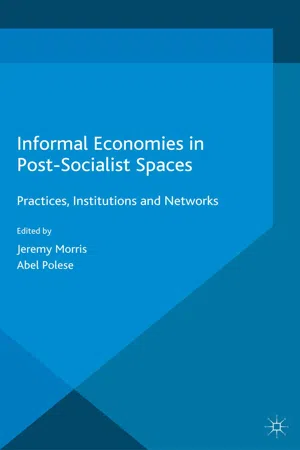
Informed by in-depth case studies focusing on a wide spectrum of micro and macro post-socialist realities, this book demonstrates the multi-faceted nature of informality and suggests that it is a widely diffused phenomenon, used at all levels of a society and by both winners and losers of post-socialist transition.
Information
Part I
Thinking Informality and Development Writ Large and Small
1
Evaluating the Validity of the Contrasting Theoretical Perspectives towards the Informal Economy in Ukraine
Colin C. Williams and Olga Onoshchenko
Introduction
To date, research on the informal economy in Ukraine has largely focused on measuring its size rather than exploring the nature and motives of people engaged in the informal economy. Only a few authors have addressed this latter question (Dzvinka, 2002; Thiessen, 1997; Williams and Round, 2008; Williams et al., 2011a,b). Moreover, even fewer have sought to evaluate the validity of the contrasting theorizations of the informal economy in relation to Ukraine (Williams, 2007; Williams and Round, 2008; Williams et al., 2011a) and none have carried out in-depth qualitative analysis.
Lack of qualitative research on the informal economy is not the only gap in knowledge in this field. The other gaps include a lack of studies of particular regions, not enough empirical evidence for theoretical conclusions, and no consensus on the theorization of the informal economy. Therefore, the objective of this chapter is to analyse the extent and nature of informal work in an urban area of Ukraine in order to evaluate existing theorizations of the informal economy.
Contrasting theorizations of the relationship between formal and informal work
Williams and Round (2008) have produced a classification of existing theorizations of the informal economy. They distinguish four different theoretical approaches that consider informal employment as a residue; a by-product of the formal economy; a complement to the formal economy; and an alternative to the formal economy. They suggest, however, that universal theorizations are not possible due to the diverse nature of the informal economy. This can be viewed as the fifth, post-structuralist perspective.
Residue theory (dualistic approach)
The first perspective, residue theory, is based on the assumption that the informal economy is a leftover from an earlier mode of production and consumption and will disappear as a result of economic advancement. This theory corresponds with Derrida’s (1967) theory of binary oppositions, where the two elements are in a hierarchical relationship with each other: one is considered superordinate, while the other is subordinate. Informality is subordinate and considered a negative phenomenon, which is associated with underdevelopment, while the formal economy is superordinate, positive and connected with progress (Williams, 2014; Williams and Round, 2008).
In the middle of the last century, there was a belief that industrialization would pull workers in developing countries from the unproductive informal sector towards a modern, industrial formal sector (Moser, 1977; Willman-Navarro, 2008). This theory stemmed from ‘the experience of rebuilding Europe and Japan following World War II, and the expansion of industrialization in the United States and Britain’ (Willman-Navarro, 2008: 369). However, in the 1970s, the informal sector around the world was still growing and these expectations were not borne out. The empirical data showed that development policies were slow to trickle down and that the formal economy could not absorb the large pool of unemployed (Willman-Navarro, 2008).
However, the actual growth of the informal economy is not the only reason to criticize the residue theory. Potts (2008) sees the main problem of the dualistic conceptualizations (residue theory) of less developed economies to be the fallacious view of ‘disconnection’ between the two sectors, and argues that the residue theory ‘has descriptive value but is dangerously misleading if translated into policy that is founded on an idea that the sectors are functionally separate’ (Potts, 2008: 152–153).
On this issue of indisputable fallacies, the view of the informal economy as a residue has ‘resurfaced’ in a vast range of studies. For example, Chen et al. (2004) argue that the residue theory has to be rethought due to the fact the informal economy has not only grown but also emerged in unexpected places and in various forms. They summarize the main differences between the ‘old’ and ‘new’ concepts of the informal economy (see Table 1.1).
Indeed, this ‘old’ view, or the formalization thesis, remains widespread and commonly accepted today, although a growing literature refutes this theory. The reason for its defectiveness is seen in ‘a widespread recognition that the informal economy is not some weak and disappearing realm but strong, persistent and even growing in the contemporary global economy’ (Williams and Round, 2007: 32).
By-product theory (structuralist approach)
The second theory, the by-product/globalization/marginalization approach, like the residue theory, represents the informal economy negatively, but, in contrast to the former, views this sphere as an integral part of the formal economy. The informal economy is here seen as emerging in late capitalism as a result of an increasingly deregulated global economy. Here, marginalized populations engage in exploitative work conditions in the informal economy as a ‘survival strategy’ in the absence of alternative means of livelihood. These first two theories tend to focus upon waged informal employment and also necessity-driven informal self-employment (Williams and Round, 2008).
The International Labour Office (2007), adopting a by-product approach, negatively depicts informal work and promotes formal employment as decent and progressive. For example, in sub-Saharan Africa, the ILO adopts the policy of ‘progressive formalization of the informal economy’. In Asia, the ILO (2007) similarly argues that informal workers are ‘unrecognized, unprotected and lack access to basic services and rights’. As the ILO (2007: 18) puts it,
The main benefit of formalization should be considered in terms of increased economic and social security that builds a platform for investment and enables informal operators to take a longer perspective on their future than day-to-day survival allows.
Another example of the by-product theory can be found in Williams and Round (2008). They studied the work practices of households in Ukraine and found that the formalization thesis is not applicable. Instead, informal work in Ukraine can best be described using a by-product approach, due to two main findings. First, over a quarter of households mainly rely on the informal economy. This shows that the informal sector is not a disappearing residue from pre-capitalism. Second, for those engaged in the informal work the main motive is to ‘eke out a living’. However, the commentators argue that the by-product thesis is not the most accurate approach to depict Ukrainian reality (although it is the closest). They argue that the informal economy in Ukraine is, rather, ‘a core integral component of contemporary work organization’ (Williams and Round, 2007: 38). This is explained by the fact that the majority of those in the formal economy rely heavily on the informal economy to secure their livelihood.
Table 1.1 Old and new views of the informal economy
The old view | The new view |
The informal sector is the traditional economy that will wither away and die with modern, industrial growth. | The informal economy is ‘here to stay’ and expanding with modern, industrial growth. |
It is only marginally productive. | It is a major provider of employment, goods and services for lower-income groups. It contributes a significant share of GDP. |
It exists separately from the formal economy. | It is linked to the formal economy – it produces for, trades with, distributes for and provides services to the formal economy. |
It represents a reserve pool of surplus labour. | Much of the recent rise in informal employment is due to the decline in formal employment or to the informalization of previously formal employment relationships. |
It is comprised mostly of street traders and very small-scale producers. | It is made up of a wide range of informal occupations – both ‘resilient old forms’ such as casual day labour in construction and agriculture as well as ‘emerging new forms’ such as temporary and part-time jobs plus homework for high-tech industries. |
Most of those in the sector are entrepreneurs who run illegal and unregistered enterprises in order to avoid regulation and taxation. | It is made up of non-standard wage workers as well as entrepreneurs and self-employed persons producing legal goods and services, albeit through irregular or unregulated means. Most entrepreneurs and the self-employed are amenable to, and would welcome, efforts to reduce barriers to registration and related transaction costs and to increase benefits from regulation; and most informal wage workers would welcome more stable jobs and workers’ rights. |
Work in the informal economy is comprised mostly of survival activities and thus is not a subject for economic policy. | Informal enterprises include not only survival activities but also stable enterprises and dynamic growing businesses, and informal employment includes not only self-employment but also wage employment. All forms of informal employment are affected by most (if not all) economic policies. |
Source: Revised version of Chen et al. (2004: 20).
One more example of the by-product approach is the work of Smith (2006), who considers the informal economy as ‘constitutive outside’ of neoliberalism. The author also employs the example of post-socialist countries in the transition period. He sees the informal economy as ‘a response to reductions in social benefits and as a way in which poor households sustain livelihoods in the face of falling incomes’ (Smith, 2006: 11). This correlates with the ‘survival strategy’ theory. However, the author also mentions the reciprocal nature of non-market informal labour, when informal activities imply being part of a community. Here, Smith adheres to the post-structuralist view (discussed below) of the informal ‘as part of a diverse economy of post-socialism constituted by a range of forces, not only those corresponding to capitalist induced austerity’ and suggests that informal practices cannot be seen just ‘as the “survival strategies” of the poor, but as complex cultural and socio-economic phenomena’ (Smith, 2009: 53). Some informal economic activities are not just profit earning; they have a particular social and cultural significance for the participants – it is the way of being a valuable member of your community; ‘the “glue” that enables “held togetherness” of societies in traumatic times’ (Smith, 2009: 62).
Finally, Varnaliy (2007) portrays the informal economy in Ukraine as having a negative impact on all social-economic processes, arguing that this sector constantly expands connections with the legal one, competes with the latter and supplants it. On the basis of this depiction of the informal economy as a negative phenomenon and as intertwined with the formal, one can assume that here the informal economy is also considered as a by-product of the formal.
Complementary theory
In the third theory, the relationship between the formal and informal economies is complementary, with both growing and declining in tandem, rather than substitutive as in the by-product approach. Nevertheless, as with the by-product approach, both spheres are again seen as intertwined with each other, albeit in a mutually iterative relationship rather than one arising as a consequence of the other. Moreover, although inclusion into the formal economy is retained as a ‘path to progress’, the informal economy is viewed more positively than in the residue and by-product approaches. Economic development implies not only formal economy development, but also informal development. Both economies are growing and declining in tandem, and those who are better off have more opportunities to generate informal income, while deprived households are less involved in the informal economy (Williams and Round, 2008).
As Williams and Round (2008) argue with reference to Ukraine, higher-income households give and receive some 41% more paid favours than the average household, while the lowest-income households account for just half of the paid favours of the average household. This displays ‘how this informal work reinforces the disparities produced in the formal economy’ (Williams and Round, 2008: 382). Paid favours here include domestic tasks conducted for kin, friends and neighbours. This work is done not only for profit motives, but also to help close people and/or reinforce social ties. A study of English localities reveals a similar situation (Williams, 2010). Here, own-account work for closer social relations can take various forms, from profit-motivated informal self-employment undertaken for more distant acquaintances to work performed solely for social motives.
Another piece of evidence supporting this theorization of the informal economy as a complement to the formal economy is provided by a study of rural Pennsylvania (Slack and Jensen, 2010). This study refutes common assumptions that formal and informal economies are substitutes: in other words, that informal work is a survival strategy and participation in the informal economy is inversely related to family income. Households with members in stable, well-paid jobs are more likely to participate in the informal economy (e.g. entrepreneurial moonlighting) than those with low-paid household members. This implies that ‘good’ jobs provide more opportunities for on-the-side earnings and informal work is a complement to formal work. In addition, Jensen et al. (1995) find that, although the prevalence of the informal activities declines with rising income, households with the lowest incomes are the least likely to report informal activities. These findings, therefore, correspond with the informal-as-complement theory. As Dzvinka (2002) similarly argues, the informal economy does not have an adverse effect on the formal economy. Instead, they are ‘complements’ rather than ‘substitutes’. Adam and Ginsburgh (1985) are in agreement when studying the Belgian economy.
Alternative theory
The fourth theory, which views the informal economy as an alternative to the formal economy, is advocated mostly by neoliberals (De Soto, 1989; Maloney, 2003; Schneider and Enste, 2000). They consider over-regulation of the economy to be very negative, and argue that the real problem is not so much informality as formality. The solution is to liberate the labour market from intervention, and informal employment exemplifies how formal employment could be organized if it were deregulated. In this approach, which is more commonly applied to a third world context, the normative hierarchy of the residue and by-product discourses is inverted. The conventional normative portrayal of economic development as a process of formalization is countered with an alternative inverted view of development as a process of informalization. In this approach, opportunity-driven informal self-employment is discussed. This consists mainly of micro-entrepreneurs who prefer informality due to the cost, time and effort required by registration (Williams and Round, 2008).
For example, Cross (2000) argues that informal sector takes over where the formal sector fails. This is the ‘micro-business’ sector that absorbs part of increased unemployment, tempering the negative social effects of economic downturn. Therefore, the view of the informal sector as ‘a bad copy of the formal’ is seen to be erroneous. Furthermore, Cross (2000) criticizes the projects for informal micro-business development. He argues that imposing formal rules on informal businesses undermines their success factors. ‘From engaging in a flexible and evolving economic activity focused on family subsistence needs …, they are sucked into a rigid set of rules that they can barely understand … ’ (Cross, 2000: 44). It is further suggested that, in order to encourage entrepreneurship, micro-firms should be allo...
Table of contents
- Cover
- Title Page
- Copyright
- Contents
- List of Tables and Figures
- Acknowledgements
- Notes on Contributors
- Introduction: My Name Is Legion. The Resilience and Endurance of Informality beyond, or in spite of, the State
- Part I: Thinking Informality and Development Writ Large and Small
- Part II: Retheorizing Informality: Power, Culture, Kinship and History
- Part III: Informal Public Sectors and Welfare: State Intervention or Withdrawal?
- Index
Trusted by 375,005 students
Access to over 1.5 million titles for a fair monthly price.
Study more efficiently using our study tools.
Frequently asked questions
Yes, you can cancel anytime from the Subscription tab in your account settings on the Perlego website. Your subscription will stay active until the end of your current billing period. Learn how to cancel your subscription
No, books cannot be downloaded as external files, such as PDFs, for use outside of Perlego. However, you can download books within the Perlego app for offline reading on mobile or tablet. Learn how to download books offline
We are an online textbook subscription service, where you can get access to an entire online library for less than the price of a single book per month. With over 1.5 million books across 990+ topics, we’ve got you covered! Learn about our mission
Look out for the read-aloud symbol on your next book to see if you can listen to it. The read-aloud tool reads text aloud for you, highlighting the text as it is being read. You can pause it, speed it up and slow it down. Learn more about Read Aloud
Yes! You can use the Perlego app on both iOS and Android devices to read anytime, anywhere — even offline. Perfect for commutes or when you’re on the go.
Please note we cannot support devices running on iOS 13 and Android 7 or earlier. Learn more about using the app
Please note we cannot support devices running on iOS 13 and Android 7 or earlier. Learn more about using the app
Yes, you can access Informal Economies in Post-Socialist Spaces by J. Morris, A. Polese, J. Morris,A. Polese in PDF and/or ePUB format, as well as other popular books in Social Sciences & Business General. We have over 1.5 million books available in our catalogue for you to explore.