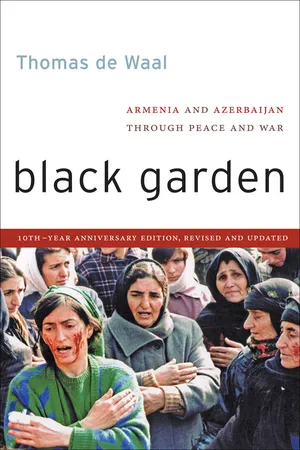
Since its publication in 2003, the first edition of Black Garden has become the definitive study of how Armenia and Azerbaijan, two southern Soviet republics, were pulled into a conflict that helped bring them to independence, spell the end of the Soviet Union, and plunge a region of great strategic importance into a decade of turmoil. This important volume is both a careful reconstruction of the history of the Nagorny Karabakh conflict since 1988 and on-the-spot reporting of the convoluted aftermath. Part contemporary history, part travel book, part political analysis, the book is based on six months traveling through the south Caucasus, more than 120 original interviews in the Moscow and Washington region, and unique historical primary sources, such as Politburo archives. The historical chapters trace how the conflict lay unresolved in the Soviet era; how Armenian and Azerbaijani societies unfroze it; how the Politiburo failed to cope with the crisis; how the war was fought and ended; and how the international community failed to sort out the conflict. What emerges is a complex and subtle portrait of a beautiful and fascinating region, blighted by historical prejudice and conflict.
The revised and updated 10th-year anniversary edition includes a new forward, a new chapter covering developments up to-2011, such as the election of new presidents in both countries, Azerbaijan's oil boom and the new arms race in the region, and a new conclusion, analysing the reasons for the intractability of the conflict and whether there are any prospects for its resolution. Telling the story of the first conflict to shake Mikhail Gorbachev's Soviet Union, Black Garden remains a central account of the reality of the post-Soviet world.
- 400 pages
- English
- ePUB (mobile friendly)
- Available on iOS & Android
eBook - ePub
About this book
Information
Subtopic
Politica1
February 1988
An Armenian Revolt
A Soviet Rebels
The crisis began in February 1988 in the depths of the Soviet Union. The central square of Stepanakert, a small but beautifully situated town in the mountains of the southern Caucasus, was a large open space, perfectly suited for public meetings. A large statue of Lenin (now removed) dominated the square with the neoclassical Regional Soviet building and a steep hill raking up behind it. A long flight of steps fell down to the plain of Azerbaijan below.
On 20 February 1988, the local Soviet of the Nagorny Karabakh Autonomous Region of Azerbaijan—essentially a small regional parliament—sitting inside a concrete-and-glass building on the square, resolved as follows:
Welcoming the wishes of the workers of the Nagorny Karabakh Autonomous Region to request the Supreme Soviets of the Azerbaijani SSR and the Armenian SSR to display a feeling of deep understanding of the aspirations of the Armenian population of Nagorny Karabakh and to resolve the question of transferring the Nagorny Karabakh Autonomous Region from the Azerbaijani SSR to the Armenian SSR, at the same time to intercede with the Supreme Soviet of the USSR to reach a positive resolution on the issue of transferring the region from the Azerbaijani SSR to the Armenian SSR.1
The dreary language of the resolution hid something truly revolutionary. Since 1921, Nagorny Karabakh had been an island of territory dominated by Armenians inside the Soviet Republic of Azerbaijan. Essentially, the local Armenian parliamentary deputies wanted the map of the Soviet Union redrawn and to see their region leave Soviet Azerbaijan and join Soviet Armenia. The USSR was already in the third year of rule by Mikhail Gorbachev, but it was still a frigid and orderly state. Gorbachev had proclaimed the doctrines of glasnost and perestroika, but they were still policies that the Communist Party regulated from above. The resolution by the Soviet in Nagorny Karabakh altered all this. By calling on Moscow to change the country’s internal borders, the Karabakh Armenians were, in effect, making politics from below for the first time in the Soviet Union since the 1920s.
A week before the Regional Soviet’s resolution, on Saturday, 13 February, a group of Karabakh Armenians had staged another unprecedented event in Lenin Square: an unsanctioned political rally. Several hundred people gathered and made speeches calling for the unification of Karabakh with Armenia. Two or three rows of policemen surrounded the demonstrators, but they were local Armenians who had been tipped off in advance and allowed the protest to go ahead. The rally was timed to coincide with the return of a delegation of Karabakh Armenian artists and writers who had taken a petition to Moscow. The head of the returning delegation, the local Armenian actress Zhanna Galstian, made the first speech to the assembled crowd. She spoke very briefly, saying that she felt happy “because by coming out here, the Karabakhi has killed the slave in himself.”2 The crowd chanted back the Armenian word “Miatsum!” or “Unity!” the one-word slogan that came to symbolize their campaign. The organizers of the rally had every reason to be afraid. No one had organized political demonstrations in the Soviet Union in living memory. At least two of the activists later admitted that they had fully expected to be arrested.3 To ward off arrest, they had devised slogans that proclaimed that they were Soviet loyal citizens acting within the spirit of glasnost. Banners carried the slogan “Lenin, Party, Gorbachev!”
In the course of these days in February 1988, many Soviet officials found that the ground under their feet was not as firm as they had believed. Members of the Communist Party hierarchy were openly disagreeing with one another, and the leadership in Moscow quickly concluded that it could not simply crush the dissenters by force. Practicing Gorbachev’s new spirit of tolerance, the Politburo told the Azerbaijani Party leaders that they should use only “Party methods”—persuasion, rather than force—to resolve the dispute. Gorbachev also decided that neither local Karabakh Armenian nor republican Azerbaijani security forces could be relied on to keep order and had a motorized battalion of 160 Soviet Interior Ministry troops dispatched from the neighboring republic of Georgia to Karabakh. As it turned out, Interior Ministry soldiers were to stay there for almost four years.4
The demonstrators in Stepanakert became more vocal. Within a week there were several thousand people in Lenin Square. Zhanna Galstian remembers an almost religious exaltation as people began to shake off the fear inbred in all Soviet citizens. “There was the highest discipline, people stood as though they were in church,” she commented. The Armenian political scientist Alik Iskandarian, who went to Stepanakert to investigate, says he found “a force of nature”: “I saw something elemental, I saw a surge of energy, energy that could have been directed in another direction. Actually, the conflict began very benignly at the very beginning … it was an astonishing thing. I had never seen anything like it in the Soviet Union—or anywhere.”5
Yet Nagorny Karabakh was not only an Armenian region. Roughly a quarter of the population—some forty thousand people—were Azerbaijanis with the strongest ties to Azerbaijan. This sudden upsurge of protest in the mainly Armenian town of Stepanakert, however peaceful its outer form, could not but antagonize them. You had only to tilt your head in Stepanakert to see the neighboring town of Shusha—90 percent of whose inhabitants were Azerbaijani—high on the cliff top above. The Azerbaijanis there were angry and began to organize counterprotests.
Events moved with speed. Eighty-seven Armenian deputies from the Regional Soviet exercised their right to call an emergency session of the assembly for Saturday, 20 February. Two top officials—the local Armenian Party leader, Boris Kevorkov, who was still fully loyal to Azerbaijan, and the first secretary of the Communist Party of Azerbaijan, Kamran Bagirov, tried and failed to stop the session’s taking place. The emergency session finally began at about 8 p.m., four or so hours behind schedule and in an explosive atmosphere. Late in the evening, 110 Armenian deputies voted unanimously for the resolution, calling for Nagorny Karabakh to join Soviet Armenia. The Azerbaijani deputies refused to vote. In a scene of high farce, Kevorkov tried to swipe the stamp needed to confirm the resolution.6 Journalists at the local newspaper, Sovetsky Karabakh, doubled the impact of the resolution by working late into the night on a special edition. Next morning, amid the usual dull TASS bulletins and reprints of Pravda, the paper published two columns on the right side of the front page announcing the local Soviet’s intention to leave Azerbaijan.
“Something Completely New”
On 21 February 1988, the Politburo met in the Kremlin to hold the first of many sessions devoted to the crisis. Heeding a keen instinct of self-preservation, members began by rejecting out of hand the Regional Soviet’s demand. Gorbachev said later that there were nineteen potential territorial conflicts in the Soviet Union and he did not want to set a precedent by making concessions on any of them. The Communist Party’s Central Committee passed the text of a resolution blackening the disloyal Karabakhis as “extremists”:
Having examined the information about developments in the Nagorny Karabakh Autonomous Region, the CPSU Central Committee holds that the actions and demands directed at revising the existing national and territorial structure contradict the interests of the working people in Soviet Azerbaijan and Armenia and damage interethnic relations.7
Other than taking this rhetorical step, it was far less obvious to the Politburo what it should do next. It ruled out the option of mass arrests but lacked any experience of dealing with mass political dissent. As the Politburo’s adviser on nationalities, Vyacheslav Mikhailov, admitted, “This was something completely new for us.” After all, the revolt came from a Soviet institution, and the Karabakh Armenians were prepared to make the argument that all they were doing was shaking the dust off Lenin’s moribund slogan “All power to the Soviets.”
Gorbachev tried dialogue. He dispatched two large delegations to the Caucasus, one of which traveled to Baku and then on to Nagorny Karabakh. In Stepanakert, the Moscow emissaries called a local Party plenum, which voted to remove Kevorkov, who had been the local leader in Nagorny Karabakh since 1974, the middle of the Brezhnev era. Kevorkov’s more popular deputy, Genrikh Pogosian, was appointed in his place. However, this created new problems for Moscow when, a few months later, Pogosian, who enjoyed much greater respect with the Karabakh Armenians, began to support the campaign for unification with Armenia.
One of the junior officials in the Politburo delegation was Grigory Kharchenko, a Central Committee official who spent most of 1988 and 1989 in the Caucasus. Kharchenko was no doubt picked for the job because of his big physical stature and open character, but he declares that he found it impossible to hold a coherent conversation with the demonstrators:
We went to one of the rallies … I would begin to say, “We have met with representatives of the intelligentsia, all these questions need to be resolved. You are on strike, what’s the point of that? We know that you are being paid for this, but all the same this question will not be resolved at a rally. The general secretary is working on it, there will be a session of the presidium of the Supreme Soviet, the issue will be studied, of course all legal complaints have to be dealt with.” But no! “Miatsum, Miatsum, Miatsum!”8
The slow descent into armed conflict began on the first day. The first tremors of violence were already stirring the two communities. The writer Sabir Rustamkhanli says he was one of several Azerbaijani intellectuals who traveled to Nagorny Karabakh wanting to begin a dialogue, but he was too late:
In the Shusha region everyone was on their feet, they were ready to go down [to Stepanakert], there would have been bloodshed. And in [the Azerbaijani town of] Aghdam, too. We didn’t want that and at the same time we did propaganda work, saying that if the Armenians carried on like this, we would be ready to respond to them. We organized the defense of Shusha. It was night, there was no fighting. The Armenians wanted to poison the water. We organized a watch. We were in the Regional Committee. I was the chief editor of the [Azerbaijani] publishing house and I had published their books in Armenian. The writers were all there. Ohanjenian was there. Gurgen Gabrielian, the children’s writer and poet who had always called me a brother. And this time, when they were standing on the square, they behaved as though they didn’t know me. There was already a different atmosphere.9
How much violence occurred during those days will probably never be known because the authorities pursued a concerted policy to cover up any incidents. But, in one example, something nasty, if not fully explained, did happen among the trainee student teachers of the Pedagogical Institute in Stepanakert. In the Azerbaijani capital Baku, during the second week of the protest, the historian Arif Yunusov and a colleague, both of whom were already collecting information on events, were called to the city’s Republican Hospital. Apparently, two Azerbaijani girls from Stepanakert had been raped. At the hospital, the head doctor denied the two academics access to the girls. The hospital nurses, however, confirmed that “these girls had come from the Pedagogic Institute in Stepanakert, that there had been a fight or an attack on their hostel. The girls were raped. They were in a bad way.”10
Two days after the local Soviet’s resolution, angry protests took place in the Azerbaijani town of Aghdam. Aghdam is a large town twenty-five kilometers east of Stepanakert, down in the plain of Azerbaijan. On 22 February, a crowd of angry young men set out from Aghdam toward Stepanakert. When they reached the Armenian village of Askeran, they were met by a cordon of policemen and a group of Armenian villagers, some of whom carried hunting rifles. The two sides fought, and people on both sides were wounded. Two of the Azerbaijanis were killed. A local policeman very probably killed one of the dead men, twenty-three-year-old Ali Hajiev, either by accident or as a result of a quarrel. The other, sixteen-year-old Bakhtiar Uliev, appears to have been the victim of an Armenian hunting rifle. If so, Uliev was the first victim of intercommunal violence in the Armenian-Azerbaijani conflict.11
News of the death of the two men sparked Aghdam into fury. An angry crowd collected trucks full of stones, crossbows, and staves and began to move on Stepanakert. A local woman, Khuraman Abasova, the head of a collective farm, famously climbed onto the roof of a car and threw her head scarf in front of the crowd. According to Azerbaijani custom, when a woman does this, men must go no further. The gesture of peace apparently restrained the crowd, and Abasova later persuaded her fellow citizens not to march on Stepanakert at a public rally. This intervention probably averted far more bloodshed.12
Origins of a Campaign
The events of February 1988 in Nagorny Karabakh occurred as if out of the blue and quickly acquired their own momentum. But the initial phase of the Armenian campaign had been carefully planned well in advance. Many Azerbaijanis, caught unawares by the revolt, believed that it had been officially sanctioned in Moscow. This was not the case, although the Karabakh movement did use the influence of well-placed Armenian sympathizers in the Soviet establishment.
An underground movement for unification with Armenia had existed inside Karabakh for decades. Whenever there was a political thaw or major political shift in the USSR—in 1945, 1965, and 1977, for example—Armenians sent letters and petitions to Moscow, asking for Nagorny Karabakh to be made part of Soviet Armenia. (It was an indication of the way the Armenians thought and the Soviet Union worked that they never raised the issue in their regional capital, Baku). With the advent of glasnost and perestroika under Gorbachev, they began to mobilize again. On 3 March 1988, Gorbachev told the Politburo that it had been remiss in failing to spot warning signals: “We must not simplify anything here and we should look at ourselves too. The Central Committee received five hundred letters in the last three years on the question of Nagorny Karabakh. Who paid any attention to this? We gave a routine response.”13
The latest Karabakh Armenian campaign was different from its predecessors in one important respect: previous campaigns had been run from inside Nagorny Karabakh itself, but the main organizers of the new movement were Karabakhis living outside the province. In the postwar years, many Karabakh Armenians had settled in Moscow, Yerevan, or Tashkent, and they now formed a large informal network across the Soviet Union.
The man in the middle was Igor Muradian, an Armenian from a Karabakhi family who was only thirty years old. Muradian had grown up in Baku and now worked in the Armenian capital, Yerevan. At first glance, he did not look the part of leader of such a big movement. Large and shambling, he speaks with a stammer and, like many Baku Armenians, is more comfortable speaking Russian than Armenian. But Muradian was both a formidable political operator and utterly uncompromising in his hard-line Armenian nationalist views. Muradian says that he was convinced that the Azerbaijani authorities were trying to settle Azerbaijanis in Nagorny Karabakh and force out Armenians, such that within a generation the province would lose its Armenian majority. He therefore argued that Armenians must seize the historical moment afforded them by Gorbachev’s reforms.
Muradian was a Soviet insider. He worked as an economist in the state planning agency Gosplan in Yerevan and had good connections among Party cadres. He learned the lesson early on that if a petition were presented in the right way, with the appropriate expressions of loyalty to the Soviet system, many influential Soviet Armenians could be persuaded to support it. For a 1983 petition on Nagorny Karabakh to then General Secretary Yury Andropov, he had secured the signatures of “veterans of the Party, people who had known Lenin, Stalin, and Beria. There was a lot of blood on their hands.”14
The scope of the Gorbachev-era campaign was much more ambitious. “The aim was set for the first time in the Soviet Union to legitimize this movement, not to make it anti-Soviet, but to make it completely loyal,” said Muradian. It is not clear whether Muradian actually believed the Soviet system would deliver Karabakh into the arms of Armenia—if so he was making a big miscalculation—or whether he was merely seeking the maximum political protection for a risky campaign.
In February 1986, Muradian traveled to Moscow with a draft letter that he persuaded nine respected Soviet Armenian Communist Party members and scientists to sign. The most prized signature was that of Abel Aganbekian, an academician who was advising Gorbachev on economic reforms: “When [Aganbekian] went into this house where he signed the letter he didn’t know where he was going and why they were taking him there, and before he signed he spent four hours there. During those four hours he drank approximately two liters of vodka.”
The Karabakh activists even received the tacit support of the local Armenian Party leader, Karen Demirchian, for one of their schemes: a campaign to discredit the senior Azerbaijani politician, Heidar Aliev, whom they had identified as the man most likely to obstruct their campaign. Aliev, the former Party leader of Azerbaijan, had been a full member of the Politburo since 1982. One of Muradian’s more outrageous ideas was that he and a fellow Armenian activist should open a prosecution case against Aliev, based on Artic...
Table of contents
- Cover Page
- Title Page
- Copyright Page
- Dedication
- Contents
- Author’s Note
- Preface to the Revised Edition
- Two Maps, of the South Caucasus and of Nagorny Karabakh
- Introduction: Crossing the Line
- 1. February 1988: An Armenian Revolt
- 2. February 1988: Azerbaijan: Puzzlement and Pogroms
- 3. Shusha: The Neighbors’ Tale
- 4. 1988–1989: An Armenian Crisis
- 5. Yerevan: Mysteries of the East
- 6. 1988–1990: An Azerbaijani Tragedy
- 7. Baku: An Eventful History
- 8. 1990–1991: A Soviet Civil War
- 9. Divisions: A Twentieth-Century Story
- 10. Hurekavank: The Unpredictable Past
- 11. August 1991–May 1992: War Breaks Out
- 12. Shusha: The Last Citadel
- 13. June 1992–September 1993: Escalation
- 14. Sabirabad: The Children’s Republic
- 15. September 1993–May 1994: Exhaustion
- 16. Stepanakert: A State Apart
- 17. 1994–2001: No War, No Peace
- 18. Sadakhlo: “They Fight, We Don’t”
- 19. 2001–2012: Deadlock and Estrangement
- Conclusion: Seeking Peace in Karabakh
- Appendix 1: Statistics
- Appendix 2: Chronology
- Notes
- Bibliography
- Index
- About the Author
Trusted by 375,005 students
Access to over 1.5 million titles for a fair monthly price.
Study more efficiently using our study tools.
Frequently asked questions
Yes, you can cancel anytime from the Subscription tab in your account settings on the Perlego website. Your subscription will stay active until the end of your current billing period. Learn how to cancel your subscription
No, books cannot be downloaded as external files, such as PDFs, for use outside of Perlego. However, you can download books within the Perlego app for offline reading on mobile or tablet. Learn how to download books offline
Perlego offers two plans: Essential and Complete
- Essential is ideal for learners and professionals who enjoy exploring a wide range of subjects. Access the Essential Library with 800,000+ trusted titles and best-sellers across business, personal growth, and the humanities. Includes unlimited reading time and Standard Read Aloud voice.
- Complete: Perfect for advanced learners and researchers needing full, unrestricted access. Unlock 1.5M+ books across hundreds of subjects, including academic and specialized titles. The Complete Plan also includes advanced features like Premium Read Aloud and Research Assistant.
We are an online textbook subscription service, where you can get access to an entire online library for less than the price of a single book per month. With over 1.5 million books across 990+ topics, we’ve got you covered! Learn about our mission
Look out for the read-aloud symbol on your next book to see if you can listen to it. The read-aloud tool reads text aloud for you, highlighting the text as it is being read. You can pause it, speed it up and slow it down. Learn more about Read Aloud
Yes! You can use the Perlego app on both iOS and Android devices to read anytime, anywhere — even offline. Perfect for commutes or when you’re on the go.
Please note we cannot support devices running on iOS 13 and Android 7 or earlier. Learn more about using the app
Please note we cannot support devices running on iOS 13 and Android 7 or earlier. Learn more about using the app
Yes, you can access Black Garden by Thomas de Waal in PDF and/or ePUB format, as well as other popular books in Politica e relazioni internazionali & Politica. We have over 1.5 million books available in our catalogue for you to explore.