The Caucasus region of Eurasia, wedged in between the Black and Caspian Seas, encompasses the modern territories of Armenia, Azerbaijan, and Georgia, as well as the troubled republic of Chechnya in southern Russia. A site of invasion, conquest, and resistance since the onset of historical record, it has earned a reputation for fearsome violence and isolated mountain redoubts closed to outsiders. Over extended efforts to control the Caucasus area, Russians have long mythologized stories of their countrymen taken captive by bands of mountain brigands.In The Captive and the Gift, the anthropologist Bruce Grant explores the long relationship between Russia and the Caucasus and the means by which sovereignty has been exercised in this contested area. Taking his lead from Aleksandr Pushkin's 1822 poem "Prisoner of the Caucasus," Grant explores the extraordinary resonances of the themes of violence, captivity, and empire in the Caucasus through mythology, poetry, short stories, ballet, opera, and film. Grant argues that while the recurring Russian captivity narrative reflected a wide range of political positions, it most often and compellingly suggested a vision of Caucasus peoples as thankless, lawless subjects of empire who were unwilling to acknowledge and accept the gifts of civilization and protection extended by Russian leaders.Drawing on years of field and archival research, Grant moves beyond myth and mass culture to suggest how real-life Caucasus practices of exchange, by contrast, aimed to control and diminish rather than unleash and increase violence. The result is a historical anthropology of sovereign forms that underscores how enduring popular narratives and close readings of ritual practices can shed light on the management of pluralism in long-fraught world areas.
eBook - ePub
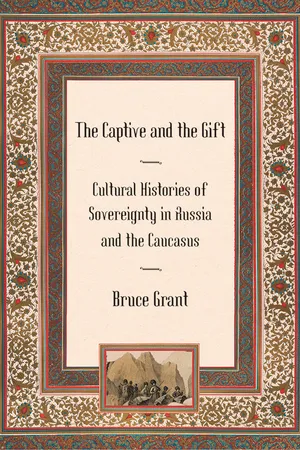
The Captive and the Gift
Cultural Histories of Sovereignty in Russia and the Caucasus
- 216 pages
- English
- ePUB (mobile friendly)
- Available on iOS & Android
eBook - ePub
About this book
Information
1
PROMETHEAN BEGINNINGS
The conquest of the earth . . . is not a pretty thing when you look into it too much. What redeems it is . . . an idea at the back of it; not a sentimental pretence but an idea; and an unselfish belief in the idea—something you can set up, and bow down before, and offer a sacrifice to.JOSEPH CONRAD, Heart of Darkness
The classic political theory of Hobbes, Locke, and Rousseau long ago focused on the kinds of social contracts inherent in sovereign rule, where sovereignty itself might be thought of simply as “supremacy” with respect to leadership—the established right to rule over others through force, custom, or law. Talk of contracts invites consideration of broad, structural dimensions to which so many studies of sovereignty have confined themselves—the absolutisms of collective good, the legitimacies and necessities of monopolies over the use of force—yet as many scholars have noted, we see less attention to how sovereignty actually operates, how such established rights come to be recognized. This is what Jens Bartelson has called “the givenness of sovereignty” (1995, 21–35). In this light, sovereignty is taken as given, in most instances, because it has already been given. Or to paraphrase Pierre Bourdieu (1977, 167), the logics of sovereignty somehow go without saying because they came without saying.
The language of social contracts such as Locke’s is ultimately one of compromise where contracts are needed to rein in individual bodies, whose unrestrained drives to conflict should be held at bay for collective goods. Individual bodies have long been at the center of sovereign logics—as the focus of morality tales demonstrating the need for new forms of rule or the probity of old ones—especially at times when questions of power and authority are most in flux (Hansen and Stepputat 2006, 297). Bodies given for higher causes can be found at the cornerstone of histories of would-be rulers in the Caucasus. It is in the tale of perhaps the most famous suffering body ever known in the Caucasus that we find some of the earliest indications of what it means to give as a route to sovereign power. The eighth century BCE, when the Greek writer Hesiod introduced Prometheus, was, perhaps not coincidentally, an age of expansion for the growing Greek empire, as flotillas began to sail east across the Black Sea looking for grains, fish, fruits, and vegetables to feed their growing armies.
The Suffering Captive Giver
Prometheus’s beginnings in the eighth century BCE tell a tale of exile and of minor characters who threaten to upset larger social orders. Prometheus was the son of Iapetos, who “was first to accept the virgin women [Klymene] fashioned by far-seeing Zeus” (Hesiod 1983, 26, line 511). Klymene bore Iapetos four sons: Atlas, Menoitis, Prometheus, and Epimetheus. In Hesiod’s telling, Iapetos’s other sons each meet burdensome fates for un-disclosed reasons. Atlas, perhaps the best known, “supports the broad sky on his head and unwavering arms” (ll. 517–518). Prometheus’s fate is more clearly causal. For his refusal to recognize the superiority of gods and for his theft of fire, Prometheus is assigned to his famous mountaintop prison.
With shackles and inescapable fetters Zeus riveted Prometheus
on a pillar—Prometheus of the labyrinthine mind;
and he sent a long-winged eagle to swoop on him
and devour the god’s liver; but what the long-winged bird ate
in the course of each day grew back and was restored to its full size.
But Herakles, the mighty son of fair-ankled Alkmene,
slew the eagle, drove the evil scourge away
from the son of Iapetos and freed him from his sorry plight,
and did all this obeying the will of Olympian Zeus,
who rules on high, to make the glory of Herakles, child of Thebes,
greater than before over the earth that nurtures many.
Zeus so respected these things and honored his illustrious son
that he quelled the wrath he had nursed against Prometheus,
who had opposed the counsels of Kronos’s mighty son.(ll. 521–534)
But no sooner is he released than Hesiod’s Prometheus, “a skillful crook” (l. 546) sets about cheating Zeus by serving him white fat instead of meat in a feast at Mekone and going on to steal fire from the king of the gods, spiriting it away “in a hollowed fennel stalk” (l. 566). No longer concerned with Prometheus and mountains, Zeus wreaks a far deeper revenge on mankind for this trickery. He creates women, inaugurated in the form of Pandora, “the tempting snare.” All men who would take wives from that time forth would know the snare’s meaning. Pandora was a beautiful woman so fraught by her mix of good and evil that “even the man who does marry and has a wife of sound and prudent mind spends his life ever trying to balance the bad and the good in her” (1983, 28, ll. 607–610). When the lid of Pandora’s box is cast open, labor, sorrow, sickness, and a multitude of plagues are let loose upon the world. And so, Hesiod tells his listeners, had it not been for Prometheus, who provoked the gods to withhold from men their means of living, “You would have been able to do easily in a day enough work to keep you for a year, to hang up your rudder in the chimney corner, and let your fields run to waste” (Thomson 1972, 317).1
There are many ways to read the life of Prometheus in Hesiod as the story of a minor actor whose transgressions drew attention to the boundaries between gods and men, leaders and followers. According to Griffith, for example, Hesiod’s story “is designed mainly to illustrate Zeus’ supreme intelligence, and the futility of any attempt to outwit him” (1983, 1). In this respect, Hesiod gives us the figure of the captive body that is held for all to see who has the power to hold bodies and to punish them. Yet Hesiod’s story already opens up a narrative element about gifts themselves. It is because of Prometheus that tributary relations between gods and men, parties who once associated freely, become firmly instituted. As Vernant has observed, “Prometheus’ failure [to outwit Zeus] not only makes the sacrificial rite into an act symbolizing the complete segregation of the two races [of gods and men], it gives this rupture the character of an irremediable and justified fall” (1989, 29). Hesiod’s Prometheus points not only to the origin of the estrangement between men and gods but to the resultant need for sacrifice itself as a means of communication across sovereign lines. It is in Prometheus that gift and sacrifice take the political stage.
Many years later, by the fifth century BCE, the Greek writer Aeschylus recycled Prometheus’s struggles with Zeus in ways that began to outline the gifts of empire when the story of Prometheus assumed a decidedly more benevolent plotline. No longer a minor actor whose calculated misdemeanors play out in a hundred lines, Prometheus becomes the subject of an extended trilogy, the second and best known of which, Prometheus Bound, offers us a generous hero of foresight, willing to suffer on a lonely mountaintop so that mankind may share in the gifts of civilization—skills such as hunting, healing, divination, and prophecy.2 In Aeschylus, Zeus’s authority has become almost entirely tyrannical, his realm “a harsh dominion” (1932, 59). Here the trickery at the feast of Mekone is omitted, and Prometheus’s theft of fire takes center stage. Prometheus—whose name means “he who knows beforehand” (from the combination of the prefix pro, meaning that which comes before; the Greek verb root manthano, meaning to know; and the suffix of benevolence, eus)—signals that he is well aware of his objectives, if not the details of his anticipated punishment. When Prometheus steals fire, Zeus, tyrant and autocrat, condemns him to exile, chaining him to the summit of Mount Caucasus, where each day an eagle descends to devour his liver, only to come again the next and devour it once more.3
All things I foreknow
That are to be: No unforeseen distress
Shall visit me, and I must bear the will
Of fate as lightly as I may, and learn
The invincible strength of Necessity.
Yet of my present state I cannot speak,
Cannot be silent. The gifts I give to man
Have harnessed me beneath this harsh duress.
I hunted down the stealthy fount of fire
In fennel stored, which schooled the race of men
In every art and taught them great resource.
Such the transgression which I expiate,
A helpless captive, shackled, shelterless!(1932, 57)4
Through his offering of vital knowledge to Zeus in the defeat of the Titans and for his deliverance of man from destruction Prometheus has, in turn, bestowed upon man the tools of prosperity.
For long in darkness hid, I brought to light.
Such help I gave and more—beneath the earth,
The buried benefits of humanity,
Iron and bronze, silver and gold, who else
Can claim that he revealed to man but I?
None, I know well, unless an idle braggart.
In these few words learn briefly my whole tale:
Prometheus founded all the arts of man.(1932, 87)
Only through a chorus of strophe and antistrophe do we meet the peoples of the earth whose lives are named by this giving. In a telling turn, they are the recent and soon-to-be conquests of the Greek Empire. Alongside the chorus themselves, those who lament Prometheus’s suffering include “every land from Asia . . . to the Black Sea . . . Scythia . . . Arabia . . . and the Caucasus . . . in their whole-hearted expression of sympathy” (Griffith 1983, 156).
Antistrophe 1And all the earth lifteth her voice in lamentation,
And all the mortals who on earth swell for thy lost splendour lament and
mourn thy brethren’s
Immemorial age of grandeur;
And the peoples who inhabit the expanse of holy Asia
In thy loud-lamented labours do partake through grief’s communion.Strophe 2Those who rule the coast in Colchis,
Maids in battle unaffrighted,
Ay, the Scythian swarm that roameth
Earth’s far verges around the wide
Water of Lake Maeotis.(Aeschylus 1932, 79)5Antistrophe 2Araby’s flower of martial manhood
Who upon Caucasian highlands
Guard their mountain-cradled stronghold,
Host invincible, armed with keen
Spears in the press of battle.(81)
In this context we can note that the mighty Caucasian highlanders, despite their strength, are cast as spectators in their own land. They receive the gifts of civilization, and what do they give in return? They give their thanks and their vigilance; they watch over the captive and weep for him. In a telling pattern that sets the stage for literally centuries of retelling this story, Prometheus is the good prisoner of the mountains who suffers for his generosity.6
As in the early episodes of Hesiod, Aeschylus’s Prometheus is eventually freed. But in this revision, Prometheus reconciles with Zeus for good, and Zeus’s reign is strengthened by the alliance. Never again in the Prometheus tale do we hear of the peoples of the Caucasus and central Asia. Yet their role is a central one. No mere stand-ins for all of mankind, they are of a very particular sort. They are the defiant peoples of the East, soon to be conquered more completely in the growing empire of the day. They make a cameo appearance long enough to make clear that Prometheus’s gifts are, in effect, gifts of empire. But they vanish as quickly as they appear. In Aeschylus, Prometheus’s giving is about the giver himself.
Prometheus knows what fate awaits him, but he gives generously to the conquered peoples and ultimately gives quite literally—with his time (thirty thousand years by one estimate) and his body in the daily capture of his liver.7 It is this figure of Prometheus who presents us the kind of paradox that Richard White, historian of North American conquest, would later characterize as “the conquering victim” ([1947] 1991). Prometheus, the bringer of imperial gifts, ends up “a helpless captive, shackled, shelterless” (Aeschylus 1932, 57). He knows in advance of his suffering, but he gives generously all the same so that conquered peoples may grow. He is an earnest volunteer.
Between Hesiod and Aeschylus, many have tracked the “transformation of Prometheus into a true tragic hero and champion of the human race” (Griffith 1983, 4). From his initial status in Hesiod as “the amoral trickster whose deceitful ways set mankind on the slippery slope of moral degeneration” (Ziolkowski 2000, 31), he became, through Aeschylus, a model giver. In the pages ahead, Prometheus plays a key role for a number of reasons. Through his actions, in very practical terms, we find one of the earliest and most luminous examples of the structural confusion between giving and taking. In Hesiod, he gives fire to man but denies man his freedom as a result, burdening him with strife. In both Hesiod and Aeschylus, he gives fire to man but has stolen it from the gods. Yet despite this giving, we find only a blur of receiving. Through the tears of the mountain peoples, we learn briefly of their sympathy and their implied gratitude. But any formal recipients as such are studiously absent: no Caucasians or Scythians come forward with testimonials. Giving, in the end, earned Prometheus a place in the pantheon, according to Aeschylus. Giving conferred his ultimate status.
P...
Table of contents
- Preface
- Acknowledgments
- 1. Promethean Beginnings
- 2. Histories of Encounter, Raidings, and Trade
- 3. Noble Giving, Noble Taking
- 4. Rites of Encounter
- 5. Captive Russians
- 6. Caucasian Reflections
- 7. From Prometheus to the Present
- Glossary
- References
Trusted by 375,005 students
Access to over 1.5 million titles for a fair monthly price.
Study more efficiently using our study tools.
Frequently asked questions
Yes, you can cancel anytime from the Subscription tab in your account settings on the Perlego website. Your subscription will stay active until the end of your current billing period. Learn how to cancel your subscription
No, books cannot be downloaded as external files, such as PDFs, for use outside of Perlego. However, you can download books within the Perlego app for offline reading on mobile or tablet. Learn how to download books offline
Perlego offers two plans: Essential and Complete
- Essential is ideal for learners and professionals who enjoy exploring a wide range of subjects. Access the Essential Library with 800,000+ trusted titles and best-sellers across business, personal growth, and the humanities. Includes unlimited reading time and Standard Read Aloud voice.
- Complete: Perfect for advanced learners and researchers needing full, unrestricted access. Unlock 1.5M+ books across hundreds of subjects, including academic and specialized titles. The Complete Plan also includes advanced features like Premium Read Aloud and Research Assistant.
We are an online textbook subscription service, where you can get access to an entire online library for less than the price of a single book per month. With over 1.5 million books across 990+ topics, we’ve got you covered! Learn about our mission
Look out for the read-aloud symbol on your next book to see if you can listen to it. The read-aloud tool reads text aloud for you, highlighting the text as it is being read. You can pause it, speed it up and slow it down. Learn more about Read Aloud
Yes! You can use the Perlego app on both iOS and Android devices to read anytime, anywhere — even offline. Perfect for commutes or when you’re on the go.
Please note we cannot support devices running on iOS 13 and Android 7 or earlier. Learn more about using the app
Please note we cannot support devices running on iOS 13 and Android 7 or earlier. Learn more about using the app
Yes, you can access The Captive and the Gift by Bruce Grant in PDF and/or ePUB format, as well as other popular books in History & Russian History. We have over 1.5 million books available in our catalogue for you to explore.