Intercultural Communicative Competence for Global Citizenship
eBook - ePub

Intercultural Communicative Competence for Global Citizenship

Identifying cyberpragmatic rules of engagement in telecollaboration

  1. English
  2. ePUB (mobile friendly)
  3. Available on iOS & Android
eBook - ePub

Intercultural Communicative Competence for Global Citizenship

Identifying cyberpragmatic rules of engagement in telecollaboration

About this book

Presents innovative research on internationalisation developments in Higher Education

Offers practical guidelines and solutions to some of the challenges faced when engaging with global citizenship projects

Advances current scholarship on telecollaboration/Online International Learning (OIL) projects

Demonstrates how, through well-crafted telecollaboration activities, educators in any field of study can shape the development of  Intercultural Communicative Competence in their learners


Frequently asked questions

Yes, you can cancel anytime from the Subscription tab in your account settings on the Perlego website. Your subscription will stay active until the end of your current billing period. Learn how to cancel your subscription.
No, books cannot be downloaded as external files, such as PDFs, for use outside of Perlego. However, you can download books within the Perlego app for offline reading on mobile or tablet. Learn more here.
Perlego offers two plans: Essential and Complete
  • Essential is ideal for learners and professionals who enjoy exploring a wide range of subjects. Access the Essential Library with 800,000+ trusted titles and best-sellers across business, personal growth, and the humanities. Includes unlimited reading time and Standard Read Aloud voice.
  • Complete: Perfect for advanced learners and researchers needing full, unrestricted access. Unlock 1.4M+ books across hundreds of subjects, including academic and specialized titles. The Complete Plan also includes advanced features like Premium Read Aloud and Research Assistant.
Both plans are available with monthly, semester, or annual billing cycles.
We are an online textbook subscription service, where you can get access to an entire online library for less than the price of a single book per month. With over 1 million books across 1000+ topics, we’ve got you covered! Learn more here.
Look out for the read-aloud symbol on your next book to see if you can listen to it. The read-aloud tool reads text aloud for you, highlighting the text as it is being read. You can pause it, speed it up and slow it down. Learn more here.
Yes! You can use the Perlego app on both iOS or Android devices to read anytime, anywhere — even offline. Perfect for commutes or when you’re on the go.
Please note we cannot support devices running on iOS 13 and Android 7 or earlier. Learn more about using the app.
Yes, you can access Intercultural Communicative Competence for Global Citizenship by Marina Orsini-Jones,Fiona Lee in PDF and/or ePUB format, as well as other popular books in Languages & Linguistics & Education General. We have over one million books available in our catalogue for you to explore.
Š The Author(s) 2018
Marina Orsini-Jones and Fiona LeeIntercultural Communicative Competence for Global Citizenshiphttps://doi.org/10.1057/978-1-137-58103-7_1
Begin Abstract

1. Introduction

Marina Orsini-Jones1 and Fiona Lee1
(1)
School of Humanities, Coventry University, Coventry, UK

Abstract

Chapter 1 introduces the themes contained in this volume, which is based on the CMC (Computer Mediated Communication) lessons learnt from the engagement with a small scale telecollaborative/Online International Learning (OIL) project, CoCo, between the UK and France, that took place in academic year 2015–2016. It discusses how OIL projects are supporting the internationalisation of the Higher Education (HE) curriculum and the development of global citizenship competences, including intercultural communicative competence (ICC) for the digital age.
The chapter provides some ICC insights stemming from OIL, with particular reference to the teaching and learning of cyberpragmatics, defined as understanding the intended meanings of others in online communication.

Keywords

Online International Learning (OIL)TelecollaborationInternationalisation of the curriculum (IoC)Intercultural communicative competence (ICC)Global citizenshipThreshold concept (TC)Cyberpragmatics
End Abstract
This work aims to report on and discuss the CMC (Computer Mediated Communication) lessons learnt from the engagement with a small scale telecollaborative project, CoCo, between the UK and France, that was modelled on larger scale one, MexCo, between the UK and Mexico (Orsini-Jones, Lloyd, Gazeley, Lopez-Vera, & Bescond, 2015).
Telecollaboration or OIL (Online International Learning) is also referred to as Online Intercultural Exchange—OIE and Collaborative Online International Learning—COIL. O’Dowd and Lewis (2016, p. 3), refer to it as OIE and define it as “the engagement of groups of students in online intercultural interaction and collaboration with partner classes from other cultural contexts or geographical locations under the guidance of educators and/or expert facilitators”. In this study telecollaboration and OIL will be used interchangeably.
OIL has become one of the major ways of internationalising the curriculum for all subjects, not just languages, as reflected in a publication coordinated by staff who operate within the COIL fellowship at SUNY (State University New York): Globally Networked Teaching in the Humanities: Theories and Practices (Shulteis Moore & Simon, 2015), which includes examples from Performing Arts, Film Studies, Literature and Feminist theory. OIL projects aim to make the HE curriculum at each of the partner institutions involved more intercultural and international, in keeping with the strategic priority to encourage their students to become digitally literate global citizens. The IoC and the acquisition of global citizenship competences are priorities in the UK HE sector. Internationalisation, according to literature from the Higher Education Academy (HEA) prepares graduates to live in and contribute responsibly to a globally interconnected society (HEA, 2016). Implementing internationalisation in HE requires not only content to be modified, “it also requires changes in pedagogy to encourage students to develop critical skills to understand forces shaping their discipline and challenge accepted viewpoints” (Zimitat, 2008, p. 143). In the field of language learning these skills include the development of Intercultural Communicative Competence (ICC) as originally defined b y Byram (1997) and further developed by other scholars (e.g. Kramsch, 2009/2015, p. 199). Interculturality is more than accepting linguistic and cultural diversity: it is about interculturally competent speakers engaging in dialogues between cultures (Byram, 2012) while at the same time acknowledging that it is not just two cultures we are dealing with, or two languages, or two nations. Kramsch proposes to go beyond these dualities and talks about ‘symbolic competence’ (2006) to place ICC within a multilingual perspective (2009/2015, p. 199). The development of ICC competences, including the ability to critically reflect on one’s own cultural assumptions, to recognise and value cultural diversity, to feel empathy for others—can be challenging for both teachers and learners (Leask, 2008, p. 128), yet it is also transformational, leading to dynamic and reflective dialogue (Leask, 2015, p. 114). Orsini-Jones et al. (2015, p. 205) argue that the development of ICC through telecollaboration is troublesome, but brings benefits that outweigh the challenge it poses. Through telecollaboration the learner’s identity is negotiated and reconfigured.
Thorne states that Web 2.0 (definition coined by O’Reilly in 2005) technologies have enabled a novel “intercultural turn” in second language education (2010, p. 139) by facilitating distant connections not previously possible.
The work reported here reflects the shift from previous models of telecollaboration focusing on tandem language learning (e.g. O’Rourke, 2007), to the development of new intercultural competences for global citizenship for both staff and students involved in exchanges that do not necessarily involve a stress on language learning and teaching of a foreign language as their primary focus. The emphasis is on practising the intercultural competences and the digital literacies necessary to operate in an interconnected world both when using English as the shared language of communication online and when engaging in bilingual and/or ‘hybrid’ communication involving code-switching.
It could be argued that the polarisation of feelings towards the “others” caused by the referendum vote for ‘Brexit’ in June 2016 in the UK makes the raising of UK-based students’ awareness of Byram’s ICC components relating to knowledge, skills, attitudes and values (Byram, Gribkova, & Starkey, 2002) more urgent. There is an ethical and appealing dimension to OIL, as there is evidence (Tcherepashenets, 2015) that it ...
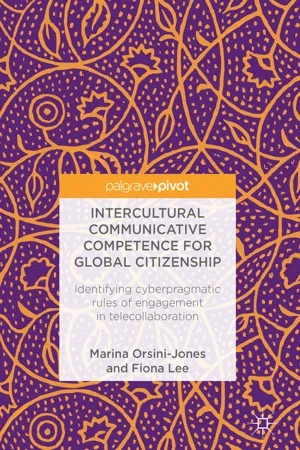
Table of contents

  1. Cover
  2. Front Matter
  3. 1. Introduction
  4. 2. Intercultural Communicative Competence (ICC) Revisited
  5. 3. Cyberpragmatics
  6. 4. The CoCo Telecollaborative Project: Internationalisation at Home to Foster Global Citizenship Competences
  7. 5.  CoCo Research Questions and Answers
  8. 6. Emerging Online Politeness Patterns
  9. 7. Conclusion
  10. Back Matter