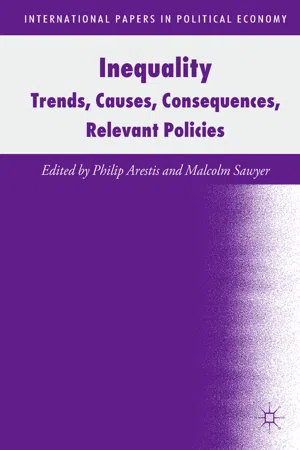
This book is the fifteenth volume in the renowned International Papers in Political Economy (IPPE) series which explores the latest developments in political economy. Containing contributions by experts in the field, this book focuses on topics that address the ongoing debate of inequalities in economic systems. Inequality has been considered a problem by many academics and policy makers for a long time now and recently here has been some evidence of increasing inequalities in society. Contributors to this book focus on the causes and consequences of inequality along with the importance of tackling inequality and recommend potential policies to reduce it, for example tax reforms. The book covers different aspects of inequality - from income to gender - and explores links between inequality and economic growth, and financialisation and financial crisis.
eBook - ePub
Inequality
Trends, Causes, Consequences, Relevant Policies
- English
- ePUB (mobile friendly)
- Available on iOS & Android
eBook - ePub
Inequality
Trends, Causes, Consequences, Relevant Policies
About this book
Information
Topic
EconomíaSubtopic
Economía del desarrollo© The Author(s) 2018
Philip Arestis and Malcolm Sawyer (eds.)InequalityInternational Papers in Political Economyhttps://doi.org/10.1007/978-3-319-91298-1_3Inequality and Growth: Marxian and Post-Keynesian/Kaleckian Perspectives on Distribution and Growth Regimes Before and After the Great Recession
Eckhard Hein1
(1)
Institute for International Political Economy (IPE), Berlin School of Economics and Law, Berlin, Germany
Keywords
DistributionGrowthFinancialisationStagnationMacroeconomic demand and growth regimesProductivity growthKaleckian modelsMarxian modelsJEL Classification
E11E21E22E25E60F43F62O401 Introduction
The re-distribution of income from labour to capital, from workers to top-managers, and from low income households to the rich has been a main feature of finance-dominated capitalism since the early 1980s, which has led to the Great Financial Crisis and the Great Recession in 2007–9. The recovery from this crisis has been sluggish so far, and this has given rise to a renewed discussion about stagnation tendencies in capitalist economies (Summers 2014, 2015). Whereas in orthodox approaches, income distribution only has a restricted role to play, if at all, the interaction between distribution and growth is at the centre of Marxian and post-Keynesian/Kaleckian approaches when it comes to explaining medium- to long-run trends of economic growth —and stagnation . This contribution first provides Marxian and Kaleckian assessments of the distribution and growth regimes under finance-dominated capitalism, both before and after the recent crisis. Second, an interpretation of stagnation tendencies in a demand-led endogenous growth model with Kaleckian, Kaldorian and Marxian features is presented.
For this purpose, the contribution builds on the recent empirical literature on different demand and growth regimes under financialisation (Hein 2012), and on the research on the distributional effects of financialisation (Hein et al. 2017) in particular. Some stylised facts on distribution and growth regimes under financialisation before the crisis are provided in Sect. 2. In order to allow for a comparative assessment of the relationship between inequality and growth in these regimes from a Marxian and a Kaleckian perspective, the method of model closure, already used in Hein (2017a), is applied in Sect. 3. First, the two extreme growth regimes under financialisation before the crisis, the ‘debt -led private demand boom’ and the ‘export-led mercantilist’ regimes , are put forward in stylised Marxian and neo-Kaleckian models. Then the effects of a rising profit share , indicating rising inequality, are studied, holding behavioural equations constant. Finally, the changes in behavioural parameters for the two regimes in each approach are added, and the main features of the distribution and growth patterns observed before the crisis are generated. In Sect. 4, the analysis turns towards the crisis and post-crisis period. Empirically, the changes in distribution and growth regimes in this period are assessed, and these changes are interpreted in the context of the stylised neo-Kaleckian model from Sect. 3. Thereafter, this model is extended by Kaldorian and Marxian views on the determinants of technological progress and productivity growth in order to generate a demand-led endogenous growth model and to show how the effects of redistribution and current stagnation tendencies can be explained by this model. The final Sect. 5 summarises and concludes.
2 Stylised Facts: Distribution and Growth Regimes Under Financialisation Before the Crisis
From a macroeconomic perspective, finance-dominated capitalism or financialisation can be described by four characteristics, as elaborated in Hein (2012; 2014, Chapter 10), for example.
- 1.With regard to distribution, financialisation has been conducive to a rising gross profit share , including retained profits, dividends and interest payments, and thus a falling labour income share, on the one hand, and to increasing inequality of wages and top management salaries and thus of personal or household incomes, on the other hand. Hein (2015) has recently reviewed the evidence for a set of developed capitalist economies since the early 1980s and finds ample empirical support for falling labour income shares and increasing inequality in the personal/household distribution of market incomes with only a few exceptions, increasing inequality in the personal/household distribution of disposable income in most of the countries, an increase in the income share of the very top incomes not only in the USA and the UK, but also in several other countries for which data are available, with rising top management salaries as one of the major driving forces. Reviewing the empirical literature on the determinants of functional income distribution against the background of the Kaleckian theory of income distribution , it is argued that features of finance-dominated capitalism have contributed to the falling labour income share since the early 1980s through three main channels: the falling bargaining power of trade unions , rising profit claims imposed in particular by increasingly powerful rentiers and a change in the sectoral composition of the economy in favour of the financial corporate sector and at the expense of the non-financial corporate sector or the public sector with higher labour income shares. In Hein et al. (2017), the relative importance of these factors has been analysed for the six countries which are included in the current study, too.
- 2.Regarding investment in the capital stock, financialisation has meant increasing shareholder power vis-à-vis firms and workers, the demand ...
Table of contents
- Cover
- Front Matter
- Importance of Tackling Income Inequality and Relevant Economic Policies
- Financialisation, Financial Crisis and Inequality
- Inequality and Growth: Marxian and Post-Keynesian/Kaleckian Perspectives on Distribution and Growth Regimes Before and After the Great Recession
- Theoretical and Empirical Analyses of the Rise of Income Inequality in Rich Countries
- Can Tax Reforms Reduce Inequality?
- Gender Inequality in the Labour Market and the Great Recession
- Rich Become Richer and Poor Become Poorer: A Wealth Inequality Approach from Great Britain
- Why Has Income Inequality Been Neglected in Economics and Public Policy?
- Back Matter
Trusted by 375,005 students
Access to over 1.5 million titles for a fair monthly price.
Study more efficiently using our study tools.
Frequently asked questions
Yes, you can cancel anytime from the Subscription tab in your account settings on the Perlego website. Your subscription will stay active until the end of your current billing period. Learn how to cancel your subscription
No, books cannot be downloaded as external files, such as PDFs, for use outside of Perlego. However, you can download books within the Perlego app for offline reading on mobile or tablet. Learn how to download books offline
Perlego offers two plans: Essential and Complete
- Essential is ideal for learners and professionals who enjoy exploring a wide range of subjects. Access the Essential Library with 800,000+ trusted titles and best-sellers across business, personal growth, and the humanities. Includes unlimited reading time and Standard Read Aloud voice.
- Complete: Perfect for advanced learners and researchers needing full, unrestricted access. Unlock 1.5M+ books across hundreds of subjects, including academic and specialized titles. The Complete Plan also includes advanced features like Premium Read Aloud and Research Assistant.
We are an online textbook subscription service, where you can get access to an entire online library for less than the price of a single book per month. With over 1.5 million books across 990+ topics, we’ve got you covered! Learn about our mission
Look out for the read-aloud symbol on your next book to see if you can listen to it. The read-aloud tool reads text aloud for you, highlighting the text as it is being read. You can pause it, speed it up and slow it down. Learn more about Read Aloud
Yes! You can use the Perlego app on both iOS and Android devices to read anytime, anywhere — even offline. Perfect for commutes or when you’re on the go.
Please note we cannot support devices running on iOS 13 and Android 7 or earlier. Learn more about using the app
Please note we cannot support devices running on iOS 13 and Android 7 or earlier. Learn more about using the app
Yes, you can access Inequality by Philip Arestis, Malcolm Sawyer, Philip Arestis,Malcolm Sawyer in PDF and/or ePUB format, as well as other popular books in Economía & Economía del desarrollo. We have over 1.5 million books available in our catalogue for you to explore.