- English
- ePUB (mobile friendly)
- Available on iOS & Android
eBook - ePub
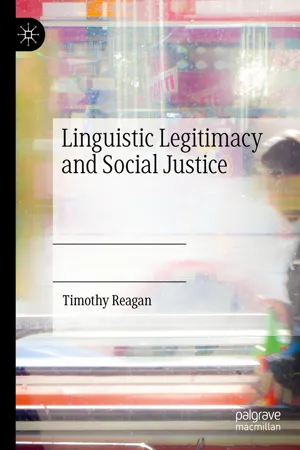
Linguistic Legitimacy and Social Justice
About this book
This book examines the nature of human language and the ideology of linguistic legitimacy – the common set of beliefs about language differences that leads to the rejection of some language varieties and the valorization of others. It investigates a broad range of case studies of languages and dialects which have for various reasons been considered 'low-status' including: African American English, Spanglish, American Sign Language, Yiddish, Esperanto and other constructed languages, indigenous languages in post-colonial neo-European societies, and Afrikaans and related language issues in South Africa. Further, it discusses the implications of the ideology of linguistic legitimacy for the teaching and learning of foreign languages in the US. Written in a clear and accessible style, this book provides a readable and pedagogically useful tool to help readers comprehend the nature of human language, and the ways in which attitudes about human language can have either positive or negative consequences for communities and their languages. It will be of particular interest to language teachers and teacher educators, as well as students and scholars of applied linguistics, intercultural communication, minority languages and language extinction.
Information
© The Author(s) 2019
Timothy ReaganLinguistic Legitimacy and Social Justicehttps://doi.org/10.1007/978-3-030-10967-7_11. Language and Other Myths: ‘Die Grenzen meiner Sprache bedeuten die Grenzen meiner Welt’
Timothy Reagan1
(1)
College of Education & Human Development, University of Maine, Orono, ME, USA
Keyword
Language‘The limits of my language mean the limits of my world’, from Ludwig Wittgenstein, Tractatus Logico-Philosophicus (1922), §5.6.
End AbstractMore than fifty years ago, in an article published in the journal the Western Political Quarterly, the historian Carl Becker commented that, “Now, when I meet a word with which I am entirely unfamiliar, I find it a good plan to look it up in the dictionary and find out what someone thinks it means. But when I have frequently to use words with which everyone is perfectly familiar—words like ‘cause’ and ‘liberty’ and ‘progress’ and ‘government’—when I have to use words of this sort which everyone knows perfectly well, the wise thing to do is to take a week off and think about them” (1955, p. 328). I am extremely fond of this passage, because it makes abundantly clear the point that words, the meanings of words, and how we choose to use words, really do matter, and indeed, they often matter a great deal. As Robert Fitzgibbons has observed, “The varying degrees of precision in ordinary language cause remarkably few difficulties in conducting our everyday, nonprofessional affairs. In private matters, people tend to overlook imprecision, and adjust. Indeed, in many cases the lack of precision is beneficial. However, the opposite tends to be the case when it comes to public matters … the problems created by imprecision become especially acute in attempting to make … decisions rationally” (1981, p. 106). The word ‘language’ is an excellent example of such imprecision. ‘Language’ is a word we use frequently, and is one we certainly believe we understand and of which we know the meaning. And yet, the more we reflect on the concept of ‘language’, the fuzzier and more problematic it becomes. Given the importance of language, and indeed, of its centrality to being human, this lack of clarity is especially intriguing. Noam Chomsky, in Language and Mind, asserted that, “When we study human language, we are approaching what some might call the ‘human essence’, the distinctive qualities of mind that are, so far as we know, unique to man” (1972, quoted in Fromkin, Rodman, & Hyams, 2014, p. 1). In fact, some linguists have gone even further, arguing that not only is language unique to human beings, but that it is, to at least some extent, a necessary condition for ‘human being-ness’. As Neil Smith has written,
Language makes us human … Whatever we do, language is central to our lives, and the use of language underpins the study of every other discipline. Understanding language gives us insight into ourselves and a tool for the investigation of the rest of the universe. Proposing marriage, opposing globalization, composing a speech, all require the use of language; to buy a meal or sell a car involves communication, which is made possible by language; to be without language—as an infant, a foreigner or a stroke victim—is to be at a devastating disadvantage. Martians and dolphins, bonobos and bees, may be just as intelligent, cute, adept at social organization and morally worthwhile, but they don’t share our language, they don’t speak ‘human’. (2002, p. 3)
The uniqueness of human language is an idea dating back thousands of years, certainly to parts of the Book of Genesis composed somewhere between the tenth and fifth centuries BCE at the very latest. It is also an idea that has become, in many ways, an act of faith (or, perhaps more accurately, a collection of claims that together constitute a series of related acts of faith) in modern linguistics. Among contemporary linguists, there are broadly speaking two different sets of views about the origins of human language: the majority advocate a continuity position, while a minority believe human language to be the result of an evolutionary discontinuity. Basically, the continuity position means that the emergence of language was the result of the evolution of pre- and proto-linguistic forms which over time became increasingly complex and that ultimately took the form of human language as it now exists. The alternative perspective, advocated by Chomsky and some others, is that language is so unique that it cannot really be explained by any kind of gradual evolution from earlier types of communicative behavior, and so must be the result of a fairly sudden—genetic and cognitive—change, which probably took place around 100,000 to 150,000 years ago. Regardless of how human language emerged, though, there is agreement about its general characteristics, and about what makes modern human language unique.
There is an important distinction that needs to be made here: there is a key difference between ‘language’, referring to all human languages and their common, universal characteristics, and any specific language (e.g., English, French, Russian, Sesotho, Thai, Spanish, Zulu, etc.) and its own special and unique features. Thus, we can assert that “all languages have nouns and verbs” (Hudson, 2000, p. 74), which is a general claim about human language as a singular, unitary construct. On the other hand, we can make observations about the features and characteristics of particular languages, as in:
Among the formal characteristics of English nouns are that they typically: (a) may be made definite in meaning by use of preceding the (the definite article), as in the book, the guy, the answer; (b) may be made possessive by suffixing—’s, as in people’s. Jane’s, a politician’s; (c) may be made negative by prefixing—non, as in nonbeliever, nonsense, nonunion … (Hudson, 2000, pp. 74–75)
Both of these types of claims are perfectly reasonable, and both are useful in certain contexts, but the kinds of evidence required to support or reject them is different. Claims that purport to be universal are particularly difficult to defend, since to reject such a claim requires evidence from only a single language—that is, if the claim is true universally, then it must be true of each and every human language, without exception. The claim that “all languages have nouns and verbs,” for instance, might be true as far as we know at the present time, but there are quite literally thousands of human languages that have not been studied, any one of which could provide disconfirming evidence for the claim—and thus leading to its rejection as a universal characteristic of human language. It is entirely possible for there to be a language that somehow gets along without anything remotely noun-like or verb-like. Further, the ways in which noun-like and verb-like lexical elements exist and are used in languages varies considerably. For instance, in Nunavut Inuktitut there is the word ‘Tusaatsiarunnanngittualuujunga’, which is a single lexical item that would be expressed in English as, ‘I cannot hear very well’. In some languages and groups of languages, such as some Bantu languages in southern Africa, this becomes especially problematic:
There has been debate as to the proper arrangement of the Bantu lexicon, and the question is far from settled. The inflection of nominals and verbals by means of prefixes, and the complex and productive derivational system, both characteristic of Bantu languages, pose difficulties … If items are alphabetized by prefix … a verb will be listed far from its nominal derivations, however transparent these may be … A competing school arranges the lexicon by stem or root; this usefully groups related items, and saves on cross-referencing. Unfortunately, in such a system the user must be able to identify the stem, which given the sometimes complex morphophonemics of Bantu languages may not be easy. (Bennett, 1986, pp. 3–4)
In fact, the situation is even more complex that this might suggest, since we actually distinguish between two logically different kinds of linguistic universals. There are absolute universals, of the types we have been discussing thus far, which must be true for every single human language, but there are also statistical universals (or tendencies) which may not be true of all languages, but which are true of far too many languages to be simply the result of chance or random accident. Linguistic universals are also sometimes divided into implicational and non-implicational universals; implicational universals are characterized by claims that assert that if one feature is present, then a second feature will also be present. Thus, an example of a statistical, implicational universal would be that “languages with subject-object-verb … word order are most likely to be postpositional.” While there is clearly a relationship between language universals and features of specific languages, it is nevertheless essential as we proceed with this discussion that we keep the distinction between the two in mind.
A key conviction of many, probably most, linguists about human language, as articulated in one of the more widely used introductory college and university linguistics textbooks, that:
The claims made in this passage are well-intentioned, and given the folk wisdo...No language or variety of language … is superior or inferior to any other in a linguistic sense. Every [language] is equally complex, logical, and capable of producing an infinite set of sentences to express any thought. If something can be expressed in one language … it can be expressed in any other language … It might involve different means and different words, but it can be expressed … All human languages … are fully expressive, complete and logical … (Fromkin, Rodman, & Hyams, 2014, pp. 10–11)
Table of contents
- Cover
- Front Matter
- 1. Language and Other Myths: ‘Die Grenzen meiner Sprache bedeuten die Grenzen meiner Welt’
- 2. Conceptualizing the Ideology of Linguistic Legitimacy: ‘Primitive people have primitive languages and other nonsense’
- 3. African American English, Race and Language: ‘You don’t believe fat meat is greasy’
- 4. Spanglish in the United States: ‘We speak Spanglish to the dogs, to the grandchildren, to the kids’
- 5. Sign Language and the DEAF-WORLD: ‘Listening without hearing’
- 6. Yiddish, the Mame-Loshn: ‘Mensch tracht, Gott lacht’
- 7. Created and Constructed Languages: ‘I can speak Esperanto like a native’
- 8. Afrikaans, Language of Oppression to Language of Freedom: ‘Dit is ons erns’
- 9. Why Language Endangerment and Language Death Matter: ‘Took away our native tongue … And taught their English to our young’
- 10. Foreign Language Education in the US: ‘But French isn’t a real class!’
- 11. Linguistic Legitimacy, Language Rights and Social Justice: ‘No one is free when others are oppressed’
- Back Matter
Trusted by 375,005 students
Access to over 1.5 million titles for a fair monthly price.
Study more efficiently using our study tools.
Frequently asked questions
Yes, you can cancel anytime from the Subscription tab in your account settings on the Perlego website. Your subscription will stay active until the end of your current billing period. Learn how to cancel your subscription
No, books cannot be downloaded as external files, such as PDFs, for use outside of Perlego. However, you can download books within the Perlego app for offline reading on mobile or tablet. Learn how to download books offline
Perlego offers two plans: Essential and Complete
- Essential is ideal for learners and professionals who enjoy exploring a wide range of subjects. Access the Essential Library with 800,000+ trusted titles and best-sellers across business, personal growth, and the humanities. Includes unlimited reading time and Standard Read Aloud voice.
- Complete: Perfect for advanced learners and researchers needing full, unrestricted access. Unlock 1.5M+ books across hundreds of subjects, including academic and specialized titles. The Complete Plan also includes advanced features like Premium Read Aloud and Research Assistant.
We are an online textbook subscription service, where you can get access to an entire online library for less than the price of a single book per month. With over 1.5 million books across 990+ topics, we’ve got you covered! Learn about our mission
Look out for the read-aloud symbol on your next book to see if you can listen to it. The read-aloud tool reads text aloud for you, highlighting the text as it is being read. You can pause it, speed it up and slow it down. Learn more about Read Aloud
Yes! You can use the Perlego app on both iOS and Android devices to read anytime, anywhere — even offline. Perfect for commutes or when you’re on the go.
Please note we cannot support devices running on iOS 13 and Android 7 or earlier. Learn more about using the app
Please note we cannot support devices running on iOS 13 and Android 7 or earlier. Learn more about using the app
Yes, you can access Linguistic Legitimacy and Social Justice by Timothy Reagan in PDF and/or ePUB format, as well as other popular books in Languages & Linguistics & Comparative Education. We have over 1.5 million books available in our catalogue for you to explore.