- English
- ePUB (mobile friendly)
- Available on iOS & Android
eBook - ePub
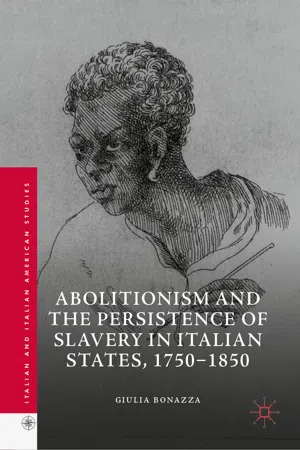
Abolitionism and the Persistence of Slavery in Italian States, 1750–1850
About this book
This volume offers a pioneering study of slavery in the Italian states. Documenting previously unstudied cases of slavery in six Italian cities—Naples, Caserta, Rome, Palermo, Livorno and Genoa—Giulia Bonazza investigates why slavery survived into the middle of the nineteenth century, even as the abolitionist debate raged internationally and most states had abolished it. She contextualizes these cases of residual slavery from 1750–1850, focusing on two juridical and political watersheds: after the Napoleonic period, when the Italian states (with the exception of the Papal States) adopted constitutions outlawing slavery; and after the Congress of Vienna, when diplomatic relations between the Italian states, France and Great Britain intensified and slavery was condemned in terms that covered only the Atlantic slave trade. By excavating the lives of men and women who remained in slavery after abolition, this book sheds new light on the broader Mediterranean and transatlantic dimensions ofslavery in the Italian states.
Information
© The Author(s) 2019
Giulia BonazzaAbolitionism and the Persistence of Slavery in Italian States, 1750–1850Italian and Italian American Studieshttps://doi.org/10.1007/978-3-030-01349-3_11. Introduction: Historiographical Perspectives
Giulia Bonazza1
(1)
German Historical Institute, Rome, Italy
Giulia Bonazza
1.1 Recovered Memory
The historical practice of slavery has long been forgotten in the Western, Arab and Ottoman worlds, and the role of the memory of slavery has likewise been overlooked. However, a slew of publications on the Atlantic and other slave trades has prompted Turkish, Moroccan, Algerian , American and European historians into efforts to reconstruct this memory. In France , for example, historiographical interest in the problem of slavery was renewed by the 150th anniversary of the abolition of slavery in 1998. The associated events highlighted the conflict between the oubli de l’histoire de l’esclavage and the oubli du passé. 1 More recently again, scholars have turned their attention to the abolitionist movements in France and England , 2 although Anglo-Saxon historiography did pay attention to abolitionism in the 1980s, led by Robin Blackburn. 3 In Italy, Salvatore Bono, a pioneer in the study of slavery in the Italian area, writes about the silence of historiography. 4 In the same vein, Grabriele Turi, in his recent Schiavi in un mondo libero, refers to Oblivion and memories. 5 Y. Hakan Erdem highlights the near-total collective amnesia about Ottoman slavery, 6 and Chouki El-Hamel emphasises the culture of silence around the history of race and slavery in Morocco which meant that black Moroccans were either outsiders in their own communities or completely absorbed by them. 7 The problem of memory is directly linked to the question of how the past is represented. Every social group makes decisions on what it wishes to be remembered, and it produces, institutionalises and preserves what is to become memory and handed down to posterity. Therefore, memory is the result of a process of selection and it can go beyond the sources available to the historian. 8 But the memory of slavery, previously lost or ignored, is progressively re-emerging.
1.2 Between the Atlantic and the Mediterranean
Research on Atlantic and Mediterranean slavery has started to appear more frequently over the last several years. This scholarship has demonstrated that the variety of trades and forms of slavery shared common traits: power relationships, the seas, the movement of men and the agency of the slaves themselves were all central dynamics. 9 The renewed historical interest in Mediterranean slavery was an offshoot of research on the Atlantic trade, and the two cannot be fully understood if viewed as wholly distinct. 10 While my research focuses on Mediterranean slavery, some of the slaves I study were products of the Atlantic trade, reinforcing the interconnectedness of the two dimensions. 11 An essential starting point is an overview of the key publications on slavery and captivity in the Italian area and in other European and extra-European countries from the fifteenth to the nineteenth centuries. 12
Within the last decade, Anglo-Saxon scholars have worked extensively on the economics of the Atlantic trade, especially the British trade, among them Seymour Drescher, 13 Zoë Laidlaw 14 and David Beck Ryden. 15 More general reviews of the Atlantic trade include David Eltis and David Richardson’s Atlas of the Transatlantic Slave Trade 16 and The Atlantic Slave Trade by Herbert S. Klein. 17 Robin Blackburn’s The Making of New World Slavery is fundamental because of the global and long-term perspective it takes. 18 Blackburn’s analysis encompasses the interconnections between the conceptualisation of modernity and slavery, and from there to the links with imperialism, the Great War and the emergence of totalitarianism. His quantitative methodology links microhistory and macrohistory, such as in his reflections on capital accumulation and chattel slavery. Blackburn demonstrates that the Atlantic trade was not simply an affair between nation states (including the African Kingdoms), as previously assumed by the Marxist historian Eric Williams, 19 but the result of collaboration between individuals:
These relationship had emerged in “civil society”, as expression of “private” relations and coercions relatively free of direct sponsorship by the formal political structure of the state…Slavery, personal lordship and contracted labor […]. The colonial state, at various times and in different degrees, legally sanctioned, encouraged, end even purported to regulate such relationship. 20
Blackburn’s interpretation of the role of states in the Atlantic trade is interesting because he identifies them as performing a role similar to that played by intermediaries in Mediterranean slavery, while the most important functions in the Atlantic trade are left to individuals and religious brotherhoods. He considers the process of colonialism beginning with early Portuguese and Spanish expansion, the growth of the sugar trade in Brazil , the war of the Dutch West India Company for Brazil and the origin of the British and French empires. He concludes by reflecting on racism and on abolitionist thought.
American scholars have also become increasingly interested in the problem of slavery and captivity in the Mediterranean, foremost among them Robert C. Davis 21 and Gillian Weiss. 22 While Davis limits himself geographically to the Mediterranean, his openness to the role of the Islamic world therein is refreshing (including raids by the Barbary States for men from Mediterranean coasts). The basis of his approach is that slavery was not a prerogative of Europeans only but also of the Arab world. As suggested by his title, his approach is to counterpoise the Christian and the Muslim worlds. His focus is on the Italian peninsula, and despite a slightly fragmented archival investigation, his book represents an important addition to the historiography because it extends the chronology to 1800 and takes in Christian slavery in the Barbary States. 23
Maintaining our gaze on the Mediterranean, Colin Heywood, together with Maria Fusaro and Mohamed-Salah Omri, recently edited a collection of articles in the volume Trade and cultural exchange in the early modern Mediterranean. 24 Anglo-Saxon historiography of Mediterranean slavery featured historians such as Godfrey Fisher in the last century and Linda Colley since the turn of the century. 25 Fisher, in the late 1950s, rehabilitated the political role of the Barbary States in the Early Modern period, demonstrating that they were not simply states devoted to piracy, but states with strong political structures and negotiating power. He charted the political and economic relationships between the Barbary States and England until 1712, 26 and in an appendix (Mediterranean Passes) provided partial information on these relationships up to 1830, the year of the French conquest of Algiers . 27
Algerian historian Yacine Daddi-Addoun completed his Ph.D. on the problem of captivity and the abolition of slavery in Algeria. Addoun argues that European historians have neglected or only superficially considered the subject of Christian captivity in Algeria. The work that has been carried out, suggests Addoun, is flawed because it relies on sources or memories originating from religious congregations and tending to stereotype the Muslim as exotic or demonic. Therefore, they do not facilitate an objective evaluation of the phenomenon. 28 Actually, Addoun’s criticism is only partially accurate, given that European historians have recently concentrated on the relativism of identities more so than the manifestation of Christian–Muslim divisions in the processes of slavery. A clear attempt is being made to illustrate the complexity and non-uniformity of Mediterranean slavery across religious and state boundaries. This is most productively implemented by reconstructing and charting the personal biographies of individual slaves because it is not possible to generalise with sufficient accuracy on the religious characteristics of Mediterranean slavery or the pattern of state involvement. 29 European historians are inclined to speak rather of proximate, reciprocal, provisional and rei...
Table of contents
- Cover
- Front Matter
- 1. Introduction: Historiographical Perspectives
- 2. The Reverberations of the Abolitionist Debate in the Italian States
- 3. Forms of Slavery in the Italian States
- 4. The Memory of Slavery
- 5. Conclusion: Abolitionism and the Continuity of Slavery
- Back Matter
Trusted by 375,005 students
Access to over 1.5 million titles for a fair monthly price.
Study more efficiently using our study tools.
Frequently asked questions
Yes, you can cancel anytime from the Subscription tab in your account settings on the Perlego website. Your subscription will stay active until the end of your current billing period. Learn how to cancel your subscription
No, books cannot be downloaded as external files, such as PDFs, for use outside of Perlego. However, you can download books within the Perlego app for offline reading on mobile or tablet. Learn how to download books offline
Perlego offers two plans: Essential and Complete
- Essential is ideal for learners and professionals who enjoy exploring a wide range of subjects. Access the Essential Library with 800,000+ trusted titles and best-sellers across business, personal growth, and the humanities. Includes unlimited reading time and Standard Read Aloud voice.
- Complete: Perfect for advanced learners and researchers needing full, unrestricted access. Unlock 1.5M+ books across hundreds of subjects, including academic and specialized titles. The Complete Plan also includes advanced features like Premium Read Aloud and Research Assistant.
We are an online textbook subscription service, where you can get access to an entire online library for less than the price of a single book per month. With over 1.5 million books across 990+ topics, we’ve got you covered! Learn about our mission
Look out for the read-aloud symbol on your next book to see if you can listen to it. The read-aloud tool reads text aloud for you, highlighting the text as it is being read. You can pause it, speed it up and slow it down. Learn more about Read Aloud
Yes! You can use the Perlego app on both iOS and Android devices to read anytime, anywhere — even offline. Perfect for commutes or when you’re on the go.
Please note we cannot support devices running on iOS 13 and Android 7 or earlier. Learn more about using the app
Please note we cannot support devices running on iOS 13 and Android 7 or earlier. Learn more about using the app
Yes, you can access Abolitionism and the Persistence of Slavery in Italian States, 1750–1850 by Giulia Bonazza in PDF and/or ePUB format, as well as other popular books in History & African History. We have over 1.5 million books available in our catalogue for you to explore.