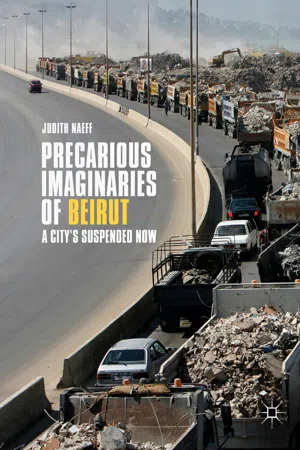
This book investigates a shared experience of time and space in the post-civil-war city of Beirut: "the suspended now". Based on the close analysis of a large corpus of cultural objects; including visual art, literature, architecture and cinema; the book argues that last decades have witnessed a gradual shift in understanding this temporality from being a transitional phase to a more durable experience of precariousness. The theoretically rich analyses take us on a journey through Beirut's real and imagined geographies, from garbage dumps to real estate advertisements, and from subterranean spaces to martyr's posters. For scholars of cultural analysis, urban studies, cultural geography and critical theory, the case of post-1990 Beirut offers a fascinating case of neoliberal urban renewal, which challenges existing theories. For scholars of Lebanon and Beirut, this study complements existing work on post-civil-war Lebanese cultural production rooted in trauma studies by its focus on thecity's continual exposure to violence.
- English
- ePUB (mobile friendly)
- Available on iOS & Android
eBook - ePub
About this book
Information
Print ISBN
9783319659329
Subtopic
Art Theory & Criticism© The Author(s) 2018
Judith NaeffPrecarious Imaginaries of Beiruthttps://doi.org/10.1007/978-3-319-65933-6_11. Introduction
Judith Naeff1
(1)
Leiden Institute for Area Studies, Leiden University, Leiden, The Netherlands
While you remain here unblinking and in flux
Waiting with the impatience of a suckling
To bury us all
And march on our corpses
With concrete shoes
You infanticidal monster
Whose children will never follow the hearse
Despite it all I sometimes think I love you
Despite it all I love you I do I love you despite it all.
—Mazen Kerbaj (2012).
The infanticidal monster addressed in these lines is the narrator’s mother, who, we understand later, is the contemporary city of Beirut. Beirut is a city that has been extensively described, discussed, debated, cursed and lyrically addressed ya Bayrūt, oh Beirut, a city intensely loved and intensely hated. To speak of, or to, the city—any city—is to be confronted by its radical irreducibility, its internal contradictions, its fluidity and multiplicity. The question “what is Beirut?”, moreover, is highly contested. One could argue that the question formed part of the issues that were fought over during the civil wars (1975–1990). Beirut is precisely interesting because there is no majority consensus over even an approximate answer to that question, so much so that any genuine approach to articulate an urban identity needs to contain a notion of radical alterity within itself. This provisionality, this lack of a hegemonic narrative, this deferral of closure, that is so open for everyone to see, is part of what makes Beirut such a vibrant and liberating city, and also part of what makes it a volatile and precarious city.
This book does not attempt to answer the question of Beirut’s identity, nor does it seek to provide an overview of multiple answers to that question. Instead, it focuses on how this provisionality is experienced and imagined. It manifests itself in an experience of time that I will call the “suspended now”—a temporality that is intricately interwoven with the spatial experience of post-civil war and contemporary Beirut. The book explores how this time-space has been given meaning in cultural objects. The suspended now is a condition that has far more complex origins and implications than the unresolved question of identity. The lack of closure experienced with regard to the history of civil conflict branches out to the judicial domain, the political domain, larger geopolitical interests, socioeconomic relations and psychological recovery, all of which are interrelated with each other. Moreover, as will be argued in the second chapter, Beirut’s suspended now is due as much to the unresolvedness of its formative narratives as it is to the city’s continued exposure to violence . If a considerable part of this introduction is dedicated to identity constructions in Lebanon, this should be read as the complex contextual background to the issues at stake in this book, rather than as the main concern of the book.
Focusing on the ways in which a particular experience of time, situated in a particular geography, is imagined and given meaning, the project demands an interdisciplinary approach that is concerned with the time and space of the city as they are lived in everyday life—as is common to the fields of social and cultural geography—and that is at the same time attentive to questions of visuality, narrative and imagination—which cultural studies is usually concerned with. I am particularly interested in the ways in which these two realms interact with each other, that is, how images and narratives give meaning to lived experience and how these imaginaries in turn affect lived experience in the city. The research project that has led to this book consists mainly of the analyses of cultural objects and, to a lesser extent, practices. By drawing parallels with findings of ethnographic, sociological and historical research, the book positions itself within broader academic endeavours to make sense of the contemporary history of Beirut. While a better understanding of contemporary Beirut is indeed the central aim of this book, it offers conceptual tools that can be used to analyse the relations between temporality, spatiality and imaginary in other places, comparatively or for their own sake.
The central concept of the suspended now will be developed separately in Chap. 2 as a temporality characterized by a protracted “presentness” with limited access to past and future. This experience has been given meaning in various ways. I will distinguish between an understanding of this temporality, which frames it as a transitional phase, and one that understands it to be produced by prolonged precarious conditions. Throughout this book, the concept will build upon the ways in which diverse thinkers, including Georges Bataille , Jean Baudrillard , Judith Butler , Guy Debord and Hans Ulrich Gumbrecht , have conceptualized the relation between socioeconomic structures and a shared experience. This shared experience often has a strong temporal character. In this sense, the temporality of the suspended now will be linked to global developments and insights, in particular with regard to the latest phase of the slippery notion of “urban modernity .” At the same time, the suspended now will be developed as a condition produced by the particular historical and geographical juncture of post-1990 Beirut.
On the level of urban regeneration, Beirut is a remarkable case because many of the conditions that define inner city renewal projects worldwide are more extreme in the case of Beirut. First, free market ideology and minimal state interference have strong historical roots in Lebanese politics. Henceforth, the globally growing influence of private developers and corporate business upon municipal policy is far more advanced in Beirut than in many other places and the political narrative of reconstruction has relatively easily been tied into contemporary global narratives of neoliberalism and intercity competition. Second, the extensive war damage in Beirut has served to legitimize large-scale demolition, allowing for a much more elaborate redevelopment scheme than would have otherwise been possible. As an extreme case of what is happening in many other places, Lebanese laments on rampant consumerism and real estate speculation gone awry could be read as an admonition for other cities (see for example Khalaf 2012, on consumerism, and the short video published by the Lebanese Economic Association 2014, on the privatization of public space; see also the section on post-war reconstruction in this chapter, pp. 22–27).
The city is also an interesting case of place identity construction. Like other cities, Beirut has often been imagined as a modern site of liberation and cosmopolitanism, as well as greed and moral degeneration, in contrast to a traditional countryside that is imagined as poor but pure, and regulated by tight familial and communal bonds. This appears from literary and cinematic works revolving around the journey towards the city, as well as from non-fictional nostalgic accounts of pre-war Beirut (e.g. Aghacy 2015). At the same time, the city, like other capital cities, is imagined as a microcosm or a symbol of the nation, implying a repetition of the friction between city and countryside within the urban setting. More than in any other Lebanese city, Beirut brings together the various denominations and classes that are present in the country and the region at large. The Lebanese population consists of religious communities that are referred to as sects, because of the strong identitarian and institutional affiliation. Eighteen of them are officially recognized and proportionally represented among public officials. As will be explained in the sections on identity constructions of this chapter (pp. 9–15 and 15–19), the Lebanese have constructed different versions of an overarching national identity. These sometimes conflicting visions of Lebanon, and of what Beirut means to that national entity, often depend upon sectarian affiliation. What is interesting in Beirut’s case is that since none of these sects holds a majority, there is no definitive hegemonic narrative of national or urban identity . Consequently, the frictions and contestations that invariably run through constructions of place identity in Beirut’s case are laid bare for everyone to see.
In short, this study of precarious imaginaries of Beirut provides a wealth of material for subsequent comparative as well as area-specific research. Before developing the suspended now more fully and delving into the visual and textual material with which this project is concerned, this introduction will first delineate the scope of its corpus. Subsequently, a considerable part of this introduction provides a view of the complex contextual background to the issues discussed in the chapters to follow, coming from two different angles. The first is dedicated to identity constructions in Lebanon, which are entangled with imaginaries of Beirut. The two sections dedicated to this issue also show why urban identity can be highly contested. The second approach revolves around Beirut’s post-civil war reconstruction , divided into one section providing a historical overview and one devoted to the case of Beirut Central District (BCD). The redevelopment of the city centre has deeply transformed the physical appearance of the city throughout the years under study. It has unleashed heated debates in which the relations between space, memory, history and identity have been negotiated and contested. As a tangible manifestation of some of the main preoccupations of post-war intellectual life, the redevelopment of Beirut’s urban environment takes an important place in the works of cinema, art and literature of the period. The final section discusses the structure of the book.
Cultural Objects
This section delineates the pool of objects from which a selection will be analysed in this book. The book is concerned with a period of history spanning 25 years, from the official end of the civil wars in 1990 to the moment of writing in 2015. This period is often subdivided into the post-war (1990–2005) and contemporary city (2005–2015), with the assassination of Rafic Hariri and the subsequent demonstrations and withdrawal of Syria considered as a turning point. While the book will occasionally refer to images and texts that engage with the pre-war and wartime city, the focus will be on the city as it has been after the fighting factions put down their arms in 1990. Covering over a quarter of a century, the book cannot be exhaustive. The reason for not narrowing down the historical scope is that I seek to trace a gradual shift occurring in the ways in which the suspended now has been given meaning. While many have interpreted the 2005 demonstrations or the 2006 war as a radical historical break, the shift in interpretative frameworks evolves slowly and in fragmented and overlapping ways—meaning that “old” narratives continue to impregnate the works by both older and younger cultural producers today, and that “new” perspectives were already present 25 years ago. It is only by setting a large frame that we begin to perceive this gradual transformation, even though they exist simultaneously throughout. The book presents this change from a comparative rather than historical approach.
The analyses cover an eclectic selection of cultural objects drawn from a broad range of fields, most extensively from the visual arts, literature, cinema and architecture. Lebanese visual and literary material has not often been studied together. With a focus on the entanglement of time, space and imaginaries, the combination of narrative and visual approaches has proved to be particularly productive. Given the central concern for the urban environment, some objects of architecture and urban design are also included in the objects under discussion. Analysing these objects of different media together, the book shows the diversity of imaginative approaches to a set of shared concerns. There is still much to be gained from expanding this type of research to the realms of music, performance and television, for example, which fall outside the scope of this book. Objects beyond the artistic realm, such as essays, blogs and advertisements, will be analysed in order to show the pervasiveness of certain narrative motifs. The choice for diversity means that the selection of objects is necessarily limited and eclectic. For more comprehensive studies, I refer to Lina Khatib’s study of Lebanese cinema (2008) and two excellent recent studies of literary engagements with the city of Beirut (Aghacy 2015; Hayek 2014).
This book follows Jacques Rancière in ascribing to aesthetics the political ability to make available to perception what has been disavowed in everyday processes of meaning making (Rancière 2004). The aesthetic practices that form the core object of this research are therefore particularly relevant for the study of a transformation in perception and meaning making—in this case of the organization of time and space in the city. The artistic engagement with life in Beirut is both expressive of and reflective upon the ways in which the city is experienced and given meaning and at times creatively imagines alternatives. It is for their capability to both express lived experience and develop new ways of meaning making that the main focus is on artistic objects.
However, this book considers these works to be thoroughly embedded within the broader production of cultural meaning at this particular historical juncture in Beirut. The strong tradition of sociopolitical commitment in the region is one argument sustaining this assumption (see Klemm 2000; Halabi 2011). The lack of institutional infrastructure in the period during and immediately following the civil war infused this c...
Table of contents
- Cover
- Frontmatter
- 1. Introduction
- 2. Beirut’s Suspended Now
- 3. The Disposable City
- 4. Surface City
- 5. Excavation and Mourning
- 6. Conclusion: Ethics in the Precarious City—The Case of YouStink
- Backmatter
Trusted by 375,005 students
Access to over 1.5 million titles for a fair monthly price.
Study more efficiently using our study tools.
Frequently asked questions
Yes, you can cancel anytime from the Subscription tab in your account settings on the Perlego website. Your subscription will stay active until the end of your current billing period. Learn how to cancel your subscription
No, books cannot be downloaded as external files, such as PDFs, for use outside of Perlego. However, you can download books within the Perlego app for offline reading on mobile or tablet. Learn how to download books offline
Perlego offers two plans: Essential and Complete
- Essential is ideal for learners and professionals who enjoy exploring a wide range of subjects. Access the Essential Library with 800,000+ trusted titles and best-sellers across business, personal growth, and the humanities. Includes unlimited reading time and Standard Read Aloud voice.
- Complete: Perfect for advanced learners and researchers needing full, unrestricted access. Unlock 1.5M+ books across hundreds of subjects, including academic and specialized titles. The Complete Plan also includes advanced features like Premium Read Aloud and Research Assistant.
We are an online textbook subscription service, where you can get access to an entire online library for less than the price of a single book per month. With over 1.5 million books across 990+ topics, we’ve got you covered! Learn about our mission
Look out for the read-aloud symbol on your next book to see if you can listen to it. The read-aloud tool reads text aloud for you, highlighting the text as it is being read. You can pause it, speed it up and slow it down. Learn more about Read Aloud
Yes! You can use the Perlego app on both iOS and Android devices to read anytime, anywhere — even offline. Perfect for commutes or when you’re on the go.
Please note we cannot support devices running on iOS 13 and Android 7 or earlier. Learn more about using the app
Please note we cannot support devices running on iOS 13 and Android 7 or earlier. Learn more about using the app
Yes, you can access Precarious Imaginaries of Beirut by Judith Naeff in PDF and/or ePUB format. We have over 1.5 million books available in our catalogue for you to explore.