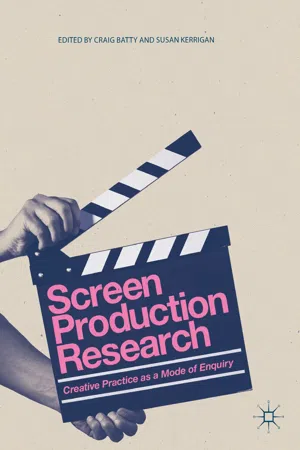
Aimed at students and educators across all levels of Higher Education, this agenda-setting book defines what screen production research is and looks like—and by doing so celebrates creative practice as an important pursuit in the contemporary academic landscape. Drawing on the work of international experts as well as case studies from a range of forms and genres—including screenwriting, fiction filmmaking, documentary production and mobile media practice—the book is an essential guide for those interested in the rich relationship between theory and practice. It provides theories, models, tools and best practice examples that students and researchers can follow and expand upon in their own screen production projects.
eBook - ePub
Screen Production Research
Creative Practice as a Mode of Enquiry
- English
- ePUB (mobile friendly)
- Available on iOS & Android
eBook - ePub
Screen Production Research
Creative Practice as a Mode of Enquiry
About this book
© The Author(s) 2018
Craig Batty and Susan Kerrigan (eds.)Screen Production Researchhttps://doi.org/10.1007/978-3-319-62837-0_11. Introduction
Craig Batty1 and Susan Kerrigan2
(1)
RMIT University, Melbourne, VIC, Australia
(2)
University of Newcastle, Newcastle, NSW, Australia
Screen production research is the study of the creation of audio-visual work that is disseminated on/with screens and can include theory-driven practices that use the screen to ‘do’ research (e.g., research-led practice), and systematic reflection upon a production to gain rigorous insights into how a work was made (e.g., practice-led research ). The term ‘screen production’ has emerged through Australian scholarship—elsewhere‚ for example, it is known as screen or media practice, filmmaking or video production—and its antecedence comes about through a combination of the film and television industry and the academy.
In line with technological developments that made it possible to create and distribute work online and via mobile media, the Australian industry embraced the term ‘screen’ in 2008 with the establishment of Screen Australia, the national funding body for screen work. The Screen Australia Act 2008 defines screen production as ‘an aggregate of images, or of images and sounds, embodied in any material that can be viewed on a screen (including, for example, a film)’. The term ‘research’ comes, of course, from the academy, and research that is conducted about/for/through screen production should comply with the philosophical, intellectual and ethical rigour that all universities uphold in their research processes and quest for new knowledge .
Bringing together screen production and research, under the umbrella of what is widely known as creative practice research, this collection offers a range of insights into and case studies of screen production research, arguing for its place in the academy as not only a legitimate but also an innovate mode of enquiry. The subsequent thirteen chapters of this book use screenwriting , filmmaking, television production, digital media, mobile media and distribution as forms and genres through which the rich and diverse landscape of screen production can be understood and—importantly—practiced. The collection is thus an attempt to put screen production research firmly on the map or in the archive, drawing on new and experienced researchers from around the world to define and defend its territory.
As in other creative disciplines, screen production draws on creative practice research enquiries that are described in a number of different ways, including practice-led research , practice-as-research, practice-based research and research-led practice. But unlike these disciplines, which have undertaken much work to define, defend and develop research modes relevant to their forms and genres, screen production has been slower to start. In art and design, for example, books such as Practice as Research : Approaches to Creative Arts Enquiry (Barrett and Bolt 2010), Creative Spaces for Qualitative Researching: Living Research (Higgs et al. 2011) and Supervising Practices for Postgraduate Research in Art, Architecture and Design (Allpress et al. 2012) have found a strong foothold in the academy, often referred to in discussions of methodology in honours, master’s and doctoral projects across the creative arts. The same can be said of the performing arts, with Robin Nelson’s Practice as Research in the Arts: Principles, Protocols, Pedagogies, Resistances (2013) emanating from this discipline, and Brad Haseman’s journal article, ‘A Manifesto for Performative Research’ (2006), being widely cited. Smith and Dean’s Practice-led Research, Research-led Practice in the Creative Arts (2009) provides a range of excellent chapters about practice research across creative arts disciplines.
Similarly, creative writing research has grown exponentially over the past two decades. Key texts such as Creative Writing Studies: Practice, Research and Pedagogy (Harper and Kroll 2007), Establishing Creative Writing Studies as an Academic Discipline (Donnelly 2011), Research Methods in Creative Writing (Kroll and Harper 2012) and Researching Creative Writing (Webb 2015), as well as journals such as New Writing: The International Journal for the Practice and Theory of Creative Writing, and TEXT: Journal of Writing and Writing Courses, have provided multiple accounts of creative practice research and are also influencing the methodological thinking of those outside the discipline.
The discipline of screen/media/video production has made some headway, too, with outlets such as the Journal of Media Practice, and the establishment in the UK of the Media, Communication and Cultural Studies Association (MeCCSA) Practice Network to champion such matters. Subject-based peak body associations such as the Australian Screen Production Education and Research Association (ASPERA), the University Film and Video Association (UFVA) in the USA, and the International Association for Media and Communication Research (IAMCR)’s Media Production Analysis Working Group in Europe, have also contributed to these debates through refereed conference proceedings and journal special issues. The rising popularity of production studies and media industries studies has also ignited interest in the practice aspects of the field, though is more often about studying production from a variety of disciplinary and methodological approaches than actually embracing production as a mode of research. Thus, unlike disciplines such as art, design, creative writing and performance that have defined what creative practice research looks like for them, screen/media/video production has been more tentative in its approach and has a less developed set of research literacies.
This collection, then, was borne out of a desire to put a stamp on what screen production research is and looks like, to provide a global benchmark of sorts from which others can contribute and move the discipline forward. As practitioner-researchers with full-time academic jobs, we have been part of countless debates about what creative practice research is (and is not), and have collectively mentored many students and staff in the area. This mode of research is complex and diverse, and it has taken us a long time to fully understand and appreciate the nature of it, in all of its guises and with all of its intricacies. This book is thus intended to provide a milestone in screen production research, staking a claim for definitions and offering useful case studies in the hope that the discipline can be confident about what it does and inspired about where it is going.
The book is purposely structured in two parts: the first scoping the field and offering definitions and methodologies ; the second providing solid examples of these ideas ‘in practice’, through reflections on research projects (including PhDs) for which screen production has been central. Contributors were invited based on their strong knowledge and appreciation of screen production research, their experience of writing about and supervising creative practice methodologies, and their passion for combining academic research with artistic/aesthetic/industry practice. The result, we hope, is a rich collection of insights into the entangled and contested, yet innovative and empowering space that is screen production research.
The first chapter, ‘A ‘Logical’ Explanation of Screen Production as Method-Led Research’ by Susan Kerrigan, explains the importance of research design and how philosophical understandings can help practitioners defend their subjective positions as creative practice researchers. Following this, Leo Berkeley looks at the development of the discipline of screen production in ‘Lights, Camera, Research: The Specificity of Research in Screen Production’ , specifically, how it has methodologically borrowed from other disciplines. Drawing on his own practice as a filmmaking professional and academic, Berkeley explores what makes screen production a distinct field of academic inquiry. Desmond Bell then uses his chapter, ‘The Primacy of Practice: Establishing the Terms of Reference of Creative Arts and Media Research’, to trace the origins of the terminology currently being used in the academy to describe practice as a mode of research. He argues that ‘artistic research’ is a more authentic way of speaking to the actual research practices of those working in creative fields.
Craig Batty and Dallas Baker provide a comprehensive overview of the screenplay as research in ‘Screenwriting as a Mode of Research, and the Screenplay as a Research Artefact’. They argue that as a growing mode of research in the academy, screenwriting functions as both a method of knowledge enquiry and a performative traditional research. Phillip McIntyre continues to explore the relationship between research enquiry and research artefact in ‘Using Practitioner-Based Enquiry (PBE) to Examine Screen Production as a Form of Creative Practice’ . Here McIntyre sees screen production research as a creative activity undertaken from the perspectives of the practitioner, which provides insights into the processes of creative actions. Marsha Berry’s chapter, ‘Ethnography and Screen Production Research’, then explores experiential strategies that can be applied through an ethnographic methodology . Using mobile media screen practice as a lens, Berry explains how writing strategies can be used to illustrate reflections on process as a way of constructing knowledge .
In the second half of the book, authors reflect more specifically on their screen production practices. This begins with Erik Knudsen, whose chapter ‘Method in Madness: A Case Study in Practice Research Methods’ draws together a number of his filmmaking experiences and reflects on what he sees as a creative research process, and the madness that ensues when a film crew embarks on such a production. Cathy Greenhalgh, in ‘Cinematography : Practice as Research , Research into Practice’, then highlights the performativity of cinematographers working on film sets or in locations, and how this act relates to research contexts and intentions. She draws on examples of her own and others’ cinematographic work to argue for praxis as a useful way of identifying and articulating this mode of research.
Aparna Sharma turns the focus to documentary in ‘Practices of Making as Forms of Knowledge : Creative Practice Research as a Mode of Documentary Making in Northeast India’. Here Sharma discusses two of her observational documentary films that are underpinned by her social aesthetic approach to haptic audio-visuality. Bettina Frankham also discusses documentary practices in her chapter, ‘Fragments, Form and Photogénie : Using Practice to Research the Intersectional Work of Poetic Documentary’. In this case study Frankham explains how intersectional methodologies provide a poetic approach to documentary, which can provoke diverse knowledges for both makers and spectators .
John Hughes discusses moving image research in ‘Peter Kennedy’s The Photographs’ Story: The Dialectical Image as Research’. Focusing on Peter Kennedy’s recent installation work, Hughes explores the poetic dimension of art at the heart of Kennedy’s work, and how it uses images as a vehicle for transmission. Also reflecting on methodological approaches to moving image research is Smiljana Glisovic, in ‘The Naïve Researcher, Resisting Methodology : a Ph.D. Experience’. Glisovic’s research explores the relationship between the body and landscape through audio-visual art practice, by describing her experience and how she, as a researcher, becomes attuned to the medium that frames colours, textures, rhythms and sounds.
Finally, in their Afterword, ‘Tacit Knowledge and Affect – Soft Ethnography and Shared Domains’, Belinda Middleweek and John Tulloch draw together the range of creative approaches to research highlighted in this book....
Table of contents
- Cover
- Front Matter
- 1. Introduction
- 2. A ‘Logical’ Explanation of Screen Production as Method-Led Research
- 3. Lights, Camera, Research: The Specificity of Research in Screen Production
- 4. The Primacy of Practice: Establishing the Terms of Reference of Creative Arts and Media Research
- 5. Screenwriting as a Mode of Research, and the Screenplay as a Research Artefact
- 6. Using Practitioner-Based Enquiry (PBE) to Examine Screen Production as a Form of Creative Practice
- 7. Ethnography and Screen Production Research
- 8. Method in Madness: A Case Study in Practice Research Methods
- 9. Cinematography: Practice as Research, Research into Practice
- 10. Practices of Making as Forms of Knowledge: Creative Practice Research as a Mode of Documentary Making in Northeast India
- 11. Fragments, Form and Photogénie: Using Practice to Research the Intersectional Work of Poetic Documentary
- 12. Peter Kennedy’s The Photographs’ Story: The Dialectical Image as Research
- 13. The Naïve Researcher Resisting Methodology: A Ph.D. Experience
- 14. Afterword: Tacit Knowledge and Affect—Soft Ethnography and Shared Domains
- Back Matter
Trusted by 375,005 students
Access to over 1.5 million titles for a fair monthly price.
Study more efficiently using our study tools.
Information
Publisher
Palgrave MacmillanYear
2017Print ISBN
9783319628363
Subtopic
Film & VideoeBook ISBN
9783319628370
Frequently asked questions
Yes, you can cancel anytime from the Subscription tab in your account settings on the Perlego website. Your subscription will stay active until the end of your current billing period. Learn how to cancel your subscription
No, books cannot be downloaded as external files, such as PDFs, for use outside of Perlego. However, you can download books within the Perlego app for offline reading on mobile or tablet. Learn how to download books offline
Perlego offers two plans: Essential and Complete
- Essential is ideal for learners and professionals who enjoy exploring a wide range of subjects. Access the Essential Library with 800,000+ trusted titles and best-sellers across business, personal growth, and the humanities. Includes unlimited reading time and Standard Read Aloud voice.
- Complete: Perfect for advanced learners and researchers needing full, unrestricted access. Unlock 1.5M+ books across hundreds of subjects, including academic and specialized titles. The Complete Plan also includes advanced features like Premium Read Aloud and Research Assistant.
We are an online textbook subscription service, where you can get access to an entire online library for less than the price of a single book per month. With over 1.5 million books across 990+ topics, we’ve got you covered! Learn about our mission
Look out for the read-aloud symbol on your next book to see if you can listen to it. The read-aloud tool reads text aloud for you, highlighting the text as it is being read. You can pause it, speed it up and slow it down. Learn more about Read Aloud
Yes! You can use the Perlego app on both iOS and Android devices to read anytime, anywhere — even offline. Perfect for commutes or when you’re on the go.
Please note we cannot support devices running on iOS 13 and Android 7 or earlier. Learn more about using the app
Please note we cannot support devices running on iOS 13 and Android 7 or earlier. Learn more about using the app
Yes, you can access Screen Production Research by Craig Batty, Susan Kerrigan, Craig Batty,Susan Kerrigan in PDF and/or ePUB format, as well as other popular books in Media & Performing Arts & Film & Video. We have over 1.5 million books available in our catalogue for you to explore.