Drawing on a variety of popular films, including Avatar, Enter the Void, Fight Club, The Matrix, Speed Racer, X-Men and War of the Worlds, Supercinema studies the ways in which digital special effects and editing techniques require a new theoretical framework in order to be properly understood. Here William Brown proposes that while analogue cinema often tried to hide the technological limitations of its creation through ingenious methods, digital cinema hides its technological omnipotence through the use of continued conventions more suited to analogue cinema, in a way that is analogous to that of Superman hiding his powers behind the persona of Clark Kent. Locating itself on the cusp of film theory, film-philosophy and cognitive approaches to cinema, Supercinema also looks at the relationship between the spectator and film that utilizes digital technology to maximum, 'supercinematic' effect.
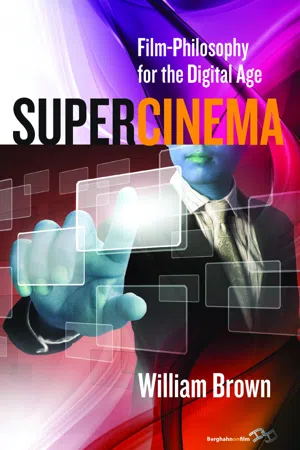
- 196 pages
- English
- ePUB (mobile friendly)
- Available on iOS & Android
eBook - ePub
About this book
Trusted by 375,005 students
Access to over 1.5 million titles for a fair monthly price.
Study more efficiently using our study tools.
Information
1
Digital Cinema’s Conquest of Space
The opening moments of Fight Club provide one of the clearest examples of how digital technology has changed film aesthetics in terms of the depiction of space. There is a sound of bubbling water, before we hear a record needle hit a groove and zip into pulsing, aggressive electroindustrial music (‘Stealing Fat’ by the Dust Brothers). This accompanies a vertiginous backward tracking shot through a dark space inhabited by strange green-grey shapes that come to resemble a series of pipes, tubes and floating objects, some of which occasionally flash an electric blue, while jets of blue-grey liquid or gas (we cannot really tell), and clumps of green globules and other unrecognizable forms float past. The names of the film’s creative personnel materialize on the screen and then dissolve, before, seemingly without a cut, we pass backwards on to a curving surface the pink-cream colour of a white human’s skin, with large black protrusions spiking upwards and with what seem to be giant droplets of water rolling off to the side.
Backwards we travel along a darker section of this flesh-coloured surface until we run – still backwards – along a black trough and away from the flesh-coloured expanse behind it. After an instant, two white dots on two parallel and upward-jutting black rectangles appear, framing the grooved black surface along which we have just travelled. The camera then comes to a rest and the music ends with the bizarre distension of a final note that warps into a strange crescendo. The camera switches focus to show us the tortured face of Fight Club’s unnamed narrator (Edward Norton), who has a handgun in his mouth. His voiceover replaces the music: ‘People were always asking me if I knew Tyler Durden’.
Instants later, as the narrator explains to us a terrorist plot called Project Mayhem, the camera rushes down alongside the exterior of a glass-fronted office block, down through the earth and into a basement car park, in which the camera races towards a van, through a bullet hole in the windscreen, and into a circling closeup of a bomb that is waiting to explode. The camera then changes trajectory and heads sideways, again at breakneck speed, through areas of solid earth until it reaches another subterranean car park that houses a bomb nestled alongside a concrete column, and which is set to destroy the buildings through which we have rapidly and impossibly just travelled.
Although it is hard for audiences to know when they first watch Fight Club, the opening shot sees the camera progress from the fear centre of the narrator’s brain, backwards through his cerebral architecture, on to his sweating scalp, down his face and along the barrel of the gun that is in his mouth. The green-grey tubes that we see are synapses, which turn electric blue as the narrator’s neurons fire; the globules of water are droplets of sweat that roll along his scalp and past his military-style crew cut. That this happens in one unbroken and continuous movement suggests that in the digital age, in which films can be made with a virtual camera, many of the older obstacles that stopped filmmakers from achieving such shots in the past have now been removed.
The second shot described above, which takes us on a tour of the Project Mayhem bomb sites, also illustrates how digital cinema can and does depict space. Sean Cubitt has noted how ‘[i]n the neo-Hollywood of the 1990s and 2000s, space has usurped the privilege of time. Narrative is diminishing in importance… while diegesis, the imaginary worlds created by films, becomes more significant’ (Cubitt 2002: 26). But while space is of renewed importance in digital cinema, as Cubitt identifies, how it is depicted has also changed – and this is of crucial importance. In the shots from Fight Club, walls and other aspects of the physical world are no longer the obstacles that they used to be; that is, we normally take walls to be solid and an analogue camera cannot pass through walls by virtue of its own status as a solid object in a world governed, on the human scale, by the laws of Newtonian physics. However, in the same way that there has since Albert Einstein been a revolution that in many respects supersedes Sir Isaac Newton’s understanding of the physical universe, so, too, with the flourishing of digital techniques and technology in film, has there been a revolution in how and what cinema can and does depict, including how it depicts space. Where once filmmakers might have had to cut to the basement car parks in which the bombs are housed, here Fincher takes us directly there and, significantly, without a cut, regardless of what solid barriers would normally prevent the camera from doing so.
The image and the index
I shall argue for the realism of the opening shots of Fight Club, but in order to do so I must establish what cinematic realism is or might mean. There are several competing levels at which a film might be deemed realistic: perceptually, spatially, temporally, in terms of its premise, and in terms of its characters’ behaviour/psychology. Here, I shall limit myself to perceptual and spatial realism, arguing for the perceptual and spatial realism of digital images, even if in other respects they show us impossible (and therefore unrealistic) feats. I shall also argue this in spite of the common objection that computer generated images are not indexically real. Indeed, I shall argue that the question of indexicality has unduly dominated discourse surrounding digital cinema. Since it bears a relation on the issue of realism in digital cinema, I shall turn my attention to indexicality before arguing for digital cinema’s perceptual and spatial realism.
Photographic (analogue) film is thought to be an index of reality, since it involves the physical-chemical effects of light on celluloid at a particular instant in time. This indexical relationship between image and world is the cornerstone of analogue cinema, which relied/relies precisely on the traces left on the filmstrip by reality itself in order to convince audiences of the physical reality of what it depicts. For this reason, various scholars have argued that film is a ‘transparent’ recording of reality, with André Bazin (1967), Siegfried Kracauer (1997) and Roland Barthes (2000) emerging as the three best known champions of this ‘realistic’ approach. Since the link to or trace of reality is lost when the object depicted did not stand before the camera, but is in fact a digital fabrication, questions of indexicality have loomed large in discussions of realism in connection with digital cinema. For example, the question of indexicality, or the supposed lack thereof in digital cinema, plays a prominent role in work by Philip Rosen (2001), Mary Ann Doane (2002; 2007), Laura Mulvey (2006) and D.N. Rodowick (2007).
For each of these theorists, indexicality is related to contingency, chance, and temporality. Regardless of framing, exposure time, film stock used and development procedures undertaken, the photographic image remains an imprint, a trace, or an index of what was before the camera at the time of the photograph’s being taken. As such, it is a frozen moment of time whose contents are to a certain extent immutable. El Cid (Anthony Mann, Italy/USA/UK, 1961), for example, features a shot showing a Boeing 747 alongside the eleventh-century Castilian history that the film otherwise claims to portray. As noted by Noël Carroll, this is an anachronism if ever there was one (Carroll 1996: 55)! The point is, though, that analogue photography for better or for worse captures what was before the camera. Analogue photography is, therefore, evidence of reality. In Mary Ann Doane’s terms, analogue photographs convey a ‘thisness’ of the objects that they depict prior to any interpretations that we as viewers may assign to them (Doane 2002: 25).
William J. Mitchell (1992) has provided a convincing history of how artists and forgers have faked analogue photographs via various means since soon after photography’s inception in the mid-nineteenth century. In the era of digital imaging, however, the indexical link to reality is more profoundly lost, since objects can appear in the image that were never there, be those objects simply background details or moving creatures such as dinosaurs. If the contents of digital images have no ontological reality in the way that the contents of analogue images do, then digital images cannot, on one level, be realistic at all.
Let us make clear that this loss of indexicality pertains to images recorded with digital cameras as well as to digital images animated on a computer. It is the transcoding of light into information that causes this indexical loss. This has nothing to do with image quality or resolution, but simply the fact that an extra step has been inserted in between capture and production; rather than light imprinted directly on to polyester, or, to take a famous example from Charles Sanders Peirce (quoted in Rosen 2001: 18), wind directly turning a weather vane, light in a digital photograph is transmuted via a computer into 1s and 0s and is then given an output format (the assignation of colours to various picture elements, or pixels) that conforms to the conventions of photography.
Intriguingly, Laura U. Marks (1999) has argued that, contrary to the above, digital images do have a sort of indexicality. Marks recognizes that indexicality in the usual sense is lost in the creation of a digital photograph. Whereas even an electronic image is indexical because the image is created by a photoconductor that is ‘excited’ at the same frequencies as the incident light that falls upon it, with digital images the incident light is translated into a symbol (consisting of 1s and 0s) that is an approximation of the light’s wavelength, not an index of it (see also Cubitt 2010). Indeed, the approximation takes place because computers cannot tolerate states between 1 and 0; rather than registering ambiguity, the computer registers only ‘mass’ behaviour on the part of light waves – again regardless of the resolution of the image. That said, the behaviour of electrons in the silicon circuit does have what Marks calls a ‘micro-indexicality’: the behaviour of some electrons determines the behaviour of others within the circuit, although not – it seems – in quite as detailed a way as the interconnection of electrons that Marks tentatively posits exists in the real world. I shall take inspiration from Marks’s appeal to physics in this and the final chapter, but I must also mention Marks’s concession to micro-indexicality simply to suggest that there is potentially some indexicality in the digital image, meaning that the digital image’s connection with reality may be simplified/approximated, but it is not totally lost.
While indexicality is considered to be a direct registration of reality – whether it is light on polyester or wind on weather vane – this is not necessarily the same as realism, as Tom Gunning (2004a; 2007) has pointed out. Nonetheless, for André Bazin and Roland Barthes indexicality is an undeniable sign of the realism of the analogue image. More than that, indexicality is a sign not of realism but of the reality of what is in the image, an approach that some philosophers also follow (see, for example, McIver Lopes 2003). This realism was held by Bazin in particular to be truly cinematic, hence his predilection for films in which the real world could manifest itself in contradistinction to the manipulated series of images put together in Russian montage, for example the films of Sergei M. Eisenstein. Not all theorists of cinema have historically agreed with Bazin’s position; Rudolf Arnheim, for example, felt that montage was the truly cinematic element of film, not its documentary properties. For Arnheim, the proliferation of films led by dialogue following the development of film sound ‘narrows the world of film… The dialogue paralyses the visual action… [Sound is] a radical artistic impoverishment if compared with the available purer forms’ (Arnheim 1983: 164–89). Arnheim also states that ‘nothing has been achieved by simply imitating real things’ (Arnheim 1933: 141).
Beyond Arnheim, Bazin’s sense of cinema as a transparent index of reality did not garner much credibility among the Screen theorists of the 1970s. If for Colin MacCabe, Laura Mulvey and others cinema was made up of signs – hence the use of semiotics as a theoretical framework through which to consider it – cinema was not therefore a transparent depiction of ‘raw’ reality; it did not have ‘thisness’, to use Doane’s term, but rather pointed to a ‘second’ meaning that could be ‘read’ in the image. Far from being experiential, then, cinema was representational; its images represented objects, and in this sense were not images of real objects. For this reason, realism was not inherent for Screen theorists, but rather a style. If for Bazin Russian montage is ‘unthinkable in any film after 1932’ (Bazin 1967: 32), the realism of continuity editing is also a deliberate manipulation of reality that seeks to give expression to a certain point of view/ideology, as Jean-Luc Comolli and Jean Narboni (1991) have argued. For this reason, Colin MacCabe posited in 1976 that ‘[n]arrative must deny the time of its own telling – it must refuse its status as discourse (articulation), in favour of its self-presentation as simply identity, complete knowledge’ (MacCabe 1991: 87). In other words, MacCabe and his peers in the Screen stable approved ‘Brechtian’ techniques, such as breaking the fourth wall via direct address to camera, so as to take us closer to what their psychoanalysis-inspired theory might term the Real (MacCabe 1991: 82).
It is important to note that neither Arnheim’s nor Screen theory’s approach to cinema denies indexicality. However, we can perceive in their work some uneasiness with the ‘transparency’ of the photographic image. For Arnheim, imitating reality simply does not equate to art, while for the Screen theorists (if I may be permitted to generalize) ‘realism’ in cinema is a style that induces us not to question the constructed nature of what we are seeing (and which must therefore be challenged). Rather than deny the indexical link between image and the real-world object that it depicts, in some senses these arguments rely upon it – since it is the very indexical nature of the images that helps to convince viewers that they are not looking at coded images, when in fact, for Screen theorists, they are.
If the digital image, even an image captured on a DV camera, is not an index of reality, then this description of indexicality might seem irrelevant. However, it is useful for at least two reasons, firstly, because it brings us to a discussion of the ontological nature of the digital image, and secondly, because, as we shall see, the introduction of the ‘coded’ nature of the image, together with the argument that realism is a style, is relevant to our thinking about digital cinema. However, before we can reach any conclusions on this matter, we must weave into the debate questions surrounding the realism of digital images.
Perceptual realism, simulations, and photorealism
In 1996, Stephen Prince saw digital artists and animators as having almost fulfilled the goal of achieving perceptual realism. It is not that perceptual realism was an explicitly stated telos for all digital artists and animators, but that perceptual realism could now be achieved was important (see Prince 1996; 2010). Perceptual realism could be achieved by making digital objects appear to have solidity, weight, texture, and mobility, so that digital objects appear to be fully embedded within the world that surrounds them, be that world digitally animated, shot on DV, or digitized from analogue via the DI. The digital dinosaurs in Jurassic Park are a common example of this: they inhabit the space of the eponymous park such that they seem to share the same ontological status as the real (indexical) world that surrounds them (see also Elsaesser and Buckland 2002: 216). In O Brother, Where Art Thou? (Joel Coen, UK/France/USA, 2000), the digital cows that get shot by George ‘Baby Face’ Nelson (Michael Badalucco), and which stampede into an oncoming car, were so realistic that the American Humane Society allegedly had to re-view the sequence ten times in order to be convinced that it was a digital creation (Anonymous 2000: 25). And yet neither the dinosaurs from Jurassic Park, nor the cows from O Brother…? are real. In fact, both of these, and myriad other examples of digital characters and monsters in contemporary cinema, are simulations.
As simulations of reality, digital entities are entirely unreal, even if they look realistic. Many might see in their perceptual realism a reason to argue that we now truly live in a postmodern world in which the difference between reality and illusion has become eroded to the point of indiscernibility. Indeed, such myths seem to pursue cinema, and art more generally, as Pliny the Elder’s recounting of the myth of Zeuxis’s grapes (and Parrhasius’s painting that was so realistic it fooled human eyes) makes clear (see also Manovich 1998). Similarly, it was alleged that when the Lumière Brothers first showed L’arrivée d’un train à la Ciotat/Arrival of a Train at La Ciotat (France, 1896), audiences fled the oncoming vehicle, believing it would erupt from the screen, even though Tom Gunning (1989) contends that this story is apocryphal. It may be that in the case of O Brother, Where Art Thou? the American Humane Society representatives knew that the Coen brothers had not literally killed a cow, but wanted to be absolutely certain that this was so (thereby engendering a promotional news story for the film). It may also be that some/many people genuinely do not/cannot see how a special effect has been achieved when they watch contemporary cinema (or cinema throughout its history). But on the whole it is worth noting that most humans do not believe in Superman or Spider-Man or the morphing T-1000 (played predominantly by Robert Patrick) from Terminator 2: Judgement Day. According to Stuart Minnis (1998), most (all?) film viewers are endowed with ‘instrumental reasoning’, whereby they can tell that such things are not real, even if perceptually they appear realistic.
The reason for evoking the simulation debate, then, is not to rehearse apocalyptic or hysterical scenarios about humanity gone insane because we believe that the balrogs and orcs from The Lord of the Rings are running around on our planet – even if myths like Bigfoot, Nessie, and the Himalayan Yeti persist. Nor is it to explore the related conspiracy theory phenomenon, whereby people genuinely believe that JFK was shot by the CIA, and that the aeroplane crashes of 11 September 2001 were an ‘inside job’ – not least because there exist films that make these claims, such as JFK (Oliver Stone, USA, 1991) and Loose Change: Second Edition (Dylan Avery, USA, 2006). Rather, the reason to mention this debate is to say that while predominantly we do not believe that digital images are real, this does not deprive them of perceptual realism. Furthermore, seeing digital images can have real effects, or affects, on us as audience members (see the final chapter).
The perceptual realism of digital images/CGI is an important achievement, since it helps us to differentiate digital animation from traditional animation. Within animation history, it has long been possible to bring dinosaurs, such as Winsor McCay’s Gertie the Dinosaur (USA, 1914), to life – be that through drawings or models. And it has also been possible, for example, for us to descend alongside the Roadrunner or Wile E. Coyote as they have been falling from a cliff top – in much the same way that the camera drops from the tower where the narrator and Tyler Durden discuss Project Mayhem in Fight Club. Animation has always been able to achieve those things that would be much harder to achieve in live action without endangering human lives and/or filmmaking equipment. But what Chuck Jones’s Roadrunner lacks – whether it wants it or not – is the perceptual realism of the animation constructed through the use of digital technology. Falling alongside the Roadrunner is not rendered with the perceptual realism of falling through the air alongside the office block in Fight Club.
Let me make clear that perceptual realism is not necessarily the same as showing things as they appear in real life. To create perceptual realism in digital images, filmmakers must, as Stephen Prince acknowledges, make objects and entities that are physically consistent with the world around them, such that they cast shadows, brush against other (profilmic) objects, and have their fur ruffled by the wind. But, as Prince also points out, they often have to add details such as motion blur to moving objects, including the dinosaurs in Jurassic Park (Prince 1996: 30). While Katherine Sarafian (2003: 219) writes about the sharpness and perfection of digital images, many are, as suggested in the introduction via Lev Manovich (2001: 201–202), downgraded in order to be believable. Both motion blur and this downgrading point not only to the perceptual realism of digital images, but also to their photorealism: digital images are made not to lo...
Table of contents
- Cover Page
- Title Page
- Copyright Page
- Dedication
- Contents
- Acknowledgements
- Introduction
- Chapter 1: Digital Cinema’s Conquest of Space
- Chapter 2: The Nonanthropocentric Character of Digital Cinema
- Chapter 3: From Temporalities to Time in Digital Cinema
- Chapter 4: The Film-Spectator-World Assemblage
- Chapter 5: Concluding With Love
- Bibliography
- Index
Frequently asked questions
Yes, you can cancel anytime from the Subscription tab in your account settings on the Perlego website. Your subscription will stay active until the end of your current billing period. Learn how to cancel your subscription
No, books cannot be downloaded as external files, such as PDFs, for use outside of Perlego. However, you can download books within the Perlego app for offline reading on mobile or tablet. Learn how to download books offline
Perlego offers two plans: Essential and Complete
- Essential is ideal for learners and professionals who enjoy exploring a wide range of subjects. Access the Essential Library with 800,000+ trusted titles and best-sellers across business, personal growth, and the humanities. Includes unlimited reading time and Standard Read Aloud voice.
- Complete: Perfect for advanced learners and researchers needing full, unrestricted access. Unlock 1.5M+ books across hundreds of subjects, including academic and specialized titles. The Complete Plan also includes advanced features like Premium Read Aloud and Research Assistant.
We are an online textbook subscription service, where you can get access to an entire online library for less than the price of a single book per month. With over 1.5 million books across 990+ topics, we’ve got you covered! Learn about our mission
Look out for the read-aloud symbol on your next book to see if you can listen to it. The read-aloud tool reads text aloud for you, highlighting the text as it is being read. You can pause it, speed it up and slow it down. Learn more about Read Aloud
Yes! You can use the Perlego app on both iOS and Android devices to read anytime, anywhere — even offline. Perfect for commutes or when you’re on the go.
Please note we cannot support devices running on iOS 13 and Android 7 or earlier. Learn more about using the app
Please note we cannot support devices running on iOS 13 and Android 7 or earlier. Learn more about using the app
Yes, you can access Supercinema by William Brown in PDF and/or ePUB format, as well as other popular books in Media & Performing Arts & Film & Video. We have over 1.5 million books available in our catalogue for you to explore.