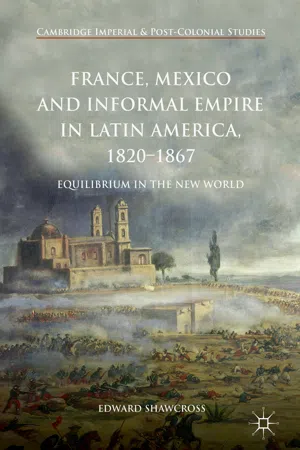
This book explores French imperialism in Latin America in the nineteenth century, taking Mexico as a case study. The standard narrative of nineteenth-century imperialism in Latin America is one of US expansion and British informal influence. However, it was France, not Britain, which made the most concerted effort to counter US power through Louis-Napoléon's military intervention in Mexico, begun in 1862, which created an empire on the North American continent under the Habsburg Archduke Ferdinand Maximilian. Despite its significance to French and Latin American history, this French imperial project is invariably described as an "illusion", an "adventure" or a "mirage". This book challenges these conclusions and places the French intervention in Mexico within the context of informal empire. It analyses French and Mexican ideas about monarchy in Latin America; responses to US expansion and the development of anti-Americanism and pan-Latinism; the consolidation of Mexican conservatism; and, finally, the collaboration of some Mexican elites with French imperialism. An important dimension of the relationship between Mexico and France, explored in the book, is the transatlantic and transnational context in which it developed, where competing conceptions of Mexico and France as nations, the role of Europe and the United States in the Americas and the idea of Latin America itself were challenged and debated.
eBook - ePub
France, Mexico and Informal Empire in Latin America, 1820-1867
Equilibrium in the New World
- English
- ePUB (mobile friendly)
- Available on iOS & Android
eBook - ePub
France, Mexico and Informal Empire in Latin America, 1820-1867
Equilibrium in the New World
About this book
Information
© The Author(s) 2018
Edward ShawcrossFrance, Mexico and Informal Empire in Latin America, 1820-1867Cambridge Imperial and Post-Colonial Studies Serieshttps://doi.org/10.1007/978-3-319-70464-7_11. Introduction
Edward Shawcross1
(1)
Independent Scholar, London, UK
In the south of Mexico City, a former Franciscan monastery built in the sixteenth century today houses the Museo Nacional de las Intervenciones. The museum’s collection documents armed interventions in Mexico from independence to the Mexican Revolution, beginning with a Spanish attempt at reconquest in 1829 and ending with punitive US expeditions in 1916. According to a review in the LA Times, the museum was proof of Mexico’s “obsession” with intervention and a “repository” of “unhealed wounds to Mexico’s self-esteem”.1 A more sympathetic interpretation is that the museum, opened in 1981, demonstrates that the history of post-independent Mexico is one throughout which foreign powers repeatedly violated its national sovereignty. Rather than dwell upon perceived slights to Mexican amour propre, it might be more pertinent to ask why foreign nations were ”obsessed” with intervening in an independent country.
Amongst the Spanish uniforms, French flags, and US weapons on display in the museum, one imperial power is conspicuous by its absence: Britain . This is surprising because the standard narrative of imperialism in post-independence Latin America is one of British influence followed by the rise of the United States . Yet, in Mexico, it was France, not Britain, that intervened militarily, first from 1838 to 1839 and then, on a much larger scale, from 1862 to 1867. These expeditions did not aim at territorial conquest. The objective of the 1838 intervention was to coerce the Mexican government into complying with French demands: payment of compensation to French nationals in Mexico and the negotiation of a Franco-Mexican treaty to regulate future relations. In order to achieve these goals, France sent its navy to blockade the Atlantic coast of Mexico. When the Mexican government refused France’s ultimatum, French forces bombarded and then occupied the fortress of San Juan de Ulúa, which guarded the entrance to the port city of Veracruz. To end the intervention, the Mexican government was forced to pay France an indemnity of 600,000 piastres and sign a provisional treaty of commerce, navigation and friendship.2
The ostensible reasons the French government gave for the second intervention, which began in 1861 as a tripartite expedition with France, Britain and Spain , shared the same basic purpose as the 1838 expedition: to ensure the compliance of the Mexican government with French demands. The specific aims were outlined in the Convention of London signed on 31 October 1861: coerce the Mexican government, led by President Benito Juárez , to honour payments on Mexico’s international debt, which Juárez had suspended in July, and secure better protection for European nationals in Mexico.3 However, the ambitions of the French emperor, Louis-Napoléon Bonaparte, extended far beyond mere debt collection. He planned regime change (to use an anachronism) in order to establish a state closely tied to French interests, but not ruled from Paris. Once this became clear, Spain and Britain withdrew from the expedition.4
Unhindered by its erstwhile allies, France, from April 1862, began an imperial project on a grand scale. The initial expeditionary force was defeated by Juárez ’s forces at Puebla on 5 May 1862, but the city was taken the following year and in the face of the advancing French army, the constitutional government of Mexico was forced to flee its capital. In June 1863, Mexico’s republican institutions were replaced by a regency which governed Mexico until the Austrian Archduke Ferdinand Maximilian and his Belgian wife Marie Charlotte (known as Carlota ) were crowned as Emperor and Empress of Mexico in June 1864.5 Faced with continuing Mexican opposition from Juárez ’s republican forces, and US diplomatic pressure, Louis-Napoléon announced in January 1866 that French troops would withdraw. Carlota returned to Europe to plead in person to Louis-Napoléon for continued military support, but, unmoved by her appeals, the French emperor ensured that the last French troops evacuated Veracruz by March 1867. Three months later, on 19 June 1867, Maximilian was executed and republican government in Mexico was restored. The life of the second emperor of Mexico ended as had that of the first, Agustín de Iturbide , by execution.6 Three years later, 4 September 1870, the French Second Empire collapsed, its emperor in captivity after defeat at the battle of Sedan during the Franco-Prussian War .
The Historiography of the 1862–67 French Intervention
The Mexican and French Second Empires have been judged by their dramatic conclusions, obscuring the ideas that underwrote French intervention in Mexico and the regime which it created. In Mexico, the empire of Maximilian (1864–67) was condemned by those who defeated it. Interpreted through the prism of national history, it was represented as an arcane aberration, like the French Second Empire in France, before the triumph of liberal republicanism. This explanation was embedded into Mexican national discourse by writers of officialist history under the Porfiriato (the period from 1876 to 1911 marked by the authoritarian rule of Porfirio Díaz) who had supported Juárez .7 The struggle was portrayed as a Manichean one of good versus evil, liberal republicans against foreign invaders supported only by a small number of reactionary and treasonous Mexican Conservatives and monarchists. Juárez ’s victory in 1867 became one of the foundational moments of Mexican history.8 The Mexican Revolution (1910–20) appropriated the legend of Juárez into its own rhetoric of triumphant progress,9 and historians repeated the by-now standard narrative of the French intervention and its place in Mexico’s past.10 With few exceptions,11 there was no counter to this interpretation because of the near-complete abandonment of the Mexican Second Empire by its adherents: even those who had been plus royaliste que le roi—such as General Leonardo Márquez , who held Mexico City for the empire even after its emperor had been executed, or Francisco de Paula Arrangoiz y Berzábal, one of the earliest proponents of a monarchy in Mexico under Maximilian— distanced themselves from the regime.12
Early analysis of the intervention in France was similarly negative for two reasons. First, the intervention never had widespread public or political support.13 The expedition to Mexico united conservative legitimists, liberal Orléanists and moderate republicans in opposition to the government. The criticisms of celebrated orators such as Pierre Antoine Berryer , Adolphe Thiers, and Jules Favre in the Corps législatif were widely publicised.14 Furthermore, returning French officers wrote unfavourable accounts of the Mexican Second Empire which augmented the negative portrayal of French policy.15 Second, events in France meant that the Mexican intervention was subsumed into a wider vilification of the Second Empire itself. After 1870, French republican historiography, building on earlier attacks,16 created a black legend around the second Bonapartist regime.17 Moreover, the abdication of Louis-Napoléon during the Franco-Prussian War encouraged his opponents to portray his Mexican policy as a microcosm for the Emperor’s own failings; a stepping stone on the road to Sedan. For French republicans, it was no coincidence that the commander-in-chief of the army in Mexico from 1863 to 1867, Achille Bazaine , was the man who surrendered the fortress of Metz to the Prussians on 27 October 1870, an act which saw him court-martialled for treason and sentenced to death.18
Contemporary French critics of Louis-Napoléon ’s policy, such as Thiers , described it as a “chimera”, an “illusion”, or an “adventure”.19 These epithets have become the conclusions of historians who have studied the intervention, which, in these works, remains condemned by the disjuncture between the Mexican ”reality” and Louis-Napoléon ’s false understanding of it. In this view, Louis-Napoléon was misled into an ill-advised intervention at the behest of a small clique of émigré Mexican Conservatives and by affairiste French diplomats.20 A recent French historian concludes: “the intervention, from the beginning, was only a monumental and regrettable misunderstanding.”21 Moreover, those anglophone historians who have addressed the French foundation of Maximilian ’s empire have done so from an almost exclusively French, or at best European and/or US, perspective, studying it in isolation with little reference either to wider French imperial policy or Mexican sources. Many have similarly concluded that the intervention was embarked upon because Louis-Napoléon was deluded, either by his own dreams, those of others, or a combination of the two.22
In studies of the French Second Empire, moreover, the Mexican intervention is generally seen as tangential to the central story of the regime, and relatively unimportant in terms of foreign policy compared to the Crimean War (1854–56), the Italian War of 1859, or the Franco-Prussian War (1870–71). Furthermore, unlike French imperialism in Algeria or Indochina , it did not form part of a longer narrative which continued to affect France and its colonies. As a consequence, scholars have focussed their attention elsewhere,23 and Louis-Napoléon ’s...
Table of contents
- Cover
- Front Matter
- 1. Introduction
- 2. French Policy towards Latin America, 1820–60
- 3. Monarchy and the Search for Order in Mexico
- 4. Towards Pan-Latinism
- 5. The Western Question
- 6. The Limits of Informal Empire: French Intervention and the Mexican Second Empire
- 7. Conclusion
- Back Matter
Trusted by 375,005 students
Access to over 1.5 million titles for a fair monthly price.
Study more efficiently using our study tools.
Frequently asked questions
Yes, you can cancel anytime from the Subscription tab in your account settings on the Perlego website. Your subscription will stay active until the end of your current billing period. Learn how to cancel your subscription
No, books cannot be downloaded as external files, such as PDFs, for use outside of Perlego. However, you can download books within the Perlego app for offline reading on mobile or tablet. Learn how to download books offline
Perlego offers two plans: Essential and Complete
- Essential is ideal for learners and professionals who enjoy exploring a wide range of subjects. Access the Essential Library with 800,000+ trusted titles and best-sellers across business, personal growth, and the humanities. Includes unlimited reading time and Standard Read Aloud voice.
- Complete: Perfect for advanced learners and researchers needing full, unrestricted access. Unlock 1.5M+ books across hundreds of subjects, including academic and specialized titles. The Complete Plan also includes advanced features like Premium Read Aloud and Research Assistant.
We are an online textbook subscription service, where you can get access to an entire online library for less than the price of a single book per month. With over 1.5 million books across 990+ topics, we’ve got you covered! Learn about our mission
Look out for the read-aloud symbol on your next book to see if you can listen to it. The read-aloud tool reads text aloud for you, highlighting the text as it is being read. You can pause it, speed it up and slow it down. Learn more about Read Aloud
Yes! You can use the Perlego app on both iOS and Android devices to read anytime, anywhere — even offline. Perfect for commutes or when you’re on the go.
Please note we cannot support devices running on iOS 13 and Android 7 or earlier. Learn more about using the app
Please note we cannot support devices running on iOS 13 and Android 7 or earlier. Learn more about using the app
Yes, you can access France, Mexico and Informal Empire in Latin America, 1820-1867 by Edward Shawcross in PDF and/or ePUB format, as well as other popular books in History & French History. We have over 1.5 million books available in our catalogue for you to explore.