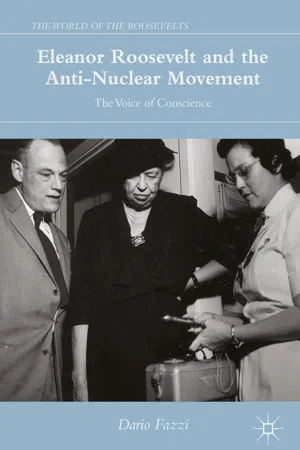
This book explores Eleanor Roosevelt's involvement in the global campaign for nuclear disarmament. Based on an extensive multi-archival research, it assesses her overall contribution to the global anti-nuclear campaign of the early cold war and shows how she constantly tried to raise awareness of the real hazards of nuclear testing. She strove to educate the general public about the implications of the nuclear arms race and, in doing so, she became for many a trustworthy anti-nuclear leader and a reliable voice of conscience.?
- English
- ePUB (mobile friendly)
- Available on iOS & Android
eBook - ePub
About this book
Information
© The Author(s) 2016
Dario FazziEleanor Roosevelt and the Anti-Nuclear MovementThe World of the Roosevelts10.1007/978-3-319-32182-0_11. Introduction
Dario Fazzi1
(1)
Roosevelt Study Center, Middelburg, The Netherlands
Writing a book on Eleanor Roosevelt is, per se, a daunting task. The amount of available primary sources is epic. During her lifetime, she managed to write hundreds of thousands of letters, hundreds of articles in dozens of different newspapers, journals, and magazines, thousands of columns, the most prominent of which appeared under the title of My Day and If You Ask Me, and 28 different books spanning a wide range of topics and genres, from women’s rights to the United Nations, from political analyses to autobiographical accounts. Moreover, Mrs. Roosevelt’s presence in the media of her era was continual. She not only hosted three radio shows and a TV series on her own, but she was also invited dozens of times to some of the most popular programs of her era. She gave countless interviews and comments on a number of varied issues, not to mention all of the speeches and talks that she delivered at universities, public meetings, or other official events.She was a supreme liberator, a liberator first of herself, then of her sex, of her country, of the abused and the injured around the planet.She stood above all for the rebirth of individual responsibility.Arthur Schlesinger, Jr. 1
A bulk of over 200 academic works represents the most relevant secondary literature on Eleanor Roosevelt. Practically almost any aspect of her life has been scrutinized, historically contextualized, politically criticized, or intellectually assessed. Encyclopedias and companions keep offering entries on her, a number of children’s books recount the story of her life and her most significant achievements, a dozen documentaries deal with her persona, and two plays are based on her character. More than 20 Web sites contain interesting materials on her, including her correspondence with US presidents, political leaders, and intellectuals, and the George Washington University has recently launched an impressive online database aimed to collect and publish most of her papers. 2
From such an abundance of sources stems the challenge to disentangle facts from fiction, relevant particulars from trivial details, and reliable stances from irrelevant opinions. So many have been the causes that Eleanor Roosevelt has endorsed, so varied the arguments that she has used to promote them, and so wide has been the breadth of her interests that, through her eyes, one could read the entire story of five crucial decades, from the roaring 1920s to the launch of the New Frontier in the 1960s. However, in order to assess her broader impact on American politics and society, one has to narrow the field of inquiry too.
My research fleshes out historian Allida Black’s invitation to use the former first lady as “a prism through which to examine the issues of human rights , containment , and nuclear disarmament .” In fact, while historians and biographers have already—and extensively—reconstructed Eleanor Roosevelt’s most important public and private achievements as well as her career as a “consummate liberal power broker,” my intention here is to explore which ideals have inspired her activism on nuclear disarmament and which effects have her pronouncements on nuclear weapons produced on the domestic debate on nuclear fallout . 3
Eleanor Roosevelt played a peculiar role in the transnational struggle against the nuclear weapons that emerged worldwide between the mid-1940s and the early 1960s. She was an integral part of a massive campaign mounted by eminent members of the international scientific community, several national and transnational organizations, and many influential individuals who were committed to mold public opinion’s understanding of nuclear weapons . She was well informed about the technical details of nuclear policymaking and remained politically well connected and influential even after her husband’s death in 1945. Accordingly, she was in the best position to lobby for nuclear disarmament . But she did more than this. Her main goal was indeed to educate the public and help common people to grasp the real hazards of the nuclear arms race . Her acute rhetoric, filled with stirring appeals and widely understandable metaphors, contributed to the opening of the nuclear fallout debate and gradually transformed her into a prominent anti-nuclear mass educator, to the point of becoming for many, as this book argues, a reliable voice of conscience.
Once nuclear deterrence became the linchpin of American foreign and national security policies, Mrs. Roosevelt’s nuclear criticism soared. She warned against the risks connected to the nuclear arms race and deplored the attempt to discredit internal nuclear opposition. In line with her lifelong commitment to pacifism and her long-standing humanitarianism , she condemned these new means of mass destruction because of the unbearable threat that they posed to mankind, because of the diversion of resources from welfare to warfare that they implied, and because of the mutual mistrust that they fostered at international level. In defense of the innermost values of American democracy and as a part of her campaign to promote human security , throughout the early Cold War , she constantly invited the American public to develop an independent and objective idea about the different positions that characterized the debate on nuclear weapons and testing. As a consequence, in contrast to Joan Hoff’s idea that Eleanor Roosevelt’s thinking on foreign policy had a somewhat protean nature, the historical analysis of a particular aspect of her stances on international affairs such as her anti-nuclear dissent reveals instead the continuity of her dedication to world peace and human rights , and this book will try to make this continuity emerging. 4
The idea that Mrs. Roosevelt’s most important contribution to the development of the first anti-nuclear campaign of the Cold War was mainly an educational one also drove the primary research in which this book is grounded. Therefore, rather than collecting and analyzing her private correspondence, I preferred to focus on her public exchanges with the principal anti-nuclear actors of her era, including political figures, social reformers, peace activists, intellectuals, and scientists. I have placed a particular emphasis on her public statements against nuclear weapons and tests—were they either broadcasted by radio and TV or published and circulated through journals, books, and newspapers—principally because of their immediacy. Moreover, such an approach fits those new methodological trends—chiefly, the so-called cultural and linguistic turn—that are broadening the traditional analyses of the Cold War by including a growing number of actors and cultural references to its description and explanation. 5 Recently declassified sources, for instance, as well as a growing body of literature, reveal how intense the public debate on nuclear fallout was and how harsh the struggle for public opinion’s consensus was among scientists, political elites, and private organizations.
Hence, my research represents the first attempt to evaluate the totality of Eleanor Roosevelt’s influence over the anti-nuclear protests of the Cold War , not only with respect to her promotion of postwar liberalism but also with reference to her plea for a new global humanitarianism . Such an analysis is divided into six chapters, which follow, chronologically, the development of her interest in nuclear disarmament as part of her constant drive toward international peace and social justice.
Chapter 1 shows that Mrs. Roosevelt was as much an American realist as an American pacifist. It mostly focuses on the interwar years, which represented the years of her intellectual formation and first political accomplishments, and it describes how, although being fully engaged in sustaining her husband’s political ascension, she was also able to build a public image and set up a political agenda on her own. The chapter stresses that, of all the many causes that she decided to endorse, she placed a particular emphasis on international cooperation and peace. Drawing on a well-established and varied pacifist tradition in the USA, she challenged the rampant isolationist mood of the 1920s by identifying the League of Nations and the US participation in the World Court with the best chances to secure a lasting world peace. In the same period, she joined several women’s peace organizations, endorsed the Women’s International League for Peace and Freedom , hosted peace conferences at her private residence in Hyde Park , wrote numerous articles on peace-related issues, and helped organize a peace prize to bolster, domestically, the idea of international cooperation. Most importantly, Eleanor Roosevelt framed such a promotion of pacifist ideals as a necessary quest for social justice. It was in these years, indeed, that she started developing the idea that peace could only stem from equal opportunities for all and that it was strongly related to people’s living conditions.
However, as the chapter highlights, Eleanor Roosevelt was not an absolute idealist. In the light of the rise of international tensions and the urgency to confront dictatorships, she understood the necessity for military preparedness and conscription. Her pacifist stances reckoned with the need to resist the emergence of totalitarianism. She pragmatically defended the idea that the USA had to wage another war to defend its ideal of freedom and contribute to the launching of a new era of progress and opportunities. Accordingly, the chapter concludes that her prominent social activism, her pragmatism, and her unmatched ability to cope with the mass media of her era transformed her not only into a reliable political leader but also into the perfect intercessor between the political elites and the American pacifist leaders.
Chapter 2 describes Eleanor Roosevelt’s reaction to and reflection on the advent of the atomic era. Mrs. Roosevelt’s criticism of the atomic weapons , indeed, came out publicly as soon as the dire effects of the atomic bombing of Japan came into the public domain. She mostly condemned the fact that these new means of indiscriminate destruction seemed to be driving and inspiring the whole American foreign and security policy. In line with the opinions of several scientists and liberal intellectuals who opposed this scheme, Eleanor Roosevelt immediately recognized the intimate post-Clausewitzian nature of the atomic weapons , to the point of defining the traditional discussion on national defense a “pure nonsense.” 6 In other words, she challenged the idea that nuclear weapons could be used as an instrument of national security or foreign policy because their destructive power had ultimately reshuffled the very meaning of war: since it could spell the extinction of the whole mankind, war could no longer be considered a mere continuation of policy by other means. Accordingly, in her view, setting up an effective international control of the atomic arsenals was a precondition for the achievement of human security . While stigmatizing the atomic weapons , Eleanor Roosevelt was therefore attacking Truman ’s doctrine’s most relevant assumptions and instruments, to a point that it is difficult to include her, even with major qualifications, in the number of the so-called cold warriors.
Chapter 3 illustrates how Eleanor Roosevelt responded to the mystification of nuclear deterrence and the qualitative upgrading of the atomic weapons into dreadful thermonuclear devices. The most difficult challenge to her was to fight against the broad consensus that such a policy and these new weapons were able to coagulate. For this reasons she strove for providing the opponents of nuclear deterrence with a forum for expressing their own views, by using her columns, her radio and TV shows as occasions to help the public to understand the real dangers connected to the nuclear arms race . Against what she defined as a policy of fear, Mrs. Roosevelt argued for the strengthening of the UN machinery, as the only guarantee of world peace and stability. Fighting against a growing sense of distrust of multilateral institutions, she praised dialogue and mutual understanding, thus gaining the approval of different anti-nuclear groups, including women’s organizations, world federalists, internationalists, moderate and even radical pacifists. Shocked by the accident that occurred at the Bikini atoll in 1954, when a US nuclear test contaminated a wide area of the Pacific Ocean along with the crew of a Japanese boat and further impressed by the harmful consequences of an overexposure to nuclear radiation that the scientists at the Oak Ridge Institute of Nuclear Studies had showed her during a visit that she had paid at their laboratories, Mrs. Roosevelt decided to outspokenly endorse the anti-nuclear campaign. The main reason for such an endorsement was related to an educational purpose: since the administration was often preventing people from gaining a real understanding of the consequences of its nuclear experiments, Mrs. Roosevelt believed that educating people about the real consequences of nuclear fallout was a matter that, in the end, concerned with the very sanity of society and the core of American democracy at the same time.
Chapter 4 further explores the broader implications of Eleanor Roosevelt’s participation in the debate on nuclear fallout and her direct involvement in the anti-nuclear campaign. In the mid- and late 1950s, indeed, fear of nuclear contamination soared and produced an unprecedented wave of popular demonstrations. While many administration officials and scientists kept defending the strategic value of nuclear testing , many other scientists, not only in the USA, overtly denounced it and its harmful consequences. Between 1955 and 1956, these alarming messages led 74 percent of Americans to back an international agreement banning the first use of nuclear weapons , and 67 percent to favor a multilateral reduction in nuclear armaments. In addition, almost 50 percent of American people supported a ban on US nuclear testing . 7 Seizing the day and in order to coordinate their efforts, different anti-nuclear groups in the USA decided to launch a nationwide campaign, led by the National Committee for a Sane Nuclear Policy (SANE ), whose numerous pleas for nuclear disarmament quickly attracted large sections of US society. In order to foster its public prominence, SANE organizers asked many leading Americans to sponsor its campaign, and Eleanor Roosevelt was among the first to join the dissident chorus. She took part in the test-ban campaign by providing liberal scientists and nuclear opponents in general with fora fo...
Table of contents
- Cover
- Frontmatter
- 1. Introduction
- 2. An Exceptional Pacifist
- 3. Entering the Atomic Era
- 4. Demystifying Nuclear Deterrence
- 5. Personal Commitment and Direct Involvement
- 6. An Agenda for Disarmament
- 7. Knowledge Is the Power, Education Is the Key
- 8. Conclusion
- Backmatter
Trusted by 375,005 students
Access to over 1.5 million titles for a fair monthly price.
Study more efficiently using our study tools.
Frequently asked questions
Yes, you can cancel anytime from the Subscription tab in your account settings on the Perlego website. Your subscription will stay active until the end of your current billing period. Learn how to cancel your subscription
No, books cannot be downloaded as external files, such as PDFs, for use outside of Perlego. However, you can download books within the Perlego app for offline reading on mobile or tablet. Learn how to download books offline
Perlego offers two plans: Essential and Complete
- Essential is ideal for learners and professionals who enjoy exploring a wide range of subjects. Access the Essential Library with 800,000+ trusted titles and best-sellers across business, personal growth, and the humanities. Includes unlimited reading time and Standard Read Aloud voice.
- Complete: Perfect for advanced learners and researchers needing full, unrestricted access. Unlock 1.5M+ books across hundreds of subjects, including academic and specialized titles. The Complete Plan also includes advanced features like Premium Read Aloud and Research Assistant.
We are an online textbook subscription service, where you can get access to an entire online library for less than the price of a single book per month. With over 1.5 million books across 990+ topics, we’ve got you covered! Learn about our mission
Look out for the read-aloud symbol on your next book to see if you can listen to it. The read-aloud tool reads text aloud for you, highlighting the text as it is being read. You can pause it, speed it up and slow it down. Learn more about Read Aloud
Yes! You can use the Perlego app on both iOS and Android devices to read anytime, anywhere — even offline. Perfect for commutes or when you’re on the go.
Please note we cannot support devices running on iOS 13 and Android 7 or earlier. Learn more about using the app
Please note we cannot support devices running on iOS 13 and Android 7 or earlier. Learn more about using the app
Yes, you can access Eleanor Roosevelt and the Anti-Nuclear Movement by Dario Fazzi in PDF and/or ePUB format, as well as other popular books in History & European History. We have over 1.5 million books available in our catalogue for you to explore.