This book offers a cultural studies approach to marketing and advertising and shows readers how scholars from different academic disciplines make sense of marketing's role in American culture and society. It is written in an accessible style and has numerous drawings by the author to give it more visual interest.
Arthur Asa BergerMarketing and American Consumer Culture10.1007/978-3-319-47328-4_1
Begin Abstract
1. Introduction: Martians and Marketers
Arthur Asa Berger1
(1)
San Francisco State University, San Francisco, California, USA
Abstract
Marketers are similar in nature to the Martians in War of the Worlds who studied human beings carefully with an eye toward using them for their own purposes: the Martians to suck people’s blood, the marketers to sell people goods and services. Several definitions of marketing are offered and marketing is contrasted with advertising and it is suggested that there is a symbiotic relationship between the two. A case study of the relationship between marketing and advertising is offered by Fred Goldberg in his analysis of the California Cooler campaign. This is followed by a discussion of the amount of media spending on advertising and a list of speculations about the impact of marketing on American culture and society. Finally, there is an exploration of some different academic disciplines and the way they look at marketing and advertising.
Down the hall from my office…is an equipment room with more than 100 cameras. Eight-millimeter video cameras, direct to hard drive, digital, even a few ancient Super 8 time-lapse film cameras.…In that same equipment room are piled cases of blank eight-millimeter videotapes, two hours per tape, five hundred tapes to a case. Across the world, we have now shot more than fifty-thousand hours of tape per year. We also have dozens of handheld computers, or PDAs, on which we painstakingly jot down the answers from the thousands of shopper interviews we conduct.…Even with all that high-tech equipment, though, our most important research tool for the past thirty years remains a piece of paper we call the track sheet, in the hands of individuals we call trackers. Trackers are the field researchers of the science of shopping, the scholars of shopping, or, more precisely, of shoppers. Essentially, trackers stealthily make their way through stores following shoppers and noting everything they do. Usually a tracker begins by loitering inconspicuously near a store’s entrance, waiting for a shopper to enter, at which point the “track” starts. The tracker will stick with the unsuspecting individual (or individuals) as long as he or she is in the store (excluding trips to the dressing room or restroom) and will record on the track virtually everything the shopper does.
Paco Underhill, Why We Buy: The Science of Shopping
Here’s something I learned at Lands’ End: how challenging it is, despite gung-ho books written by self-appointed marketing gurus, to win the hearts and minds of customers. While nearly every company on the Sell Side boasts that it is “customer-centered”—viz. they do it all for us, many retailers are just blowing smoke.
Lee Eisenberg, Shoptimism: Why the American Consumer Will Keep on Buying No Matter What
End Abstract
When I think of marketing, my mind returns to the beginning of H.G. Wells’ War of the Worlds (1997). He wrote (and I’m taking some liberties with his words in places):
As men [and women] busied themselves about their various concerns, they were being scrutinized and studied, perhaps almost as narrowly as a man with a microscope scrutinizes the transient creatures that swarm and multiply in a drop of water. With infinite complacency men [and women] went to and fro about this globe about their little affairs serene in their assurance of their empire of matter.
Shortly after, Wells described the creatures that were studying us, and wrote another interesting passage:
Across the gulf of space, minds that are to our minds as ours are to the beasts that perish, intellects vast and cool and unsympathetic, regarded this earth (and earth’s shoppers) with envious eyes and slowly and surely drew their plans against them.
Wells was writing about Martians but what he wrote about Martians can also be applied to market researchers like Paco Underhill and a host of others. They want to know why we buy this automobile and not another, this bottle of mustard and not another, Coca-Cola and not Pepsi-Cola, this anything and not a competing brand.
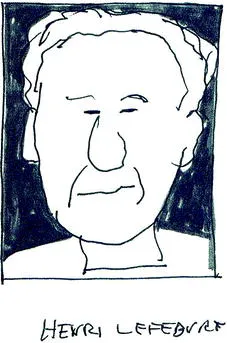
Henri Lefebvre
The United States is a country where marketing has reached its apotheosis. There is no aspect of everyday life in the country that has not been affected by marketing and advertising. Henri Lefebvre, a French Marxist, explains one aspect of advertising and marketing, in his book Everyday Life in the Modern World (1971:105):
In the second half of the twentieth century in Europe, or at any rate in France, there is nothing—whether object, individual, or social group—that is valued apart from its double, the image that advertises and sanctifies it. This image duplicates not only an object’s material, perceptible existence but desire and pleasure that it makes into fictions situating them in the land of make-believe, promising “happiness”—the happiness of being a consumer. Thus publicity [marketing and advertising] that was intended to promote consumption is the first of consumer goods; it creates myths—or since it can create nothing—it borrows existing myths, canalizing signifiers to a dual purpose: to offer them as such for general consumption and to stimulate the consumption of a specific object.
Lefebvre and many other scholars seek to explain to people the role that marketing and advertising plays in their lives and in their societies. For Lefebvre, advertising is not just a nuisance but one of the most important institutions of modern capitalism society and plays a major role in maintaining capitalism and the political order.
What Is Marketing?
In Kalman Applbaum’s The Marketing Era, we find some useful definitions of marketing. He quotes the American Marketing Association Board, which defines marketing as (2004:24) “the process of planning and executing the conception, pricing, promotion, and distribution of ideas, goods, and services to create exchanges that satisfy individual and organizational objectives.” He also quotes Theodor Levitt who describes marketing (2004:24) as “The idea of satisfying the needs of the customer by means of the product and the whole cluster of things associated with creating, delivering, and finally consuming it.”
Then Applbaum offers his own definition of marketing (2004:25)
It is paramount to recognize that marketing works through more than just advertising messages. Marketing’s role encompasses management of the entire circulatory path from market research to product creation to distribution channel selection and management to pricing to advertising generation to media planning to point-of-sale promotion to merchandising to setting the terms of exchange to administrating sales and after-sales service and sometimes to supervising the discarding of the object (trade-ins, for example, or recycling) repurchase stimulation, and more.
Applbaum’s laundry list of functions connected with marketing suggests it is involved in everything from the creation of new products and services to advertising them, and everything in between. He quotes Levitt’s pithy definition of marketing as (2004:24) “separating customers from loose change.”
The big question that marketers face is how do they find ways to separate their customers from their loose change? A number of years ago, I spent three weeks at an advertising agency in San Francisco, Goldberg Moser O’Neill, and it had a marketing director and a staff of marketing researchers. From what I got out of my time there I concluded that, roughly speaking, the marketers are the strategic thinkers who search for information about the needs, desires, and interests of potential customers for a product or service and the copywriters and creatives are the tacticians who create print advertisements and television commercials based on the information provided by the marketing people. Their relationship, roughly speaking, can be seen in a table of oppositions:
Marketing
Advertising
Strategic
Tactical
Theoretical
Applied or Operational
Motivations
Behavior
The disease
The symptoms
Fred Goldberg was kind enough to write a case study showing the relationship between marketing and advertising. It deals with a campaign his advertising agency, Goldberg Moser O’Neill, ran that was very successful. It follows in a boxed insert.
Fred Goldberg
Marketing and Advertising: A Symbiotic Relationship
Advertising is but one element of marketing. There are other critical components like packaging, distribution, product placement, sales, pricing, promotion, public relations, and more. But it is advertising that is generally responsible for generating fast, broad, and efficient awareness, interest, and trial of a product or service and doing so in an affordable manner.
Marketing a product without the benefit of advertising is substantially more difficult: takes far longer to generate expected sales volumes and there is much less control over the way the product or service is perceived and received by the intended customer.
Advertising: Very Often Shaped by the Marketing Elements.
There is a plethora of examples where a product or service’s marketing have shaped and even dictated its advertising. Most smart and informed marketers expect their advertising to support and extend other aspects of the marketing mix.
One of the most illustrative examples of a product where its marketing most definitely shaped its advertising was California Cooler.
California Cooler, a low-alcohol mixture of fruit juice and white wine: a wine cooler. This recipe was packaged in long neck bottles with screw caps, with a beer-like label, sold in a four pack cardboard carton; distributed at retail in supermarket, convenience stores, and bars; placed on-shelf and in coolers positioned next to beer. And, although California Cooler was essentially a wine product, its marketing elements were designed to be more like beer brands.
California Cooler was a refreshing, thirst-quenching beverage that was more often than not consumed at informal and casual situations (picnics, lunch, at the beach), a drink that could be sipped or chugged right out of the bottle. It was a refreshing social lubricant just like beer.
The drink was clearly similar to beer in the way it looked and felt in the bottle, in the way and where it was consumed, and in its alcohol content (albeit a bit higher). Despite the fact that its taste was very different. At the time, a significant proportion of the beer drinking population (light and medium beer drinkers) as well as a large group outside of it who never drank beer, while attracted to the beer drinking experience (its idea and usage occasions) didn’t enjoy the bitter, strong taste of beer all that much, if at all. This was particularly true of women, the vast proportion of whom did not drink beer because of its bitter taste.
With all this said, targeting the lighter consuming end of the beer-drinking market and non-beer drinkers made a lot of sense. California Cooler was the best thing since beer particularly if you didn’t really enjoy the taste of beer and didn’t want to have to acquire a taste, but still wanted to enjoy its experience. California Cooler tasted good (sweet, fruity, carbonated, refreshing) and happened to have an added benefit having a somewhat higher level of alcohol than did beer. It was a “beer-drinking experience” with a taste everyone could enjoy.
So it is not surprising that the advertising that was developed came directly out of the essence of the way the product had been developed and marketed.
The ads exploited the beverage’s beer-like attributes and benefits and in particular the experiential aspects of consuming the product.The advertising recognized, too, that beer drinking, and the selection of a particular beer brand, was a statement of a consumer’s personality. It was a “badge” just as it...
Access to over 1.5 million titles for a fair monthly price.
Study more efficiently using our study tools.
Frequently asked questions
Yes, you can cancel anytime from the Subscription tab in your account settings on the Perlego website. Your subscription will stay active until the end of your current billing period. Learn how to cancel your subscription
No, books cannot be downloaded as external files, such as PDFs, for use outside of Perlego. However, you can download books within the Perlego app for offline reading on mobile or tablet. Learn how to download books offline
Perlego offers two plans: Essential and Complete
Essential is ideal for learners and professionals who enjoy exploring a wide range of subjects. Access the Essential Library with 800,000+ trusted titles and best-sellers across business, personal growth, and the humanities. Includes unlimited reading time and Standard Read Aloud voice.
Complete: Perfect for advanced learners and researchers needing full, unrestricted access. Unlock 1.5M+ books across hundreds of subjects, including academic and specialized titles. The Complete Plan also includes advanced features like Premium Read Aloud and Research Assistant.
Both plans are available with monthly, semester, or annual billing cycles.
We are an online textbook subscription service, where you can get access to an entire online library for less than the price of a single book per month. With over 1.5 million books across 990+ topics, we’ve got you covered! Learn about our mission
Look out for the read-aloud symbol on your next book to see if you can listen to it. The read-aloud tool reads text aloud for you, highlighting the text as it is being read. You can pause it, speed it up and slow it down. Learn more about Read Aloud
Yes! You can use the Perlego app on both iOS and Android devices to read anytime, anywhere — even offline. Perfect for commutes or when you’re on the go. Please note we cannot support devices running on iOS 13 and Android 7 or earlier. Learn more about using the app
Yes, you can access Marketing and American Consumer Culture by Arthur Asa Berger in PDF and/or ePUB format. We have over 1.5 million books available in our catalogue for you to explore.