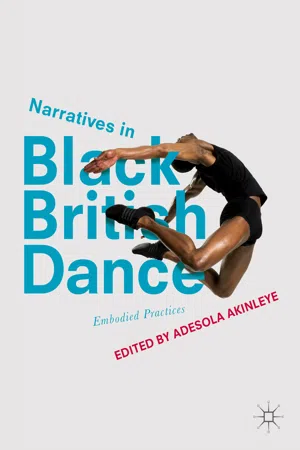
This book explores Black British dance from a number of previously-untold perspectives. Bringing together the voices of dance-artists, scholars, teachers and choreographers, it looks at a range of performing arts from dancehall to ballet, providing valuable insights into dance theory, performance, pedagogy, identity and culture. It challenges the presumption that Blackness, Britishness or dance are monolithic entities, instead arguing that all three are living networks created by rich histories, diverse faces and infinite future possibilities. Through a variety of critical and creative essays, this book suggests a widening of our conceptions of what British dance looks like, where it appears, and who is involved in its creation.
- English
- ePUB (mobile friendly)
- Available on iOS & Android
eBook - ePub
About this book
Information
Topic
Sciences socialesSubtopic
Danse© The Author(s) 2018
Adesola Akinleye (ed.)Narratives in Black British Dancehttps://doi.org/10.1007/978-3-319-70314-5_11. Narratives in Black British Dance: An Introduction
Adesola Akinleye1
(1)
Middlesex University, London, UK
…to live at the tense borders of the skin, to live in an uneasy truce of evolution and the molting of cultural identity into something unforeseen and new.
(Wilson in Hereniko & Wilson, 1999, p. 3)
End AbstractBritain’s colonial history has left a network of ‘Black’ family, particularly from Britain to the Caribbean, across Africa, and North America. While part of the legacy of colonialism exported Britain’s mainstream aesthetic of whiteness around the world, these Commonwealth connections also underwrite the day-to-day, on the ground, multicultural face of Great Britain. Sitting on a London bus, the passengers and people we pass on the streets testify to the complex range of backgrounds and values that form the British population. The dance field is no exception—although its mainstream face may appear to reflect a mono-cultural pre-war whiteness , British dance artists hail from the same colourful range of cultures over which the sun never set. These artists contribute to a dance scene that is often invisibilised or suffers by being constructed as in a continual state of early emergence. This gives a sense that those identifying with ‘Black’ dance and dancers are new to Britain, (just emerging ) rather than a contributing part across the expanse of British dance history. There is also a plethora of professional Black British dancers and choreographers who have influenced dance worldwide, ironically being identified as British outside Britain’s borders but being ‘othered ’ when they return home to her shores.
Therefore, despite a strong creative presence in the arts through a history of individual artists and companies identifying as ‘Black’ , there is a distinct lack of acknowledgement regarding dance and dancers with a relationship to the African Diaspora from the twenty-first century perspective of ‘being British’. To this end, this book presents narratives from across the UK and beyond with the aim of offering a (re)articulation of the physical and cultural mapping of the richness of British dance. In order to present the narratives in the chapters that follow, this introductory chapter discusses and challenges some of the contexts for talking about the dancing body to expose them as having concealed or drowned out Black, British dance stories in the past. I suggest that the context of blackness as ‘otherness’ contributes to this along with the context of what kinds of dance styles are valuable, particularly the notion of a divide in value between ‘cultural’ dance and ‘high -art’. I consider how we talk about dance in the West and suggest that some non-Western concepts for understanding what dance is are lost because of a lack of interest or knowledge of them in the language of Western mainstream media. I draw attention to the context of the historical legacy of abuse to the Black body and the effects that this has on how Black dancers are audienced . I draw attention to the many contexts created by dualism’s separation of mind from body and how this is contrary to many non-Western dance forms. This introduction therefore suggests that by starting to theorise the contexts that have invisibilised some dance artists we can start to create more fertile ground from which to hear them and in turn have a richer dance community in general. This book attempts to refresh contexts for future discussion of the work of dance artists through broadening the narratives heard about Black and British dancing bodies.
Challenging the Context of the ‘Other’
In the context of the post-colonial globe, living in London of Nigerian and English descent, I have been privy to the distinct experience gained from being ‘black’ living outside of the ‘Mother land’ of Africa. This experience is given a particular focus for those who identify as black yet come from a Western country—to be African -American or to be Black British. To be a part of the collective consciousness of where you live and yet experience it from the side-lines of being the ‘other ’: not British but ‘Black British’. Growing up my very existence as black and living in London seemed to contribute to my non-‘black’ neighbours confirming their own British-ness. In Chap. 7 Thea Barnes describes how for the artists in Kokuma Dance Company, dance became a safe haven to shelter from the daily experiences of being the black ‘other’ in their own local communities.
It is of course an interesting phenomenon to meet people whose role in a culture appears to be the ‘other’ within it. To this end, there is a mainstream interest in engaging with black artists in terms of how they can define their own otherness —what is ‘Black Dance’? What is ‘Black British-ness’? However, this interest in what it is like to be outside comes only from the perspective of those who consider themselves inside. In addressing the question, for instance of ‘What is Black British dance?’ there is an implication that there is something distinctly specific and universally describable about being ‘black’ . ‘What is Black British dance?’ implies that I could subtract the black from my experience of Britishness and of Dance and have a concept of what was left. The question infers that there will be something that I could recognise as ‘not black’ and be able to compare that to my ‘blackness’.
When I was eight, a classmate asked me ‘What is it like to be black?’ I said ‘I don’t know I have never been not-black’. It is equally difficult to answer questions such as ‘How have you addressed your whiteness in the choreography?’ But such questions are rarely asked of artists. Similarly, I have not met a white dancer who has been asked to define what white British dance was and how their work contributed to it? But I have met many black dancers who have been asked ‘What is Black British dance and how does your work contribute to it?’ Such questions require artists to be willing to accept themselves as ‘other’ in terms of their own work. These questions imply the possibility that we can be the ‘other’ in our own narratives, and can explain how that otherness manifests. To respond to such questions is to suffer the burden of justifying oneself within someone else’s story: it denies the artists the liberty of telling their own stories about their work.
I am not suggesting that artists identifying as Black have been complacently silent or not attempted to articulate their own narratives on their own terms. Rather, I am suggesting that this is a problem for the field of dance in general. The context within which we consider dance is often constrained by a lack of challenge to mainstream Western values for what dance is, how it manifests, and the processes that lead to dance. Dance’s problem of marginalising people who identify outside its mainstream (and therefore losing the full potential of their contribution to the art form) extends beyond the marginalisation of black dancers and choreographers. However, in the case of artists identifying or identified as Black it has meant that before many can talk about their dance work, they are tasked with proving it is ‘dance’ at all, worth the full prestige of the dance industry listening in the first place. To this end, in Chap. 4 Tia-Monique Uzor considers the projections of otherness on to ‘brown bodies’ as they create work within the British dance industry today. The question ‘What is Black British dance?’ is about defining a kind of dance as much as it is about defining a kind of Blackness —both are limiting. It is clear that the notion of dance from the full spectrum of the British experience consists of a number of un-listened stories, many of which converge in the territory of Blackness, Britishness, and Dance.
Challenging the Context in Which Dance Is Given Value
A challenge of globalisation in the twenty-first century is how we engage with the spectrums we have created for identifying ourselves, others, and the world around. This challenge begins with us looking at the ontological context into which each other’s narratives are received (Appiah, 1991; Smith, 1999). The constructs we have for the truth of our dancing bodies lead to frameworks for understanding the world. Dance technique training is often guilty of expecting students (and audiences ) to have a tacit acceptance of a specific philosophical construct for dance, implicitly inherited from the teacher demonstrating the movement . Students are not only taught to strive to look like the teacher demonstrating but are expected to think like them in order to attain that same aesthetic. Across many codified dance forms, this leaves a lack of encouragement for critical thinking or philosophical inquiry into what da...
Table of contents
- Cover
- Front Matter
- 1. Narratives in Black British Dance: An Introduction
- Part I
- Part II
- Part III
- Back Matter
Trusted by 375,005 students
Access to over 1.5 million titles for a fair monthly price.
Study more efficiently using our study tools.
Frequently asked questions
Yes, you can cancel anytime from the Subscription tab in your account settings on the Perlego website. Your subscription will stay active until the end of your current billing period. Learn how to cancel your subscription
No, books cannot be downloaded as external files, such as PDFs, for use outside of Perlego. However, you can download books within the Perlego app for offline reading on mobile or tablet. Learn how to download books offline
Perlego offers two plans: Essential and Complete
- Essential is ideal for learners and professionals who enjoy exploring a wide range of subjects. Access the Essential Library with 800,000+ trusted titles and best-sellers across business, personal growth, and the humanities. Includes unlimited reading time and Standard Read Aloud voice.
- Complete: Perfect for advanced learners and researchers needing full, unrestricted access. Unlock 1.5M+ books across hundreds of subjects, including academic and specialized titles. The Complete Plan also includes advanced features like Premium Read Aloud and Research Assistant.
We are an online textbook subscription service, where you can get access to an entire online library for less than the price of a single book per month. With over 1.5 million books across 990+ topics, we’ve got you covered! Learn about our mission
Look out for the read-aloud symbol on your next book to see if you can listen to it. The read-aloud tool reads text aloud for you, highlighting the text as it is being read. You can pause it, speed it up and slow it down. Learn more about Read Aloud
Yes! You can use the Perlego app on both iOS and Android devices to read anytime, anywhere — even offline. Perfect for commutes or when you’re on the go.
Please note we cannot support devices running on iOS 13 and Android 7 or earlier. Learn more about using the app
Please note we cannot support devices running on iOS 13 and Android 7 or earlier. Learn more about using the app
Yes, you can access Narratives in Black British Dance by Adesola Akinleye in PDF and/or ePUB format, as well as other popular books in Sciences sociales & Danse. We have over 1.5 million books available in our catalogue for you to explore.