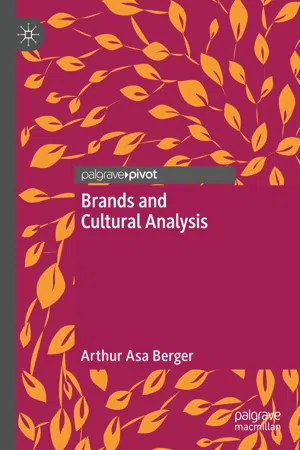
This book, written in an accessible style with numerous illustrations and with drawings by the author, discusses what brands are and the role brands play in American society and consumer cultures, in general. The book uses a cultural studies approach and draws upon concepts and theories from semiotics, psychoanalytic theory, sociological theory, discourse theory, and other related fields. It also quotes from a number of important thinkers whose ideas offer insights into various aspects of brands. Brands has chapters on topics such as what brands are, their role in society, brands and the psyche, brands and history, language and brands, the marketing of brands, brands and logos, the branded self, San Francisco and Japan as brands, brand sacrality, multi-modal discourse analysis and brands, and competition among brands.
- English
- ePUB (mobile friendly)
- Available on iOS & Android
eBook - ePub
Brands and Cultural Analysis
About this book
Information
© The Author(s) 2019
A. A. BergerBrands and Cultural Analysishttps://doi.org/10.1007/978-3-030-24709-6_11. Introduction: Thinking About Brands
Arthur Asa Berger1
(1)
Department of Broadcast and Electronic Communication Arts, San Francisco State University, San Francisco, CA, USA
Arthur Asa Berger
A Bloomberg analysis of the top 20 spots of the Billboard Hot 100 over the past three years found that the most popular brand name dropped was—somewhat unexpectedly—Rolls-Royce, which was mentioned in 11 songs. Eight of the top 12 brands are vehicles; the other four are Hennessy cognac, Nike’s Air Jordan sneakers, Rolex watches, and Xanax. I really hope Xanax never makes a car. [Bloomberg]
Significant Digits, August 22, 2017
Psychology professor Jean Twenge studies differences between generations. A few years ago, she started to notice dramatic shifts in the behavior and attitudes of teens in the yearly surveys that she analyzes for her research. These teens were more lonely, more depressed, and more socially awkward than their predecessors. Because their childhoods coincided with the rise of the smartphone, Twenge calls this generation iGen—and her new book is the first to analyze the impact of the smartphone on an entire generation of kids.
The Conversation, August 22, 2017
Brands are taking back control. The trend we have all been suspecting is going on, through our own daily experiences, is gathering weight across adland. The latest figures from the WFA show that a majority of the world’s biggest brands, some 70%, have changed media agencies in a bid to regain control of their spending. OK—so we’re only talking about 35 global brands here, because the bar is set high on advertising across the planet, but between them these brands account for a $30bn ad spend each year. So that is a lot of budget being moved to new agencies.
Sean Hargrave, Media Post, August 21, 2017
Abstract
This chapter considers topics such as the ubiquity of brands, the cultural studies nature of this book, the importance of logos and brands in consumer cultures, and the amount of advertising, for brands, to which we are subjected. It argues that because brands play such a large role in our lives, we don’t pay much attention to them—except, of course, when we decide to buy something.
Keywords
BrandsCultural studiesConsumer culturesAdvertisingI’ve been thinking about brands for many years and writing about them, in articles and chapters in books as well, but the idea of writing an entire book on brands only came to me recently. When I asked a friend of mine who is a well-known futurist and who lectures widely how he got so many invitations to lecture, he said, “Because I’m a brand.” Just recently, in the New York Times, there was an article about grade school teachers as “brands.” So people are brands, like almost everything else.
On the Ubiquity of Brands
And then it occurred to me that just about everything I own and have purchased, except for fruits and vegetables and certain foods I buy in bins in grocery stores and supermarkets, is branded. And since almost all national brands are advertised on television, then all the commercials we see are about brands. In supermarkets, there are nationally branded products, which are heavily advertised, and generic store brands, which are generally much less expensive and, if Consumer Reports is correct, generally as good. Brands, then, have a cost.
So I decided to write a book about brands. I’d written a book on advertising, Ads, Fads and Consumer Culture, a book on shopping, Shop ‘Til You Drop, and two books on marketing, Marketing and American Consumer Culture and A Dictionary of Advertising and Marketing Concepts. Given my background and interests, a book on brands made sense to me, as part of my continuing investigation of American consumer culture.
A No-Brand or Brandless Brand
An article in the October 2017 issue of San Francisco magazine has an article about “The Brand That Hated Branding.” It discusses a new company,
Brandless achieves its economies by making its supply chain more efficient and by avoiding traditional marketing. It has its products move directly to the Brandless distribution centers in Indiana and California. It has 165 products. Whether it will succeed is hard to say.Brandless, which sells a pared-down line of high-quality household staples, from organic peanut butter and fair-trade coffee pods to premium face cream and porcelain rimmed dishware, that each cost no more than $3.
The article also compares some Brandless products with the same products at Whole Foods and found that in some cases, products at Whole Foods were less expensive than Brandless ones and with other products, much more expensive than Brandless. I would describe Brandless as an Internet Dollar Store on steroids, with products that are often more expensive than branded products. Brandless may not put a brand label on its products, but Brandless is, in the final analysis, also a brand. It is what we might call an “unbranded” brand.
I have made use of information from many sources in writing this book, which can be seen as a kind of literary documentary full of quotes from experts on brands, and an analysis of brands and their role in our lives and in society.
A Semiotic and Cultural Studies Perspective on Brands
Let me offer a quotation from the International Journal of Marketing Semiotics that offers a semiotic overview of brands and marketing.
My subtitle, “And Cultural Analysis,” refers to my methods of analysis. This book can be considered a cultural studies text. That is, it uses many different disciplines, such as semiotics, psychoanalytic theory, and sociological theory, in trying to understand what brands are and their role in our lives and in consumer cultures in America and also in other advanced countries. Bishop Berkeley, the philosopher, said: “To be is to be perceived.” To this I would add, the brands we use help determine how we are perceived. We use brands both to help shape how we are perceived by others and to develop our sense of self. And branding is also used by tourist destinations, cities, countries, corporations, political parties, and so on. This book will explore many of these areas.By virtue of semiotics’ ability to account for the processes whereby meaning is generated, it constitutes the discipline par excellence for addressing the issue of brand signification. Semiotic approaches to branding have been furnished both from within the semiotics…and the consumer research…Semiotic approaches have been incumbent on different perspectives in the semiotic literature, such as Peirceanism, Structuralism, Social Semiotics. Semiotics have been applied in various marketing related research areas, including strategic brand positioning, brand identity, brand equity and brand image, advertising copy development, advertising encoding and decoding, retail branding, media messages, package design, to name a few. The usefulness of semiotics consists both in furnishing typologies of brands as signs, as well as a conceptual and methodological platform for designing and managing brands as sign systems. As an applied market research tool, semiotics have been used either as a standalone research method or in combination with other qualitative and quantitative research techniques.
On the Importance of Logos and Brands
What I didn’t realize when I decided to write on brands was how important they are to the corporations that own brands, to our everyday lives, to our society, and to our economy. Like many people, I thought all those logos and their taglines were trivial concerns, but as I investigated the matter, I found that logos, brands, trademarks, and everything connected with branding are of central importance to understanding our social and political order. As Naomi Klein writes in her book No Logo (2002: 7):
In a sense, brands are the doorways through which corporations and corporate capitalism enter our households and ultimately take control of things. The average four-year-old can identify 100 brands, according to Paco Underhill in his book Why We Buy. And all the advertising to which we are subjected, if you think about it, is about brands of products. If we watch four hours of television a day, which is the average for American households, we are subjected to about an hour of commercial messages about brands. Over the years this adds up to thousands and thousands of television commercials, plus countless other advertisements for brands in newspapers, magazines, and on our smartphones...By the end of the 1940s, there was a burgeoning awareness that a brand wasn’t just a mascot or a catchphrase or a picture printed on the label of a company’s product; the company as a whole could have a brand identity or a “corporate consciousness,” as this ephemeral quality was termed at the time. As this idea evolved, the adman ceased to see himself as a pitchman and instead saw himself as “the philosopher-king of commercial culture,” in the words of ad critic Randall Rothberg. The search for the true meaning of brands—or the “brand essence,” as it is often called—gradually took the agencies away from individual products and their attributes and toward a psychological/anthropological examination of what brands mean to the culture and to people’s lives. This was seen to be of crucial importance, since corporations may manufacture products, but what consumers buy are brands.
Table of contents
- Cover
- Front Matter
- Part I. Theoretical Considerations
- Part II. Applications
- Back Matter
Trusted by 375,005 students
Access to over 1.5 million titles for a fair monthly price.
Study more efficiently using our study tools.
Frequently asked questions
Yes, you can cancel anytime from the Subscription tab in your account settings on the Perlego website. Your subscription will stay active until the end of your current billing period. Learn how to cancel your subscription
No, books cannot be downloaded as external files, such as PDFs, for use outside of Perlego. However, you can download books within the Perlego app for offline reading on mobile or tablet. Learn how to download books offline
Perlego offers two plans: Essential and Complete
- Essential is ideal for learners and professionals who enjoy exploring a wide range of subjects. Access the Essential Library with 800,000+ trusted titles and best-sellers across business, personal growth, and the humanities. Includes unlimited reading time and Standard Read Aloud voice.
- Complete: Perfect for advanced learners and researchers needing full, unrestricted access. Unlock 1.5M+ books across hundreds of subjects, including academic and specialized titles. The Complete Plan also includes advanced features like Premium Read Aloud and Research Assistant.
We are an online textbook subscription service, where you can get access to an entire online library for less than the price of a single book per month. With over 1.5 million books across 990+ topics, we’ve got you covered! Learn about our mission
Look out for the read-aloud symbol on your next book to see if you can listen to it. The read-aloud tool reads text aloud for you, highlighting the text as it is being read. You can pause it, speed it up and slow it down. Learn more about Read Aloud
Yes! You can use the Perlego app on both iOS and Android devices to read anytime, anywhere — even offline. Perfect for commutes or when you’re on the go.
Please note we cannot support devices running on iOS 13 and Android 7 or earlier. Learn more about using the app
Please note we cannot support devices running on iOS 13 and Android 7 or earlier. Learn more about using the app
Yes, you can access Brands and Cultural Analysis by Arthur Asa Berger in PDF and/or ePUB format, as well as other popular books in Social Sciences & Marketing. We have over 1.5 million books available in our catalogue for you to explore.