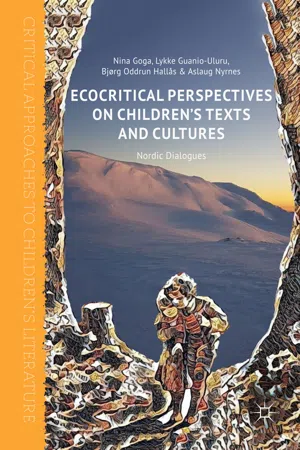
This volume presents key contributions to the study of ecocriticism in Nordic children's and YA literary and cultural texts, in dialogue with international classics. It investigates the extent to which texts for children and young adults reflect current environmental concerns. The chapters are grouped into five thematic areas: Ethics and Aesthetics, Landscape, Vegetal, Animal, and Human, and together they explore Nordic representations and a Nordic conception, or feeling, of nature. The textual analyses are complemented with the lived experiences of outdoor learning practices in preschools and schools captured through children's own statements. The volume highlights the growing influence of posthumanist theory and the continuing traces of anthropocentric concerns within contemporary children's literature and culture, and a non-dualistic understanding of nature-culture interaction is reflected in the conceptual tool of the volume: The Nature in Culture Matrix.
eBook - ePub
Ecocritical Perspectives on Children's Texts and Cultures
Nordic Dialogues
- English
- ePUB (mobile friendly)
- Available on iOS & Android
eBook - ePub
Ecocritical Perspectives on Children's Texts and Cultures
Nordic Dialogues
About this book
Information
© The Author(s) 2018
Nina Goga, Lykke Guanio-Uluru, Bjørg Oddrun Hallås and Aslaug Nyrnes (eds.)Ecocritical Perspectives on Children's Texts and CulturesCritical Approaches to Children's Literaturehttps://doi.org/10.1007/978-3-319-90497-9_11. Introduction
Nina Goga1 , Lykke Guanio-Uluru1 , Bjørg Oddrun Hallås1 and Aslaug Nyrnes1
(1)
Western Norway University of Applied Sciences, Bergen, Norway
Representations of nature in children’s texts and cultures tend to be filled with flowering gardens, exciting woods, fresh mountain air, vulnerable and courageous animals , plants and beings that are made of flesh and blood, wood, metal and different fabrics. Many have become iconic images and ideas of what an ideal or idyllic world should look like, or of how a threatening environment could be changed or restored. Nature , as presented to children and young adults (YAs) in literary texts, images, films, games, apps and in outdoor and educational activities, may influence the way young people understand and cope with the actual environmental challenges and concerns in their immediate surroundings (Massey and Bradford 2011).
The Nordic countries —Finland, Sweden, Denmark, Norway and Iceland—are often promoted as being particularly child friendly, and regarded as countries that are respectful of child rights. They are also blessed with large areas of spectacular and untouched nature . The Nordic cultural tradition of friluftsliv , defined as nature-based outdoor recreation, may help illuminate the idea of connectedness to nature as an essential part of culture (Beery 2013). Contact with nature is regarded as an educational ideal, and measures are taken to provide Nordic children with frequent nature experiences through the use of natural settings for both play and learning. Based on empirical findings from a Swedish outdoor perspective, there is reason to believe that encounters with nature have the potential to play a vital role in environmental education (Sandell and Öhman 2010). In addition, the Nordic model of welfare, sustainability and equality across gender and generations guides Nordic politicians as they strive to meet a number of Nordic solutions to global challenges, including how to reach the United Nations Sustainability Goals before the year 2030 (Nordic Co-operation 2017). In order for such Nordic solutions to gain global significance, one should ask: How is Nordic nature, or the Nordic conception or feeling of nature, similar to, or different from, that of other places around the world?
Nordic children’s and YA literature offers significant sites for research into Nordic nature and the Nordic conception or feeling of nature. Recent researchers (Slettan 2013; Ørjasæter 2013; Goga 2011) underline for instance the strong relation between the literary depictions (in both earlier and contemporary children’s texts) of the Norwegian child , and typical or highlighted aspects of Norwegian nature such as snow, mountains, fjords, forests and wild nature. Ørjasæter (2013, p. 48) claims that Norwegian wildlife metaphors have traces of Romanticism and that “the ability to live in harmony with the deep fjords, steep mountains, and large forests has been defined as the most significant Norwegian character trait”. It is not only the relation to nature that is seen as a character trait of the Norwegian child, who, as part of being Nordic, is often considered a competent child (Brembeck et al. 2004).
Children’s relation to nature should be regarded as part of this competence. That is, the Nordic competent child seems to have a special nature competence. Brembeck et al. (2004) have challenged, questioned and finally come to terms with the particular Nordic way of conceptualizing the competent child. They contend that the ‘competent child ’ concept is clearly influenced by Rousseau’s romantic view of the child, but could also “be conceived of as part of the Nordic rural tradition” (p. 15) where children took care of younger siblings and guarded animals in the woods during long days.
Representations of the nature competent Nordic child in literature have changed over the years, especially when it comes to gendered ways of positioning children in nature. Consonant with the classic template, boys are depicted as acting and developing in the wilderness , and girls are shown as reaching a state of harmony and belonging in the green worlds of gardens. Prominent Anglo-American classics that represent this template are Mark Twain’s The Adventures of Tom Sawyer (1876) and Frances H. Burnett’s The Secret Garden (1911). As Kerry Mallan ’s contribution to this volume demonstrates, contemporary children’s literature still tends to follow this template. The texts studied by Slettan (2013) and Ørjasæter (2013) demonstrate that this gendered understanding of nature is valid also in earlier Nordic children’s literature . However, the findings of Ahmed Khateeb, Aslaug Nyrnes , Nina Goga and Kirsti Pedersen Gurholt in this volume seem to highlight a new tendency in contemporary Nordic children’s literature where girls are wilderness explorers, while boys are hesitant and tend to prefer the safe gardens of home. Changes and differences like these make it relevant to bring Nordic children’s literature into the research fields of ecocriticism and environmental humanities and engage in dialogues with established theoretical perspectives.
The overarching question that guides this volume is: How is nature represented in children’s and YA texts and cultures with an emphasis on a Nordic corpus? The emphasis on a Nordic corpus helps to fill a gap in international children’s literature criticism and broaden an appreciation of Nordic children’s literature (most of the primary texts are available to an international audience through translations). In the present volume, children’s and YA literature is understood as digital and analogue literary texts that are primarily addressed to children and YAs, including picturebooks and graphic novels. The volume also includes research on story apps and media texts for children. In addition, the collection complements the textual analyses with the lived experiences of outdoor learning practices in preschools and schools captured through children’s own “voices”. The analyses presented here thus invite the reader to reflect on how the Nordic view of nature , as expressed in literary texts for children and YAs, is influenced by, and how it influences, a wider European, but also an international and global, conception of the relationship between humanity and nature .
In the following, we present the background and scope of this volume and a short survey of its ecocritical influences, emphasizing contributions to the study of children’s and YA literature . The survey is followed by a presentation of “The Nature in Culture Matrix ” (The NatCul Matrix ), a conceptual tool developed by the NaChiLit group, which we regard as one of our key contributions to the study of ecocriticism in children’s texts and cultures. Lastly, the introduction contains a chapter-by-chapter outline of the contents of the book.
Background and Scope
The present volume is motivated by the fact that “the ecological crisis is not only a crisis of the physical environment but also a crisis of the cultural and social environment” ...
Table of contents
- Cover
- Front Matter
- 1. Introduction
- Part I. Ethics and Aesthetics
- Part II. Landscape
- Part III. Vegetal
- Part IV. Animal
- Part V. Human
- Back Matter
Trusted by 375,005 students
Access to over 1.5 million titles for a fair monthly price.
Study more efficiently using our study tools.
Frequently asked questions
Yes, you can cancel anytime from the Subscription tab in your account settings on the Perlego website. Your subscription will stay active until the end of your current billing period. Learn how to cancel your subscription
No, books cannot be downloaded as external files, such as PDFs, for use outside of Perlego. However, you can download books within the Perlego app for offline reading on mobile or tablet. Learn how to download books offline
Perlego offers two plans: Essential and Complete
- Essential is ideal for learners and professionals who enjoy exploring a wide range of subjects. Access the Essential Library with 800,000+ trusted titles and best-sellers across business, personal growth, and the humanities. Includes unlimited reading time and Standard Read Aloud voice.
- Complete: Perfect for advanced learners and researchers needing full, unrestricted access. Unlock 1.5M+ books across hundreds of subjects, including academic and specialized titles. The Complete Plan also includes advanced features like Premium Read Aloud and Research Assistant.
We are an online textbook subscription service, where you can get access to an entire online library for less than the price of a single book per month. With over 1.5 million books across 990+ topics, we’ve got you covered! Learn about our mission
Look out for the read-aloud symbol on your next book to see if you can listen to it. The read-aloud tool reads text aloud for you, highlighting the text as it is being read. You can pause it, speed it up and slow it down. Learn more about Read Aloud
Yes! You can use the Perlego app on both iOS and Android devices to read anytime, anywhere — even offline. Perfect for commutes or when you’re on the go.
Please note we cannot support devices running on iOS 13 and Android 7 or earlier. Learn more about using the app
Please note we cannot support devices running on iOS 13 and Android 7 or earlier. Learn more about using the app
Yes, you can access Ecocritical Perspectives on Children's Texts and Cultures by Nina Goga, Lykke Guanio-Uluru, Bjørg Oddrun Hallås, Aslaug Nyrnes, Nina Goga,Lykke Guanio-Uluru,Bjørg Oddrun Hallås,Aslaug Nyrnes in PDF and/or ePUB format, as well as other popular books in Literature & Literary Criticism. We have over 1.5 million books available in our catalogue for you to explore.