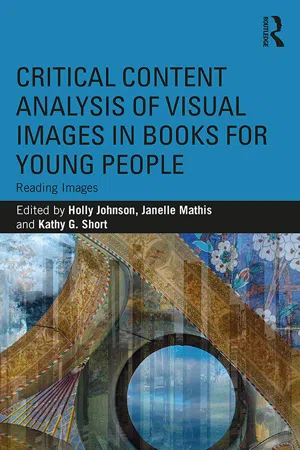
Extending the discussion of critical content analysis to the visual realm of picturebooks and graphic novels, this book provides a clear research methodology for understanding and analyzing visual imagery. Offering strategies for "reading" illustrations in global and multicultural literature, chapter authors explore and bring together critical theory and social semiotics while demonstrating how visual analysis can be used to uncover and analyze power, ideologies, inequity, and resistance in picturebooks and graphic novels. This volume covers a diverse range of texts and types of books and offers tools and procedures for interpreting visual images to enhance the understandings of researchers, teachers, and students as they engage with the visual culture that fills our world. These methods are significant not only to becoming a critical reader of literature but to also becoming a critical reader of visual images in everyday life.
eBook - ePub
Critical Content Analysis of Visual Images in Books for Young People
Reading Images
- 288 pages
- English
- ePUB (mobile friendly)
- Available on iOS & Android
eBook - ePub
Critical Content Analysis of Visual Images in Books for Young People
Reading Images
About this book
Information
PART I
Research Methodology and Analytical Tools
1
CRITICAL CONTENT ANALYSIS OF VISUAL IMAGES
As a community, we are excited about the potential of critical content analysis as a means of bringing a critical lens to our work as researchers and educators, defining critical as a stance of locating power in social practices to challenge conditions of inequity. Our initial efforts to identify useful procedures focused primarily on the analysis of written language in global and multicultural literature (Johnson, Mathis, & Short, 2016). We recognized, however, that we needed other analytical tools to effectively use critical content analysis to examine the visual images that are so integral to meaning-making in books for young people.
This chapter provides a description of critical content analysis as a research methodology that includes tools for examining visual images, specifically the illustrations in picturebooks and graphic novels. Throughout the book, researchers share studies in which they used various visual tools within a theoretical lens to engage in critical content analysis of a particular text(s). By sharing a range of research studies to show the different ways in which this methodology can play out, the flexibility of critical content analysis becomes apparent as does the usefulness of the analytical tools. The final chapter highlights the ways in which we are taking this work into our own teaching and our interactions around literature with teachers and young people.
Our Inquiry into Critical Content Analysis
Our understandings of critical content analysis began several years ago and grew out of inquiring as a community about the processes and procedures because we wanted to use this methodology in our research. We talked with literary critics who engage in critical content analysis such as Clare Bradford, and read literary critics such as John Stephens, Perry Nodelman, and Mavis Reimer. We also read critical content analyses by educators who focus on representational issues, power relations, and language as a postcolonial tool, particularly seminal studies by Rudine Sims Bishop (1982) and Joel Taxel (1986), along with research by Vivian Yenika Agbaw, Wanda M. Brooks, Carmen Medina, Maria Botelho, and Masha Rudman. We revisited content analysis within the field of communication to understand the history of this methodology and engaged in our own research. In addition, we met as a group over several years, discussing published critical content analysis studies, and developing descriptions of the methodology from our readings and research studies. We proposed sessions and a study group on critical content analysis at the Literacy Research Association’s annual conference to engage in conversations with other researchers. This inquiry was pulled together by writing a book about the methodology to share our understandings of the procedures we found most useful with each of us writing a chapter to share our research (Johnson, Mathis, & Short, 2016).
No inquiry is ever final, however, as new questions always emerge, so we soon found ourselves struggling with how to more effectively analyze the meaning-making processes within the visual images of illustrations in books. We read about illustration and visual image, examined published studies of illustrations and books on visual methodologies, and talked with other researchers in our search for analytical tools to examine visual images within a critical frame.
Connections between Content Analysis and Critical Content Analysis
Content analysis is an umbrella term used to indicate different research methods for analyzing texts and describing and interpreting the written artifacts of a society (White & Marsh, 2006). The content of texts is interpreted through coding and identifying themes or patterns, with the actual approaches ranging from impressionistic, intuitive, and interpretive analyses to systematic quantitative textual analyses (Hseih & Shannon, 2005). Since content analysis involves making inferences from texts to the contexts of their use by using analytical constructs derived from theories or research, researchers adapt content analysis to their research questions and develop a range of techniques and approaches for analyzing text (Krippendorff, 2003).
Content analysis has a long history but is particularly associated with communication studies and includes both quantitative and qualitative approaches. Quantitative approaches are used in fields concerned with mass communications (Neuendorf, 2002), while qualitative content analysis covers methods such as discourse analysis, social constructivist analysis, rhetorical analysis, and textual analysis. Krippendorff (2003) sees content analysis as a “research technique for making replicable and valid inferences from the texts to the contexts of their uses” (p. 18), while Hsieh and Shannon (2005) argue that this approach reflects a focus on “the characteristics of language with attention to the content or contextual meaning of the text” (p. 1278).
Content analyses of children’s books were initially quantitative, counting the presence and images of a specific cultural group or phenomena (Galda, Ash, & Cullinan, 2000). Current research is qualitative, with researchers taking a theoretical position that frames the development of research criteria for text analysis based on an understanding of texts and readings of these texts in the social, cultural, and political contexts in which they are considered (Short, 1995).
Content analysis reflects a hermeneutic, reader-response oriented research stance. Meaning is not in the text but in the reading event, which is a transaction between a researcher and a text (Rosenblatt, 1938). Texts thus have multiple meanings that are dependent on the researcher’s intentions as a reader and the context of the study because the purpose for the reading influences the meanings that are constructed as research findings. Analysts read to draw inferences from texts to apply to the context of the study, thus to make sense of something outside of the text. The texts do not speak for themselves but are read to inform another context.
Since content analysis is a stance, one option for researchers is to take a critical stance. What makes a study “critical” is the theoretical framework used to think within, through, and beyond the text, and so involves a specific critical theory such as postcolonialism, critical race theory, or queer studies. Adding the word “critical” in front of content analysis signals a political stance by the researcher, particularly in searching for and using research tools to examine inequities or resistance to inequities from multiple perspectives. Researchers who adopt a critical stance focus on locating power in social practices by understanding, uncovering, and transforming conditions of inequity embedded in society (Rogers, 2004). This critical consciousness challenges assumptions within thought and in the world that privilege some and oppress others (Willis, Montavon, Hall, Hunter, Burke, & Herrrera, 2008).
Critical content analysis differs from content analysis by prioritizing a critical lens as the frame for the entire study, not just in discussing the findings or citing scholarship in a literature review. In critical content analysis, the researcher uses a specific critical lens as the frame from which to develop the research questions, select texts, analyze the data, and reflect on findings. Since the researcher takes a political stance based in issues of inequity and power, some researchers believe that this positioning is subjective and unduly influences the research. Freire (1970) points out that all research is political and is always conducted within the subjective stance of a researcher. Critical content analysis makes the researcher’s stance explicit and public to readers of that research.
Freire (1970) states that the world and texts are socially constructed and read through perspectives that differ from one reader to another. Each person conditions or transacts with a specific text in unique ways based on their lived experiences, value systems, and cultural understandings (Rosenblatt, 1938). Texts are never neutral as readers can revise, rewrite, and reconstruct texts to shift and reframe meaning. Texts are also written from a specific perspective to convey certain understandings of the world by positioning readers toward certain meanings through the language and visual images of the text and the use of narrative strategies. Because of this positioning of text and reader, the perspectives of each should be questioned. The concept of critical therefore requires a questioning stance when reading the word and the world (Freire & Macedo, 1987).
A critical stance focuses on social issues and the ways language and images are used to shape representations of others in relation to the intended audience. Language and visual image can impact readers’ perceptions of specific groups of people and influence the power that people within those groups may or may not have within a society. A critical stance questions the concept of “truth” and how it is presented, by whom, and for what purposes, along with whose values, texts, and ideologies are privileged or considered normative. A critical stance thus focuses on voice and who gets to speak or be seen, whose story is told, and in what ways. Groups marginalized due to gender, language, race/ethnicity, sexual orientation—anyone labeled as “different” by mainstream society—are often the focus of a critical lens (Luke, 2012).
Freire (1970) argues that a critical lens involves:
- Critique (questioning what is and who benefits).
- Hope (asking what if and considering new possibilities).
- Action (taking action for social justice).
A critical lens thus moves from deconstruction to reconstruction and then to action. Freire points out that in everyday life many people stop at critique (deconstruction), which often paralyzes them with guilt or overwhelms them with the enormity of societal problems, unsure how to take action. In critical content analysis, the focus is on critique, on a critical examination of stereotyping and misrepresentation in literature, a deconstruction of books and the societal issues reflected in representations of marginalized groups. Freire makes it clear that we should also engage in reconstruction to look for the ways texts can position characters as resistant to existing stereotypes and representations. These counter-narratives offer new possibilities for how to position ourselves and others in the world. Based on critique and hope, researchers act by publishing for a broader audience and engaging with teachers and students in their own critical analyses and use of these texts.
Analysis of Visual Images
In this book, we focus on the critical content analysis of visual images in picturebooks and graphic novels, formats in which both words and illustrations are essential for readers to create meaning. The visual images do not just enhance a story told in language or provide some additional information, they are integral to the reader’s experience and understanding of a book. Graphic novels add an additional visual element through the use of frames in addition to words and visual images.
Books with strong visual images hold special appeal and meaning because children are immersed in a visual culture in which images are integral to their experiences and interactions. A visual culture is one in which images are central to how meaning is created in the world. Duncam (2002) argues that more than any time in history, “we are living our everyday lives through visual imagery” (p. 15). This visual way of life influences what children know and how they think and feel about the world.
Visual image is no longer limited to a specialized form of expression in an art class, museum, or picturebook, but is instead an essential form of daily communication reflecting multiple ways of knowing. Duncam (2002) notes that this visual culture offers new freedom of expression and a willingness to play at signification, but can also be self-referential and depthless with an emphasis on immediate, short, intense sensations. This shift in visual culture has increased the significance and influence of picturebooks and graphic novels in the lives of youth of all ages and led to more extensive integration of visual images into middle grade novels and more focus on book design.
Our search for strategies for analyzing visual images began with Molly Bang (1991/2016) and Perry Nodelman (1988), whose work is grounded in art theory. Bang’s work provided an easy entrée into basic art principles related to the composition of images and how the elements of art can provide the power to tell a story, particularly in the use of color, line, shape, and space. Nodelman’s pioneering study of the narrative form of picturebooks deepened our understandings of the interplay of word and image to create a rhythm in which words and images “define and amplify each other” (p. viii). He focuses on how illustrations engage with words to tell stories. Pulling from art theory and semiotics, Nodelman particularly draws from Arnheim (1974) and Moebius (1986) to discuss how the visual choices of style and codes, along with the communicative elements of visual images, such as color, texture, shape,...
Table of contents
- Cover
- Half Title
- Title Page
- Copyright Page
- Table of Contents
- PART I: Research Methodology and Analytical Tools
- PART II: Visual Images in Counter-Narratives
- PART III: Visual Images and Positioning
- PART IV: Visual Images and Ideologies
- PART V: Final Reflections
- Contributors
- Index
Trusted by 375,005 students
Access to over 1.5 million titles for a fair monthly price.
Study more efficiently using our study tools.
Frequently asked questions
Yes, you can cancel anytime from the Subscription tab in your account settings on the Perlego website. Your subscription will stay active until the end of your current billing period. Learn how to cancel your subscription
No, books cannot be downloaded as external files, such as PDFs, for use outside of Perlego. However, you can download books within the Perlego app for offline reading on mobile or tablet. Learn how to download books offline
Perlego offers two plans: Essential and Complete
- Essential is ideal for learners and professionals who enjoy exploring a wide range of subjects. Access the Essential Library with 800,000+ trusted titles and best-sellers across business, personal growth, and the humanities. Includes unlimited reading time and Standard Read Aloud voice.
- Complete: Perfect for advanced learners and researchers needing full, unrestricted access. Unlock 1.5M+ books across hundreds of subjects, including academic and specialized titles. The Complete Plan also includes advanced features like Premium Read Aloud and Research Assistant.
We are an online textbook subscription service, where you can get access to an entire online library for less than the price of a single book per month. With over 1.5 million books across 990+ topics, we’ve got you covered! Learn about our mission
Look out for the read-aloud symbol on your next book to see if you can listen to it. The read-aloud tool reads text aloud for you, highlighting the text as it is being read. You can pause it, speed it up and slow it down. Learn more about Read Aloud
Yes! You can use the Perlego app on both iOS and Android devices to read anytime, anywhere — even offline. Perfect for commutes or when you’re on the go.
Please note we cannot support devices running on iOS 13 and Android 7 or earlier. Learn more about using the app
Please note we cannot support devices running on iOS 13 and Android 7 or earlier. Learn more about using the app
Yes, you can access Critical Content Analysis of Visual Images in Books for Young People by Holly Johnson, Janelle Mathis, Kathy Short, Holly Johnson,Janelle Mathis,Kathy Short,Kathy G. Short, Holly Johnson, Janelle Mathis, Kathy G. Short in PDF and/or ePUB format, as well as other popular books in Literature & Literary Biographies. We have over 1.5 million books available in our catalogue for you to explore.