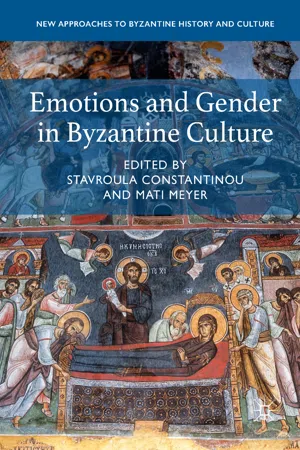
This book examines the gendered dimensions of emotions and the emotional aspects of gender within Byzantine culture and suggests possible readings of such instances. In so doing, the volume celebrates the current breadth of Byzantine gender studies while at the same time contributing to the emerging field of Byzantine emotion studies. It offers the reader an array of perspectives encompassing various sources and media, including historiography, hagiography, theological writings, epistolography, erotic literature, art objects, and illuminated manuscripts. The ten chapters cover a time span ranging from the early to the late Byzantine periods. This diversity is secured by an expanded and enriched exploration of the collection's unifying theme of gendered emotions. The scope and breadth of the chapters also reflect the ways in which Byzantine gender and emotion have been studied thus far, while at the same time offering novel approaches that challenge established opinions in Byzantinestudies.
eBook - ePub
Emotions and Gender in Byzantine Culture
- English
- ePUB (mobile friendly)
- Available on iOS & Android
eBook - ePub
Emotions and Gender in Byzantine Culture
About this book
Information
© The Author(s) 2019
Stavroula Constantinou and Mati Meyer (eds.)Emotions and Gender in Byzantine CultureNew Approaches to Byzantine History and Culturehttps://doi.org/10.1007/978-3-319-96038-8_11. Towards an Approach to Gendered Emotions in Byzantine Culture: An Introduction
Mati Meyer1
(1)
The Open University of Israel, Ra’anana, Israel
Mati Meyer
The US presidential elections for 2016 will be remembered not only for the widely unexpected outcome, but also for the gendered emotional distinctiveness each candidate brought to the presidential race. Donald Trump will be recalled for his roaring voice, his often angry facial traits, and energetic body language , bespeaking anger but also strength and manliness . 1 Hillary Clinton’s most unforgettable moment will probably turn out to be the emotional address and apology, aka soft and feminine, in the concession speech after losing the presidential seat, ‘I’m sorry that we did not win this election…’, 2 which points to issues of gender bias and sexism. This observation chimes in with the prevailing emotional stereotype, that is, ‘she is emotional, he is not’. 3 Indeed, emotional gender paradigms are and have always been part of human behaviour and culture; what he or she is supposed to feel is based on cultural beliefs and values in respect to masculinity and femininity . 4 Furthermore, both candidates’ repetitive exposure in the media and their various affects , emotions , and moods have drawn attention to the ways in which gender , among other factors, shapes emotions and vice versa: how emotions are shaped through gender.
Similar general processes of gendered constructs of emotions also inform the medieval world and its history. 5 This multi-authored volume represents a first attempt to bring together various disciplines (philology, literary studies, political and cultural history, and history of art) to examine gendered emotions in Byzantine culture , 6 and is designed to significantly contribute to relevant ongoing discussions in Medieval Studies. It will be a corrective to the current lacuna of research, where only a handful of studies acknowledge the strong interconnection between gender and emotion. This research gap is reflected in the online database ‘Bibliography on Gender in Byzantium’, where a search for the term ‘emotion’ yields but two results, with only one of them concerning specifically Byzantine culture. 7 Indeed, Byzantine gendered emotions are practically not charted, neither problematised nor for that matter theorised. The current state of Byzantine research is thus perplexing in view of the rich and varied scholarship on the subject, particularly in connection with the Western Middle Ages, that has been generated over the past twenty years.
Byzantine culture , in particular, offers extremely rich material on gendered emotions, which necessitates a thorough investigation. As far as Byzantine literature is concerned, there are genres in which certain emotions are exclusively gendered either male or female . In martyr legends (sixth to fifteenth century), for example, anger is the feeling that defines the male pagan torturer whose horrific violence imposed upon the martyr proves ineffective. 8 Anger is also the emotion that describes the warrior in such epics as Digenis Akritis (twelfth century) and the War of Troy (thirteenth century). 9 In the latter work, men are mostly defined through anger, whereas women are subject to grief . 10 Shame (aidos) , on the other hand, appears mostly as a female emotion in historiographical works, such as the Alexiad of Anna Komnene (twelfth century; Alex. 12.3.2–12.3.4; 15.9.1), 11 a work in which the emotions of its female author are prominent. 12 Moreover, men are generally identified as fearless, proud, and brave, whereas women are associated with excessive expressions of grief , unbridled joy , and merriment .
Furthermore, in texts where certain emotions are shared by both male and female characters, their manifestations are often gender-specific. A case in point is grief . The ‘womanish manner’ of performing sorrow includes loud lamentation , the tearing out of hair , the disfigurement of cheeks, and the throwing of ashes on the head (Life of Macrina , §10.6–10; Life of Mary the Younger , §4). 13 The sorrow of Gregory of Nyssa (335–c. 394) over the death of his sister Macrina, in contrast, is not expressed in gestures and bodily reactions, but is experienced intellectually. He criticises Macrina’s nuns, who burst into loud lamentations thus revealing a feminine and, accordingly, a weak character (Life of Macrina , §26–27).Yet, one can encounter instances of emotional gender shifts. Suffice it to mention an author of the fifth century, Synesios of Cyrene, who in a letter addressed to his friend Herkulianos constructs his own identity in feminine terms: ‘While wanting to make virile your holy soul […], I myself became more feminine’. 14 Synesios uses gender transformation to express his pleasure at the charms of the Homeric sirens and to flatter his friend. 15
Likewise, Byzantine art harbours a plethora of images presenting manifold emotional expressions by both male and female figures. In Christological scenes associated with the Passion of Christ and his death, which decorate many churches, particularly from the twelfth century onwards, the emotive value of Christian history is usually displayed through female figures sketching dramatic and even violent gestures of grief and by emphatic and exaggerated facial expressions . However, most of the images that can yield insights into emotional expressions regarding gender in Byzantine art can be found earlier in the monumental media of mosaic and wall paintings, and most particularly in the ‘unofficial’ art of small objects and illuminated manuscripts. 16 In spite of what may appear at first glance as near immobility and placid facial expressions of the figures and the fact that gestures are not dramatic, images can still reveal inner emotional states. Evocative of emotional gender distinctiveness are the Schechemites, whose facial expressions and bodily gestures convey the mental agony and physical pain they experienced during the forced circumcision they underwent at the hands of one of Jacob’s sons. 17
Another example is the figure of Auge being sexually coerced by Herakles as carved on the tenth-century Darmstadt ivory box; her emotional reluctance to accept the act is expressed through her particular bodily pose: she turns away from him. 18 One can also find signs in art of emotions shared by both sexes. The gender blending of emotions is visualised, for example, in the representations of female and male martyrs experiencing the excruciating pain of their tortures, which may be visibly inscribed on their faces, articulated through the recurring motif of the inverted “V” eyebrows, as seen in the portrayals of Anastasia the Younger and some of the male companions of Saint Varos. 19 Moreover, the gentle cheek-to-cheek kiss Joachim and Anna exchange at their meeting at the outskirts of Jerusalem evinces a mutual mood of tenderness, their joy being expressed by dynamic bodily movements. 20
As this short list of textual and visual material—which could be immensely extended—shows, the Byzantines, like their Western counterparts, were preoccupied with questions of emotions both in relation to their inner selves and their capacity to convey those emotions to others. 21 It is this kind of material, as well as many other sources that leads to the central twofold question that informs this volume: how did gender determine feeling and vice versa: how was emotion determined by gender in Byzantium? Other, related questions include the following: In what ways were Byzantine emotions gendered, and what was their specific nature? How did emotions define Byzantine masculinity and femininity? In what contexts and under what circumstances did gendered emotions emerge? What kind of emotional patterns can we detect in gendered individuals or groups? To what extent are these patterns performative? What were the male and female experiences of emotions? How is gender blending reflected in emotions, and how do emotions determine gender blending? To what extent did gendered emotions validate or violate social rules? How did they determine social, religious, and political relationships? In what ways are the rhetoric and bodily language of male and female emotions discernible today? Are emotions conducive in constructing not only gender, but also other identities such as social class, religion, and sexuality ? Was the articulation of this or other emotion different in written sources as compared to their visual representations?
Why does it matter to attempt to answer these questions, specifically so in relation to the Byzantine world? Broadly speaking, the physical and mental capacity to experience emotions is universal. Feelings are forceful agents in men’s and women’s lives determining their actions and interactions and affecting the ways in which social, religious, intellectual, and other communities are created. Emotions also point to the inclusion or exclusion of an individual from these communities. Hence, emotions have a factual and existential value. Associated with corresponding senses, feelings impose on human bein...
Table of contents
- Cover
- Front Matter
- Part I. Introduction
- Part II. The Gender of Grief
- Part III. Women and ‘Male’ Emotions
- Part IV. Men, Women and Erotic Passion
- Part V. Conclusion
- Back Matter
Trusted by 375,005 students
Access to over 1.5 million titles for a fair monthly price.
Study more efficiently using our study tools.
Frequently asked questions
Yes, you can cancel anytime from the Subscription tab in your account settings on the Perlego website. Your subscription will stay active until the end of your current billing period. Learn how to cancel your subscription
No, books cannot be downloaded as external files, such as PDFs, for use outside of Perlego. However, you can download books within the Perlego app for offline reading on mobile or tablet. Learn how to download books offline
We are an online textbook subscription service, where you can get access to an entire online library for less than the price of a single book per month. With over 1.5 million books across 990+ topics, we’ve got you covered! Learn about our mission
Look out for the read-aloud symbol on your next book to see if you can listen to it. The read-aloud tool reads text aloud for you, highlighting the text as it is being read. You can pause it, speed it up and slow it down. Learn more about Read Aloud
Yes! You can use the Perlego app on both iOS and Android devices to read anytime, anywhere — even offline. Perfect for commutes or when you’re on the go.
Please note we cannot support devices running on iOS 13 and Android 7 or earlier. Learn more about using the app
Please note we cannot support devices running on iOS 13 and Android 7 or earlier. Learn more about using the app
Yes, you can access Emotions and Gender in Byzantine Culture by Stavroula Constantinou, Mati Meyer, Stavroula Constantinou,Mati Meyer in PDF and/or ePUB format, as well as other popular books in History & Art Theory & Criticism. We have over 1.5 million books available in our catalogue for you to explore.