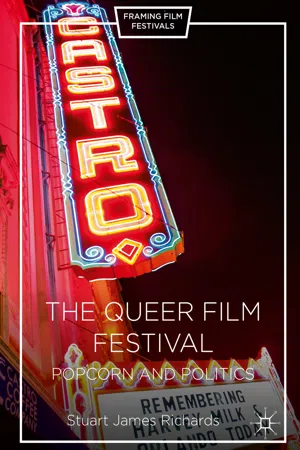
This book examines the queer film festival and opens the discussion on social enterprises and sustainable lesbian, gay, bisexual, transgender and intersex (LGBTI) organisations. With over 220 events worldwide and some of the bigger budgets exceeding $1 million, the queer film festival has grown to become a staple event in all cosmopolitan cities' arts calendars. While activism was instrumental in establishing these festivals, the pink dollar has been a deciding factor in its financial sustainability. Pretty gay boys with chiselled abs are a staple feature, rather than underground experimental faire. Community arts events, such as these, are now a creative industry. While clearly having a social purpose, they must also concern themselves with the bottom line. For all the contradictory elements of its organisational growth, this conflict makes the queer film festival an integral site for analysis. This book takes a multidisciplinary approach in examining the queer film festival as a representative snapshot of the current state of queer cinema and community based film festivals. The book looks at queer film festivals in San Francisco, Hong Kong and Melbourne to argue for the importance of these institutions remaining as community events.
- English
- ePUB (mobile friendly)
- Available on iOS & Android
eBook - ePub
About this book
Information
Subtopic
Film & Video© The Author(s) 2016
Stuart James RichardsThe Queer Film FestivalFraming Film Festivals10.1057/978-1-137-58438-0_11. Introduction
Stuart James Richards1
(1)
University of Melbourne, Melbourne, Victoria, Australia
From grassroots screenings organised by community activists to commercially minded organisations, the queer film festival has always been an integral player in the development of queer film. Beginning as underground radical and experimental film festivals that directly challenged dominant ideologies of sexuality and gender identity, queer film festivals have grown to become part of an elite film institution with an influential position in queer cinema. These festivals provide space for the lesbian, gay, bisexual, transgender, and intersex (LGBTI) community to access films otherwise unavailable. However, in order for the festivals to achieve their social missions, they must achieve financial sustainability. The blossoming of professional queer film festivals highlights the relevance of the social enterprise as a conceptual framework for an analysis.
The rubric of the social enterprise will be used to unpack the manner in which the queer film festival employs market-focused activities to serve its social goals of providing quality cinema and a communal experience. The social enterprise is a non-profit organisation that will engage in economic strategies to fulfil its social mission, where the social entrepreneur will engage with various income streams to create sustainable social transformations (Dees et al. 2001; Westall 2001; Nicholls 2006; Doherty et al. 2009). This is a dramatic development from the early inceptions of the queer film festival, many of which began as community art events. This transition from community-based organisations to elite film institutions will be explored within the conceptual framework of cultural policy and the development of the creative industry in order to illuminate the queer film festival’s road to professionalisation. The queer film festival no longer depends on subsidies or philanthropic gestures, as it can now be recognised as providing specific creative value to their respective cities. This discussion will place the queer film festival within existing scholarship pertaining to the relationship between art and commerce. In light of this consideration, this book will be an important addition to current scholarship, both in its inclusion of audience studies and in its analysis of how social and economic values interrelate. The extent to which these two seemingly opposing objectives can coexist will be a focus of this study.
Three case studies will be presented for analysis, highlighting this book’s concerns with the specific spaces within which queer films are exhibited. The first case study will be the Melbourne Queer Film Festival (hereafter MQFF), a festival for which I have been a selector of for the past six years. Second, the Hong Kong Lesbian & Gay Film Festival (hereafter HKLGFF) will be an interesting case study as it is emblematic of Hong Kong’s cosmopolitan identity. These festivals will be compared to the largest and oldest film festival of its kind internationally, the Frameline San Francisco International LGBTQ Film Festival (hereafter Frameline); while MQFF had its inaugural film festival in 1991 and HKLGFF in 1990, Frameline commenced in 1977. These case studies will allow for a robust discussion of the contemporary state of queer film festivals. While Frameline screens many of its films in San Francisco’s famous gay ghetto the Castro, MQFF has its home in the central business district (CBD) of Melbourne. HKLGFF screens films in both Central and Kowloon. All are creative cities. The developments of their cultural milieus have influenced these film festivals. This research will aim to identify common themes in each of these festivals with the central research question being thus: in the exhibition of films at the queer film festival, can economic value and social empowerment coexist? This raises various questions relevant to the relationship between theory and contemporary sexual politics.
From Gay Politics to Queer Theory
A development of significant relevance to this book is the widening theoretical gap between the terms “gay” and “queer.” Much has been written academically about the definition of queer, and it now has a firm placing in academia. It is not the aim of this book to provide an in-depth discussion of the history of queer theory. It is, however, necessary to begin with a commentary on the current state of what queer means. A key position of this project is a queer critique of sexual normativity, while acknowledging the current ambiguity around the use of the word.
Queer politics and theory were born out of the limitations of the gay and lesbian liberationist movement. Whereas it was once a radical political force alongside the student radicals, black militants, and anti-war activists fighting conservative notions of sexuality and gendered behaviour, gay activism began to concentrate on “securing equality for (the) homosexual population defined in terms of same-sex object choice” (Jagose 1996, 58). This was a political transformation from opposing the social institutions that marginalised and pathologised homosexuality to assimilation within the dominant institutions of society. This saw the hegemonic binary of homosexual versus heterosexual identity affirmed. This formation of a clearly defined, socially assimilationist gay and lesbian community has been termed “the ethnic model” of gay and lesbian difference (Seidman 1994).
The ethnic model’s aim was to establish the gay and lesbian community as a legitimate minority group, similar to an “ethnic group.” This established visible and commodified lesbian and gay urban communities and legitimised “lesbian” and “gay” as categories of identification. 1 For the most part, this was considered successful; however, there was a lack of fluidity within the maintenance of normative identity categories, thus creating a hegemonic rigid binary between heterosexual and homosexual identities. This resulted in limited room for those that did not neatly fit into these categories, such as differences in socio-economic status, race, and so on. This was a significant departure from the gay and lesbian liberationist era of politics. Gay liberation demanded a radical exodus from traditional sex and gender categories, whereas the onset of the ethnic model formulated an assimilationist mindset. This was a transition “from a broadly conceived sexual and general liberation movement” to the “agenda of the male-dominated gay culture … winning civil rights” (Seidman 1993, 117). These contradictory desires of liberation versus legitimation hindered the gay and lesbian movement (Vaid 1995). The “equal but different” mentality saw equal rights sought under an order that many originally thought to be corrupt. While visible communities were established and solidified, many pre-existing inequalities (such as race, age, and ability) were rearticulated within the ethnic model. Ironically, Jagose argues (1996), “the ethnic model’s gay and lesbian subject was white” (62). The ethnic model was based on an essentialist notion of identity, that is, the idea that our sexuality and gender are a set of innate characteristics as opposed to the queer idea of the possibility of identity being fluid and made and unmade through performance.
In her aptly titled book Queer Theory (1996), Jagose discusses queer as an early 1990s movement away from the identity politics that underpin these notions of the lesbian and gay identity. While previous gay and lesbian movements saw identity politics as integral to progress, queer theory developed a post-structuralist critique that highlighted the limitations of identity categories. Foucault (1988) shaped the beginnings of a contemporary queer approach to identity where sexual identities are seen as discursive productions as opposed to a natural inherent condition. Ultimately, this plays into the ideological difference between essentialism and constructionism, where queer theory challenges the essentialist notion that sexuality and gender are fixed. Instead, queer theorists argue that identity is socially constructed and that we are subjects of our own culture. In this sense, queer marks a suspension of identity as something fixed, coherent, and natural, and can be seen to give voice to previously obscured voices within the hetero/homo binary. Queer theory critiques identity as problematic. Writes Jagose:
Queer can be used to describe an open-ended community whose shared characteristic is not identity itself but an anti-normative positioning with regard to sexuality. Thus, queer need not materialise in any specific form; rather, queer exists as a critical resistance to normality. Warner’s theory on heteronormativity is representative of this type of thinking. Conceptually developed in his introduction to Fear of a Queer Planet (1993), heteronormativity identifies the view that any sexual relations that are not between a monogamous man and woman are deemed to be deviant. An instrument of queer critique, heteronormativity recognises the extent to which heterosexual privilege saturates our everyday life:The suspicion that normative models of identity will never suffice for the representational work demanded of them is strengthened by the influential postmodern understandings of identity, gender, sexuality, power and resistance. These provide the context in which queer becomes an intelligible … phenomenon (Jagose 1996, 71).
Warner’s work is an articulation of what it means to be queer and is a departure from gay and lesbian identity politics. Likewise, many scholars of the time, such as Gayle Rubin, Adrienne Rich, and Eve Kosofsky Sedgwick, began to rethink the relationship between gender and sexuality. The development of queer politics is a critique of sexual oppression and power—including expressions of power in the name of gay identity.Because the logic of the sexual order is so deeply embedded by now in an indescribably wide range of social institutions, and is embedded in the most standard accounts of the world, queer struggles aim not just at toleration or equal status but at challenging those institutions and accounts. The dawning realisation that themes of homophobia and heterosexism may be read in almost any document of our culture means that we are only beginning to have an idea of how widespread those institutions and accounts are (Warner 1993, 6).
A homonormative critique is an extension of Warner’s work on heteronormativity by looking at the uneven power relations within the LGBTI community. Duggan asserts that homonormativity is a product of neoliberalism and involves assimilationist politics rather than confrontation. According to Duggan, homonormativity:
She continues by stating that homonormativity recodes key terms in gay politics. In an age where the American LGBTI rights movement has primarily been concerned with access to conservative institutions such as marriage and the military, “freedom” is transformed into “inequalities in commercial life and civil society” (65). Freedom and equality, it seems, are not distributed evenly to all members of the LGBTI community. Contemporary queer cinema exists within these constantly negotiating positions on identity and community.Does not contest dominant heteronormative assumptions and institutions, but upholds and sustains them, while promising the possibility of a demobilized gay and lesbian constituency and a privatized, depoliticized gay culture anchored in domesticity and consumption (Duggan 2003, 65).
The Queer Film Festival
The underlining definition of the queer film festival is a series of film screenings that primarily focus on queer themes. The labels associated with these festivals range from lesbian and gay (such as Hong Kong), queer (such as Melbourne), LGBTQ (such as Frameline in San Francisco) to names that don’t explicitly state an association with the LGBTI community, such as MIX NYC, Image, and Nation in Montreal, or Side by Side in St Petersburg. The primary purpose of these festivals is to provide a space for the exhibition of films that would otherwise struggle to secure a large audience. The development of queer cinema from a radical impulse to a niche market (Rich 2000) has been propelled by the increased professionalism of the queer film festival. The queer film festival has a mission statement in serving the queer community and promoting social empowerment while still remaining financially viable. There is a limited but a gradually expanding array of scholarly literature written on the queer film festival. It is widely assumed among scholars that the queer film festival is a space for films that are by/for/about queers to be exhibited and discussed (Ferrelli 1999; June 2003; Ford 2014); “Such zones are part of a concerted political project to seize the means of self-representation in the face of widespread cultural invisibility and stereotyping” (Pidduck 2003, 267). The queer film festival plays a significant role in any queer community, where it is a “destination to which folks make pilgrimages to fix memory and reclaim history, a sort of moving-image version of, say, Gettysburg” (Rich in Straayer and Waugh 2006, 624). These are spaces for reflection and social engagement.
From the outset, it is important to clarify that the very nature of a film festival is so much more than the films being exhibited, particularly when discussing a queer film festival. Siegel (1997) argues that the location...
Table of contents
- Cover
- Frontmatter
- 1. Introduction
- 2. The Queer Film Festival and the Creative Industries
- 3. The Queer Film Festival as a Social Enterprise
- 4. Queer Film Festival Programming and Homonormativity
- 5. The Space of the Film Festival
- 6. Conclusion
- Backmatter
Trusted by 375,005 students
Access to over 1.5 million titles for a fair monthly price.
Study more efficiently using our study tools.
Frequently asked questions
Yes, you can cancel anytime from the Subscription tab in your account settings on the Perlego website. Your subscription will stay active until the end of your current billing period. Learn how to cancel your subscription
No, books cannot be downloaded as external files, such as PDFs, for use outside of Perlego. However, you can download books within the Perlego app for offline reading on mobile or tablet. Learn how to download books offline
Perlego offers two plans: Essential and Complete
- Essential is ideal for learners and professionals who enjoy exploring a wide range of subjects. Access the Essential Library with 800,000+ trusted titles and best-sellers across business, personal growth, and the humanities. Includes unlimited reading time and Standard Read Aloud voice.
- Complete: Perfect for advanced learners and researchers needing full, unrestricted access. Unlock 1.5M+ books across hundreds of subjects, including academic and specialized titles. The Complete Plan also includes advanced features like Premium Read Aloud and Research Assistant.
We are an online textbook subscription service, where you can get access to an entire online library for less than the price of a single book per month. With over 1.5 million books across 990+ topics, we’ve got you covered! Learn about our mission
Look out for the read-aloud symbol on your next book to see if you can listen to it. The read-aloud tool reads text aloud for you, highlighting the text as it is being read. You can pause it, speed it up and slow it down. Learn more about Read Aloud
Yes! You can use the Perlego app on both iOS and Android devices to read anytime, anywhere — even offline. Perfect for commutes or when you’re on the go.
Please note we cannot support devices running on iOS 13 and Android 7 or earlier. Learn more about using the app
Please note we cannot support devices running on iOS 13 and Android 7 or earlier. Learn more about using the app
Yes, you can access The Queer Film Festival by Stuart James Richards in PDF and/or ePUB format, as well as other popular books in Media & Performing Arts & Film & Video. We have over 1.5 million books available in our catalogue for you to explore.