Implementing and Managing Collaborative Relationships
eBook - ePub

Implementing and Managing Collaborative Relationships

A Practical Guide for Managers

  1. 156 pages
  2. English
  3. ePUB (mobile friendly)
  4. Available on iOS & Android
eBook - ePub

Implementing and Managing Collaborative Relationships

A Practical Guide for Managers

About this book

In today's competitive, globalized marketplace, the provision of services and products is a result of teamwork between several organizations. Relationships between organizations of any size are strategically important. If your supplier falls down at a crucial moment, it can have survival implications for your company or for other members of your supply chain. The management of these strategic assets cannot be left to chance and the same attention that you devote to finance, operations, HR, etc. must be applied to business relationships. Despite this, very few organizations focus on this or are even aware that they need to do it. Those that do are unsure how to do it. This is not helped by business schools that focus on either customer relationship management (CRM) or supplier relationship management (SRM) rather than collaboration between partners (Enterprise Relationship Management).

This book is a unique "go-to" guide for all managers who should be looking at collaboration with other organizations as a new way to attain outstanding results that would not be achieved on their own. Currently, there is nothing else of this nature on the market.

The book identifies relationship management as a pivotal management function. It presents a comprehensive, flexible, end-to-end management process that can be easily incorporated into the existing management structures. Further, they describe the crucial role of the relationship manager who is at the heart of the system and provides the drive to achieve high performance. Any company can tailor this discipline to the needs of its organization – whether an SME or a multi-national company selecting a new partner or managing existing relationships.

This book covers the decision of whether or not to partner and with whom, the creation of an appropriate system of governance, the transition to operations, managing performance for continuous improvement, and, finally, controlled wind-up of the partnership.

Throughout, diagrams to signpost the sequence of activities, checklists of important actions, and job-related worksheets are provided. In addition, there are numerous case studies in a variety of industries and public sectors that will be used as illustrations. Altogether these make this book ideally suitable for experienced managers as well as for training and induction purposes.

Essentially, Implementing and Managing Collaborative Relationships: A Practical Guide for Managers shows managers how they can create and operate a simple and effective system of Enterprise Relationship Management that will enable them to maximize efficiency, resilience, innovation, and profitability.
Tools to learn more effectively

Saving Books

Saving Books

Keyword Search

Keyword Search

Annotating Text

Annotating Text

Listen to it instead

Listen to it instead

Information

Chapter 1 Implementing and Managing Collaborative Relationships – An Introduction

DOI: 10.4324/9781003221340-1

The Purpose of This Guide and How to Use It

Our purpose is to show you how to put together a simple system of collaborative relationship management that you can tailor to the needs of your organization – whether you are an SME or a multi-national company, selecting a new partner or managing existing relationships. It will allow you to get the maximum value from your collaborative relationships, such as improved revenues, reduced costs, greater market share, specialized know-how, and better resilience in difficult conditions. For instance, uncertainty challenges the partners to adapt and capitalize on problems raised by unforeseeable events such as the recent global pandemic, ocean supply chain disruptions in the Suez Canal, local wars, and terrorist activities. Adaptability requires a high degree of coordination, cooperation, and collaboration by relationship partners. However, these require significant management effort and are critical to relationship survival.
Whether you have a Supplier in Tianjin or 15 miles down the road, whether you have a Joint-Venture Partner in Madrid or New York, whether you have an OEM Customer in Loughborough or Sao Paulo, an unrelenting focus on developing and maintaining mutually successful medium and long-term business partnerships through meaningful collaboration is critical to building a company in the 21st century. After all, with the complexities and competitiveness of today’s business environment, none of us ‘can do it all on our own’, can we?
Mike Reilly, CEO, Ether NDE
Most companies will have well-established management systems; however, these are not usually optimized to manage beyond the organization’s boundaries. A joint enterprise, working with partners, is completely different and therefore will need a new type of management system. There are significant differences in attitude between working on your own and working with others; it’s no longer ‘me’, but it’s ‘us’. In a joint enterprise, the partners must learn how to earn each other’s trust. Our purpose is to describe such a system and show you how to implement and successfully manage in a collaborative environment. As you get better at managing your relationships, you will find that inevitably your financial and other business returns will continue to improve as will your reputation as a company that others want to do business with.

Transactions or Collaboration?

There are two main types of relationships – those tending toward transactional and those tending toward collaborative. Transactional relationships are those based on the simple purchase or supply of a widely available product or service which is driven by price, quality, and time. Often transactional relationships become collaborative as trust develops over time. Conversely, collaborative relationships are those where the partners work together using their specialized resources innovatively to achieve aims and objectives that could not be realized on their own. Organizations must continually identify whether dealings with both prospective and existing suppliers are transactional or collaborative. In the latter situation, the managers must decide whether there is a compelling benefit to a closer relationship. Thus more often than not collaboration emerges rather than being created from scratch.

Collaborative Relationships

The most valuable of all business relationships are likely to be those that are collaborative, regardless of where they fit within the spectrum of relationship types. They could be buyer–seller relationships, supply chain partnerships, services marketing arrangements, facilities management, R&D, or any other relationship combination. They are likely to be strategically important and of long duration and, therefore, collaborative relationship management principles will apply.
However, managing them is often seen as a ‘black art’ where we don’t know what to do, we don’t know that we don’t know what to do, it’s somebody else’s job, or we don’t have the time or money to do it. These attitudes are prevalent, despite the high value (both bottom line and strategic) that is usually tied-up in the often long-standing formal and informal agreements between collaborating organizations of any size.

Achieving Collaborative Value

Collaborating organizations will bid for contracts that were previously out of reach, put products on the shelves at a fraction of the cost of their competitors’, dream up a new product which will corner the market, and provide a super service package well beyond anything they have ever done before. Two years later when none of these objectives have been achieved, they have no idea why things have gone wrong. There is thus a gulf between these grandiose views of collaborative value and the ability of managers to translate them into achievable goals. Contrary to some traditional views that collaborative relationships can be established immediately simply by having the right partner selection process and signing the contract, it is clear that collaborative working, value creation, and capture develop in an increasingly productive cycle.
Traditionally, value (benefits) is seen as the achievement of increased profits, greater market share, and the fulfillment of project objectives. These benefits will be underpinned by operational imperatives of time, cost, quality, and delivery and are easy to quantify and track. However, there is more to value than this. A number of intangible factors will also come into play such as innovation, knowledge and skills capture, enhanced reputation and brand value, and satisfied stakeholders. More difficult to quantify, but equally important as an enabler, is relationship quality. This is characterized by harmony, trust, commitment, open communications, and a willingness to work together for the long term.
The relationship has been absolutely outstanding. The trust established makes us want to do anything we can for the customer.
Project Director, Defense Supplier
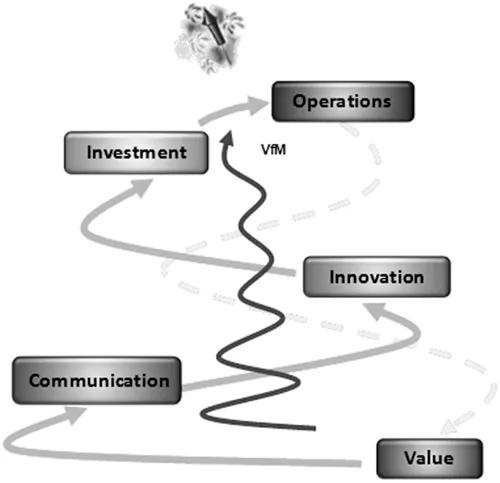
When companies start working collaboratively, they often begin with specific aims. These will take into account the known capabilities on both sides. As they move forward, further abilities will become evident. More open and in-depth communication will occur, creativity and innovation will be stimulated, and the partners will broaden their focus to include these and ‘up their game’. Suddenly ideas that were vague dreams become achievable. These provide impetus for joint investment that enables the partners to seize unforeseen opportunities as they arise. It is this enhanced capability of the partnership that enables them to recognize and take advantage of potential collaborative value. It becomes a method of working that is capable of continuous value creation as the quality of the relationship increases. Therefore, the partners must expect that new value opportunities will emerge and be prepared to manage their creation and exploitation. Overall, it is important that benefit realization is tracked so that it sustains the impetus of the collaborative enterprise. Benefits encourage innovation which generates more value which can be reinvested in a virtuous cycle (Figure 1.1).
Figure 1.1 The virtuous relationship value cycle.

Relationship Management in Principle

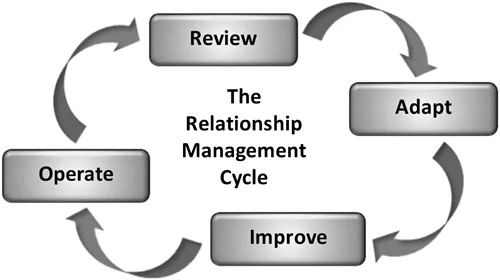
Relationship management is one of the most important management systems that you can have, and as such, it should be clearly documented both in policy and in practice. Good relationship management has the capability to give you startling results, but, without it, full relationship value is unlikely to be achieved. Business tends to follow a standard ‘Plan, Do, Check, Act’ action cycle. Relationship management principles use a slightly different virtuous circle that acknowledges the joint nature of the endeavor (Figure 1.2).
Figure 1.2 The relationship management cycle.
The partners first ‘Review’ the quality of their collaborative relationship and its achievements. They then ‘Adapt’ their way of working to keep their relationship in-step. Next, they agree ‘Improvements’ to their processes and behaviors. Finally, they ‘Operate’ together. In this way, continuous improvement is achieved and performance increases become inevitable.

Relationship Management in Practice

However, most relationships will miss opportunities to capitalize on their strengths because no one has an overall view of the joint enterprise. More often than not, the relationship management that exists is scattered among a number of individuals: the bosses at their annual game of golf, the salesman who is keen to keep the customer happy so he can land the follow-on deal, the commercial officer who manages the contract and sorts out the problems left by the salesman, and, finally, the administration, logistics, and operations people who have the job of making things happen. In the case of the micro business owner, it’s tucked away in the back of his head while trying to juggle 20 things at once.
Many organizations do recognize the need to work more closely with partners, but their efforts miss the target. For example, they will take a ‘gung-ho’ attitude and remove governance arrangements which usually result in cost or time repercussions. They may re-badge their supplier management team as ‘Vendor Managers’ team which just perpetuates the old ‘them and us’ way of doing things. Some will see the adoption of standards as the way forward and fall into the trap of managing the standard rather than the relationship. They then wonder why this investment is not paying off.
There is suspicion on all sides regarding the relationship. This is fueled by the customers’ approach to management (micro-management) and the supplier’s unwillingness to be open in discussion. Both parties are contributing to the poor performance of the contract.
Regional Director, IBM
In the case of a supply chain, the end-to-end perspective is lost among the people who manage the individual links. This is particularly evident in the just-in-time situation where the links between the organizations have become ‘mechanized’. In good times, these are very efficient; however, they are highly vulnerable to disruption because there is no relationship management in place to effectively overcome the risks.
The prospect of doing business across organizational boundaries within collaborative relationships is a daunting one. Fulfilling strategic needs through collaboration by selecting the right partner(s) and improving the performance of existing relationships will certainly only be fully successful if relationship management is effective. Continuous improvement will include diverse activities such as developing joint and outsourced processes (do you do your own accounting and website design?), rescuing fail...

Table of contents

  1. Cover
  2. Endorsements
  3. Half-Title
  4. Title
  5. Copyright
  6. Contents
  7. About the Authors
  8. Foreword
  9. 1 Implementing and Managing Collaborative Relationships – An Introduction
  10. 2 Enterprise Relationship Management (ERM) – A Target Operating Model for Collaboration
  11. 3 The Relationship Manager – Clears Tall Buildings in One Bound!
  12. 4 The Enterprise Relationship Management Plan (ERMP) – The ‘Dashboard’
  13. 5 The Decision Phase – To Collaborate or Not to Collaborate? That Is the Question
  14. 6 Transition to Day-to-Day Operations – From Exploration to Operations
  15. 7 The Operations Phase – Business as Usual
  16. 8 Performance Measurement – If You Don’t Measure It, You Can’t Manage It
  17. 9 Performance Management – If You’ve Measured It, You Can Now Manage It
  18. 10 Managing Exit – All’s Well That Ends Well
  19. 11 Review
  20. Index

Frequently asked questions

Yes, you can cancel anytime from the Subscription tab in your account settings on the Perlego website. Your subscription will stay active until the end of your current billing period. Learn how to cancel your subscription
No, books cannot be downloaded as external files, such as PDFs, for use outside of Perlego. However, you can download books within the Perlego app for offline reading on mobile or tablet. Learn how to download books offline
Perlego offers two plans: Essential and Complete
  • Essential is ideal for learners and professionals who enjoy exploring a wide range of subjects. Access the Essential Library with 800,000+ trusted titles and best-sellers across business, personal growth, and the humanities. Includes unlimited reading time and Standard Read Aloud voice.
  • Complete: Perfect for advanced learners and researchers needing full, unrestricted access. Unlock 1.4M+ books across hundreds of subjects, including academic and specialized titles. The Complete Plan also includes advanced features like Premium Read Aloud and Research Assistant.
Both plans are available with monthly, semester, or annual billing cycles.
We are an online textbook subscription service, where you can get access to an entire online library for less than the price of a single book per month. With over 1 million books across 990+ topics, we’ve got you covered! Learn about our mission
Look out for the read-aloud symbol on your next book to see if you can listen to it. The read-aloud tool reads text aloud for you, highlighting the text as it is being read. You can pause it, speed it up and slow it down. Learn more about Read Aloud
Yes! You can use the Perlego app on both iOS and Android devices to read anytime, anywhere — even offline. Perfect for commutes or when you’re on the go.
Please note we cannot support devices running on iOS 13 and Android 7 or earlier. Learn more about using the app
Yes, you can access Implementing and Managing Collaborative Relationships by Andrew Humphries,Linda McComie in PDF and/or ePUB format, as well as other popular books in Business & Customer Relations. We have over one million books available in our catalogue for you to explore.