eBook - ePub
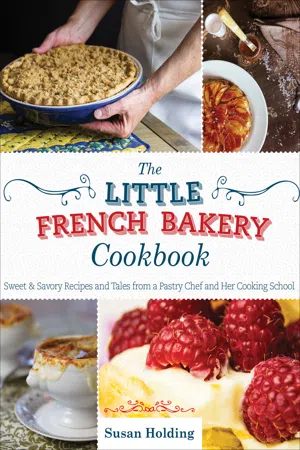
The Little French Bakery Cookbook
Sweet & Savory Recipes and Tales from a Pastry Chef and Her Cooking School
- English
- ePUB (mobile friendly)
- Available on iOS & Android
eBook - ePub
The Little French Bakery Cookbook
Sweet & Savory Recipes and Tales from a Pastry Chef and Her Cooking School
Information
Topic
ArtSubtopic
Culinary ArtsChapter One
LET’S GET STARTED
Bonjour!
Welcome to the Little French Bakery and Cooking School. In each class at The Little French Bakery, students receive a collection of recipes based on the topic of the day. In this book, you’ll find many of the recipes I’ve been teaching since my classes began. Some are sweet, some are savory. While some are easier than others, I’ve written the directions so new, aspiring cooks and bakers can be successful.
In 2010 I began blogging about pastry school experiences, baking, cooking, and life here in rural Wisconsin. My photography started out underexposed and out of focus. With the help of some great tutors, books, and classes, my photography is improving. My Canon 7D and I have become good friends. I’m delighted I was able to shoot the photos for this book. The photos of me, Gary, and our dogs were taken by Mike and Heather Krakora of Krakora Studios. Lindsey Carlyle Eastman of Lindsey Carlyle Photography took the photo of me with my camera when we were in Ireland studying food styling and photography with Beatrice Peltre, of La Tartine Gourmande.
Tucked between the recipes and photographs of this book you’ll find my stories. I hope you’ll be able to join me in person some day as we bake, eat, and share time together.
How Did This All Begin?
As a little girl, I loved to bake. My parents made a great choice when I was in kindergarten. Rather than going the Easy Bake Oven route, they gave me a set of small pans and bowls with tiny mixes for Christmas. With some adult supervision, I could make a cake and bake it in the big oven. I remember my grandma was a great cook. It was so fun standing at her side with an apron tied around me. Sometimes it was a dish towel, sometimes a pretty embroidered apron from her kitchen drawer. As I grew up, I baked in Girl Scouts for badges, baked for family events, and baked with my college roommates trying recipes in the cooking magazines and cookbooks.
Fast forward a few (ok, more than a few!) years. Like many of my students and readers, I was an enthusiastic home cook. I was working in the healthcare industry, and I was trying all kinds of recipes and enjoyed taking evening demo-style classes at local cooking stores on evenings and weekends. New pieces of cooking equipment were my favorite gifts.
One day, I decided to expand my horizons and enroll in a weekend baking class. Since my work required travel, I was accumulating many frequent flyer miles. My plan was to use some of the miles and learn more about baking. I wasn’t sure where I wanted to go so I found the most recent edition of Gourmet magazine and looked for the ads for cooking schools. I pulled out the reader response card—you know, the little cardboard postcards that used to be tucked in between the pages. There were about one hundred numbers on the card corresponding to ads in the magazine. I circled the numbers for all the cooking schools I thought were a good match. The schools were mostly on the East or West Coast of the United States featuring weekend bread and pastry classes. My plan was right on target.
I waited for the materials to arrive. Now remember, this was pre-internet so information was gathered by phone or what is kindly referred to now as snail mail. Over the span of a few weeks, literature began to arrive: little pamphlets with schedules and class descriptions. The next step was to decide which class and when. Then came the big day. When I arrived home from work one day, there was a large, thick white envelope waiting for me. I opened the outer wrapper to find a shiny, high-quality folder containing the registration materials and information for Le Cordon Bleu, Paris. It was beautifully organized and contained all I needed to apply for culinary school. I had circled the number on the reply card by accident. I had no intention of leaving my job and heading off to school, so I set it aside and continued to review the other classes’ info.
A few weeks went by. I couldn’t get the Cordon Bleu folder out of my mind. What if I did go away to school? I loved school and maybe this could work. As I read all the requirements and schedules in Le Cordon Bleu’s folder, I found a program they referred to as Intensive. Each part was three weeks long and held in August or December. The first class was called Pâtisserie de Base, Basic Pastry. By now the wheels were really turning. What if I took a short leave of absence from work and went to Paris to take this class? I could learn enough French to get by. I had the miles, and there must be places the school could recommend for lodging. Gary and I had a long talk about my idea. He was excited, and encouraged me take the next step.
One of the prerequisites was experience in a commercial kitchen. I found a local European-style bakery who kindly welcomed me to help with odds and ends after my real work day was finished. I got to see firsthand how a commercial kitchen works. I learned how to handle batches larger than one or two dozen, and several pieces of really big equipment. Experience, check. Now I was ready to apply.
I sent off the application and within the month was accepted into Pâtisserie de Base. Even the acceptance letter was beautiful. Each correspondence arrived Par Avion—Air Mail. I was going to Paris to study at Le Cordon Bleu.
After sending in my uniform sizing information, my dream was becoming a reality. I now needed to brush up on my French. And I’ll be honest, it wasn’t brushing up, it was essentially learning from scratch. Using tapes, CDs, books, and flashcards, I taught myself enough French to get by. Looking back, my French was terrible, but I was enthusiastic and trying my hardest.
Now that I had been accepted I needed to find a place to stay. Rather than an apartment, which seemed daunting, I looked through the hotels listed in guide books and lists provided by the school, and found a hotel in the 17th arrondissement. The description sounded lovely, was near the school, and offered a monthly rate. In my best French and with the help of notes with phonetic spelling scribbles, I called the hotel, made the reservation, and was set.
Story: My First Days in Paris
My flight was uneventful. Upon arriving in Charles de Gaulle airport, I realized everyone really was speaking French. Nothing could have prepared me for this adventure.
My first order of business was to find a taxi. As luck would have it, a driver approached and asked if I needed a cab. How nice I thought, he’s speaking English. I followed him down a stairwell and into the basement parking garage. The whole time I was thinking how odd it was that Parisian taxis didn’t have any markings. He kindly placed my bags in the trunk, and off we went. About five minutes into the trip it struck me. I wasn’t in a taxi, and I was clearly being kidnapped. We were on the expressway heading into central Paris going at least 60 miles per hour. Should I jump? I told him to let me out. He said, “Not here!” I realized my purse was in the trunk. How could I jump and leave my belongings in this car? He pointed to the buildings and assured me we were going to my hotel. I settled a bit when I saw buildings looking like typical postcard Paris. After what seemed like hours, we arrived at my hotel. Rather than the usual fare, he asked for much more. I paid him, thankful to be out of the fake taxi, gathered my luggage, and entered the hotel.
TIP! Don’t be afraid of Paris. There is a very safe cab stand at the Paris airport. Just don’t ever follow someone who approaches you asking you if you need a taxi. It’s a huge scam and I was really lucky.
“Bonjour!” I said to the desk clerk. I told her my name, and she gave me a very strange look. I couldn’t understand what she was saying, but I did recognize the word yesterday. What?!? I had made my reservation for the day I left home, not the day I arrived. I had forgotten to take the time change into consideration. Did I still have a room? What else could possibly go wrong? “Bien sur,” she assured me. I carried my bags and my tired self to the tiny elevator and found my room.
I opened my door to find a twin bed, a desk and chair, a mini fridge, and enough room to stand at the edge of the bed and look out the window, quickly realizing things were much smaller in a French hotel room. It was 85°F outside, quite warm for Paris. My non-air–conditioned room was very warm, but the marble walls of the beautiful bathroom were so cool. I rested my cheek and forehead on it and with a huge sigh of relief, surveyed my home for the next month.
I figured out how to open the window and discovered no window screen. I stuck my head out the window to check other windows. None of the rooms had screens. Could a bird fly in? Could someone scale the building and jump in my window? I pulled the sheer curtain panel across the window so the breeze could enter, but hopefully not a bird. I rested a bit and set off on my first adventure. A Metro pass.
The Metro was just across the street. I found the booth and asked for a pass. Of course the attendant couldn’t understand me, nor I her. She pointed to the pass info on the window. I needed a photo. I found a photo booth and figured out how to get the photo, took it back to her and had my first Paris document. A Carte L’Orange. A weekly renewable Metro pass. This took nearly the whole day, but I had done it. All by myself.
There was a small always-open food shop just down the street from my hotel, and a beautiful charcuterie, on the street level below the hotel. I wanted this to be “my place.” I walked in, took a look at the meats and pâtés, and had to leave. My stomach just wasn’t ready for the sights and smells. Jet lag was winning. I went to the little shop and found some water, cheese, bread, and crackers. I was set for a few days. Feeling miserable, I called home at least three times to tell Gary I had made a big mistake. Maybe I should come home. He reassured me, and reminded me that class would start in a few days and I’d be fine.
The next day I decided I would use my Metro pass. I know this was crazy, but I decided to go to Euro Disney. It was new, and I thought it would help pass the time and be something familiar. I got to the park, bought my ticket, and proceeded through the gates. Upon arrival at the Castle, there was a sign explaining, in French of course, how it was closed. How could the Magic Castle be closed? This was Disneyland. The sign went on to explain a special event was taking place, and the staff was sprinkling pixie dust in preparation. How could I argue with pixie dust? I walked around a bit, watched families having fun, and realized this wasn’t the best idea. I took the Metro back to the hotel, had a bit more bread and cheese, and planned my next adventure, finding Le Cordon Bleu.
The next morning I went to the basement of the hotel for breakfast. Each day they set up a selection of pastries, meats, cheeses, cereals, coffee and tea. It was heavenly. I ate some baguette with cheese, drank an espresso, and studied the map. I memorized the directions so I would look confident on the street. I hopped on the Metro and stepped off at Metro stop Vaugirard, the stop nearest Le Cordon Bleu. There are at least five exits for the stop. Of course I got off and headed in exactly the wrong direction. I stopped in Shoppie, a small grocery and convenience store, and asked for directions. The clerk said, “Non.” Just no. With a half smile and shrug of her shoulders. Hmm, I thought. How could she not know Le Cordon Bleu? Wasn’t it a major landmark in Paris? Or at least this neighborhood? I asked a few more shopkeepers. No one knew. I sat on a bench, pulled out my map, and found my way. I set off with a better sense of direction. I turned the corner, then another, walked down the block, and in front of me at 8 rue Léon Delhomme was Le Cordon Bleu. It was unassuming, and blended into the neighborhood like all the other beautiful limestone four-story buildings in central Paris. I was ready to begin pastry school the next day.
I swear I didn’t sleep a wink that night due to my nerves and excitement. The next morning, I was the first and only person in the breakfast room. After a few sips of coffee and a few bites of baguette I set off on the journey that would change my life forever. At the time, I had no idea this day would ignite a spark and passion that would lead me to the remaining classes and completion of the Diplôme de Pâtisserie over the next two years.

Kitchen wisdom
Many people ask me about kitchen equipment and seek suggestions for essential tools. I’d like to share some of my favorite things to help you choose your equipment. Many are investment pieces that will last a long time.
First, your hands are your best tools: smearing dough, kneading bread, tossing and sprinkling, along with many other kitchen tasks. Wash them with hot, soapy water and use them often. Sometimes during a cooking class students are surprised when I ask them to mix certain ingredients with their fingers instead of using a utensil. It’s easier and often faster to use your fingers.
Second, use a kitchen scale. Find a small scale that will switch from pounds and ounces to grams. Make sure it will weigh up to at least 5 pounds. Why a scale? Weighing ingredients will give you accuracy in baking. It won’t matter if you’ve scooped, packed, or sprinkled the flour into the bowl. The weight will be the same. Your results will be like mine because we’ll both have been using the same a...
Table of contents
- Cover
- Title Page
- Copyright
- Dedication
- Contents
- 1. Let’s Get Started
- 2. Must-Have Recipes and Techniques
- 3. Appetizers and Starter Courses
- 4. Breads: Spin Three Times and Flip
- 5. Pastries
- 6. Cookies and Bars
- 7. Cakes
- 8. Favorite Meals
- 9. Soups
- 10. The Breakfast Class
- 11. Our Family Favorites
- 12. Tarts and Pies
- 13. Comfort Foods
- 14. Acknowledgments
- 15. Metric and Imperial Conversions
- 16. Oven Temperatures
- 17. Recipe Index
Trusted by 375,005 students
Access to over 1.5 million titles for a fair monthly price.
Study more efficiently using our study tools.
Frequently asked questions
Yes, you can cancel anytime from the Subscription tab in your account settings on the Perlego website. Your subscription will stay active until the end of your current billing period. Learn how to cancel your subscription
No, books cannot be downloaded as external files, such as PDFs, for use outside of Perlego. However, you can download books within the Perlego app for offline reading on mobile or tablet. Learn how to download books offline
Perlego offers two plans: Essential and Complete
- Essential is ideal for learners and professionals who enjoy exploring a wide range of subjects. Access the Essential Library with 800,000+ trusted titles and best-sellers across business, personal growth, and the humanities. Includes unlimited reading time and Standard Read Aloud voice.
- Complete: Perfect for advanced learners and researchers needing full, unrestricted access. Unlock 1.5M+ books across hundreds of subjects, including academic and specialized titles. The Complete Plan also includes advanced features like Premium Read Aloud and Research Assistant.
We are an online textbook subscription service, where you can get access to an entire online library for less than the price of a single book per month. With over 1.5 million books across 990+ topics, we’ve got you covered! Learn about our mission
Look out for the read-aloud symbol on your next book to see if you can listen to it. The read-aloud tool reads text aloud for you, highlighting the text as it is being read. You can pause it, speed it up and slow it down. Learn more about Read Aloud
Yes! You can use the Perlego app on both iOS and Android devices to read anytime, anywhere — even offline. Perfect for commutes or when you’re on the go.
Please note we cannot support devices running on iOS 13 and Android 7 or earlier. Learn more about using the app
Please note we cannot support devices running on iOS 13 and Android 7 or earlier. Learn more about using the app
Yes, you can access The Little French Bakery Cookbook by Susan Holding in PDF and/or ePUB format, as well as other popular books in Art & Culinary Arts. We have over 1.5 million books available in our catalogue for you to explore.