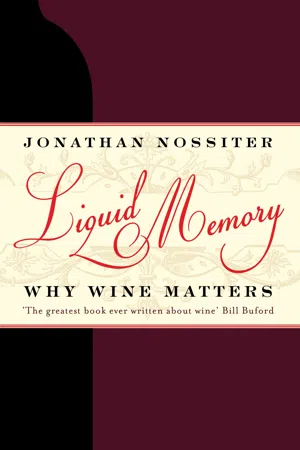
Jonathan Nossiter had his first taste of wine at the age of three in Paris, from his father's finger. For him, wine is 'memory in its most liquid and dynamic form,' as essential an expression of culture as film, books or painting.
From the wine shops and three-star restaurants of Paris to the biodynamic vineyards of Burgundy, from the hipster bistros of New York to film locations in Rio de Janeiro and Athens,
Liquid Memory investigates the infinite mysteries of
terroir, the historical sense of place that makes wine a living, expression of cultural identity that can stretch back centuries. It is also a joyful master class in locating the soul of a wine, and in learning to trust your own palate and desires.
- English
- ePUB (mobile friendly)
- Available on iOS & Android
eBook - ePub
About this book
Information
Topic
ArtSubtopic
Food IndustryPART I
The (None)sense of Place
1
WHY WE’RE NOT DOGS
Terroir Is Where You Come From.
Or Where You’re Going
The term globalization is frequently misused. This is particularly disturbing for me, a child of the globe. My father, Bernard Nossiter, an American journalist, moved our family from Washington, D.C., to Paris when I was two. I grew up across the cultures of France, Italy, Greece, India, and England, as well as the United States. So, where do I belong? A German filmmaker, Thomas Struck, told me that while riding his bicycle through the vineyards of the Rheingau, he stumbled across Stuart Pigott, one of the world’s most experienced drinkers of German wines. He asked Pigott, an Englishman who lives in Berlin, “What is your heimat?” Pigott paused before responding to this peculiar German term, which means, variously, “roots,” “origin,” “home,” or “homeland.”
“My heimat?” he repeated. “German Rieslings.”
I couldn’t agree with him more. Of course, my own heimat would include not just the Rieslings of the Rheingau, Mosel, or Franconia, but equally the wines of the Loire’s Vouvray or Burgundy’s Volnay. My heimat is globe spanning. It would also include the Aglianico del Vulture from the Basilicata region of southern Italy, which I drank recently in Rio de Janeiro, where I now live. Part of what makes it my heimat is that I drank this “Vulture,” a 1998 vintage from the producer Paternoster, in the company of my neighbors and fellow film directors, Karim Aïnouz and Walter Salles. Why is that a part of determining my heimat? Because the force of a wine—or any cultural expression (or expression of love, for that matter)—is also dependent on the context in which it’s understood. It was only in explaining the origins of the bottle to my film world friends that I remembered that this fiercely dry, earthy, and bittersweet drink is made not far from the dramatically barren rock formations of Matera where Pier Paolo Pasolini shot The Gospel According to St. Matthew. And this film gives the three of us a common heritage. In fact, we can go further. We could each one of us say that Pasolini—and Gospel especially—is our joint heimat. And this is the best explanation of what allows three such radically different filmmakers to sit down happily together at a dinner table.
It’s a strange film to link the three of us, just as it is strange that we three are linked. Through the story of Jesus, Pasolini made an uncompromisingly personal effort to reconcile his own devout Catholicism with a kind of exuberant homosexuality and Gramscian Marxism (an Italian humanist vision of utopian social justice). I wondered what Pasolini would’ve felt, knowing that Gospel (miraculously endorsed by the Vatican in 1963) begat three such disparate followers. What would he think of Karim, a half Algerian from the hardscrabble Northeast of Brazil, making Madame Satã (a radical, tender portrait of a boxing Rio transvestite); Walter, a debonair French-educated son of a Brazilian diplomat, launching his career with Terra Estrangeira (a delicate story of Brazilians adrift in Portugal); and me, a secular, rootless American Jew, shooting Mondovino (a black comedy about wine, shot on three continents)? It doesn’t matter.
Although we may all claim Pasolini as a heimat, he bears no responsibility for the claim. And it’s precisely this notion of claiming a heimat, without the heimat claiming you (or, like a country, having any claim on you), that is most essential to me. It has shaped my greatest pleasures in cinema and wine, and it’s this distinction from “belonging” or “nationalism” that is at the root of my understanding of terroir, the singularly French expression of heimat that I grew up with. Terroir formed my sense of taste, wherever I happened to be living. And it’s the reason for writing this book.
Without terroir—in wine, cinema, or life (I’m happiest when the three are confused)—there is no individuality, no dignity, no tolerance, and no shared civilization. Terroir is an act of generosity. The last thing it should be is sectarian or reactionary. In fact, the often willful misunderstanding of this concept led me to a number of fights during the release of Mondovino, because of knee-jerk anti-Americanism in Avignon—where reactionary locals misread terroir as an exclusively French birthright—or because of the smugly disingenuous political correctness of San Francisco’s affluent liberals with a vested interest in denying substantial value to Old World terroir. A true expression of terroir—say, a Meursault Luchets from Jean-Marc Roulot in Burgundy—is a very precise means to share the beauty of a specific identity, a specific culture, with the rest of the world. It is using the local not to exclude, but to include any one of us in the mystery and distinctive beauty of an “other.” Any other. It is an affirmation of difference in fact in many ways. Not only will the Meursault Luchets of Jean-Marc be distinct from that of his father, Guy, but each year his own expression will evolve, as his understanding and the soil and climate also shift.
In cinema, these notions are readily accepted. It’s a given that when someone sees Ira Sachs’s The Delta—one of the rare American films of the last twenty years that conveys the emotional and physical texture of a peculiarly American psyche, seen through the lens of misfits in Memphis, Tennessee—they feel included in the experience of American life. And America becomes more human and comprehensible. When you see Wong Kar-wai’s Fallen Angels, where an idiosyncratically Taiwanese spirit meets Hong Kong reality (a dumping ground at the time for global kitsch), a certain conception of “Chineseness” becomes intimate without losing its otherness. Though it’s very interesting to see how this quality of otherness has shifted in the decade since Wong Kar-wai made that film: how he’s repackaged it in subsequent movies for Western consumption on the back of his international success, losing, in my opinion, both his films’ intimacy and their otherness.
So why should wine be any different? The defense of terroir is not a reactionary, unquestioning clinging to tradition. It is the will to progress into the future with a firm rootedness in a collective past, but where that rootedness is left to evolve freely and continuously above ground, in the present, to create a sharply etched—and hard-earned—identity. It’s a way to counteract the relentless homogenization of certain global forces. It is the only way, I believe, to progress forward ethically, to respect and place oneself in relation to, but not to ape, the past.
Terroir has never been fixed, in taste or in perception. It has always been an evolving expression of culture. What distinguishes our era is the instantaneousness and universality of change. Before, the sense of a terroir would evolve over generations, hundreds of years, allowing for the slow accretion of knowledge and experience to build into sedimentary layers, like the geological underpinning of a given terroir itself. Today layers are stripped away overnight, and a new layer is added nearly each vintage. “Why is this dangerous?” ask those genuinely eager for progress and modernity, as well as the conscious (or self-deluding) profiteers of this new world order. Because it risks wiping out historical memory, which is our only safeguard against the devastating lies of marketing and the cynical exploitation of global markets, culture, and politics.
So the fight for wine’s individuality, for the survival of individual taste in relation to the homogenizing forces of impersonal power (especially when wielded by a very individual person) is a fight (as much as that in cinema) that concerns all of us. But if these differences, these expressions of diversity and cultural identity, these vital links to the past are being threatened, who decides what to preserve, what to safeguard? Who says what should survive? Why should a Burgundy Volnay be safe-guarded as something distinct as opposed to, say, a Uruguayan Tannat, a wine that only recently began to assert its identity and almost as quickly seems to be losing it? But what should its taste be, and who gets to judge? And what does it mean when we express our taste? And are we sure that it really is our own taste, when we do express it?
For that matter, what is taste? It could be described as the expression of a preference between, say, A and B. But what distinguishes taste from mere opinion is that such a preference emerges from a sensory, emotional reaction with the subsequent ability to intellectually decipher that reaction for the self (and, if really necessary, for others). But ultimately, the defining characteristic of taste is the coherent relation of that preference to one’s own conduct, to an ethical relation to oneself and to the world.
Taste and Memory
THE ART OF MEMORY HAS BEEN FORGOTTEN
I’m convinced that wine is among the most singular repositories of memory known to man. If historical memory is the essential quality by which we are distinguished from beasts, that which gives us shape and purpose and ethical structure, as the historian of Vichy France Robert Paxton said to me in an interview for the research of Mondovino, then it’s worth considering wine’s relationship to memory. Without cultivating memories of our dead parents, of acts of history, of our own prior conduct, we are lost and become prey to all evildoing, lies, and exploitation, especially our own.
A museum contains works of art that are fixed expressions of a specific sensibility, a specific memory, no matter how rich and varied our responses and our understanding of that sensibility. A novel is the same. And while one might argue that the patina of a building reflects both the original expression of a memory and the visible traces of that memory across time, it is still inert matter. Its fixity clings to it, even once decayed, restored, or buried underground.
Why is wine unique in its relation to memory? Because it is the only animate vessel of both personal memory—that of the drinker (or maker) and the subjectivity of his experience and the memory of that subjectivity—and communal memory. That is, it is communal to the extent that a wine is also the memory of the terroir, which the wine expresses as an evolving, active taste. As communal memory, it is above all an expression of place as a communal identity, the history of the civilization of that place and the history of the relationship to its nature (especially soil, subsoil, and microclimate).
A well-made wine from a terroir of some complexity, when the grapes are born healthy and the wine is allowed to develop in further salutary circumstances (i.e., when the process is chemical-free, organic), can live about the same life span as a human being, sixty to eighty years (this is also, perhaps not coincidentally, the life span of a well-cared-for vine). Consider further that the wine itself is constantly evolving in bottle, from its birth to its death (i.e., its consumption). The wine’s expression of “memory” is in perpetual, biological evolution, just as ours is. The memory of a wine is the closest thing to human memory.
In fact, nothing so complex, so dynamic, and so specific, nothing that links both nature and civilization, can be said in relation to memory in literature, painting, cinema, music, architecture: any of the other records of human civilization. However, precisely because neither terroir, nor nature, nor men are fixed, and because a wine itself is destined to be consumed—to vanish—a wine of terroir is by its nature, an ultimately indefinable, unquantifiable agent of memory. This is a curse for relentless rationalists, unrepentant pragmatists, and all the busy codifiers of this world, anxious for absolutes. And a blessing for the rest of us.
Since the beginnings of Near Eastern civilizations, since the Greco-Roman civilizations that have circumscribed (until recently) our own culture, across the entire Judeo-Christian tradition (and even a dash of the Moslem), wine has been a singular expression of who we are and, equally important, what we hope or pretend to be. Wine is bedrock truth, blood of the earth, but also a heightened agent of pretension, snobbery, and a double agent of deception (because, when false, it beckons us with promises of precisely that truth). The evolution across thousands of years of taste in wine has revealed fundamental things about the people who expressed (and repressed) those tastes.
Frances Yates, legendary historian of the art of memory, writes that when Charlemagne wished to restore the educational system of antiquity to the Carolingian empire after hundreds of years of barbarism, he summoned the scholar Alcuin, who wrote the following dialogue:
CHARLEMAGNE: What, now are you to say about Memory, which I deem to be the noblest part of rhetoric?
ALCUIN: What indeed unless I repeat the words of Marcus Tullius that “memory is the treasure-house of all things and unless it is made custodian of the thought-out things and words, all will come to nothing.”
From Homer through Primo Levi, we’ve learned that if there is a sacred trust that passes from one year to another, from one generation to the next, it is that testimony to experience, no matter how gruesome, is essential for our moral survival. Bearing witness and preserving memory is the bedrock of civilization. Wine is memory in its most liquid and dynamic form.
Taste and Power
Simonides of Ceos, the sixth-century BC pre-Socratic poet, said to be the inventor of the Greek art of memory, was asked by a queen whether it was better to be born rich or a genius. He replied, “Rich, for genius is ever found at the gates of the rich.” Taste is always subservient to power—though the great irony is that whenever true taste is expressed, power is subverted. The expression of taste is an expression of freedom. The moment you abdicate responsibility for your own taste is the moment you voluntarily abdicate your freedom. When you rely on others to largely determine your tastes, you are undermining your own liberty. Kant, among other philosophers, believed that judgments of taste are an expression of human autonomy, symbols of moral freedom.
The time we live in is quite peculiar. It seems to be distinguished by the voluntary, mass relinquishing of this liberty, from cinema to politics, from wine to academia (political correctness is nothing less than a voluntary suppression of one’s own tastes). We speak of the “taste for power,” but often that taste for power is merely power itself and is in fact a substitute for the absence of taste. One generally seeks power because one has no taste. That is, one doesn’t have the means to make taste an expression of one’s power. Power naturally accrues to those who do have taste. The difference is in the seeking of it. This distinction in wine and cinema is apparent everywhere.
Film producers—those responsible for the financing and administration of film production—can express this division quite clearly and brutally. They are anxious to be around artists, writers, directors, actors, people who try to express their taste for their living. But insecure producers can become deeply resentful of the power that gathers around these people because of their taste. They sometimes seek to unproduce as their only available means of expression. They look to undo, sabotage, actually undermine their own film productions, in an attempt to assert power over the artists, out of the rage of knowing either that they have no taste or that they lack the courage to express it if they do. And at least in this way, they insert themselves in a venerable tradition of arts patronage.
After my second feature film, Sunday, catapulted me, briefly, to Hollywood’s attention, my new agent explained to me, “The only rule you’ll need to know here is this: studio executives and their producers are in the business of saying no, of not making films.” “Why?” I asked naïvely. “Because the minute they say yes to a film, their taste and reputation, their job, is on the line. The clearest path to being a successful producer or studio executive is a career of saying no to movies.” Those in power often fear taste. Because the expression of taste devolves power back to the self, away from the voice of authority, the corporation, the institution, the state.
I recently saw Ettore Scola’s La Nuit de Varennes for the first time in many years. From my first viewing as an eighteen-year-old through later viewings in my twenties, I thought it was a slight, if charming entertainment. This was my inexperience. Its depth and brilliance are subtly disguised behind the lightness, the ludic tone (much like a highacid, impossibly low-alcohol Riesling from the Mosel Valley). Twenty-five years on, I now understand that Il Mondo Nuovo, as it’s called in Italian, is a profoundly graceful meditation on the irreconciliable tension between notions of liberty and matters of taste. Scola is surely one of the most underrated of the great Italian directors, author of at least four masterpieces (in my opinion): Nuit de Varennes, The Most Wonderful Evening of My Life, A Special Day, and We All Loved Each Other So Much. I think his reputation, in fifty years’ time, will eclipse that of Visconti, De Sica, and Rossellini . . . and he’ll be viewed alongside Pasolini and Fellini as part of the great Italian cinema trinity. (If, at the very least, this last phrase hasn’t provoked some disagreement of taste with the reader, then one of us isn’t doing our job.)
The twinned heroes of Varennes are Jean-Louis Barrault and Marcello Mastroianni, two of the most charming and complex masculine presences in the history of French and Italian cinema. Here Marcello is a physically decaying but cuttingly aware Giacomo Casanova, a deliquescent aesthete hovering on the periphery of radical political change. Barrault is Restif de la Bretonne, witty and libidinous chronicler of his times and someone more sympathetic to the demands of the people as they hunt down the fleeing Louis XVIth in the spring of 1791.
What emerges from their adventures from Paris to the border town of Varennes is a delightful expression of the struggle between taste and justice. While Mastroianni-Casanova is himself a victim of power (he’s in fact fleeing from his role as court jester to German nobles), his sympathies as a fop, a dandy, a lover of pleasures, a man of consummate good taste—and unquenchable tastes—lie completely with the collapsing ancien régime. He remarks acidly to Barrault-Bretonne, as they take a midnight pee side by side, that “The play has changed. The audience has taken over the stage from the actors.”
Is he a defender of aristocratic taste and privilege (or of terroir)? Is he an apologist for the status quo? Yes and no, since Mastroianni-Casanova—part of the genius of Scola is to induce us to view actor and character as twin spirits—is a radical and...
Table of contents
- Cover
- Title Page
- Copyright
- Dedication
- Contents
- Introduction: The Liberty of Taste
- Part I: The (None)sense of Place
- Part II: What Do We Talk About When We Talk About Wine?
- Part III: All Roads Lead to Burgunday
- Part IV: The Taste of Authenticity
- Epilogue: The Fonsalette Mystery—Solved
- Acknowledgments
- Index
Trusted by 375,005 students
Access to over 1.5 million titles for a fair monthly price.
Study more efficiently using our study tools.
Frequently asked questions
Yes, you can cancel anytime from the Subscription tab in your account settings on the Perlego website. Your subscription will stay active until the end of your current billing period. Learn how to cancel your subscription
No, books cannot be downloaded as external files, such as PDFs, for use outside of Perlego. However, you can download books within the Perlego app for offline reading on mobile or tablet. Learn how to download books offline
Perlego offers two plans: Essential and Complete
- Essential is ideal for learners and professionals who enjoy exploring a wide range of subjects. Access the Essential Library with 800,000+ trusted titles and best-sellers across business, personal growth, and the humanities. Includes unlimited reading time and Standard Read Aloud voice.
- Complete: Perfect for advanced learners and researchers needing full, unrestricted access. Unlock 1.5M+ books across hundreds of subjects, including academic and specialized titles. The Complete Plan also includes advanced features like Premium Read Aloud and Research Assistant.
We are an online textbook subscription service, where you can get access to an entire online library for less than the price of a single book per month. With over 1.5 million books across 990+ topics, we’ve got you covered! Learn about our mission
Look out for the read-aloud symbol on your next book to see if you can listen to it. The read-aloud tool reads text aloud for you, highlighting the text as it is being read. You can pause it, speed it up and slow it down. Learn more about Read Aloud
Yes! You can use the Perlego app on both iOS and Android devices to read anytime, anywhere — even offline. Perfect for commutes or when you’re on the go.
Please note we cannot support devices running on iOS 13 and Android 7 or earlier. Learn more about using the app
Please note we cannot support devices running on iOS 13 and Android 7 or earlier. Learn more about using the app
Yes, you can access Liquid Memory by Jonathan Nossiter in PDF and/or ePUB format, as well as other popular books in Art & Food Industry. We have over 1.5 million books available in our catalogue for you to explore.