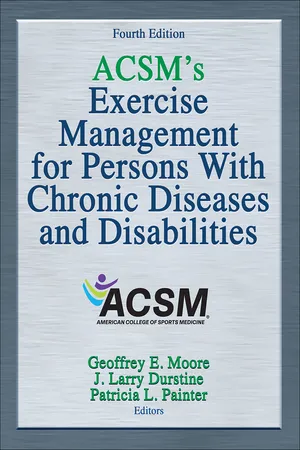
ACSM's Exercise Management for Persons With Chronic Diseases and Disabilities
- 416 pages
- English
- ePUB (mobile friendly)
- Available on iOS & Android
ACSM's Exercise Management for Persons With Chronic Diseases and Disabilities
About this book
The fourth edition of ACSM's Exercise Management for Persons With Chronic Diseases and Disabilities reveals common ground between medical and exercise professionals, creating a more collaborative approach to patient care. Developed by the American College of Sports Medicine (ACSM) with contributions from a specialized team of experts, this text presents a framework for optimizing patients’ and clients’ functionality by keeping them physically active. Featuring new content on common comorbid conditions, this edition is streamlined and updated to better suit chronic populations.
This fourth edition of ACSM's Exercise Management for Persons With Chronic Diseases and Disabilities outlines why exercise is significant in the treatment and prevention of disease, advises medical and exercise professionals in considering proper exercise prescription protocols, and provides evidence-informed guidance on devising individualized exercise programs.
Major advancements and features of the fourth edition include the following:
• Current evidence on exercise management for persons with multiple conditions, providing guidance on working with these common yet complex populations
• A refocused goal of using physical activity to optimize patients’ and clients’ functionality and participation in life activities rather than only to treat and prevent disease
• Specific content to help physicians prescribe physical activity and exercise to patients for promotion of health, well-being, and longevity
• Reorganization of case studies into one streamlined chapter along with commentary from the senior editor to encourage critical thinking and recognize the unique needs of each patient
The case studies in the text are real-life scenarios that help professionals and clinicians combine scientific knowledge with experience to find appropriate solutions for each individual. Commentary on the case studies from the senior editor illustrates when improvisation may be appropriate and where further research is needed. Tables are highlighted throughout the text to help readers quickly reference important clinical information. Evidence-informed guidelines, suggested websites, and additional readings further encourage practical use of information and identify further learning opportunities. For instructors, an ancillary PowerPoint presentation package aids in classroom discussion.
The critical element that distinguishes the fourth edition of ACSM's Exercise Management for Persons With Chronic Diseases and Disabilities is its unifying mission to incorporate physical activity and exercise in both disease treatment and prevention. Its emphasis on assisting people with multiple conditions, which is ever present in health care today, moves beyond primary and secondary prevention to focus on how patients and clients can be kept physically active and functionally fit.
Frequently asked questions
- Essential is ideal for learners and professionals who enjoy exploring a wide range of subjects. Access the Essential Library with 800,000+ trusted titles and best-sellers across business, personal growth, and the humanities. Includes unlimited reading time and Standard Read Aloud voice.
- Complete: Perfect for advanced learners and researchers needing full, unrestricted access. Unlock 1.4M+ books across hundreds of subjects, including academic and specialized titles. The Complete Plan also includes advanced features like Premium Read Aloud and Research Assistant.
Please note we cannot support devices running on iOS 13 and Android 7 or earlier. Learn more about using the app.
Information
Table of contents
- Cover Page
- ACSMās Exercise Management for Persons With Chronic Diseases and Disabilities
- Copyright Page
- Contents
- Foreword
- Preface
- Acknowledgments
- Notice and Disclaimer
- Part I: Foundations of Exercise in Chronic Disease and Disability
- Chapter 1: Exercise Is Medicine in Chronic Care
- Chapter 2: Basic Physical Activity and Exercise Recommendations for Persons With Chronic Conditions
- Chapter 3: Art of Clinical Exercise Programming
- Chapter 4: Art of Exercise Medicine: Counseling and Socioecological Factors
- Part II: Common Chronic Conditions and Comorbidities
- Chapter 5: Approach to the Common Chronic Conditions
- Chapter 6: Chronic Conditions Strongly Associated With Physical Inactivity
- Chapter 7: Chronic Conditions Very Strongly Associated With Tobacco
- Chapter 8: Cancer
- Chapter 9: Significant Sequelae Related to Common Chronic Conditions
- Part III: Cardiovascular Diseases
- Chapter 10: Chronic Heart Failure
- Chapter 11: Atrial Fibrillation
- Chapter 12: Pacemakers and Implantable Cardioverter-Defibrillators
- Chapter 13: Valvular Heart Disease
- Chapter 14: Heart Transplantation
- Chapter 15: Aneurysms
- Part IV: Pulmonary Diseases
- Chapter 16: Chronic Restrictive Pulmonary Disease
- Chapter 17: Asthma
- Chapter 18: Cystic Fibrosis
- Chapter 19: Pulmonary Hypertension
- Part V: Immunological, Hematological, and Organ Failure
- Chapter 20: Chronic Kidney and Liver Disease
- Chapter 21: Acquired Immune Deficiency Syndrome
- Chapter 22: Chronic Fatigue Syndrome
- Chapter 23: Fibromyalgia
- Chapter 24: Hemostasis Disorders
- Part VI: Neuromuscular Conditions
- Chapter 25: Stroke, Brain Trauma, and Spinal Cord Injuries
- Chapter 26: Peripheral Neuropathy, Myopathy, and Myasthenia Gravis
- Chapter 27: Cerebral Palsy
- Chapter 28: Multiple Sclerosis
- Chapter 29: Parkinsonās Disease
- Chapter 30: Muscular Dystrophy
- Part VII: Cognitive and Psychological Disorders
- Chapter 31: Dementia and Alzheimerās Disease
- Chapter 32: Depression and Anxiety Disorders
- Part VIII: Case Studies
- Abdominal Aortic Aneurysm
- Amyotrophic Lateral Sclerosis
- Asthma
- Atrial Fibrillation
- Becker Muscular Dystrophy
- Breast Cancer Survivor
- Cerebral Palsy
- Chronic Fatigue Syndrome
- Chronic Heart Failure With Mild COPD
- Chronic Kidney Disease: Stage 4, Renal Insufficiency
- Chronic Kidney Disease: Stage 5, Treated With Hemodialysis
- Chronic Kidney Disease: Status/PostāRenal Transplantation
- Chronic Obstructive Pulmonary Disease
- Coronary Artery Disease and Dyslipidemia, Status/Post-Angioplasty With Stent Placement
- Cystic Fibrosis
- Deep Venous Thrombosis
- Dementia and Frailty
- Fibromyalgia
- Hearing Impairment
- Heart Transplant
- Human Immunodeficiency Virus
- Hypertension, Dyslipidemia, and Obesity
- Interstitial Lung Disease (Chronic Restrictive Lung Disease)
- Major Depressive Disorder
- Multiple Sclerosis
- Myasthenia Gravis
- Myocardial Infarction
- Parkinsonās Disease
- Peripheral Artery Disease
- Pulmonary Hypertension
- Refractory Angina
- Spinal Cord Injury
- Stroke
- Type 2 Diabetes and Disability From Morbid Obesity With Multiple Chronic Conditions
- Type 2 Diabetes and Obesity With Osteoarthrosis
- Valvular Heart Disease
- Visual Impairment
- Appendix A
- Appendix B
- About the ACSM
- Contributors
- Index