The step-dancing of the Scotch Gaels in Nova Scotia is the last living example of a form of dance that waned following the great emigrations to Canada that ended in 1845. The Scotch Gael has been reported as loving dance, but step-dancing in Scotland had all but disappeared by 1945. One must look to Gaelic Nova Scotia, Cape Breton, and Antigonish County, to find this tradition. Gaelic Cape Breton Step-Dancing, the first study of its kind, gives this art form and the people and culture associated with it the prominence they have long deserved.
Gaelic Scotland’s cultural record is by and large pre-literate, and references to dance have had to be sought in Gaelic songs, many of which were transcribed on paper by those who knew their culture might be lost with the decline of their language. The improved Scottish culture depended proudly on the teaching of dancing and the literate learning and transmission of music in accompaniment. Relying on fieldwork in Nova Scotia, and on mentions of dance in Gaelic song and verse in Scotland and Nova Scotia, John Gibson traces the historical roots of step-dancing, particularly the older forms of dancing originating in the Gaelic-speaking Scottish Highlands. He also places the current tradition as a development and part of the much larger British and European percussive dance tradition.
With insight collected through written sources, tales, songs, manuscripts, book references, interviews, and conversations, Gaelic Cape Breton Step-Dancing brings an important aspect of Gaelic history to the forefront of cultural debate.
eBook - ePub
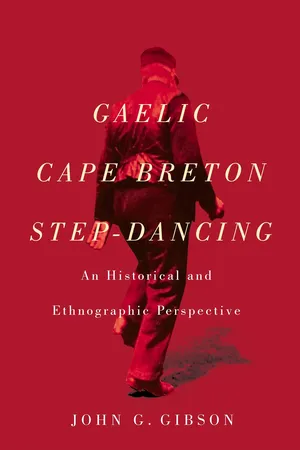
Gaelic Cape Breton Step-Dancing
An Historical and Ethnographic Perspective
- English
- ePUB (mobile friendly)
- Available on iOS & Android
eBook - ePub
About this book
Information
Table of contents
- Cover
- Copyright
- Contents
- Abbreviations
- Maps, Illustrations, and Genealogical Charts
- Acknowledgments
- Introduction
- 1. The Religious Background in Scotland, 1746–1846
- 2. Step-Dancing in Catholic Gaelic Cape Breton and Northeastern Nova Scotia from 1790
- 3. The Mary “Tulloch” Macdonald Phenomenon Examined
- 4. Dancing in the Catholic Margarees, Glendale, and Boisdale
- 5. The Gluasad Gàidhealach/Gaelic Movement in Cape Breton, 1919–46
- 6. Step-Dancing in Presbyterian Cape Breton from 1790
- 7. The Evidence for Step-Dancing in Scotland, 1775–1848
- 8. Dancing in Moderate Presbyterian Gaelic Parishes in Scotland
- 9. Dancing in Inland Gaelic Strathspey and Northwestern Perthshire
- 10. Changes in Dancing in Gaelic Scotland: The Dancing Record from Gaelic Songs, 1850–85
- 11. The Four Doctors, An t-Òranaiche/The Songster, and Others, 1879–1914
- 12. Scottish Attitudes to Dance: Twentieth-Century Letters from Gaelic Scotland
- 13. Dancing Schools and Dancing-Masters in Gaelic Scotland, 1775–1845
- 14. Last Words: A Scottish Country Dancing Enigma
- APPENDICES
- Notes
- Bibliography
- Index
Trusted by 375,005 students
Access to over 1.5 million titles for a fair monthly price.
Study more efficiently using our study tools.
Frequently asked questions
Yes, you can cancel anytime from the Subscription tab in your account settings on the Perlego website. Your subscription will stay active until the end of your current billing period. Learn how to cancel your subscription
No, books cannot be downloaded as external files, such as PDFs, for use outside of Perlego. However, you can download books within the Perlego app for offline reading on mobile or tablet. Learn how to download books offline
Perlego offers two plans: Essential and Complete
- Essential is ideal for learners and professionals who enjoy exploring a wide range of subjects. Access the Essential Library with 800,000+ trusted titles and best-sellers across business, personal growth, and the humanities. Includes unlimited reading time and Standard Read Aloud voice.
- Complete: Perfect for advanced learners and researchers needing full, unrestricted access. Unlock 1.5M+ books across hundreds of subjects, including academic and specialized titles. The Complete Plan also includes advanced features like Premium Read Aloud and Research Assistant.
We are an online textbook subscription service, where you can get access to an entire online library for less than the price of a single book per month. With over 1.5 million books across 990+ topics, we’ve got you covered! Learn about our mission
Look out for the read-aloud symbol on your next book to see if you can listen to it. The read-aloud tool reads text aloud for you, highlighting the text as it is being read. You can pause it, speed it up and slow it down. Learn more about Read Aloud
Yes! You can use the Perlego app on both iOS and Android devices to read anytime, anywhere — even offline. Perfect for commutes or when you’re on the go.
Please note we cannot support devices running on iOS 13 and Android 7 or earlier. Learn more about using the app
Please note we cannot support devices running on iOS 13 and Android 7 or earlier. Learn more about using the app
Yes, you can access Gaelic Cape Breton Step-Dancing by John G. Gibson in PDF and/or ePUB format, as well as other popular books in Media & Performing Arts & Dance. We have over 1.5 million books available in our catalogue for you to explore.